Plant and Animal Cells: Structure and Function Lesson Slides
A ready-to-teach lesson for ages 11–14 on plant and animal cells: the parts they share, the three extra parts plant cells have, and what each part does. Speaker notes on every slide, a microscope example, a 5-question quiz and a worksheet.
Ages 11–14 · Grades 6–8 (US) · Years 7–9 (UK) · Classes 6–8 (India)
- England KS3 Years 7–9
- AQA GCSE 4.1.1.2
- Cambridge IGCSE 0610 2.1
- NGSS MS-LS1-2
- NGSS MS-LS1-1
- Australian Curriculum v9 AC9S8U01
- CBSE Class 9
- CBSE Class 8
NGSS is a registered trademark of WestEd. Cambridge and IGCSE are trademarks of Cambridge University Press & Assessment. Names and codes are used only to describe curriculum fit; LearnBySlides is not endorsed by these organisations.
15 slides · 45 min lesson · 5-question quiz · speaker notes
Learning objectives
- State that all living things are made of cells and that cells are the basic unit of life.
- Identify the nucleus, cell membrane, cytoplasm, mitochondria and ribosomes and describe what each does.
- Name the three structures found in plant cells but not animal cells: cell wall, chloroplasts and a large permanent vacuole.
- Compare plant and animal cells and explain how their structures suit their jobs.
- Describe what plant and animal cells look like under a light microscope.
What this lesson covers
This deck teaches plant and animal cells to students aged 11–14 in a single 45-minute biology lesson. It starts with the idea that every living thing is made of cells, works through the parts that plant and animal cells share, then adds the three extra parts that only plant cells have. A microscope example, a slide on specialised cells and a common mix-ups slide help students turn a list of labels into real understanding.
Every slide has speaker notes, so a teacher, a cover teacher or a student revising alone can follow the reasoning, not just the bullet points.
The parts every plant and animal cell shares
Cells are the smallest units that carry out the processes of life. New cells only come from existing cells, and most are far too small to see without a microscope: a typical plant or animal cell is about 10–100 micrometres across.
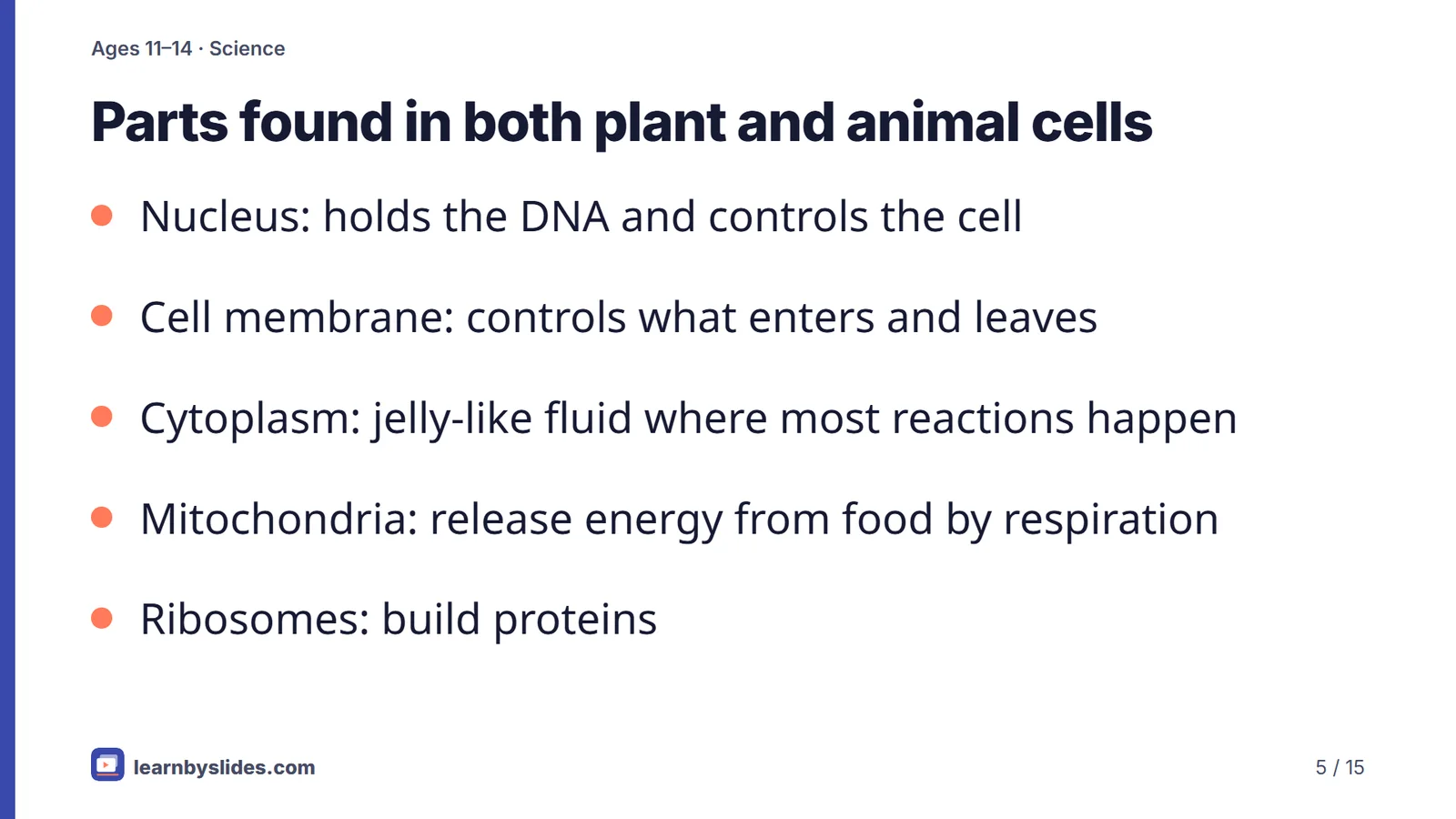
Inside, plant and animal cells share five key structures:
- Nucleus: holds the cell's DNA and controls its activities.
- Cell membrane: a thin, flexible layer that controls what enters and leaves.
- Cytoplasm: a jelly-like fluid where most of the cell's chemical reactions happen.
- Mitochondria: release energy from glucose by respiration.
- Ribosomes: tiny structures that build proteins.
The three extra parts in plant cells
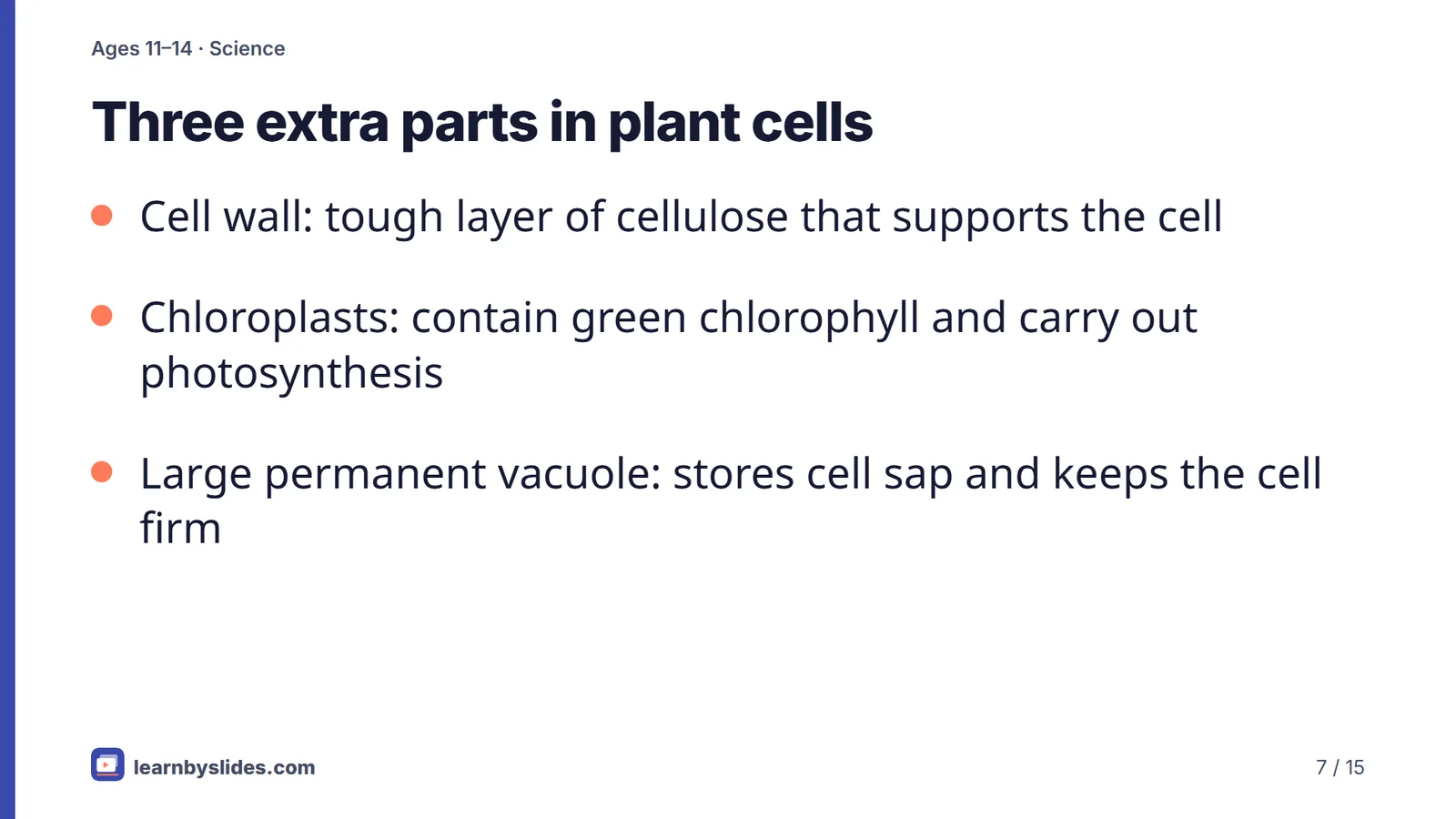
Plant cells have everything an animal cell has, plus three extra structures:
- A cell wall made of cellulose, outside the membrane, which gives the cell strength and a fixed shape.
- Chloroplasts, which contain green chlorophyll and carry out photosynthesis. They are found in the green parts of the plant, such as leaves.
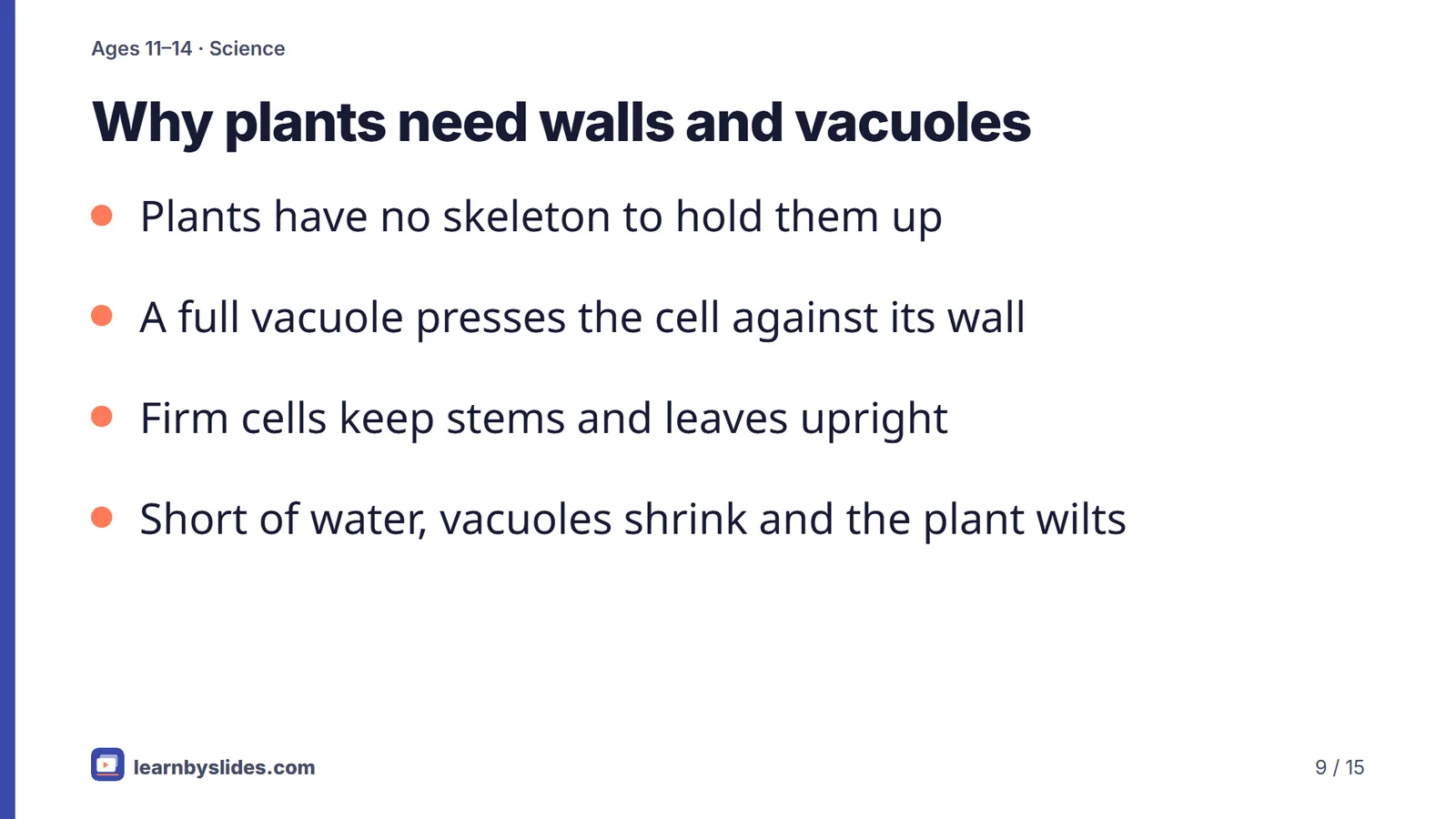
- A large permanent vacuole filled with cell sap. When it is full of water it presses outwards against the wall and keeps the cell firm.
That last point explains wilting. A plant has no skeleton, so it relies on firm cells to hold up its stems and leaves. When water runs short, the vacuoles shrink, the walls are left unsupported and the plant droops.
Common mix-ups to tackle
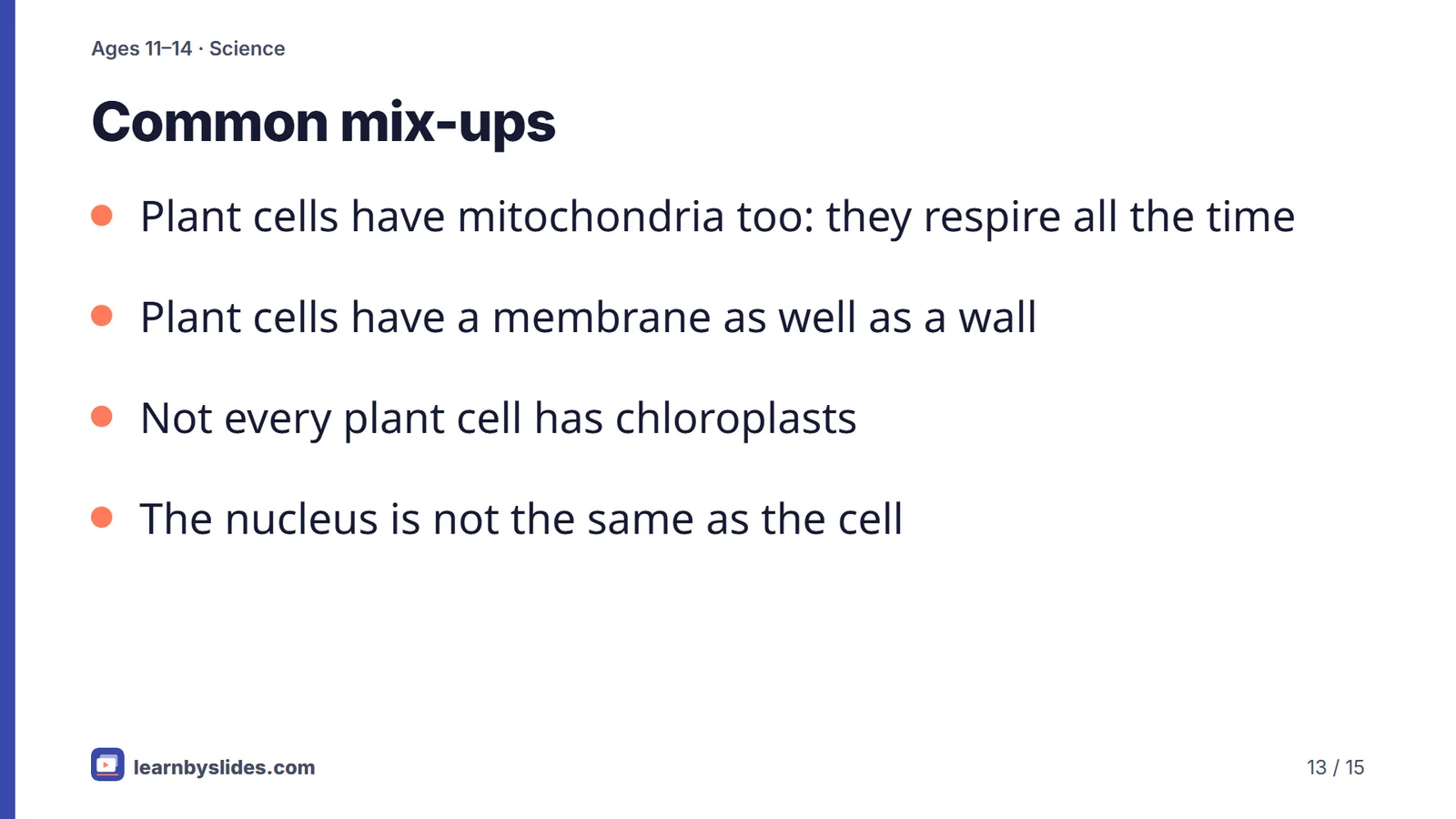
Students often think plant cells have chloroplasts instead of mitochondria. In fact plant cells have both: they make glucose by photosynthesis and release energy from it by respiration, day and night. Another frequent error is that the cell wall replaces the membrane; plant cells have both layers. Finally, not every plant cell is green: root cells, for example, are underground with no light, and their job is absorbing water and minerals or storing food.
How to use these slides
Present the deck in class with the Present button, or download the free PDF to print handouts. The editable PowerPoint (PPTX) opens in Google Slides, so you can swap in your own microscope photos. Pause at the quick-check slide, then finish with the five-question quiz on this page. The printable worksheet reuses the key terms and quiz for homework or a cover lesson, and the matching InfoGraphHub poster makes a classroom wall display.
Slide-by-slide content
1. Plant and Animal Cells
Biology · The building blocks of every living thing
Speaker notes
Hold up a leaf and point to your own hand. Ask: what do these two things have in common? Collect ideas, then reveal that both are built from cells. Today we find out what is inside a cell and why plant cells and animal cells are not quite the same.
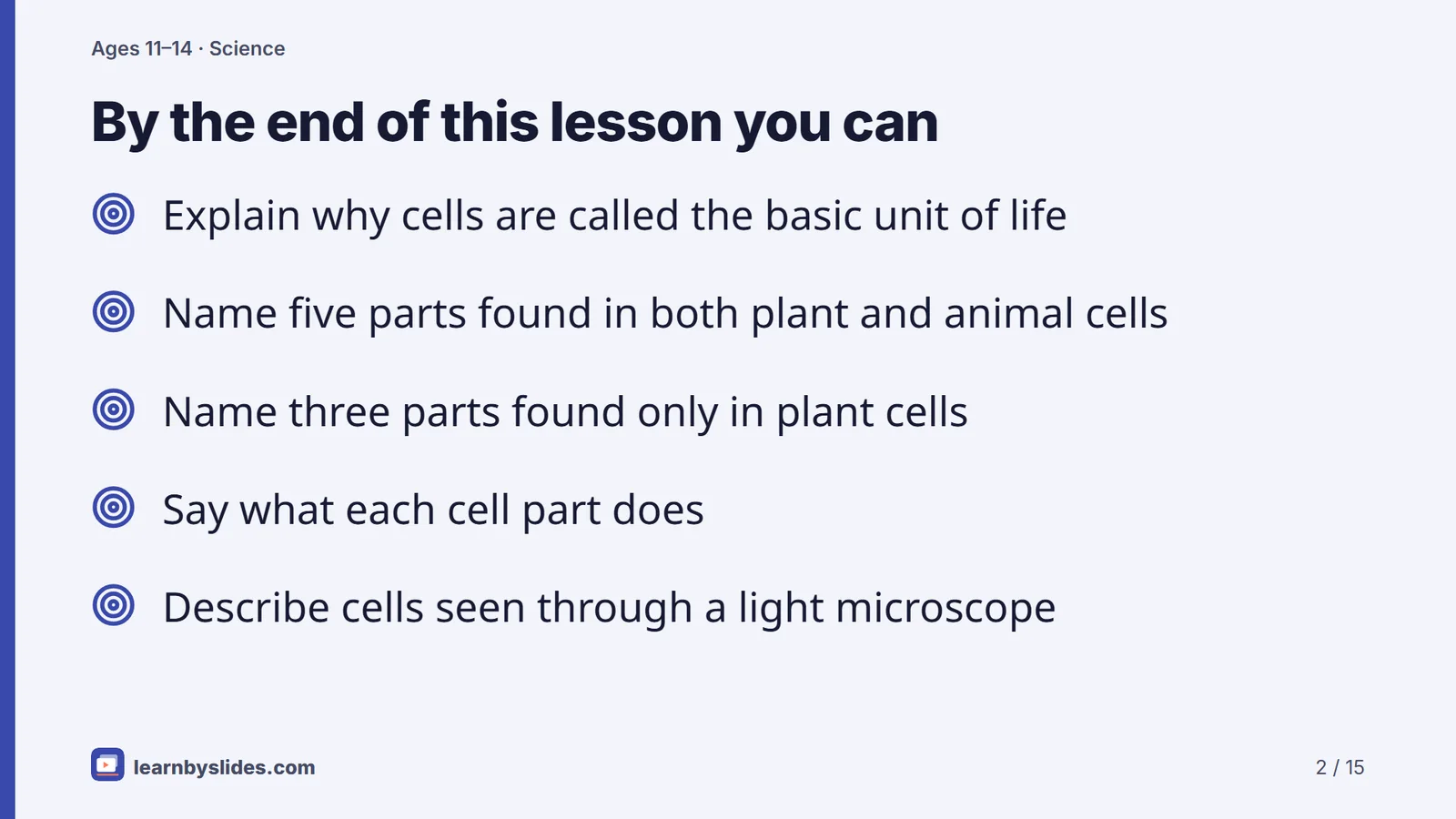
2. By the end of this lesson you can
- Explain why cells are called the basic unit of life
- Name five parts found in both plant and animal cells
- Name three parts found only in plant cells
- Say what each cell part does
- Describe cells seen through a light microscope
Speaker notes
Read the objectives aloud. Tell students to draw a two-column table in their books headed 'plant' and 'animal' and fill it in as the lesson goes on. They will need it for the quick check and the quiz.
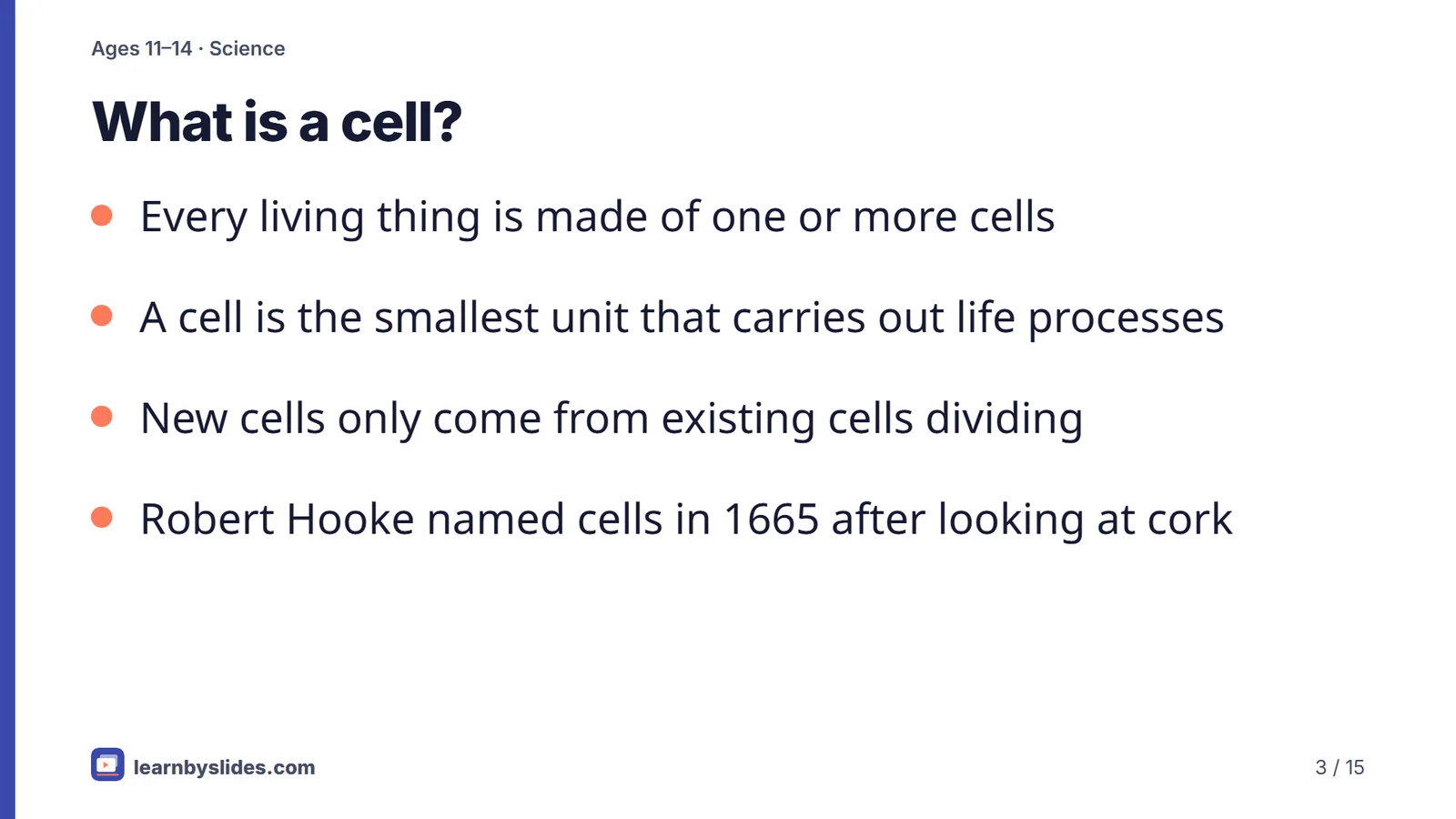
3. What is a cell?
- Every living thing is made of one or more cells
- A cell is the smallest unit that carries out life processes
- New cells only come from existing cells dividing
- Robert Hooke named cells in 1665 after looking at cork
Speaker notes
These three ideas together are called the cell theory. Hooke saw the empty, box-like walls of dead cork cells through his lenses and called them cells. Some organisms, such as bacteria and yeast, are a single cell; you are made of trillions.
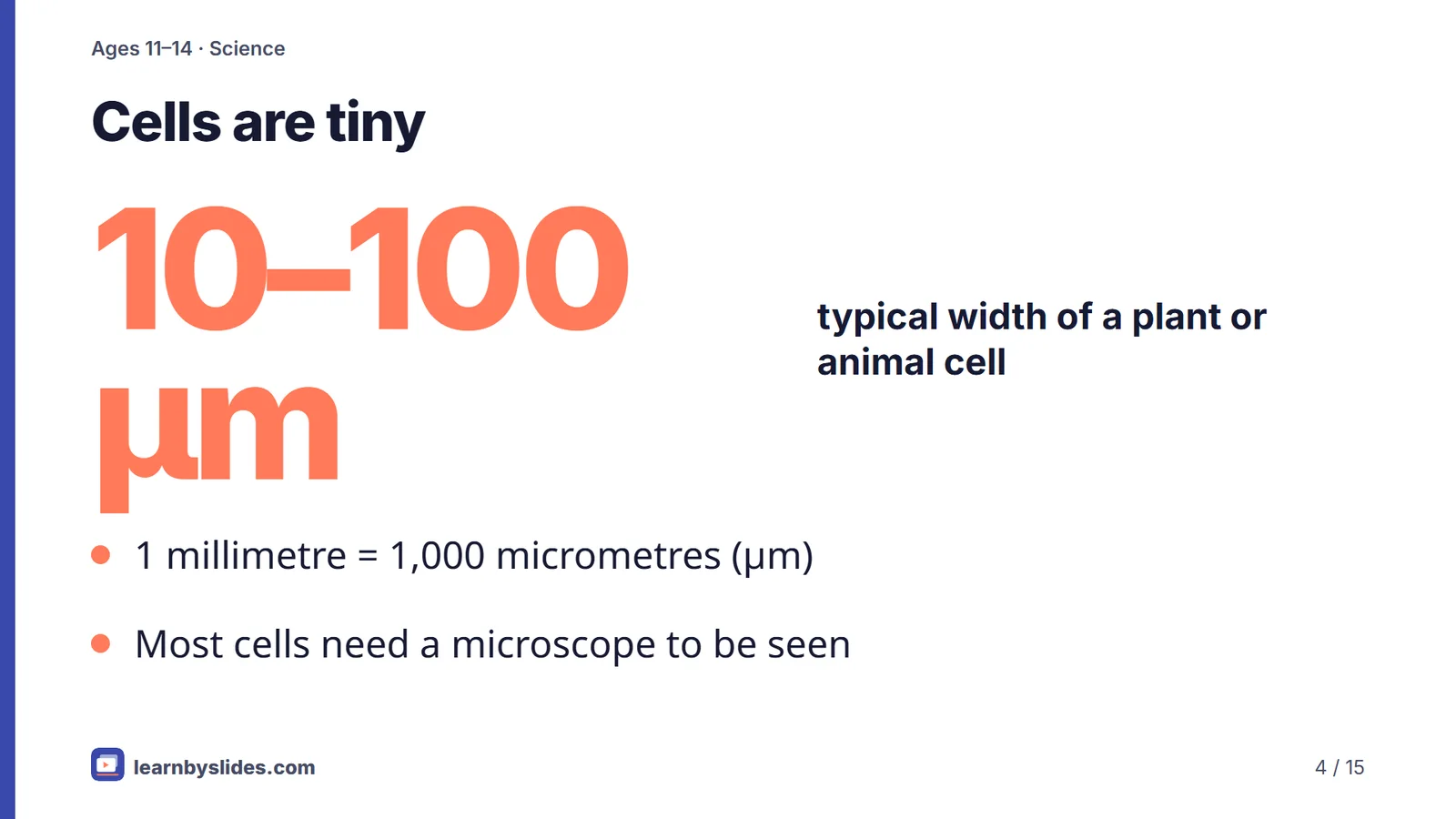
4. Cells are tiny
10–100 µm typical width of a plant or animal cell
- 1 millimetre = 1,000 micrometres (µm)
- Most cells need a microscope to be seen
Speaker notes
Ask students to find 1 mm on a ruler, then imagine splitting it into 1,000 parts. Ten to a hundred of those parts is one cell. An adult human body is estimated to contain somewhere between 10 and 100 trillion cells, so there is a huge range of estimates; the point is that the number is enormous.
5. Parts found in both plant and animal cells
- Nucleus: holds the DNA and controls the cell
- Cell membrane: controls what enters and leaves
- Cytoplasm: jelly-like fluid where most reactions happen
- Mitochondria: release energy from food by respiration
- Ribosomes: build proteins
Speaker notes
Use a school analogy if it helps: the nucleus is the head teacher's office holding the instructions, the membrane is the security gate, the cytoplasm is the corridors where work happens, the mitochondria are the boiler room and the ribosomes are the workshops. Remind students that analogies are not perfect. Ribosomes are too small to see with a school light microscope.
6. Plant and animal cells side by side
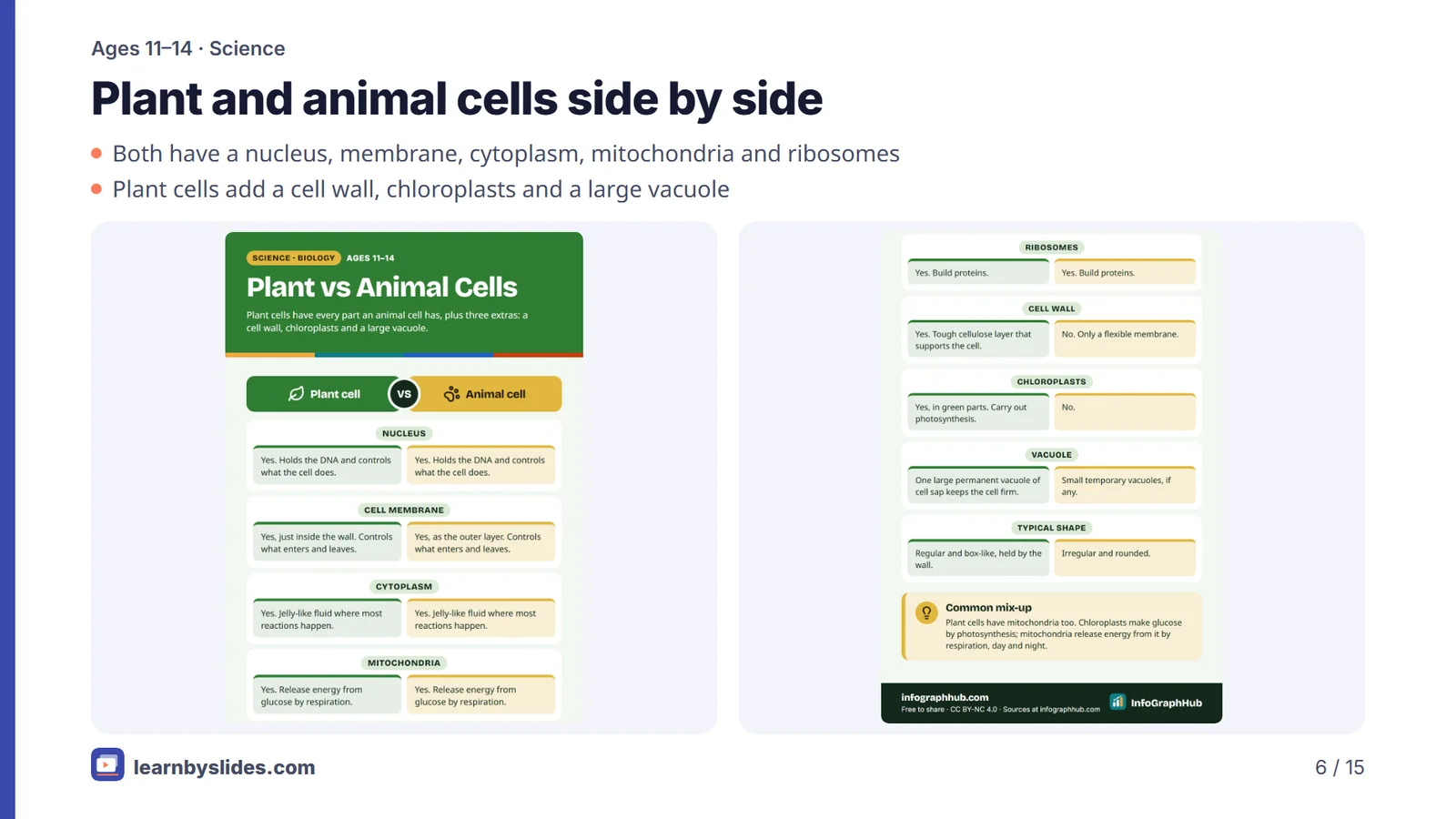
- Both have a nucleus, membrane, cytoplasm, mitochondria and ribosomes
- Plant cells add a cell wall, chloroplasts and a large vacuole
Speaker notes
Use the comparison poster to point to each structure in turn. Ask students to tick off each part in their two-column table. Stress that the shared parts come first: plant cells have everything an animal cell has, plus three extras.
7. Three extra parts in plant cells
- Cell wall: tough layer of cellulose that supports the cell
- Chloroplasts: contain green chlorophyll and carry out photosynthesis
- Large permanent vacuole: stores cell sap and keeps the cell firm
Speaker notes
The cell wall sits outside the cell membrane; it does not replace it. Chloroplasts are found in the green parts of a plant that photosynthesise, such as leaves. Animal cells may have small, temporary vacuoles, but not one large permanent vacuole.
8. Plant cell vs animal cell
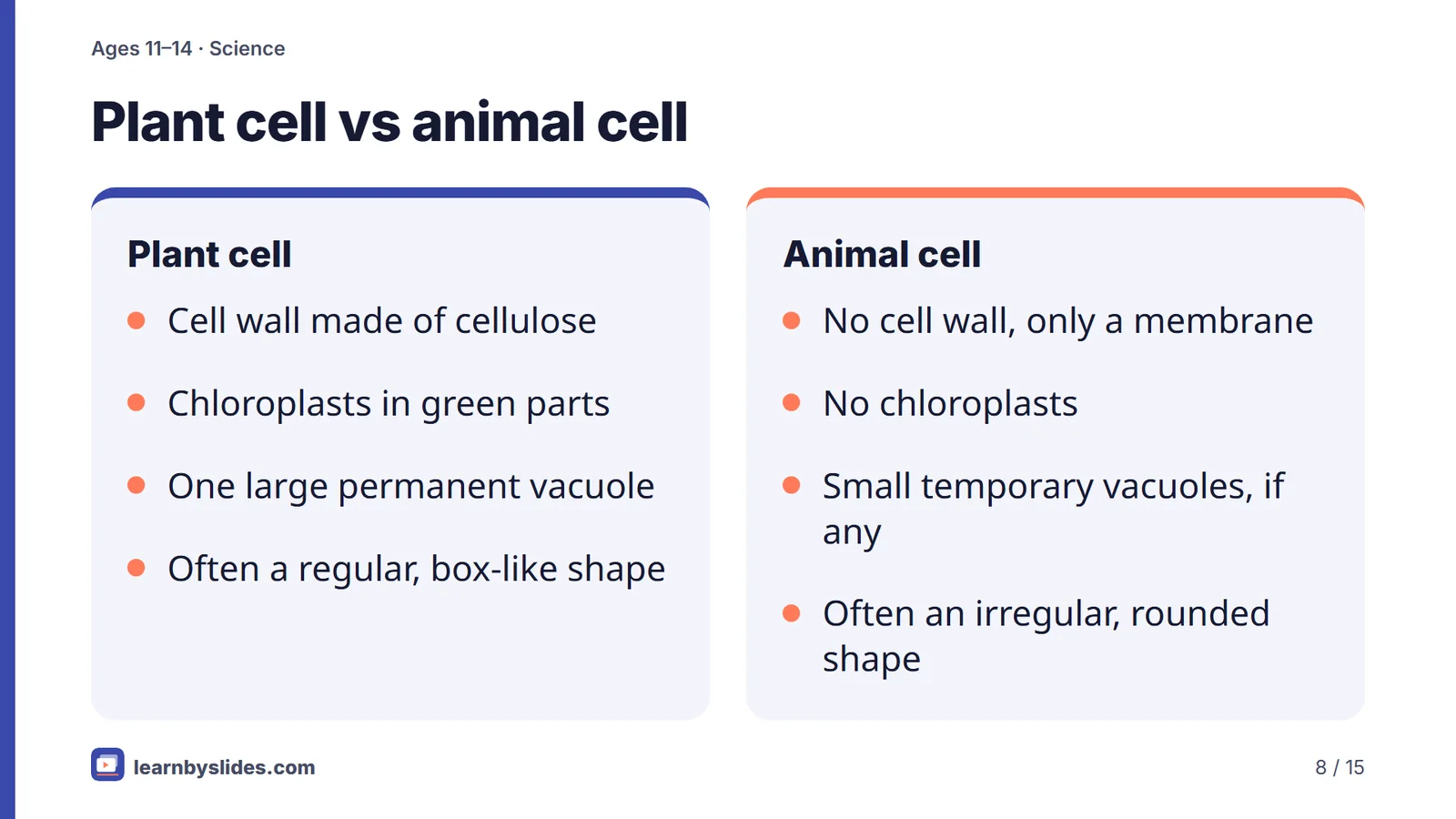
Plant cell
- Cell wall made of cellulose
- Chloroplasts in green parts
- One large permanent vacuole
- Often a regular, box-like shape
Animal cell
- No cell wall, only a membrane
- No chloroplasts
- Small temporary vacuoles, if any
- Often an irregular, rounded shape
Speaker notes
Ask students why animal cells can change shape more easily: without a rigid wall, only the flexible membrane holds them in. Then ask why plants need walls at all. That leads into the next slide on support.
9. Why plants need walls and vacuoles
- Plants have no skeleton to hold them up
- A full vacuole presses the cell against its wall
- Firm cells keep stems and leaves upright
- Short of water, vacuoles shrink and the plant wilts
Speaker notes
Show a wilted plant or a photo of one if you can. Explain that when the vacuole loses water it no longer pushes outwards, so the wall is left unsupported and the plant droops. Watering refills the vacuoles and the plant can stand upright again.
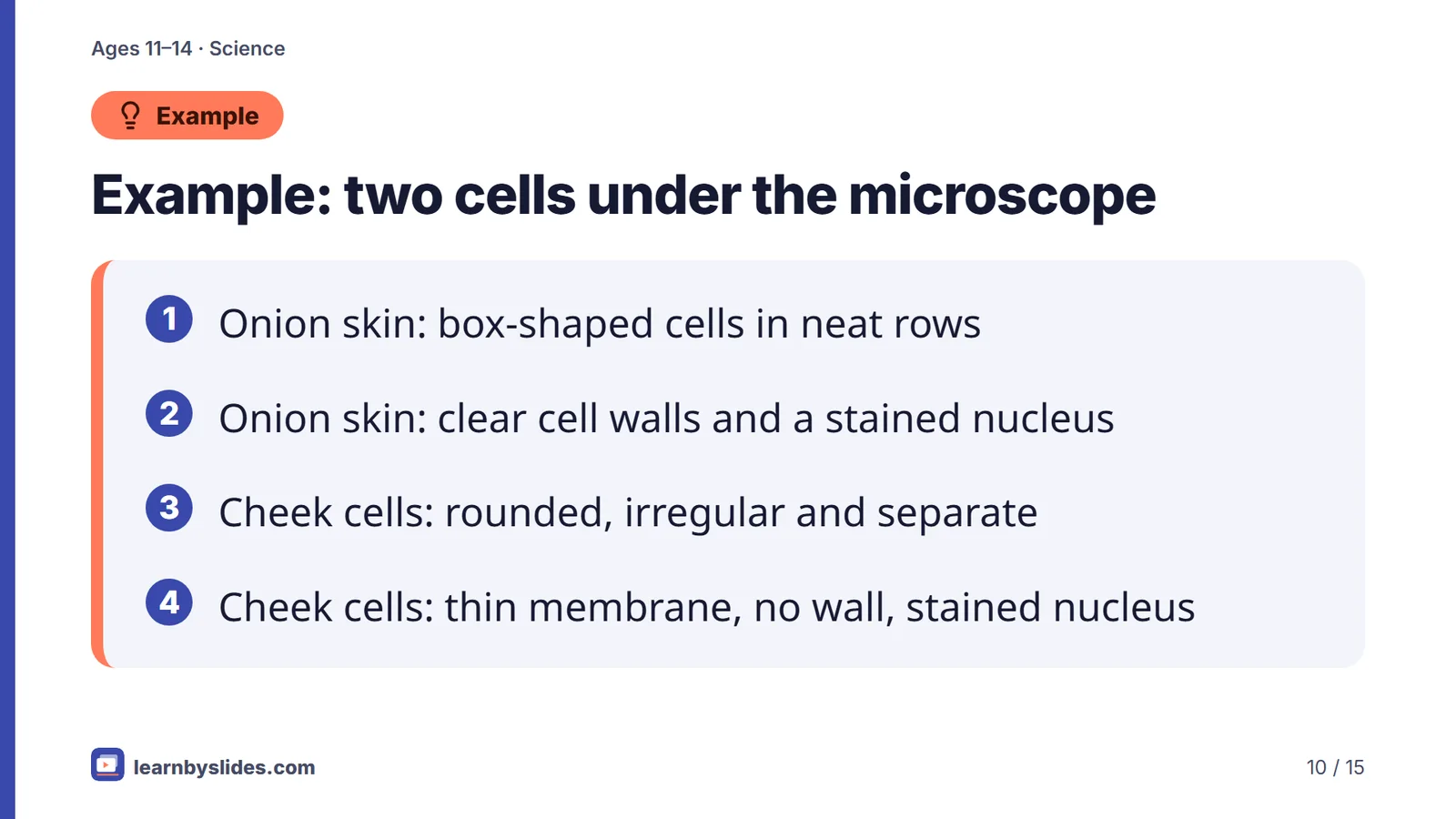
10. Example: two cells under the microscope
- Onion skin: box-shaped cells in neat rows
- Onion skin: clear cell walls and a stained nucleus
- Cheek cells: rounded, irregular and separate
- Cheek cells: thin membrane, no wall, stained nucleus
Speaker notes
If you run this as a practical, follow your school's risk assessment for stains and for collecting cheek cells. A school light microscope magnifies up to about 400 times. Ask students to draw one cell of each with a sharp pencil, label only what they can actually see and write the magnification next to the drawing.
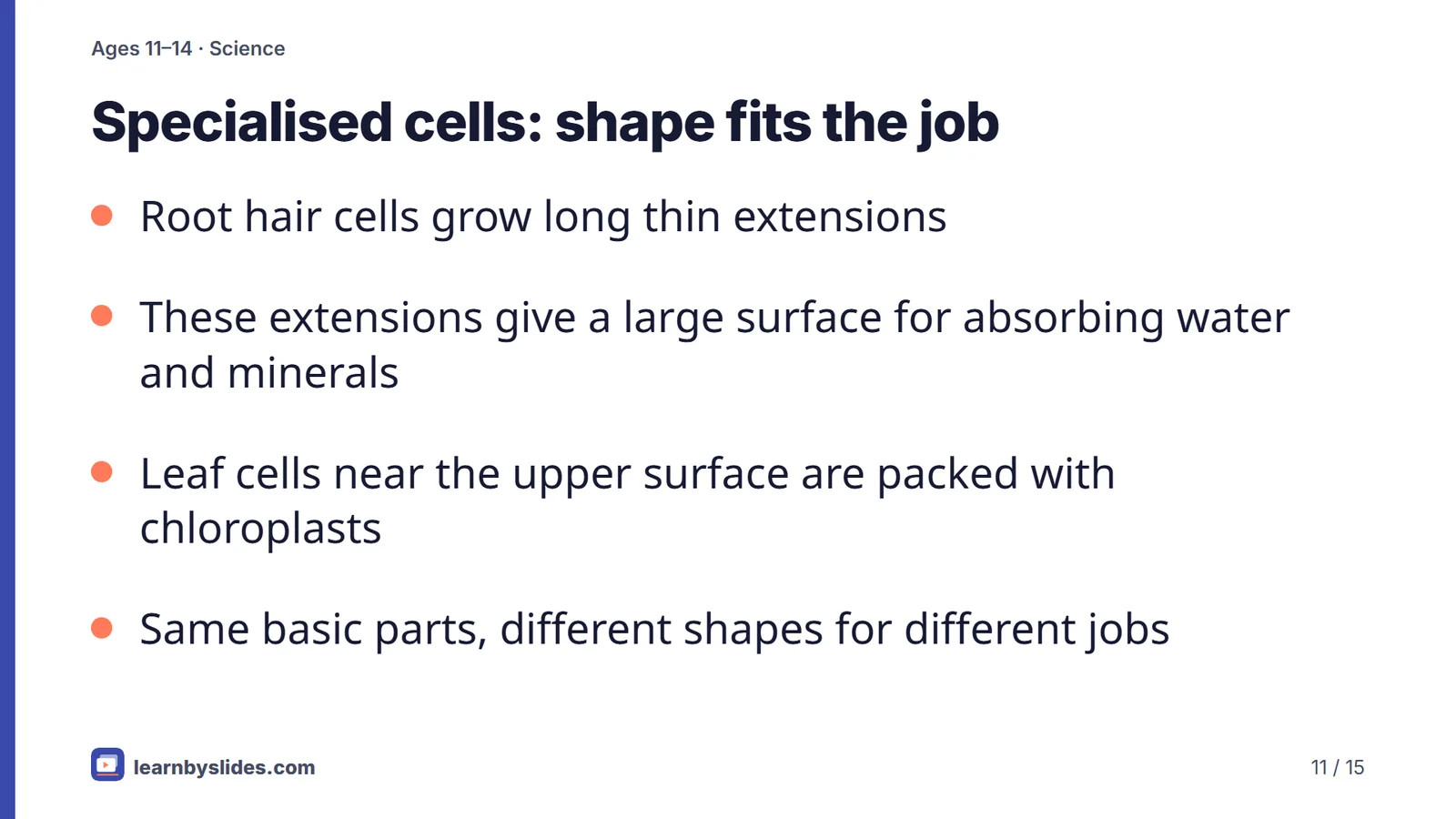
11. Specialised cells: shape fits the job
- Root hair cells grow long thin extensions
- These extensions give a large surface for absorbing water and minerals
- Leaf cells near the upper surface are packed with chloroplasts
- Same basic parts, different shapes for different jobs
Speaker notes
This bridges to later lessons. Ask: why would a root hair cell not need chloroplasts? (It is underground, with no light.) Ask students to suggest one specialised animal cell they already know, such as a nerve cell or a red blood cell, and guess how its shape helps.
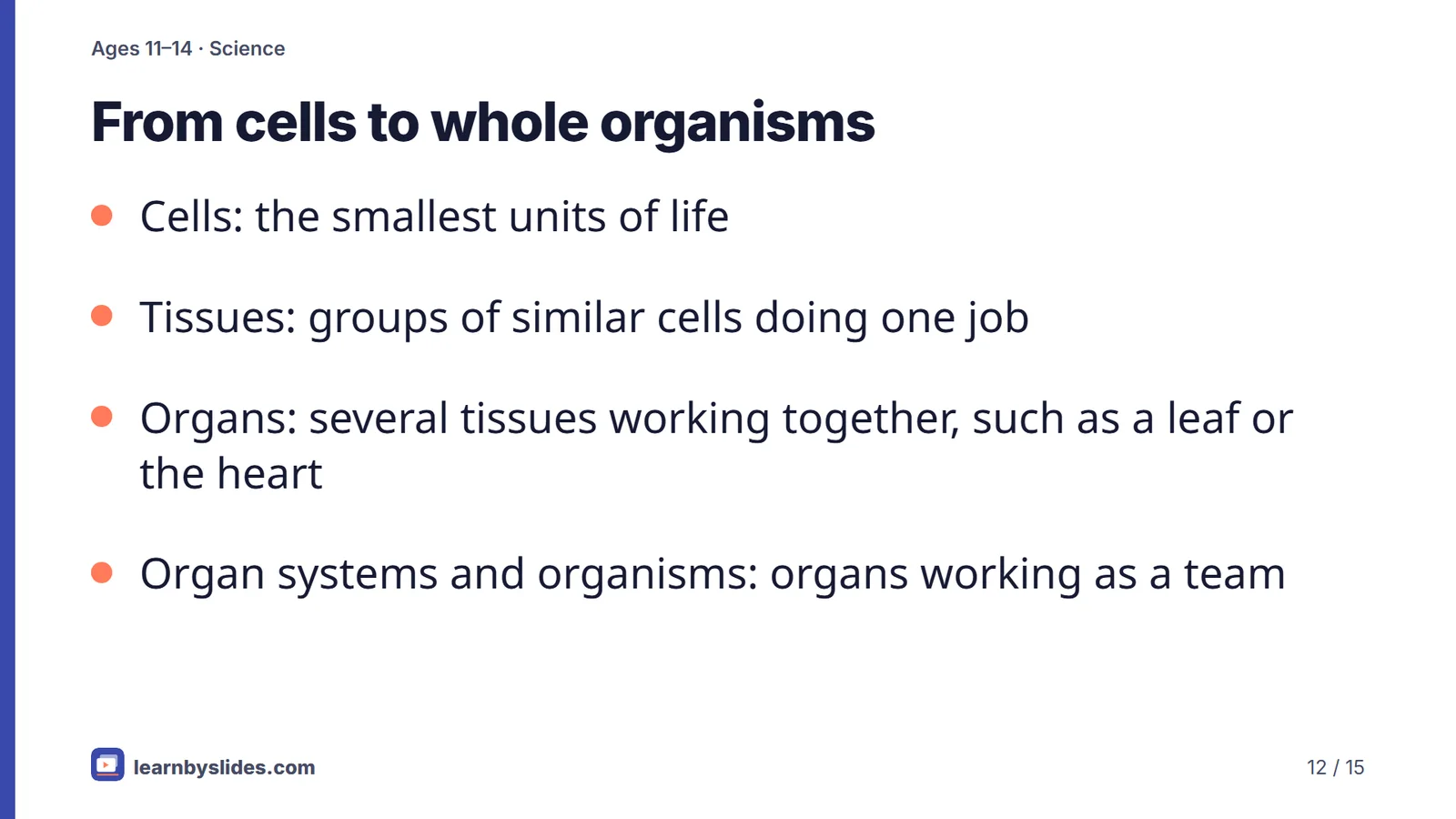
12. From cells to whole organisms
- Cells: the smallest units of life
- Tissues: groups of similar cells doing one job
- Organs: several tissues working together, such as a leaf or the heart
- Organ systems and organisms: organs working as a team
Speaker notes
Keep this brief: it shows where cells fit in the bigger picture and sets up the next lesson. Give one plant and one animal example at each level if time allows.
13. Common mix-ups
- Plant cells have mitochondria too: they respire all the time
- Plant cells have a membrane as well as a wall
- Not every plant cell has chloroplasts
- The nucleus is not the same as the cell
Speaker notes
These are the errors that come up most in tests. Ask students to vote true or false on each statement before revealing the bullet. The mitochondria point matters most: many students think chloroplasts replace mitochondria in plants, but plants need to release energy from glucose just as animals do.
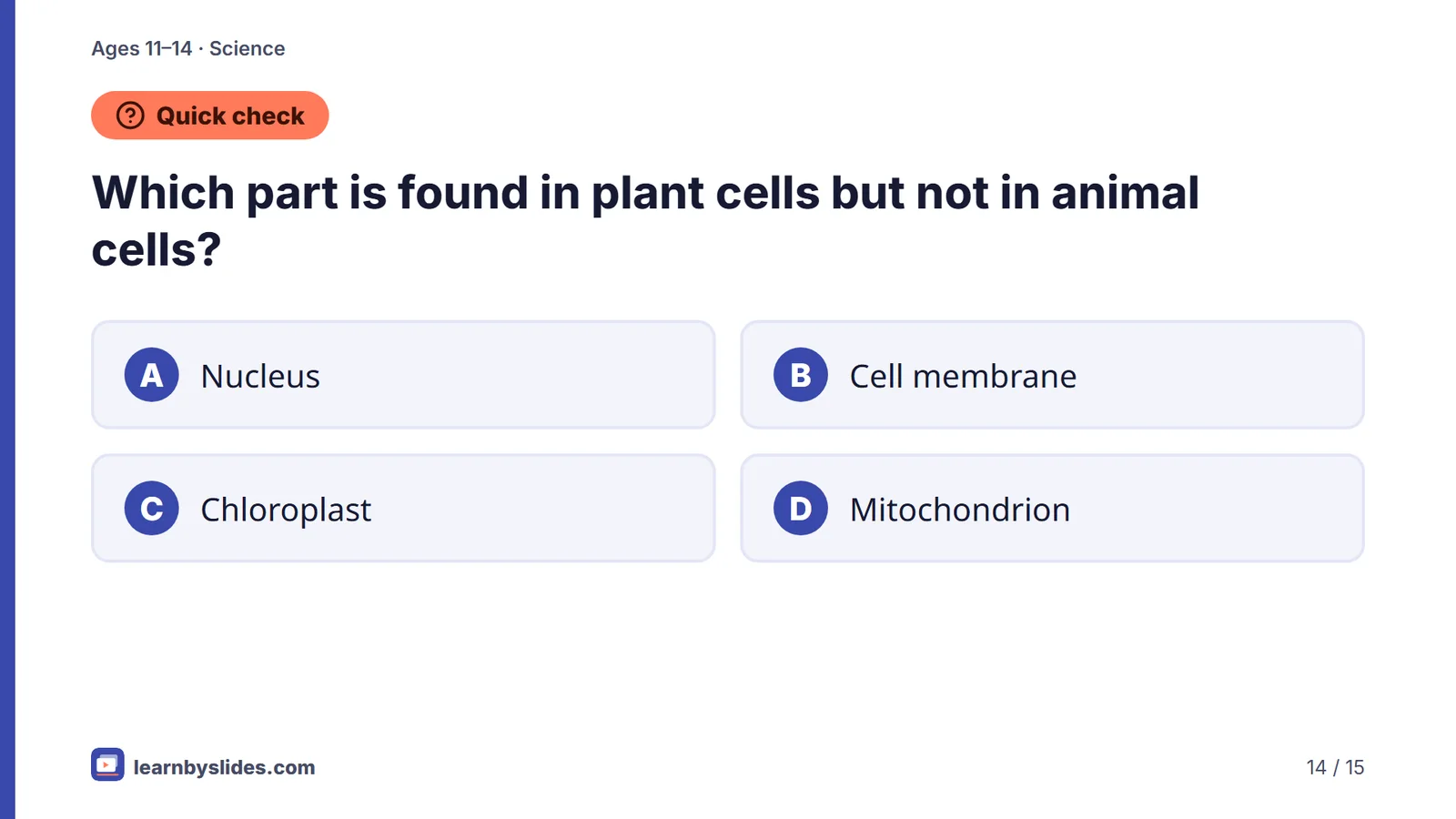
14. Quick check
Which part is found in plant cells but not in animal cells?
- Nucleus
- Cell membrane
- Chloroplast
- Mitochondrion
Speaker notes
Answer: chloroplast. Ask students to show the answer on fingers (1 to 4) before you reveal it. If many choose mitochondrion, revisit the common mix-ups slide.
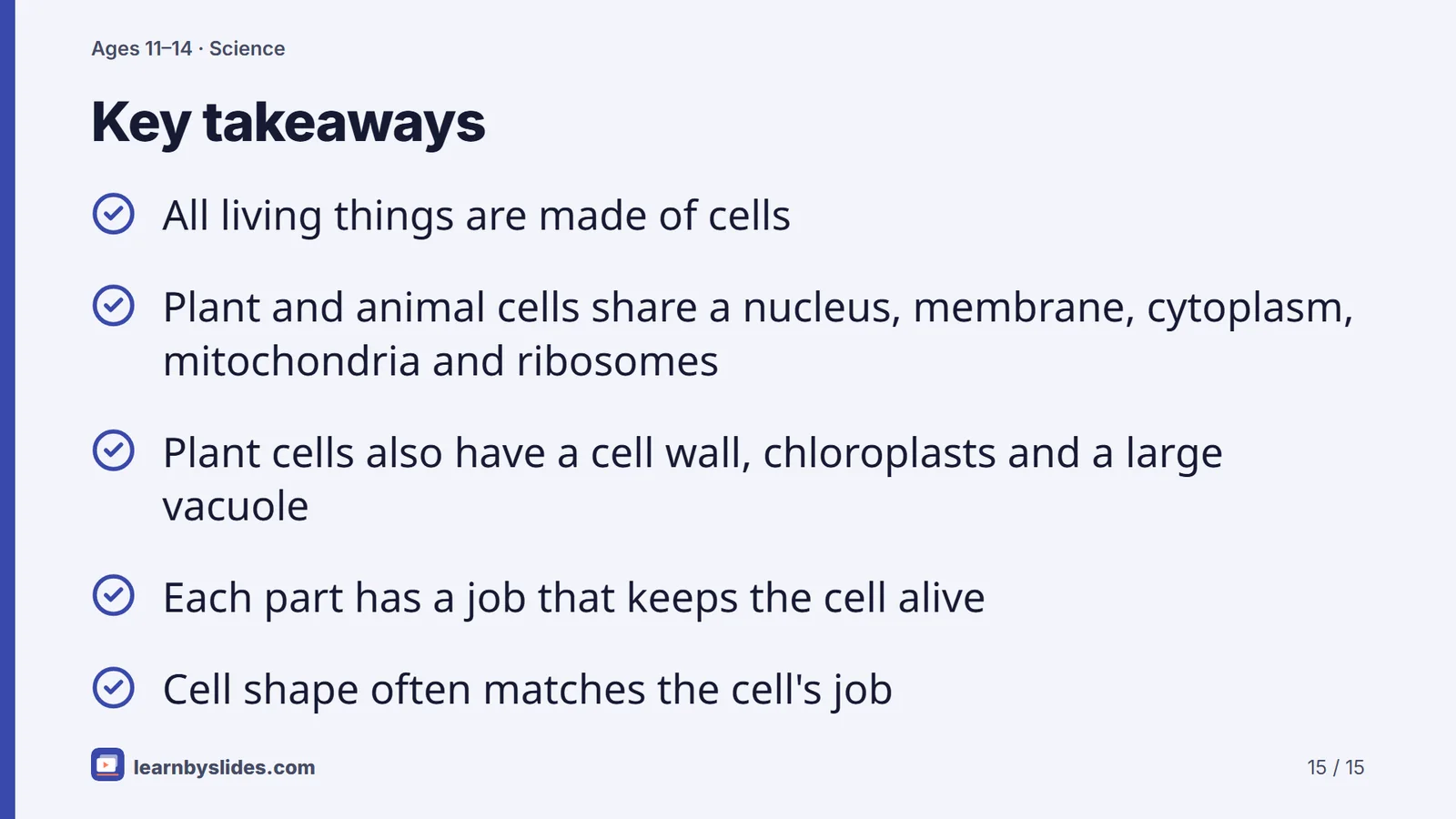
15. Key takeaways
- All living things are made of cells
- Plant and animal cells share a nucleus, membrane, cytoplasm, mitochondria and ribosomes
- Plant cells also have a cell wall, chloroplasts and a large vacuole
- Each part has a job that keeps the cell alive
- Cell shape often matches the cell's job
Speaker notes
Ask students to check their two-column table against this slide and fill any gaps. Then move to the five-question quiz on the page. Homework idea: draw and label a plant cell and an animal cell from memory, then check against the poster.
Key terms
- Cell
- The smallest unit of a living thing that can carry out the processes of life.
- Nucleus
- The part of a cell that contains its genetic material (DNA) and controls the cell's activities.
- Cell membrane
- A thin, flexible layer around the cell that controls what enters and leaves.
- Cytoplasm
- The jelly-like fluid inside the cell where most chemical reactions take place.
- Mitochondria
- Structures in the cytoplasm where respiration releases energy from glucose.
- Ribosome
- A tiny structure where proteins are made.
- Cell wall
- A tough outer layer made of cellulose that supports and protects a plant cell.
- Chloroplast
- A structure containing green chlorophyll, where photosynthesis takes place.
- Vacuole
- A space filled with cell sap; plant cells have one large permanent vacuole that keeps the cell firm.
Quick quiz
Teacher notes
Suggested 45-minute plan: 5 min opener (leaf and hand: what do they share?), 10 min on cell theory, size and the five shared parts (slides 3–6), 12 min on plant-only parts, the comparison and wilting (slides 7–9), 8 min on the microscope example and specialised cells (slides 10–12), 5 min common mix-ups and quick check, 5 min quiz and homework. Common misconceptions: plant cells have no mitochondria (they do, and they respire day and night); the cell wall replaces the membrane (plant cells have both); every plant cell has chloroplasts (only cells in green parts that photosynthesise); cells are flat because diagrams are flat (cells are three-dimensional). Extension: ask students why a cell cannot simply keep growing bigger (hint: the surface has to supply the whole volume), or introduce bacterial cells, which have no nucleus. If you run the microscope practical, follow your school's risk assessment for stains and cheek-cell sampling.
Frequently asked questions
Which curricula does this lesson fit?
It covers the plant and animal cell content taught at ages 11–14 in most English-medium science courses, and it is a good foundation for GCSE and IGCSE biology. The curriculum chips at the top of the page list each matching code. Always check against the syllabus your school follows.
Do plant cells have mitochondria?
Yes. Plant cells have mitochondria as well as chloroplasts. Chloroplasts make glucose by photosynthesis, and mitochondria release energy from that glucose by respiration, which plants do all the time.
What is the difference between the cell wall and the cell membrane?
The cell membrane is a thin, flexible layer that controls what enters and leaves the cell; all plant and animal cells have one. The cell wall is a tough cellulose layer outside the membrane that supports plant cells; animal cells do not have one.
How long does this lesson take?
It is planned for one 45-minute period. If you add the microscope practical, split it across two periods: theory in the first and the practical, drawings and quiz in the second.
Can I edit these slides in Google Slides or PowerPoint?
Yes. Download the PPTX file and open it in PowerPoint, or upload it to Google Drive to edit it in Google Slides. Speaker notes and text boxes stay editable.
Sources & methodology
Every fact is checked against the sources below. We write original explanations and draw original graphics; no figures are copied from textbooks. Spotted an error? See our corrections policy.
- Biology 2e, 4.3 Eukaryotic Cells (OpenStax (Rice University), accessed 1 Oct 2026)
- Biology 2e, 4.2 Prokaryotic Cells (cell size) (OpenStax (Rice University), accessed 1 Oct 2026)
- Biology 2e, 4.1 Studying Cells (Hooke, cell theory, microscopes) (OpenStax (Rice University), accessed 1 Oct 2026)
- Biology 2e, 30.3 Roots (root hairs) (OpenStax (Rice University), accessed 1 Oct 2026)
- Biology 2e, 30.4 Leaves (palisade cells) (OpenStax (Rice University), accessed 1 Oct 2026)
- Biology 2e, 1.2 Themes and Concepts of Biology (levels of organisation) (OpenStax (Rice University), accessed 1 Oct 2026)
- Talking Glossary of Genomic and Genetic Terms: Cell (National Human Genome Research Institute (NIH), accessed 1 Oct 2026)
Editorial review pending · Updated
Related lessons
 Science · Ages 12–15
Acids, Bases and the pH Scale Lesson Slides
A ready-to-teach chemistry lesson for ages 12–15 on acids, bases and alkalis: the pH scale, litmus and universal indicator, everyday examples, neutralisation and how to name salts, with a safe indicator practical.
 Science · Ages 12–15
Electric Circuits: Current, Voltage & Resistance Lesson Slides
A ready-to-teach physics lesson for ages 12–15 on electric circuits: current, potential difference (voltage), resistance and Ohm's law, how to use ammeters and voltmeters, and the rules for series and parallel circuits.
 Science · Ages 12–15
Forces and Newton's Laws of Motion Lesson Slides
A ready-to-teach physics lesson for ages 12–15 on forces: contact and non-contact forces, resultant force, balanced and unbalanced forces, mass and weight, and Newton's three laws of motion, with F = ma worked examples.
 Science · Ages 11–14
States of Matter and the Particle Model Lesson Slides
A ready-to-teach science lesson for ages 11–14 on solids, liquids and gases: how particles are arranged and move, the changes of state, energy in and out, evaporation vs boiling, and gas pressure. Speaker notes on every slide, a 5-question quiz and a worksheet.
 Science · Ages 15–16
Life Processes: Nutrition, Respiration, Transport & Excretion Slides
A ready-to-teach biology lesson for ages 15–16 on the four life processes: nutrition, respiration, transport and excretion. Original diagrams, speaker notes on every slide, a 5-question quiz and a printable worksheet.
 Science · Ages 13–16
Photosynthesis: How Plants Make Food Lesson Slides
A ready-to-teach biology lesson for ages 13–16 on photosynthesis: the word and balanced equations, how a leaf is built for the job, limiting factors and what plants do with glucose. Speaker notes on every slide, a 5-question quiz and a worksheet.
For teachers and parents: new LearnBySlides resources by email
One short email when new free resources go live. For adults (18+) only. No spam, no tracking in emails, unsubscribe anytime.