States of Matter and the Particle Model Lesson Slides
A ready-to-teach science lesson for ages 11–14 on solids, liquids and gases: how particles are arranged and move, the changes of state, energy in and out, evaporation vs boiling, and gas pressure. Speaker notes on every slide, a 5-question quiz and a worksheet.
Ages 11–14 · Grades 6–8 (US) · Years 7–9 (UK) · Classes 6–8 (India)
- England KS3 Years 7–9
- AQA GCSE 4.2.2.1
- AQA GCSE 4.3.1.2
- AQA GCSE 4.3.3.1
- Cambridge IGCSE 0620 1.1
- Cambridge IGCSE 0620 1.2
- Cambridge IGCSE 0625 2.1.1
- Cambridge IGCSE 0625 2.1.2
- NGSS MS-PS1-4
- Australian Curriculum v9 AC9S7U05
- CBSE Class 8
NGSS is a registered trademark of WestEd. Cambridge and IGCSE are trademarks of Cambridge University Press & Assessment. Names and codes are used only to describe curriculum fit; LearnBySlides is not endorsed by these organisations.
17 slides · 45 min lesson · 5-question quiz · speaker notes
Learning objectives
- Describe the arrangement and movement of particles in solids, liquids and gases.
- Use the particle model to explain the properties of each state, such as shape, volume and how easily it flows or squashes.
- Name the changes of state and say whether energy is taken in or given out in each.
- Explain the difference between evaporation and boiling.
- Explain gas pressure and diffusion in terms of moving particles.
What this lesson covers
This deck teaches states of matter and the particle model to students aged 11–14 in a single 45-minute science lesson. Students build up particle drawings of solids, liquids and gases, use them to explain each state's properties, then move on to the changes of state, the energy involved, the difference between evaporation and boiling, and how moving particles cause gas pressure and diffusion.
Every slide has speaker notes, so a teacher, a cover teacher or a student revising alone can follow the reasoning, not just the bullet points. The topic sits in both chemistry and physics, so the deck works in either course.
Solids, liquids and gases in the particle model
All matter is made of tiny particles that are always moving, with attractions pulling them together. The state of a substance depends on the balance between those attractions and the particles' movement energy.
- Solids have a fixed shape and volume. Their particles are tightly packed, often in a regular pattern, and vibrate about fixed positions.
- Liquids have a fixed volume but take the shape of their container. Their particles are close together with no regular pattern and slide past each other.
- Gases fill any container. Their particles are far apart and move quickly and randomly, which is why gases are easy to squash and diffuse fast.
The particles themselves are the same in every state; only their spacing, arrangement and movement change.
Changes of state and energy
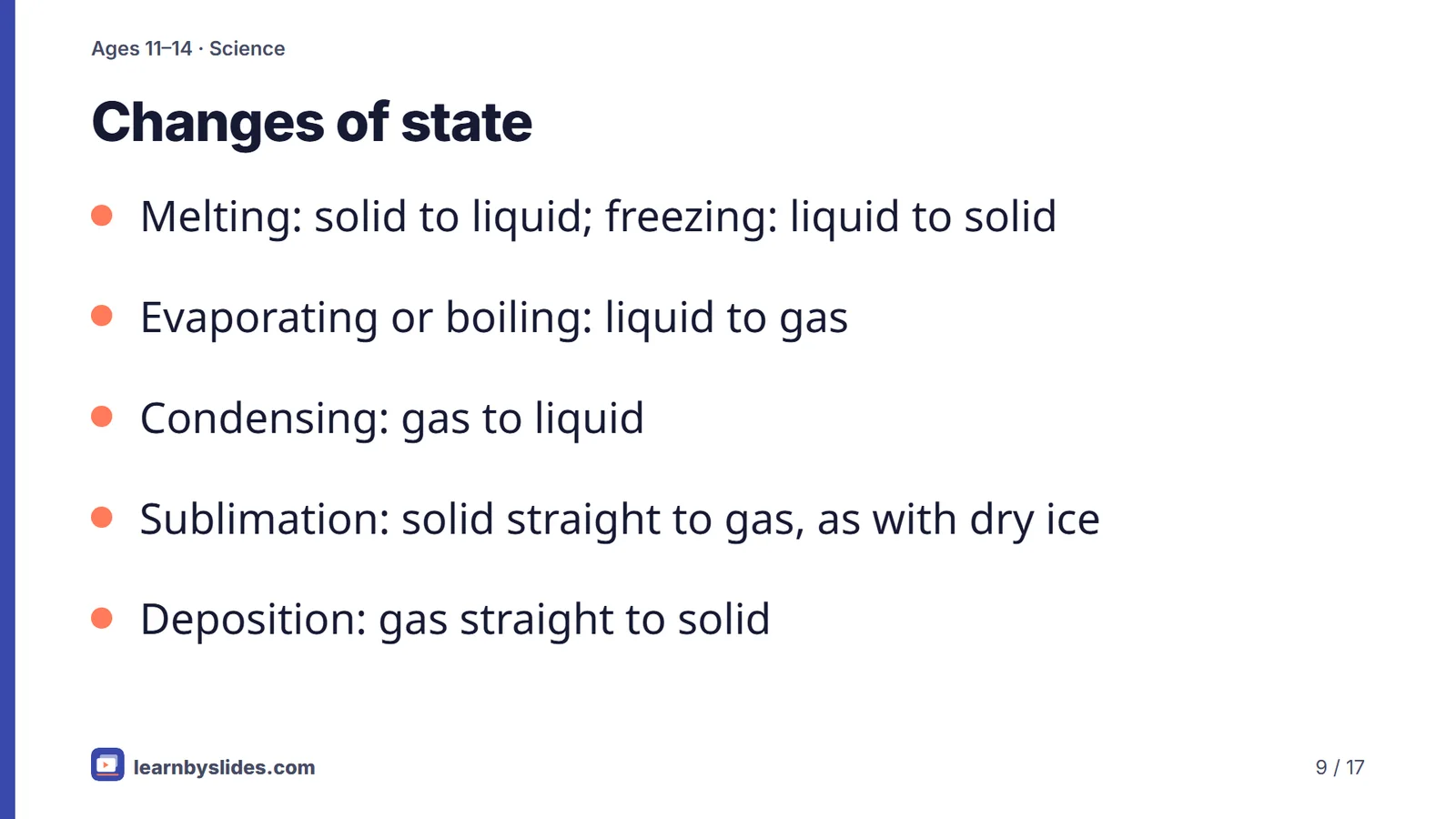
Heating gives particles more movement energy. A solid melts into a liquid, and a liquid evaporates or boils into a gas. Cooling reverses this: a gas condenses and a liquid freezes. Some substances skip a stage: dry ice (solid carbon dioxide) sublimes straight into a gas.
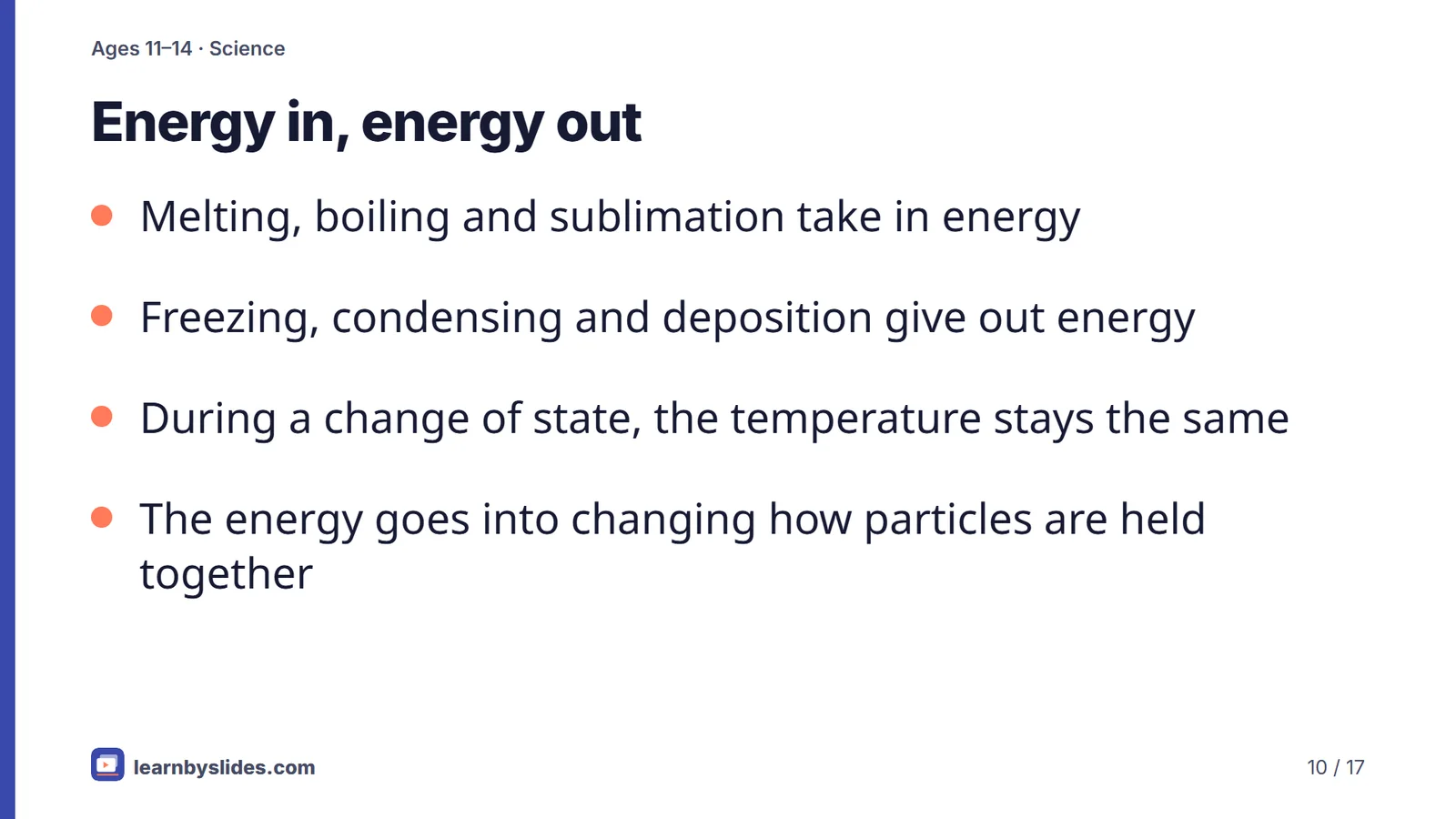
Melting, boiling and sublimation take in energy; freezing, condensing and deposition give it out. While a substance changes state its temperature stays constant, which gives a heating curve its flat sections. The mass does not change either, because no particles are created or destroyed.
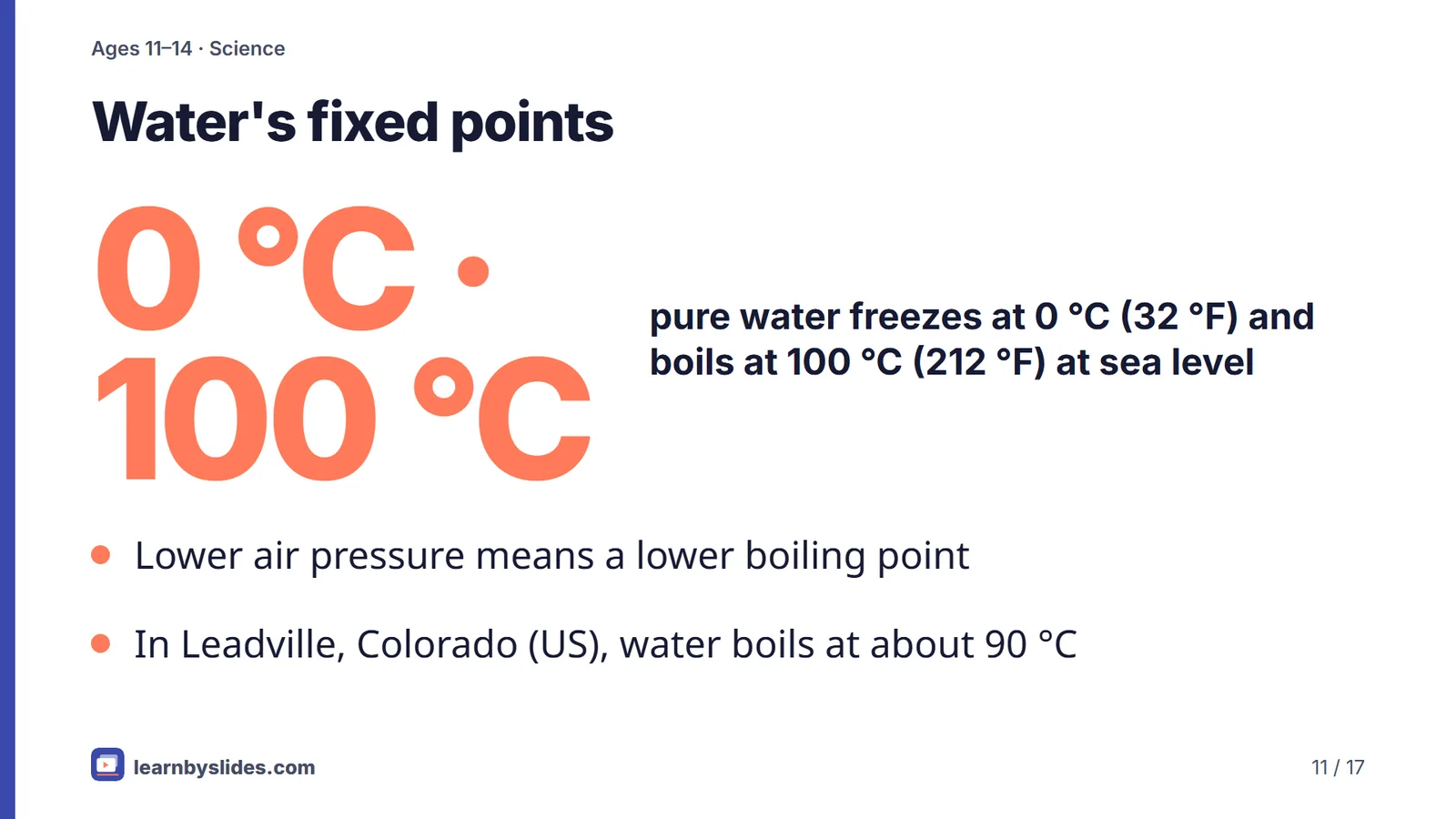
Pure water freezes at 0 °C (32 °F) and boils at 100 °C (212 °F) at sea level. Boiling point falls when air pressure is lower: high in the mountains at Leadville, Colorado, in the US, water boils at about 90 °C.
Evaporation, boiling and gas pressure
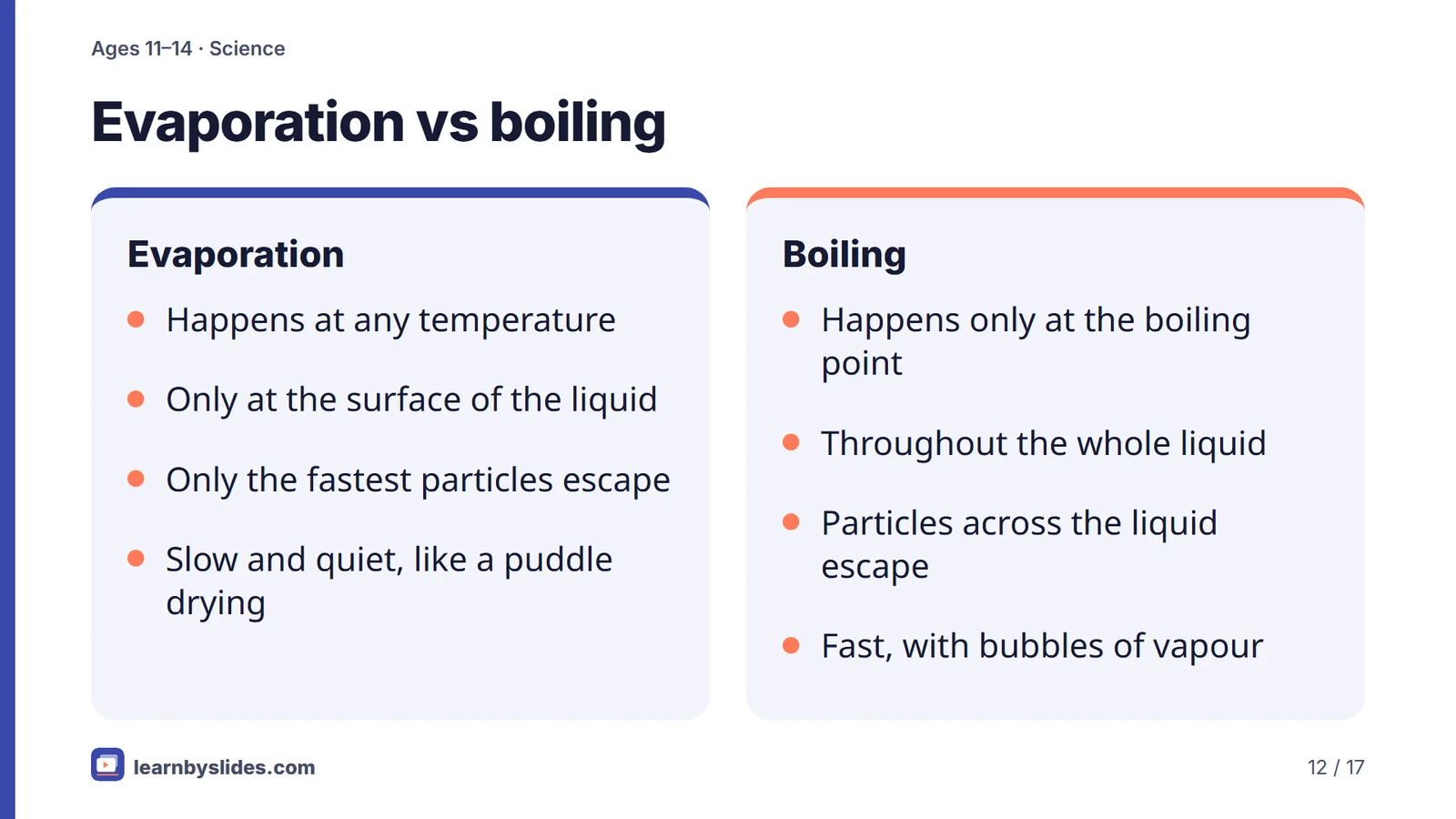
Evaporation happens at the surface of a liquid at any temperature, when the fastest particles escape; this is why puddles dry without boiling. Boiling happens throughout the liquid, and only at the boiling point.
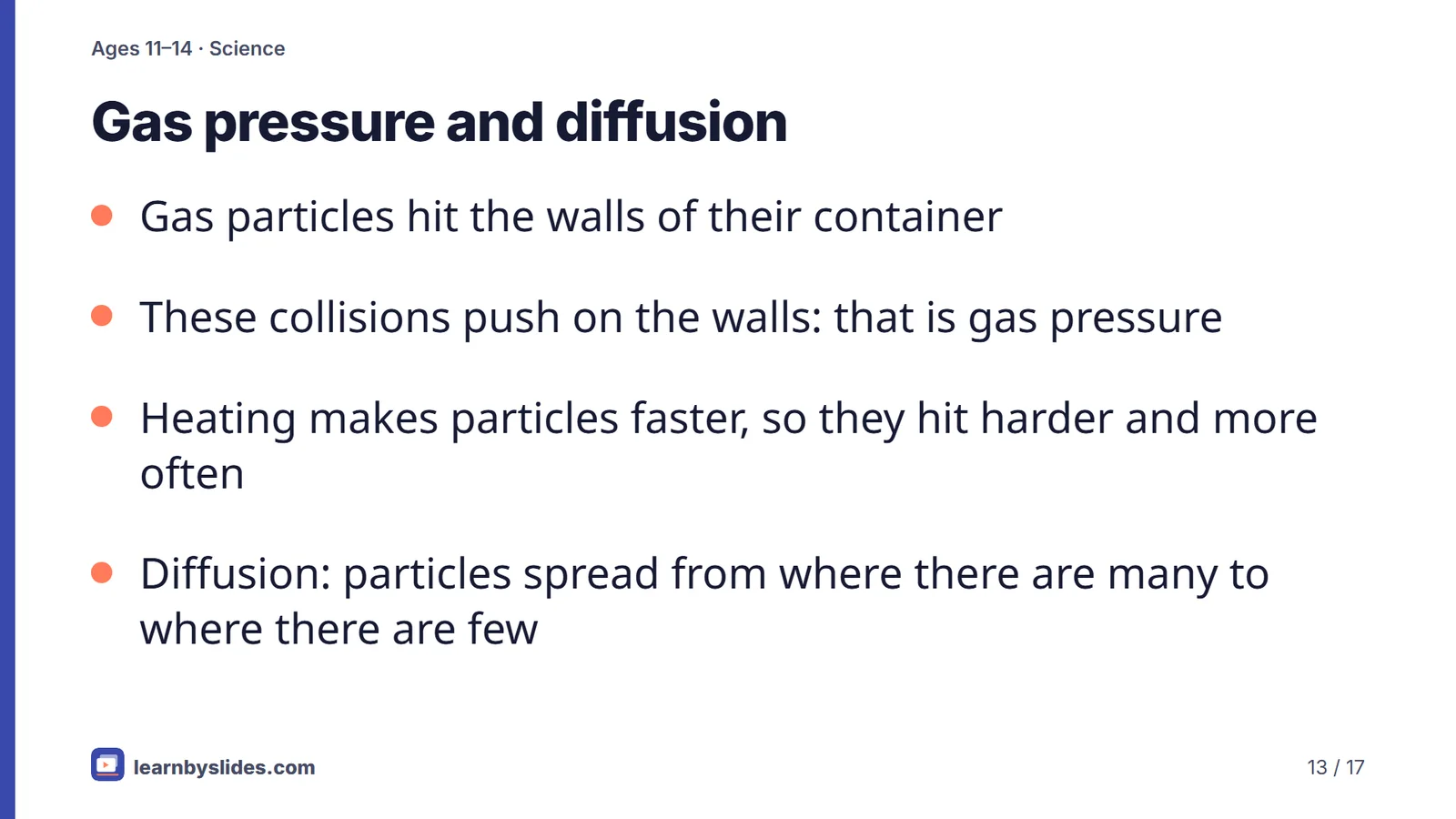
Gas particles constantly collide with the walls of their container. Those collisions create gas pressure. Heat a sealed container and the particles move faster, hitting the walls harder and more often, so the pressure rises.
How to use these slides
Present the deck with the Present button, or download the free PDF to print handouts. The editable PowerPoint (PPTX) opens in Google Slides. Pause at the quick-check slide, then finish with the five-question quiz on this page. The printable worksheet reuses the key terms and quiz, and the matching InfoGraphHub poster compares the three states for a classroom wall.
Slide-by-slide content
1. States of Matter
Science · Solids, liquids, gases and the particle model
Speaker notes
Put an ice cube on a saucer at the front of the room at the start of the lesson. Ask: what will this look like in 40 minutes, and where will the water have gone by tomorrow? Keep the predictions on the board and return to them at the end.
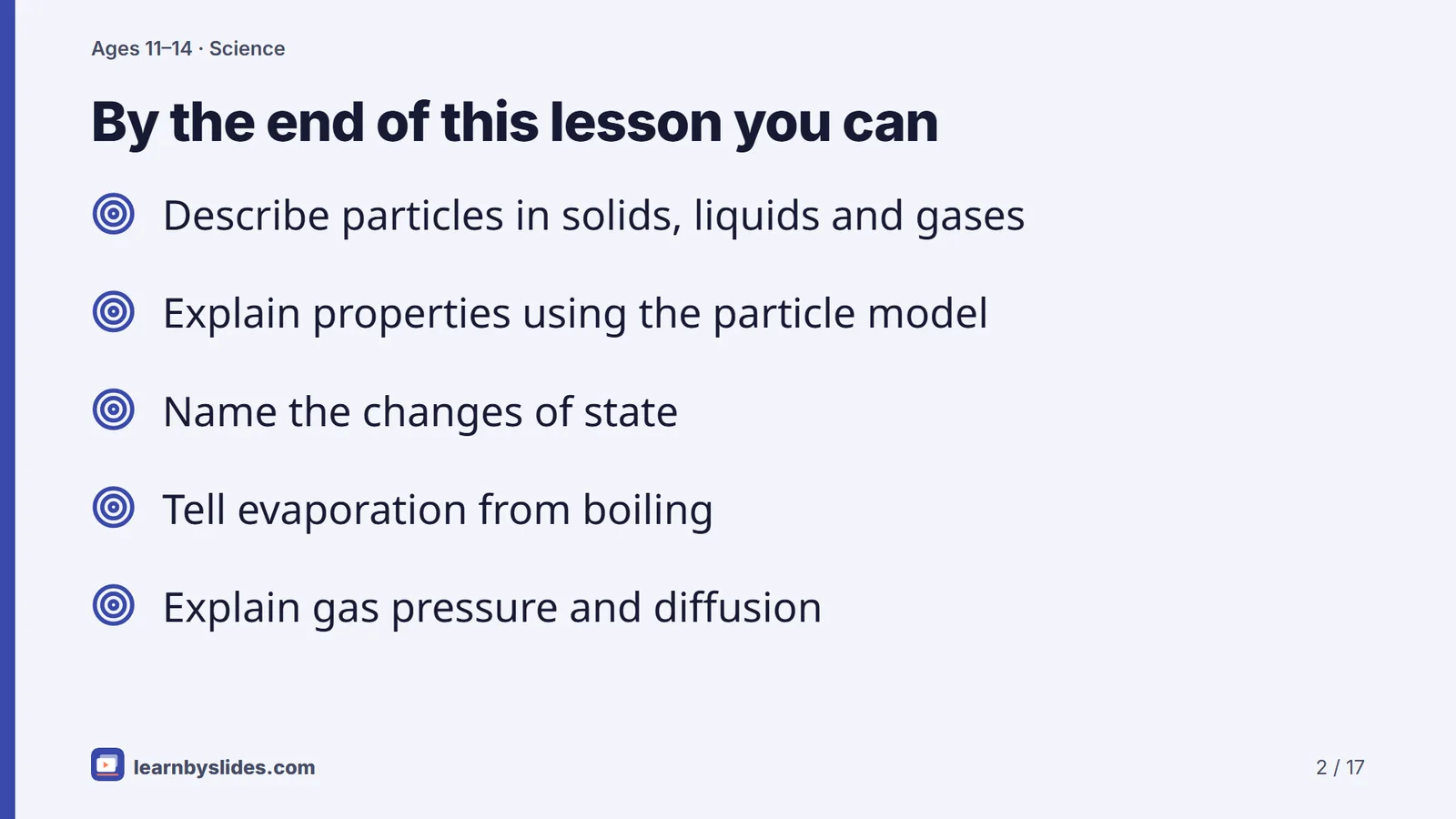
2. By the end of this lesson you can
- Describe particles in solids, liquids and gases
- Explain properties using the particle model
- Name the changes of state
- Tell evaporation from boiling
- Explain gas pressure and diffusion
Speaker notes
Read the objectives aloud. Ask students to draw three empty boxes labelled solid, liquid and gas; they will fill them with particle drawings during the lesson.
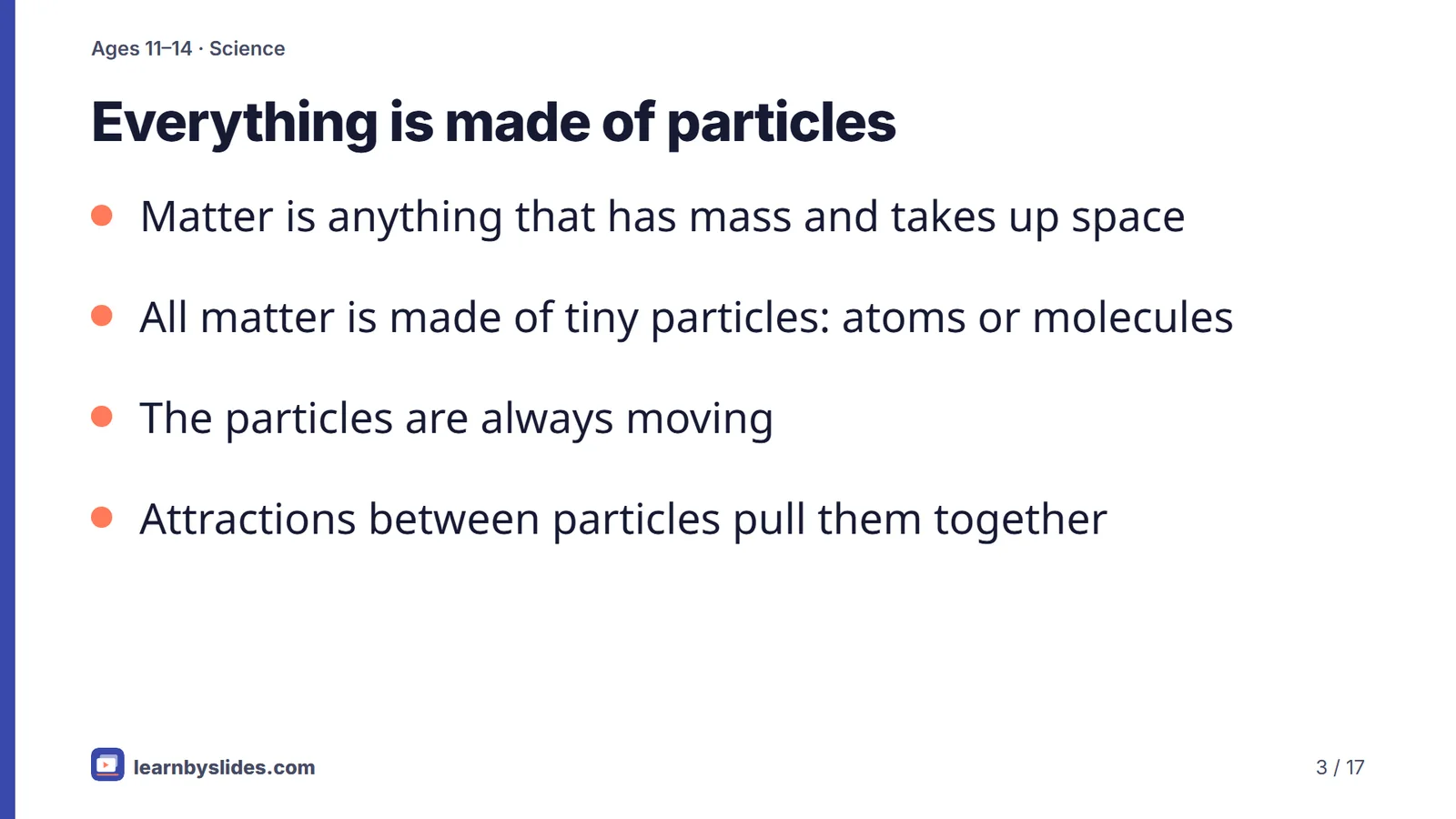
3. Everything is made of particles
- Matter is anything that has mass and takes up space
- All matter is made of tiny particles: atoms or molecules
- The particles are always moving
- Attractions between particles pull them together
Speaker notes
This is the particle model. It is a model, which means a simplified picture that helps us explain and predict. We draw particles as circles, but real atoms and molecules are far too small to see even with a school microscope.
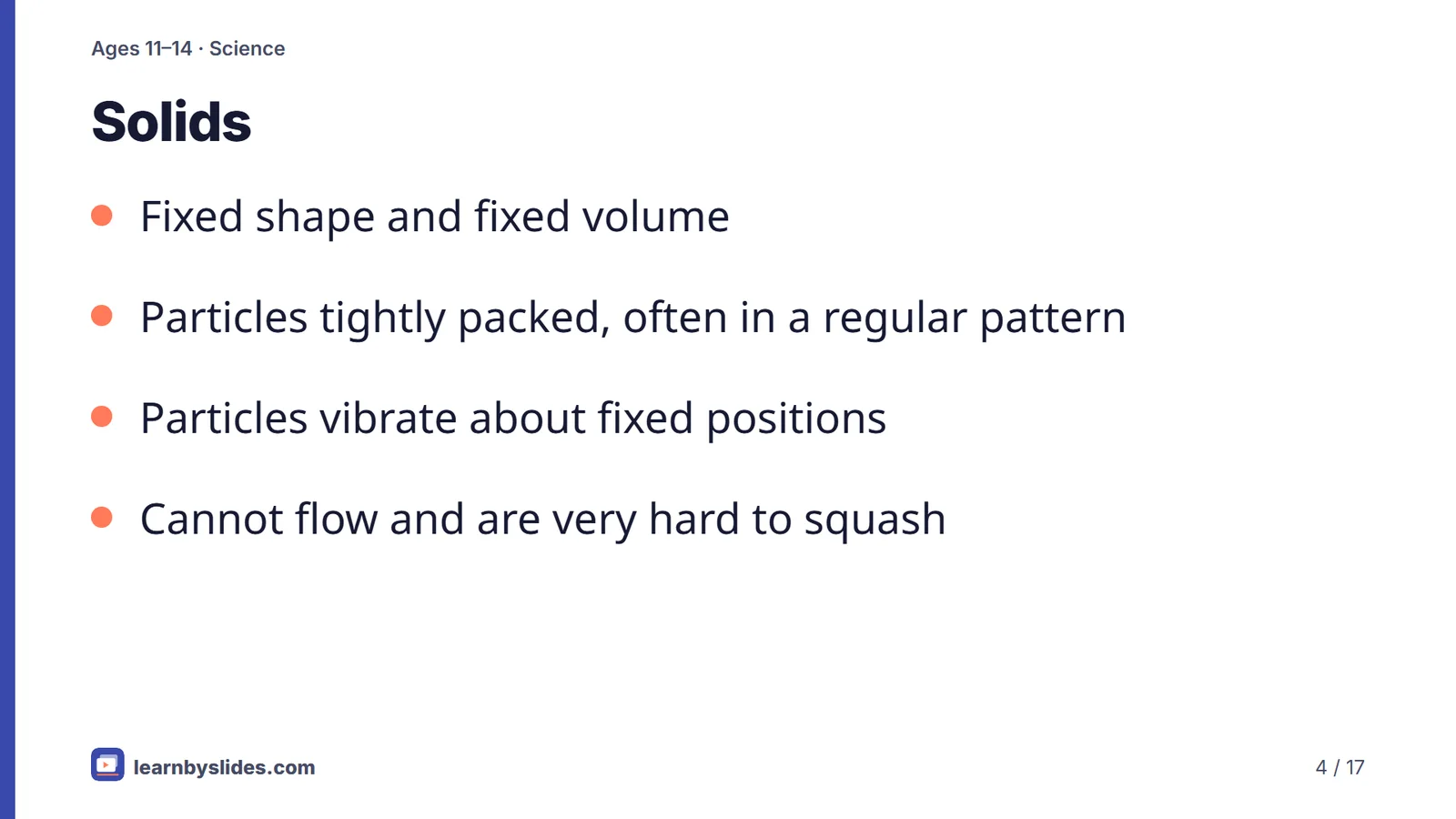
4. Solids
- Fixed shape and fixed volume
- Particles tightly packed, often in a regular pattern
- Particles vibrate about fixed positions
- Cannot flow and are very hard to squash
Speaker notes
Ask students to draw a solid in their first box: circles touching, in neat rows. Ask them to add small zigzag lines to show vibration. Link each property to the picture: no gaps, so it cannot be squashed; fixed positions, so it keeps its shape.
5. Liquids
- Fixed volume, but take the shape of their container
- Particles close together with no regular pattern
- Particles move past each other but stay in contact
- Can flow, but are very hard to squash
Speaker notes
In the second box, students draw particles still touching but jumbled, with arrows showing them sliding past each other. Common error: drawing liquid particles far apart. Remind them that liquids are almost as hard to squash as solids, so the particles must still be close.
6. Gases
- No fixed shape or volume: they fill any container
- Particles far apart with no regular pattern
- Particles move quickly and randomly in all directions
- Flow easily and are easy to squash
Speaker notes
In the third box, students draw a few widely spaced particles with long arrows. The space between gas particles is empty: there is no air between the particles of air. Squeezing a sealed syringe of air works because there is space to push the particles into.
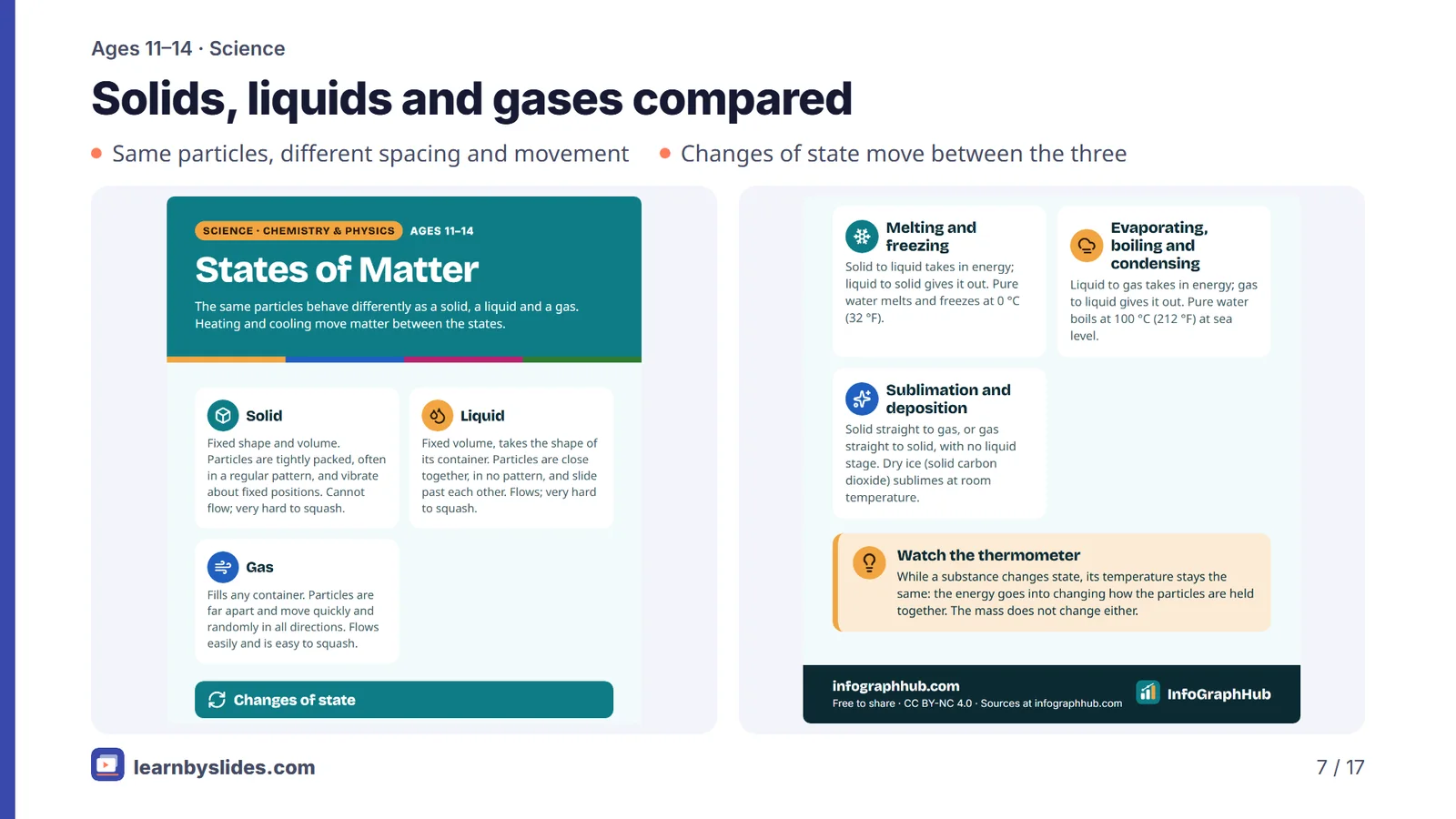
7. Solids, liquids and gases compared
- Same particles, different spacing and movement
- Changes of state move between the three
Speaker notes
Use the poster to check students' three drawings. Ask them to correct any box that does not match. Point out that the particles themselves are the same in all three states: only their spacing, arrangement and movement change.
8. What decides the state?
- Attractions between particles pull them together
- Movement energy lets particles break away
- Strong attractions, little energy: solid
- More energy than the attractions can hold: gas
Speaker notes
Use a tug-of-war image: attractions pull particles together while movement energy pulls them apart. Heating gives particles more movement energy, so a solid can become a liquid and then a gas. Cooling does the opposite.
9. Changes of state
- Melting: solid to liquid; freezing: liquid to solid
- Evaporating or boiling: liquid to gas
- Condensing: gas to liquid
- Sublimation: solid straight to gas, as with dry ice
- Deposition: gas straight to solid
Speaker notes
Draw a triangle on the board with solid, liquid and gas at the corners and add an arrow for each change. Dry ice is solid carbon dioxide; at room temperature and normal pressure it turns straight into a gas. Changes of state are physical changes: the substance is still the same substance, and its mass does not change.
10. Energy in, energy out
- Melting, boiling and sublimation take in energy
- Freezing, condensing and deposition give out energy
- During a change of state, the temperature stays the same
- The energy goes into changing how particles are held together
Speaker notes
Sketch a heating curve: temperature rises, then a flat section while the solid melts, then rises again, then another flat section while the liquid boils. Students are often surprised that a pan of boiling water stays at the same temperature however hard you heat it.
11. Water's fixed points
0 °C · 100 °C pure water freezes at 0 °C (32 °F) and boils at 100 °C (212 °F) at sea level
- Lower air pressure means a lower boiling point
- In Leadville, Colorado (US), water boils at about 90 °C
Speaker notes
Leadville is a mountain town in the Rocky Mountains where the air pressure is about 68 kPa, roughly two-thirds of the 101.3 kPa at sea level, so water boils at around 90 °C (194 °F). The boiling point is the temperature at which the liquid's vapour pressure equals the pressure of the air above it.
12. Evaporation vs boiling
Evaporation
- Happens at any temperature
- Only at the surface of the liquid
- Only the fastest particles escape
- Slow and quiet, like a puddle drying
Boiling
- Happens only at the boiling point
- Throughout the whole liquid
- Particles across the liquid escape
- Fast, with bubbles of vapour
Speaker notes
Ask students where the puddle goes on a sunny day without ever reaching 100 °C. Only the fastest-moving particles at the surface have enough energy to break away, so evaporation is slow but happens at any temperature. Warmer liquids evaporate faster because more particles have enough energy.
13. Gas pressure and diffusion
- Gas particles hit the walls of their container
- These collisions push on the walls: that is gas pressure
- Heating makes particles faster, so they hit harder and more often
- Diffusion: particles spread from where there are many to where there are few
Speaker notes
Demonstrate diffusion by spraying air freshener or opening a bottle of perfume at the front and asking students to raise a hand when they smell it. Gases diffuse quickly because their particles move fast and there is lots of space between them. Ask why a sealed bag of crisps swells on a warm day.
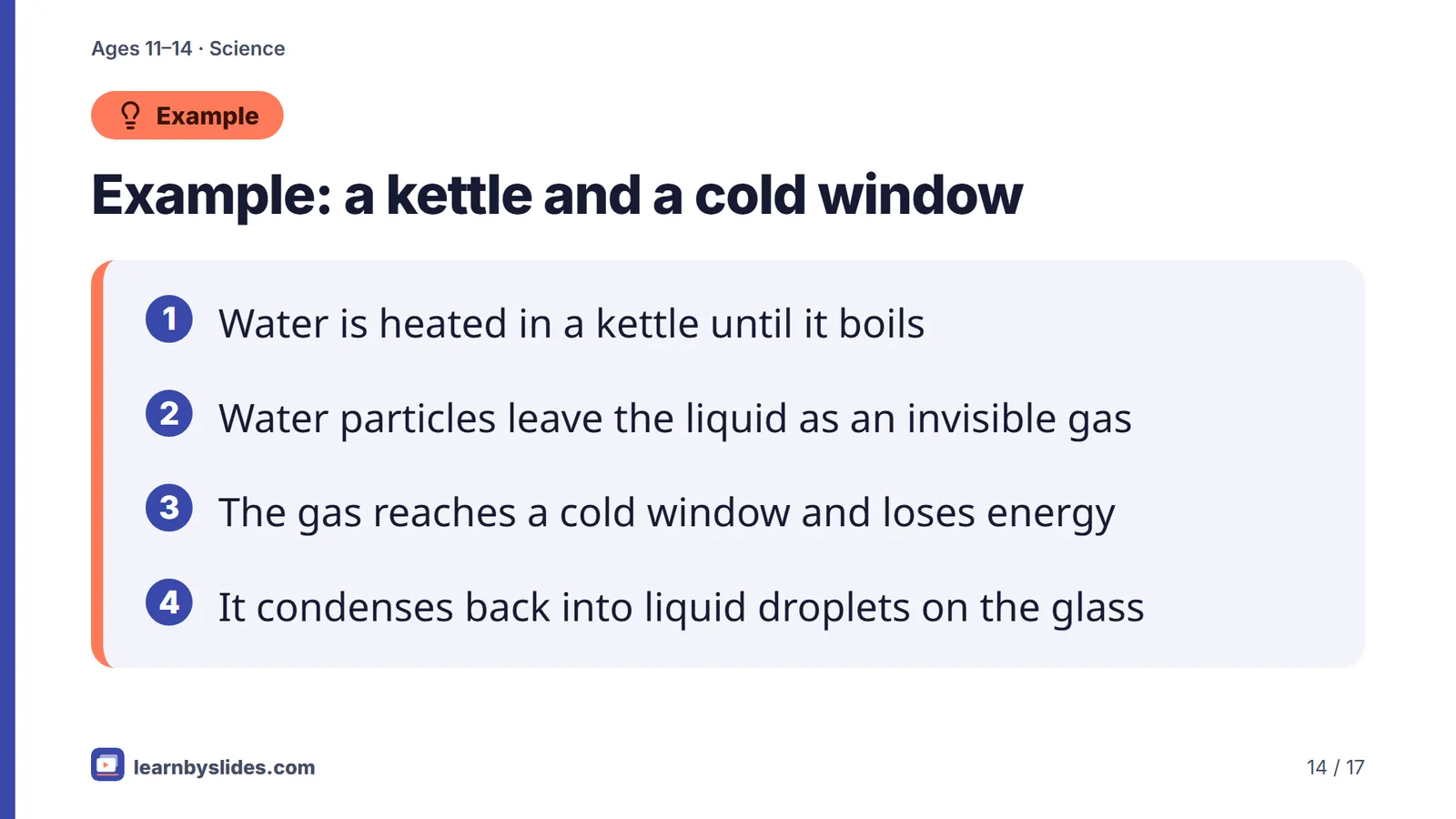
14. Example: a kettle and a cold window
- Water is heated in a kettle until it boils
- Water particles leave the liquid as an invisible gas
- The gas reaches a cold window and loses energy
- It condenses back into liquid droplets on the glass
Speaker notes
Ask students to name each change of state and say whether energy is taken in or given out at each step. Then ask them to draw particle diagrams for the water in the kettle, in the air and on the window. Kettles get hot: keep any real demonstration at a safe distance.
15. Common mix-ups
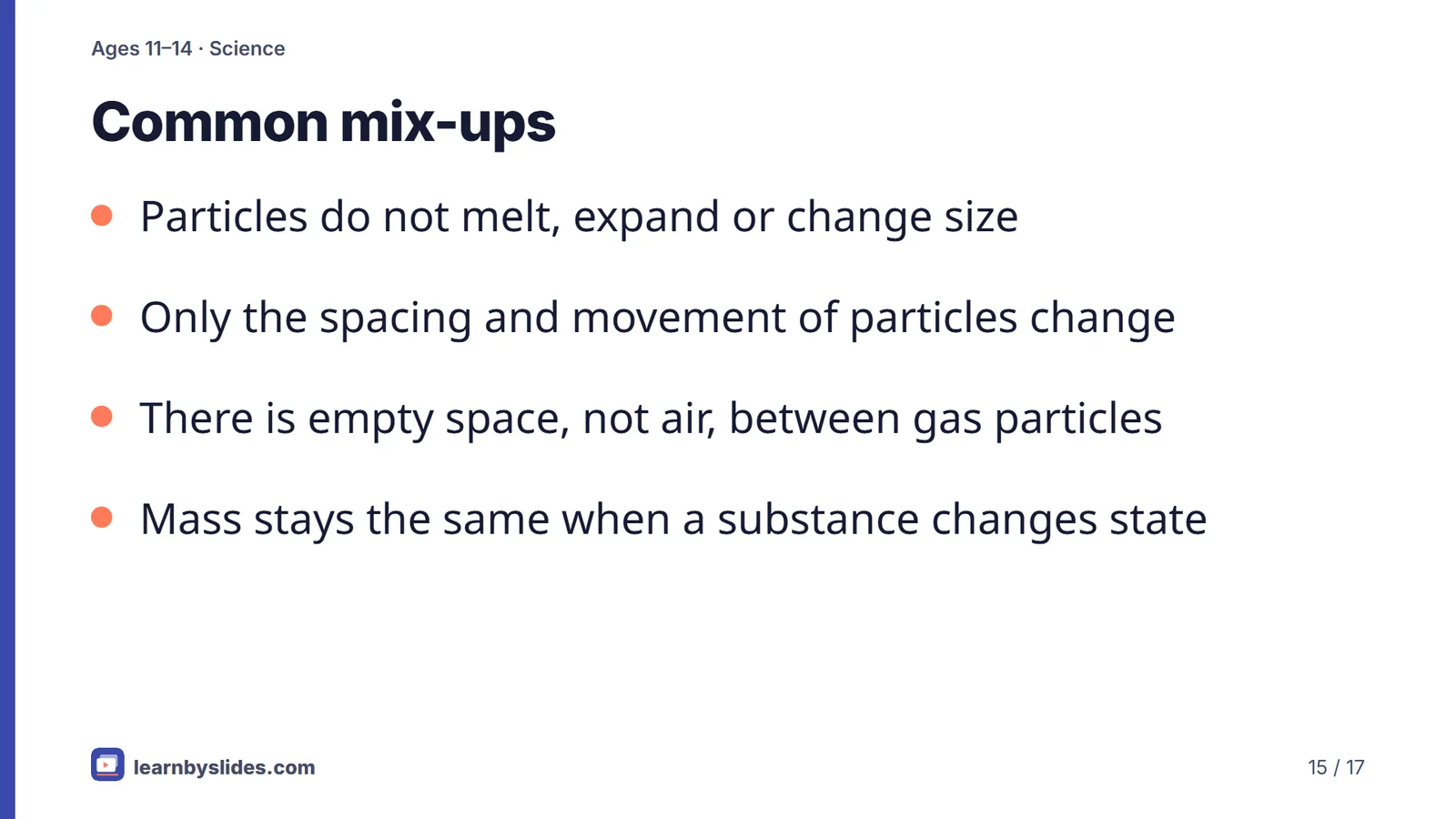
- Particles do not melt, expand or change size
- Only the spacing and movement of particles change
- There is empty space, not air, between gas particles
- Mass stays the same when a substance changes state
Speaker notes
Ask students to vote true or false before revealing each bullet. A sealed bag of ice that melts has exactly the same mass afterwards; you can show this on a balance. When something expands on heating, it is because the particles move more and spread out, not because each particle grows.
16. Quick check
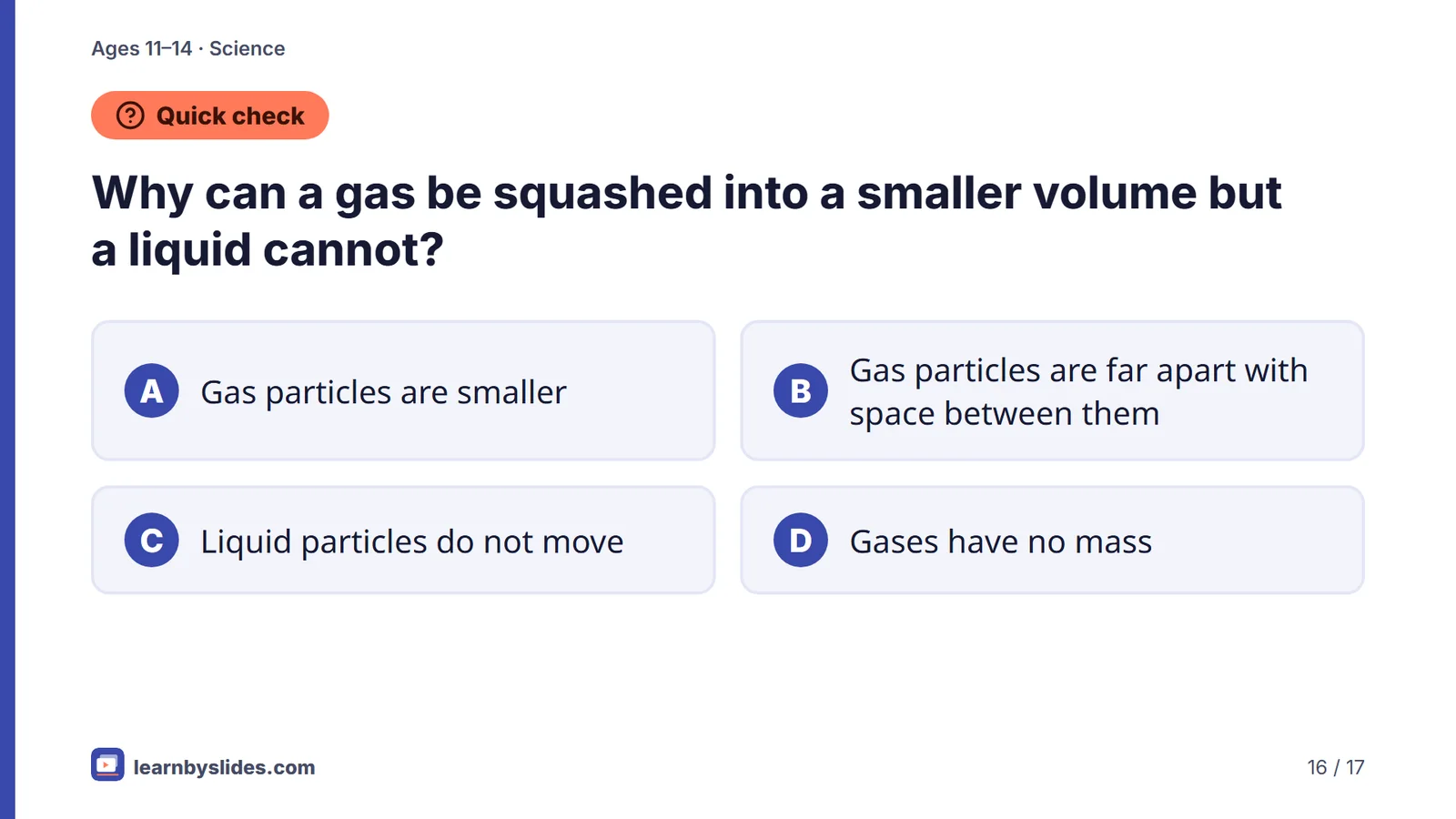
Why can a gas be squashed into a smaller volume but a liquid cannot?
- Gas particles are smaller
- Gas particles are far apart with space between them
- Liquid particles do not move
- Gases have no mass
Speaker notes
Answer: gas particles are far apart. Liquid particles are already touching, so there is almost no space to push them into. Use wrong answers to revisit the common mix-ups slide.
17. Key takeaways
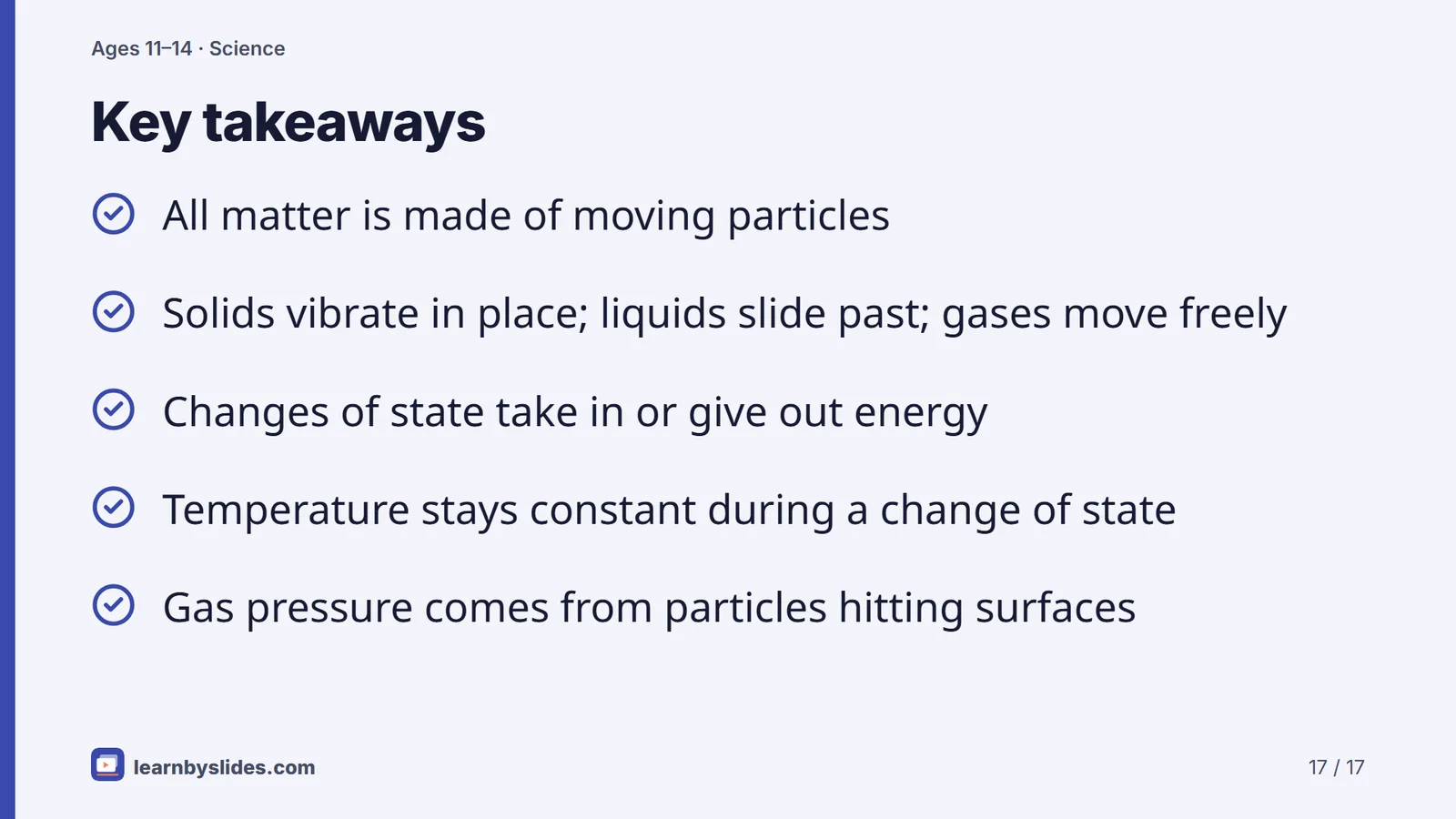
- All matter is made of moving particles
- Solids vibrate in place; liquids slide past; gases move freely
- Changes of state take in or give out energy
- Temperature stays constant during a change of state
- Gas pressure comes from particles hitting surfaces
Speaker notes
Look at the ice cube from the start of the lesson and ask students to explain what has happened using particles. Then move to the five-question quiz on the page. Homework idea: draw a labelled heating curve for water from −10 °C to 110 °C.
Key terms
- Matter
- Anything that has mass and takes up space.
- Particle model
- The idea that all matter is made of tiny moving particles, used to explain the properties of solids, liquids and gases.
- Melting
- The change from solid to liquid, which takes in energy.
- Condensing
- The change from gas to liquid, which gives out energy.
- Evaporation
- A liquid turning into a gas at its surface, at any temperature below the boiling point.
- Boiling point
- The temperature at which a liquid turns into a gas throughout; for pure water at sea level it is 100 °C.
- Sublimation
- The change from solid straight to gas without becoming a liquid.
- Diffusion
- The spreading of particles from where there are many of them to where there are fewer.
- Gas pressure
- The push on a surface caused by gas particles colliding with it.
Quick quiz
Teacher notes
Suggested 45-minute plan: 5 min opener (ice cube predictions), 12 min on the particle model and the three states, with students drawing particle boxes (slides 3–7), 10 min on what decides the state, changes of state and energy (slides 8–10), 8 min on water's fixed points, evaporation vs boiling and gas pressure (slides 11–13), 5 min kettle example and common mix-ups, 5 min quick check and quiz. Common misconceptions: particles expand, melt or change size when heated (only their spacing and motion change); there is air between gas particles (it is empty space); evaporation only happens at 100 °C (it happens at the surface at any temperature); mass changes when ice melts (it does not). Extension: ask students to explain why a heating curve has flat sections, or to research absolute zero (0 K, which is −273.15 °C), the temperature at which particles have the least possible movement energy. For any demonstration with kettles, hot water or dry ice, follow your school's risk assessment.
Frequently asked questions
Which curricula does this lesson fit?
It covers the states of matter and particle model content taught at ages 11–14 in most English-medium science courses, in both chemistry and physics, and it lays the groundwork for GCSE and IGCSE. The curriculum chips at the top of the page list each matching code. Always check against the syllabus your school follows.
What is the difference between evaporation and boiling?
Evaporation happens only at the surface of a liquid and at any temperature, as the fastest particles escape. Boiling happens throughout the liquid and only at its boiling point, which for pure water at sea level is 100 °C.
Why does the temperature stay the same while ice melts?
The energy being taken in is used to overcome the attractions holding the particles in place, not to make them move faster. Once all the ice has melted, the temperature starts rising again.
Is plasma a state of matter?
Yes. Plasma is often called the fourth state: a very hot gas containing many electrically charged particles, found in stars and lightning. Most courses for ages 11–14 focus on solids, liquids and gases, so this deck mentions plasma only as an extension.
Can I edit these slides in Google Slides or PowerPoint?
Yes. Download the PPTX file and open it in PowerPoint, or upload it to Google Drive to edit it in Google Slides. Speaker notes and text boxes stay editable.
Sources & methodology
Every fact is checked against the sources below. We write original explanations and draw original graphics; no figures are copied from textbooks. Spotted an error? See our corrections policy.
- Chemistry 2e, 1.2 Phases and Classification of Matter (OpenStax (Rice University), accessed 1 Oct 2026)
- Chemistry 2e, 10.1 Intermolecular Forces (OpenStax (Rice University), accessed 1 Oct 2026)
- Chemistry 2e, 10.3 Phase Transitions (OpenStax (Rice University), accessed 1 Oct 2026)
- Chemistry 2e, 9.5 The Kinetic-Molecular Theory (OpenStax (Rice University), accessed 1 Oct 2026)
- Chemistry 2e, 1.4 Measurements (water's freezing and boiling points) (OpenStax (Rice University), accessed 1 Oct 2026)
- Phases of Matter (NASA Glenn Research Center, accessed 1 Oct 2026)
Editorial review pending · Updated
Related lessons
 Science · Ages 12–15
Acids, Bases and the pH Scale Lesson Slides
A ready-to-teach chemistry lesson for ages 12–15 on acids, bases and alkalis: the pH scale, litmus and universal indicator, everyday examples, neutralisation and how to name salts, with a safe indicator practical.
 Science · Ages 12–15
Electric Circuits: Current, Voltage & Resistance Lesson Slides
A ready-to-teach physics lesson for ages 12–15 on electric circuits: current, potential difference (voltage), resistance and Ohm's law, how to use ammeters and voltmeters, and the rules for series and parallel circuits.
 Science · Ages 12–15
Forces and Newton's Laws of Motion Lesson Slides
A ready-to-teach physics lesson for ages 12–15 on forces: contact and non-contact forces, resultant force, balanced and unbalanced forces, mass and weight, and Newton's three laws of motion, with F = ma worked examples.
 Science · Ages 11–14
Plant and Animal Cells: Structure and Function Lesson Slides
A ready-to-teach lesson for ages 11–14 on plant and animal cells: the parts they share, the three extra parts plant cells have, and what each part does. Speaker notes on every slide, a microscope example, a 5-question quiz and a worksheet.
 Science · Ages 15–16
Chemical Reactions and Equations: Lesson Slides & Worksheet
A ready-to-teach chemistry lesson for ages 15–16 on chemical reactions and equations: writing and balancing equations, the main reaction types, exothermic and endothermic changes, oxidation, reduction, corrosion and rancidity.
 Science · Ages 14–15
Motion: Speed, Velocity, Acceleration & Graphs Lesson Slides
A ready-to-teach physics lesson for ages 14–15 on motion in a straight line: distance and displacement, speed, velocity, acceleration, position–time and velocity–time graphs, the equations of motion and uniform circular motion.
For teachers and parents: new LearnBySlides resources by email
One short email when new free resources go live. For adults (18+) only. No spam, no tracking in emails, unsubscribe anytime.