Electric Circuits: Current, Voltage & Resistance Lesson Slides
A ready-to-teach physics lesson for ages 12–15 on electric circuits: current, potential difference (voltage), resistance and Ohm's law, how to use ammeters and voltmeters, and the rules for series and parallel circuits.
Ages 12–15 · Grades 7–9 (US) · Years 8–10 (UK) · Classes 7–9 (India)
- England KS3 Years 7–9
- Australian Curriculum v9 AC9S9U04
- AQA GCSE 4.2.1.2–4.2.1.4
- AQA GCSE 4.2.2
- AQA GCSE 6.2.2
- Cambridge IGCSE 0625 4.2.2–4.2.4
- Cambridge IGCSE 0625 4.3.2
- CBSE Unit IV
Cambridge and IGCSE are trademarks of Cambridge University Press & Assessment. Names and codes are used only to describe curriculum fit; LearnBySlides is not endorsed by these organisations.

14 slides · 45 min lesson · 5-question quiz · speaker notes
Learning objectives
- Explain that a current flows only in a complete circuit and is not used up by components.
- Describe current, potential difference (voltage) and resistance, with their units and meters.
- Use V = IR to calculate voltage, current or resistance.
- State the rules for current and potential difference in series and parallel circuits.
- Explain why the lights and sockets in a home are wired in parallel.
What this lesson covers
This deck teaches students aged 12–15 how simple electric circuits work, in one 45-minute physics lesson. It explains current, potential difference (voltage) and resistance, links them with V = IR, and then compares series and parallel circuits with a worked example and a hands-on practical. Every slide has speaker notes, and the lesson ends with a quick check and a five-question quiz.
Current, potential difference and resistance
Charge flows only around a complete loop. A cell or battery pushes the charge round, and opening a switch anywhere in the loop stops the current.
- Current is the rate of flow of charge, measured in amperes (A) with an ammeter connected in series.
- Potential difference is the energy transferred per unit of charge, measured in volts (V) with a voltmeter connected in parallel across a component.
- Resistance is how much a component opposes the current, measured in ohms (Ω).
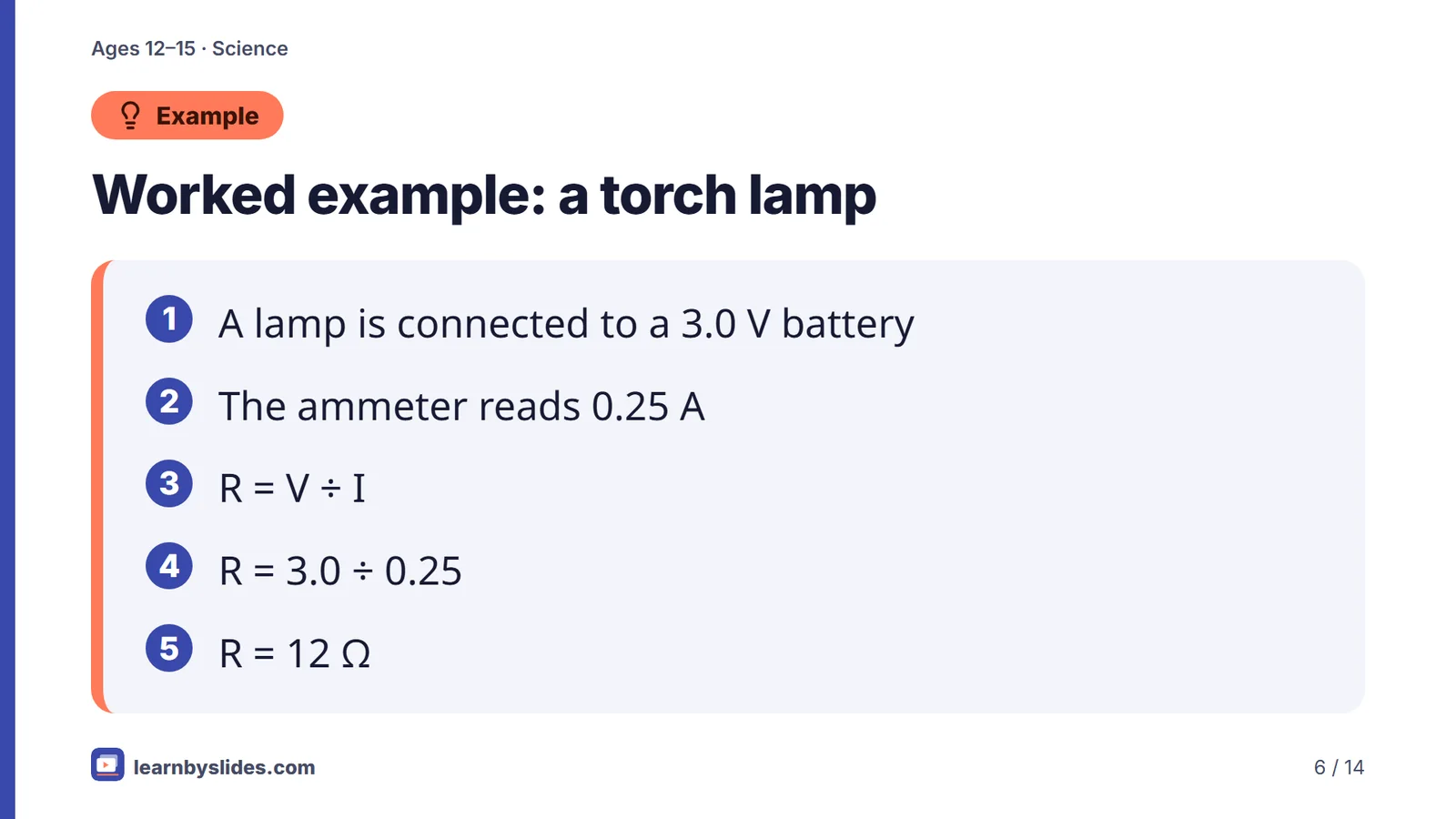
The three are linked by V = IR. For example, a torch lamp with 3.0 V across it and 0.25 A through it has a resistance of 12 Ω.
Series circuits
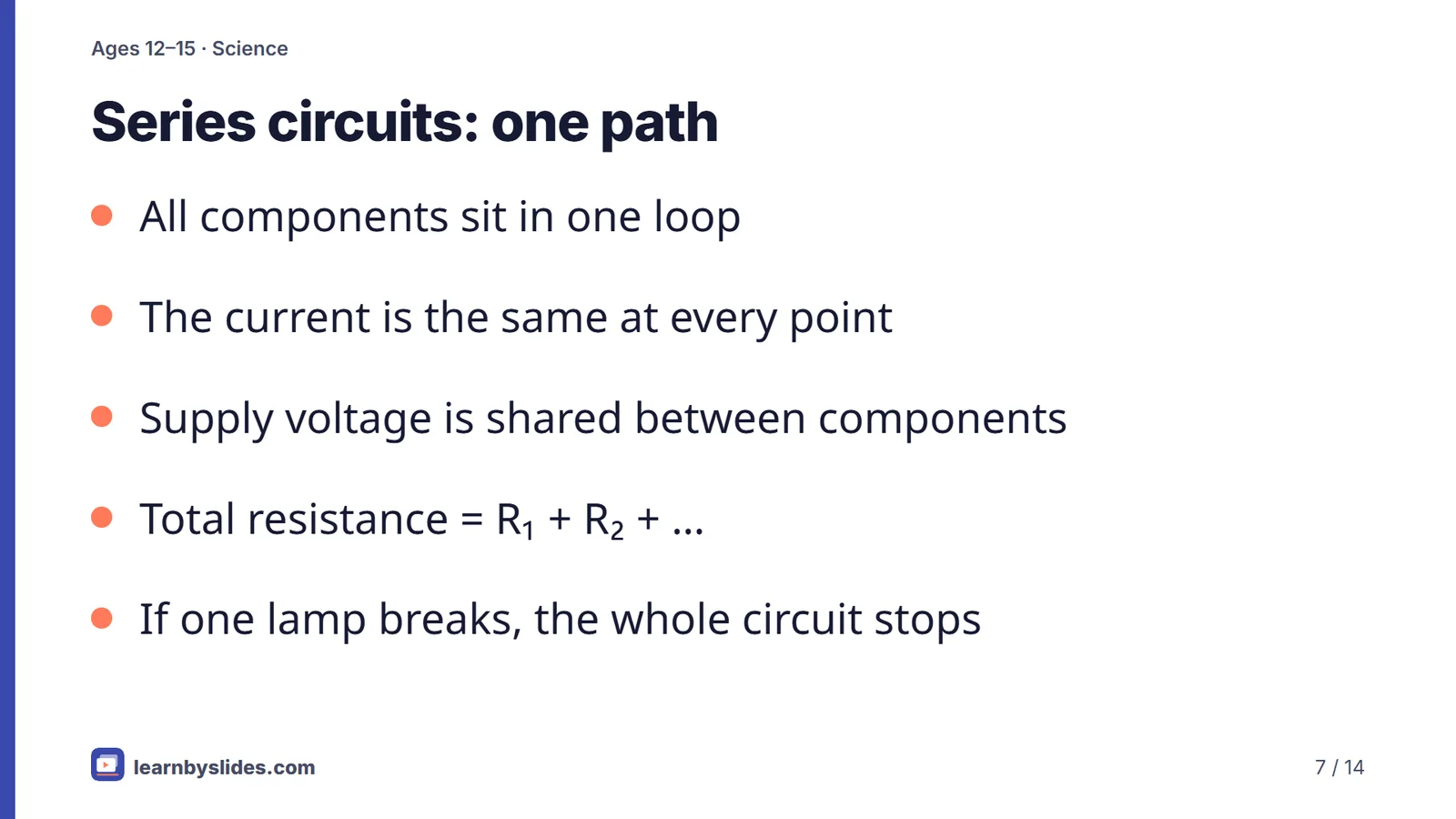
In a series circuit, all the components are in one loop. The current is the same at every point, the supply voltage is shared between the components, and the total resistance is the sum of the individual resistances. Adding more lamps makes each one dimmer, and if one lamp breaks, the whole circuit stops.
A key idea here is that current is not used up. The ammeter reading before a lamp is the same as the reading after it: the lamp transfers energy from the charge, not the charge itself.
Parallel circuits
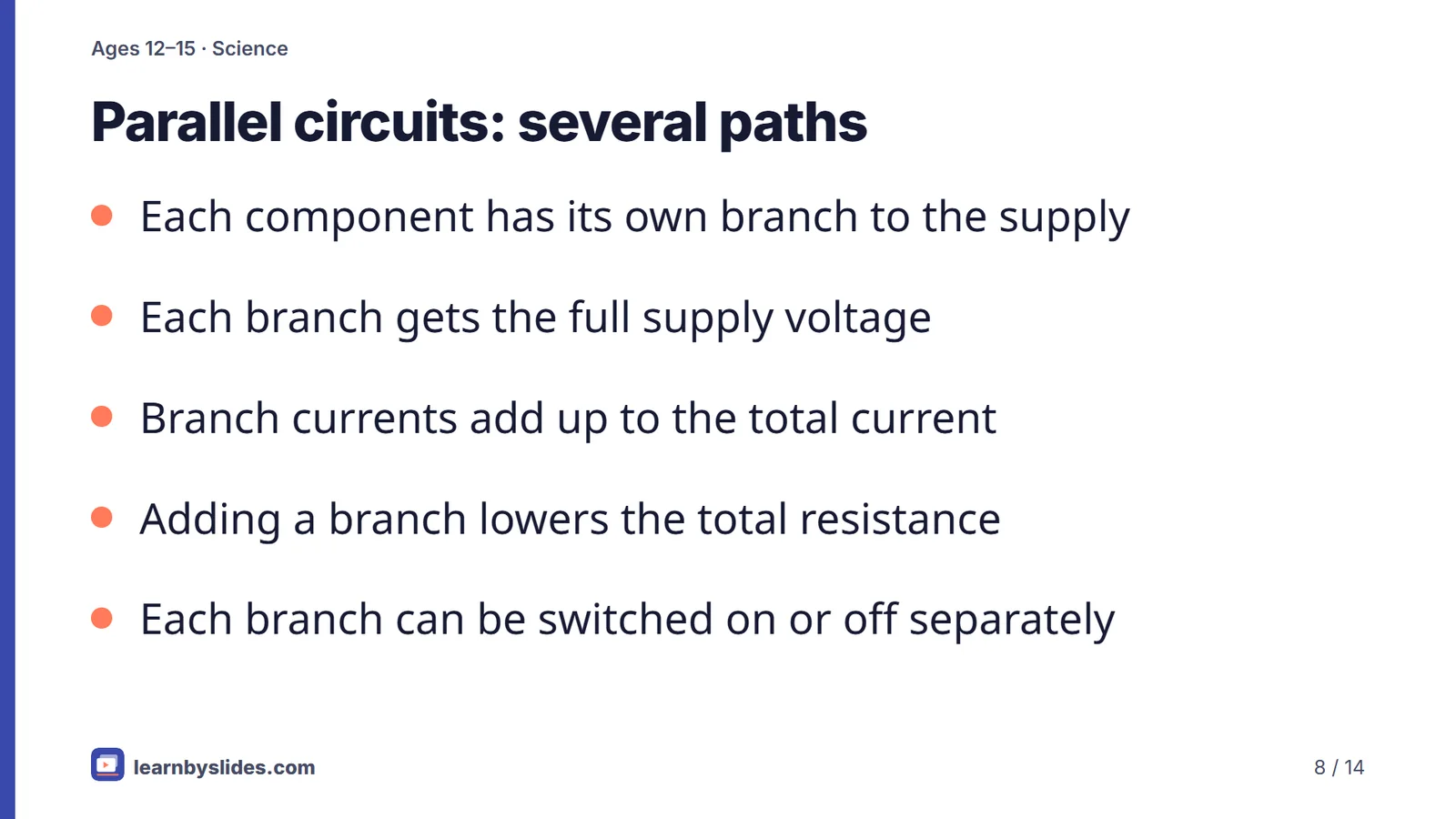
In a parallel circuit, each component has its own branch connected to the supply. Each branch gets the full supply voltage, and the branch currents add up to the total current from the battery. Adding a branch lowers the total resistance, so the battery supplies more current and runs down faster.
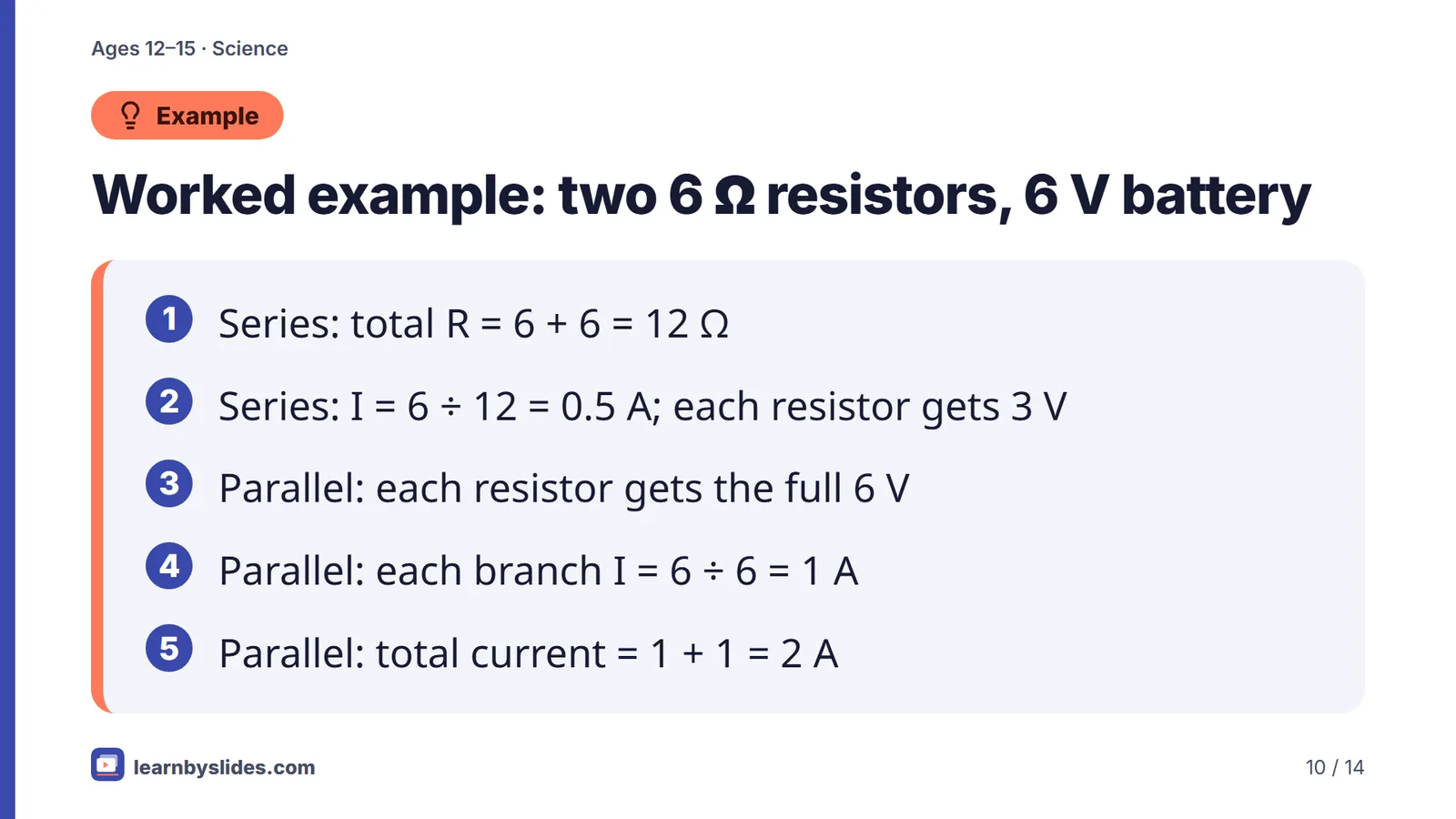
With two 6 Ω resistors and a 6 V battery, a series circuit carries 0.5 A, with 3 V across each resistor. The same resistors in parallel each get 6 V and carry 1 A, so the battery supplies 2 A in total.
Why homes use parallel circuits
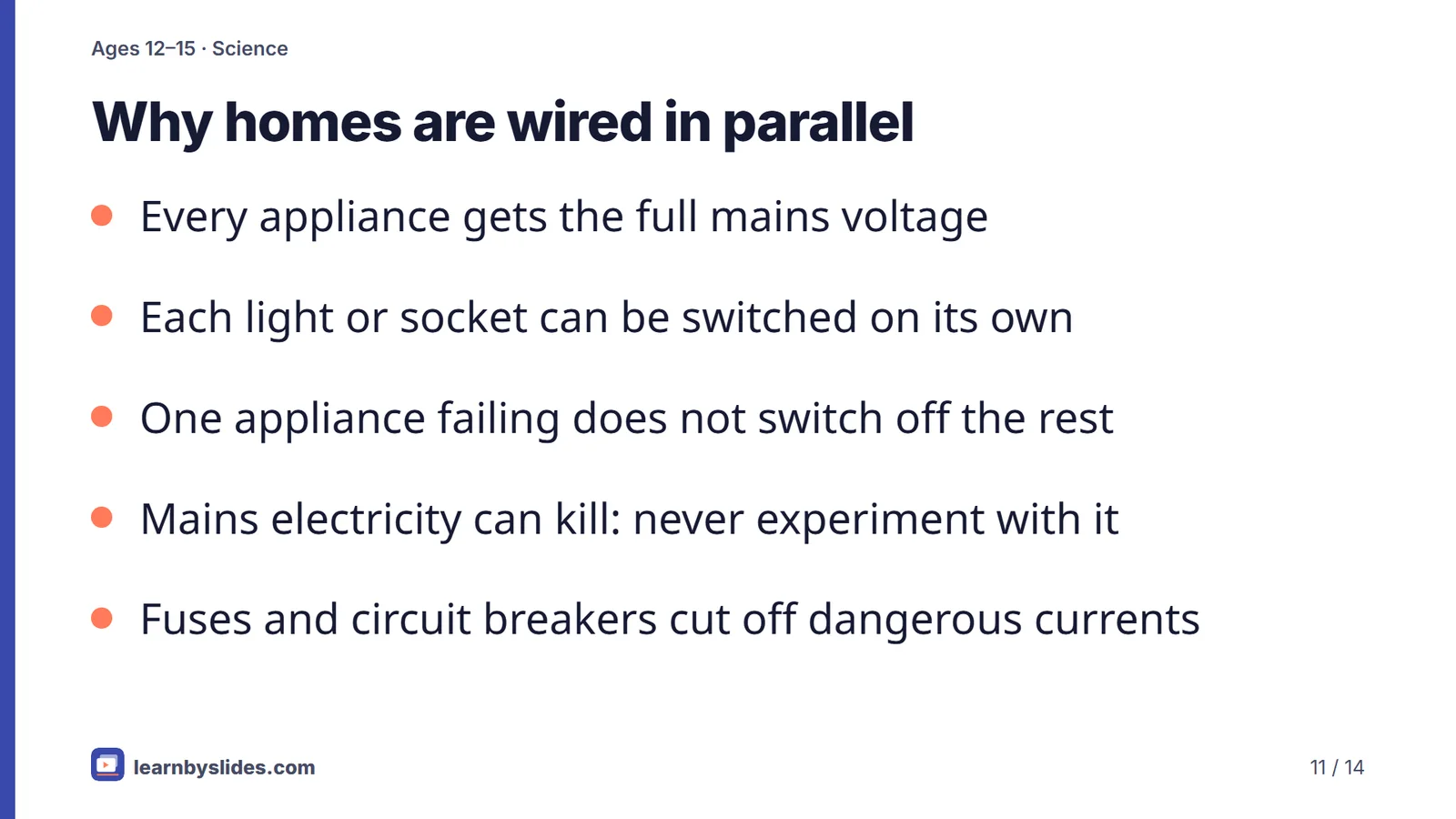
The lights and sockets in a home are wired in parallel. Every appliance gets the full mains voltage, each one can be switched on or off by itself, and one faulty appliance does not switch off the rest. Mains voltage is high enough to kill, so the lesson keeps all practical work to low-voltage cells and power packs, and explains the role of fuses and circuit breakers.
How to use these slides
Present the deck in class, download the editable PowerPoint (PPTX), or make your own copy in Google Slides. The teacher notes include a 45-minute plan, a low-voltage series and parallel practical with safety notes, common misconceptions and an extension on total resistance in parallel. Pair the lesson with the printable series and parallel circuits poster from InfoGraphHub.
Slide-by-slide content
1. Electric Circuits
Physics · Current, voltage, resistance, and series vs parallel
Speaker notes
Show a torch or a desk lamp and ask: what has to happen inside for the bulb to light? Collect ideas. Many students will say electricity 'flows into the bulb and gets used up'. Tell them the lesson will test that idea.
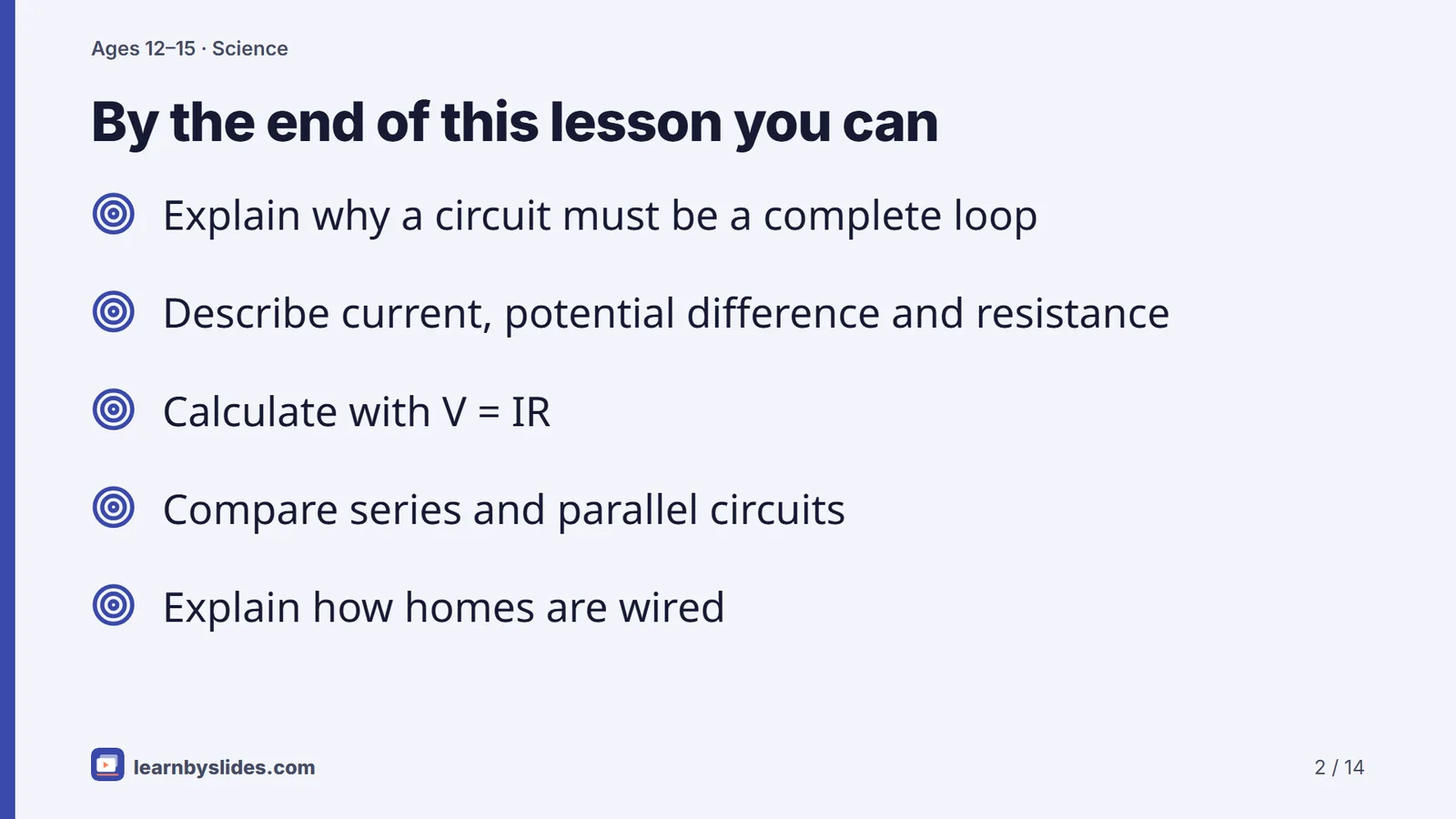
2. By the end of this lesson you can
- Explain why a circuit must be a complete loop
- Describe current, potential difference and resistance
- Calculate with V = IR
- Compare series and parallel circuits
- Explain how homes are wired
Speaker notes
Point out that 'voltage' and 'potential difference' mean the same thing in this lesson; some courses prefer one term, some the other. Ask which objective students think will be hardest.
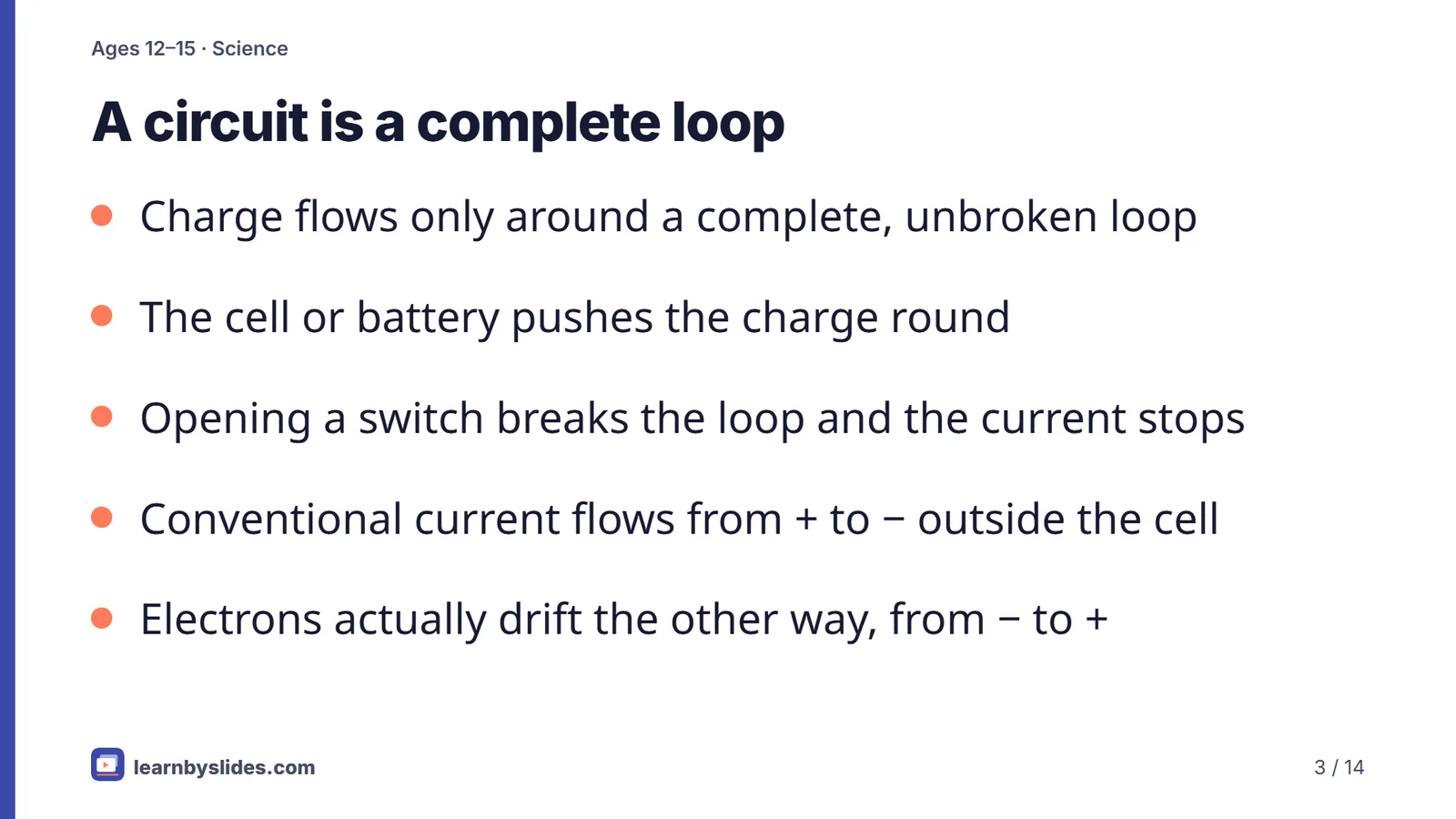
3. A circuit is a complete loop
- Charge flows only around a complete, unbroken loop
- The cell or battery pushes the charge round
- Opening a switch breaks the loop and the current stops
- Conventional current flows from + to − outside the cell
- Electrons actually drift the other way, from − to +
Speaker notes
Draw a cell, a switch and a lamp in a loop using standard circuit symbols. Ask what happens if one wire is disconnected anywhere in the loop: everything stops. The direction convention was chosen before electrons were discovered, which is why the two directions differ.
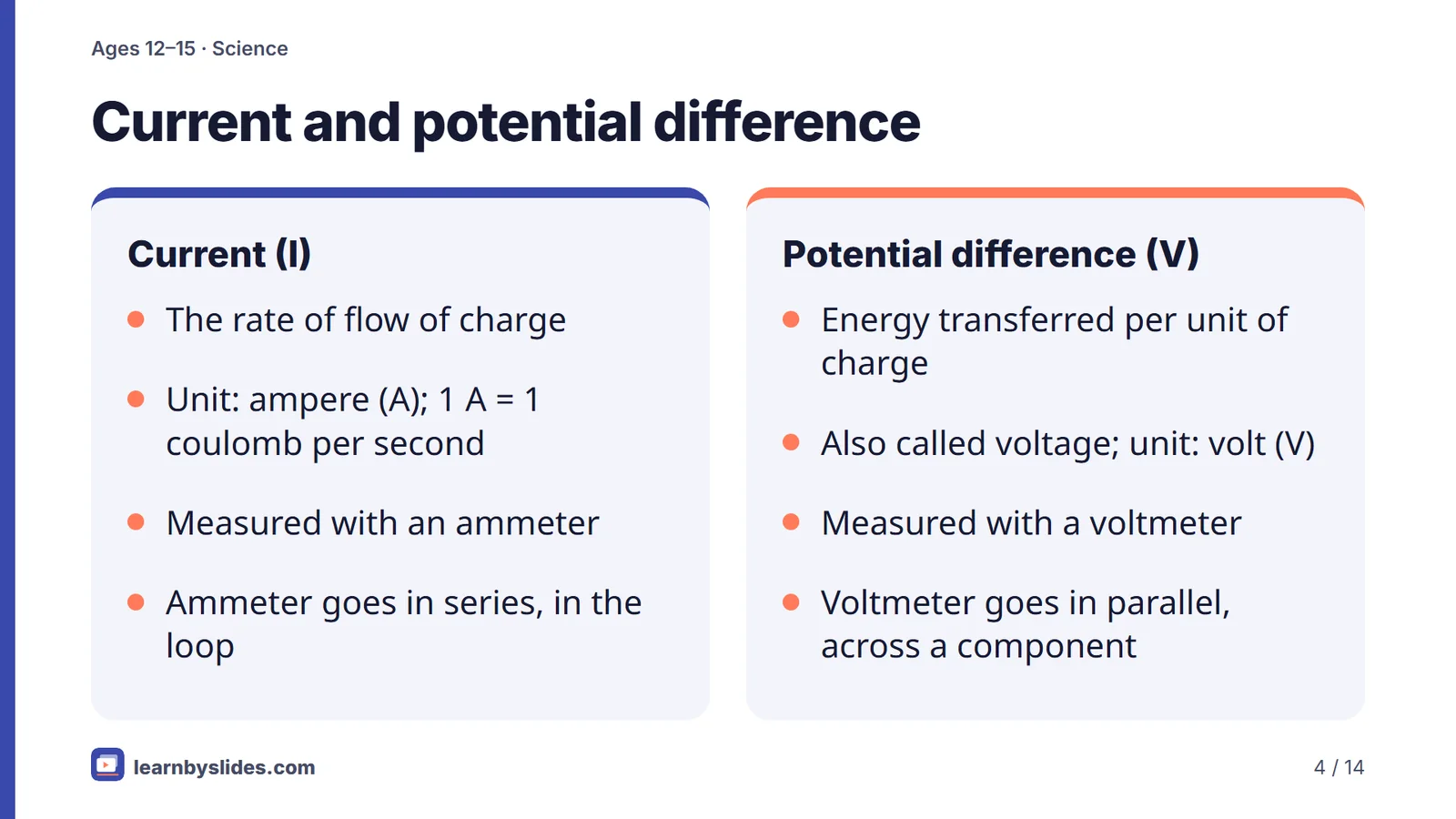
4. Current and potential difference
Current (I)
- The rate of flow of charge
- Unit: ampere (A); 1 A = 1 coulomb per second
- Measured with an ammeter
- Ammeter goes in series, in the loop
Potential difference (V)
- Energy transferred per unit of charge
- Also called voltage; unit: volt (V)
- Measured with a voltmeter
- Voltmeter goes in parallel, across a component
Speaker notes
A useful picture: current is how much charge passes a point each second; potential difference is how much energy each unit of charge gives up in a component. Ask students where the ammeter and voltmeter must go in a circuit and why: the ammeter must have all the current pass through it, the voltmeter compares two points.
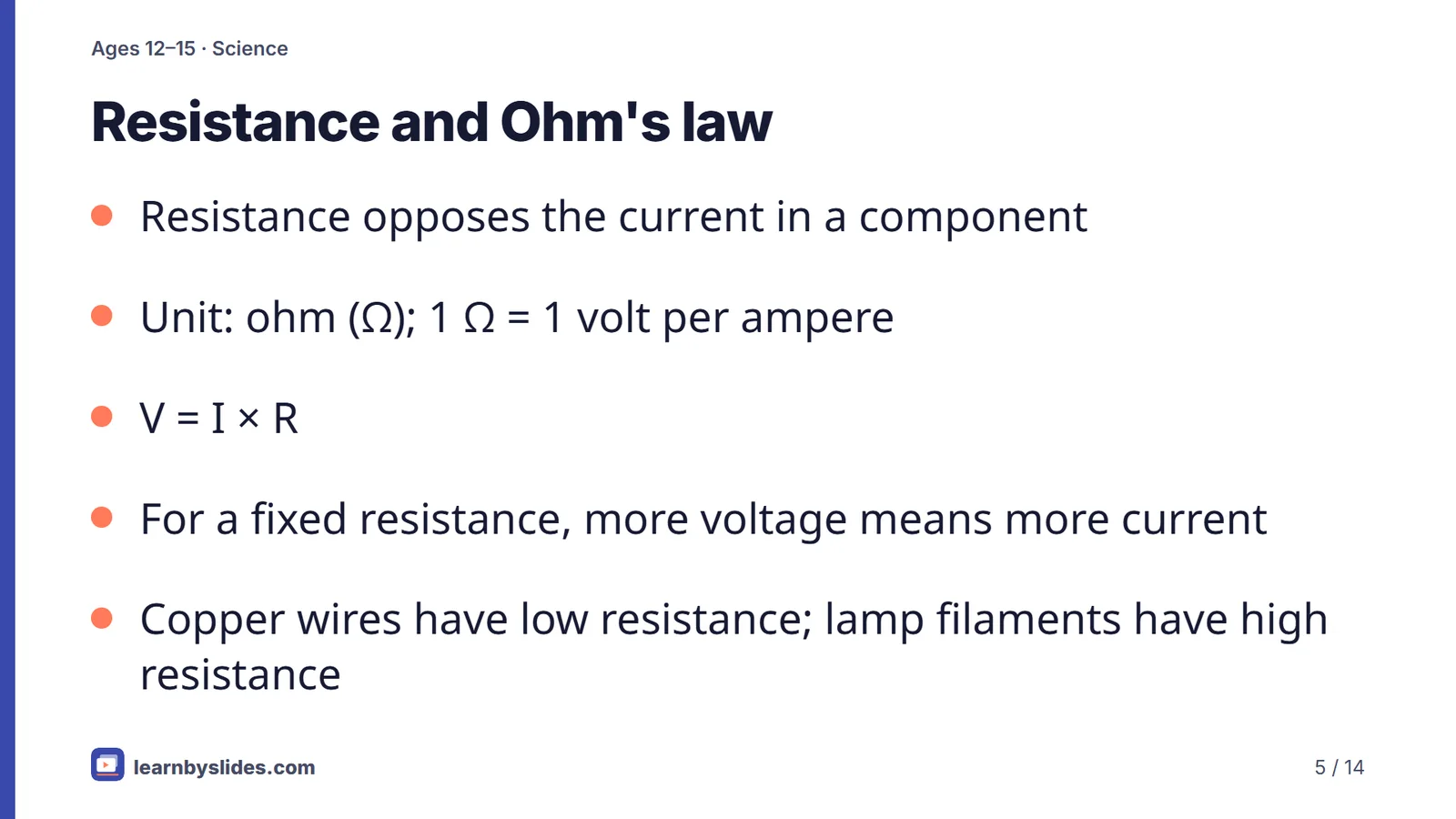
5. Resistance and Ohm's law
- Resistance opposes the current in a component
- Unit: ohm (Ω); 1 Ω = 1 volt per ampere
- V = I × R
- For a fixed resistance, more voltage means more current
- Copper wires have low resistance; lamp filaments have high resistance
Speaker notes
Show the rearrangements I = V ÷ R and R = V ÷ I. Components that keep the same resistance as the current changes are called ohmic; a filament lamp is not, because its resistance rises as it heats up. Older students can sketch a current-voltage graph for each.
6. Worked example: a torch lamp
- A lamp is connected to a 3.0 V battery
- The ammeter reads 0.25 A
- R = V ÷ I
- R = 3.0 ÷ 0.25
- R = 12 Ω
Speaker notes
Write each line on the board and ask students to check the units: volts divided by amperes gives ohms. Follow-up: if the same 12 Ω lamp were connected to a 6.0 V battery and its resistance did not change, the current would be 0.5 A. In reality the filament gets hotter, so the current would be a little less.
7. Series circuits: one path
- All components sit in one loop
- The current is the same at every point
- Supply voltage is shared between components
- Total resistance = R₁ + R₂ + …
- If one lamp breaks, the whole circuit stops
Speaker notes
Add a second lamp in series and the lamps get dimmer, because the total resistance goes up and the current goes down. Show ammeter readings before and after each lamp: they are the same. Current is not used up; energy is transferred to the lamps.
8. Parallel circuits: several paths
- Each component has its own branch to the supply
- Each branch gets the full supply voltage
- Branch currents add up to the total current
- Adding a branch lowers the total resistance
- Each branch can be switched on or off separately
Speaker notes
Add a second lamp in parallel and both stay as bright as a single lamp, because each gets the full supply voltage. The battery now supplies more current in total, so it runs down faster. For ages 14–15, introduce 1/R = 1/R₁ + 1/R₂ as an extension.
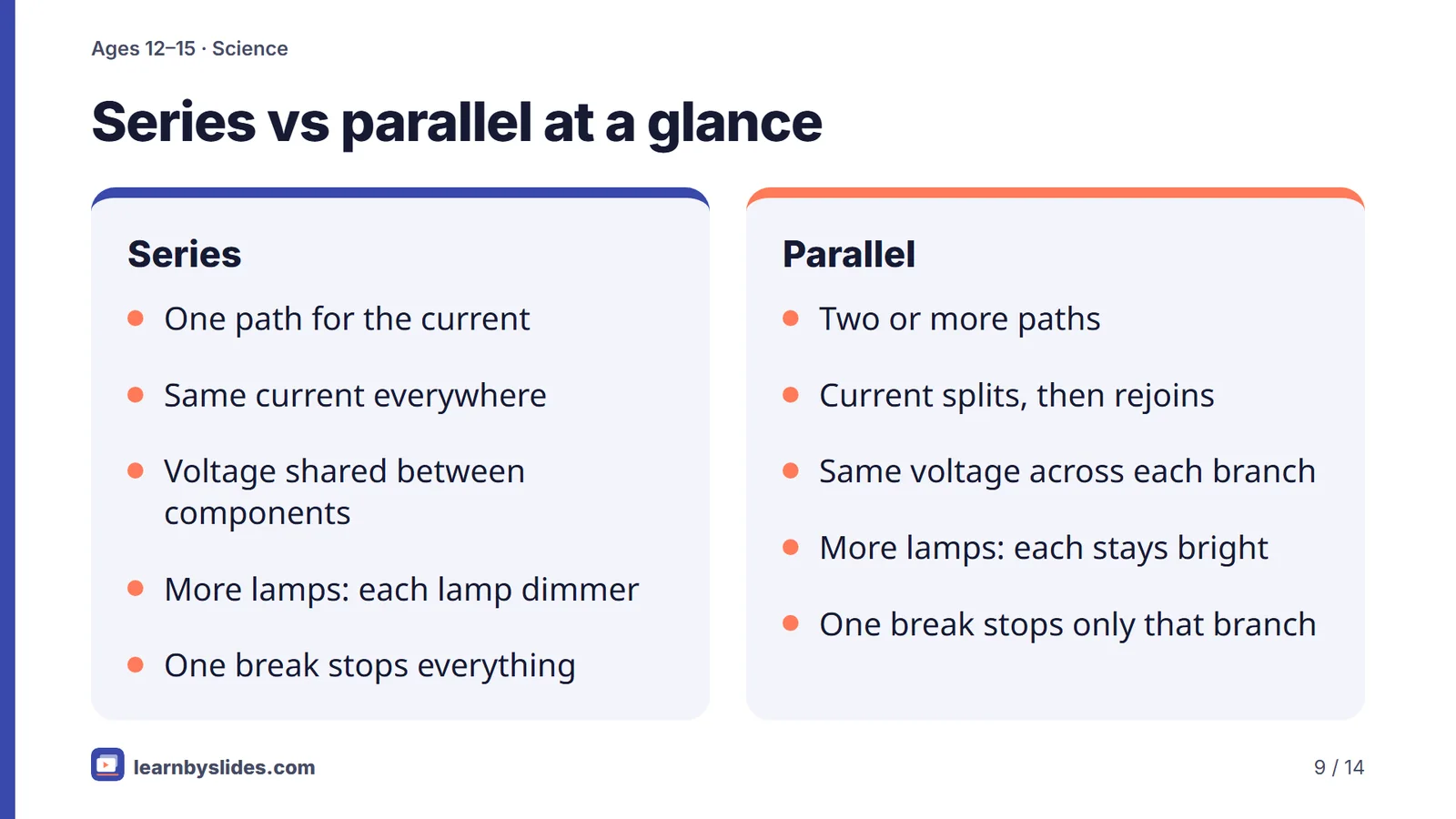
9. Series vs parallel at a glance
Series
- One path for the current
- Same current everywhere
- Voltage shared between components
- More lamps: each lamp dimmer
- One break stops everything
Parallel
- Two or more paths
- Current splits, then rejoins
- Same voltage across each branch
- More lamps: each stays bright
- One break stops only that branch
Speaker notes
Ask students to copy this table and add a sketch of each circuit. Then ask a hinge question: a string of decorative lights goes out completely when one bulb fails. Is it wired in series or parallel? Series.
10. Worked example: two 6 Ω resistors, 6 V battery
- Series: total R = 6 + 6 = 12 Ω
- Series: I = 6 ÷ 12 = 0.5 A; each resistor gets 3 V
- Parallel: each resistor gets the full 6 V
- Parallel: each branch I = 6 ÷ 6 = 1 A
- Parallel: total current = 1 + 1 = 2 A
Speaker notes
Same parts, very different results. In parallel the total resistance is 6 V ÷ 2 A = 3 Ω, less than either resistor on its own. Check with older students: 1/R = 1/6 + 1/6 = 1/3, so R = 3 Ω. Ask why the battery would run down four times faster in the parallel circuit (four times the current).
11. Why homes are wired in parallel
- Every appliance gets the full mains voltage
- Each light or socket can be switched on its own
- One appliance failing does not switch off the rest
- Mains electricity can kill: never experiment with it
- Fuses and circuit breakers cut off dangerous currents
Speaker notes
Mains voltage differs between countries, for example about 230 V in many countries and about 120 V in others, so avoid quoting one figure as universal. Make the safety message explicit: classroom experiments use low-voltage cells or power packs only.
12. Series and parallel on one page
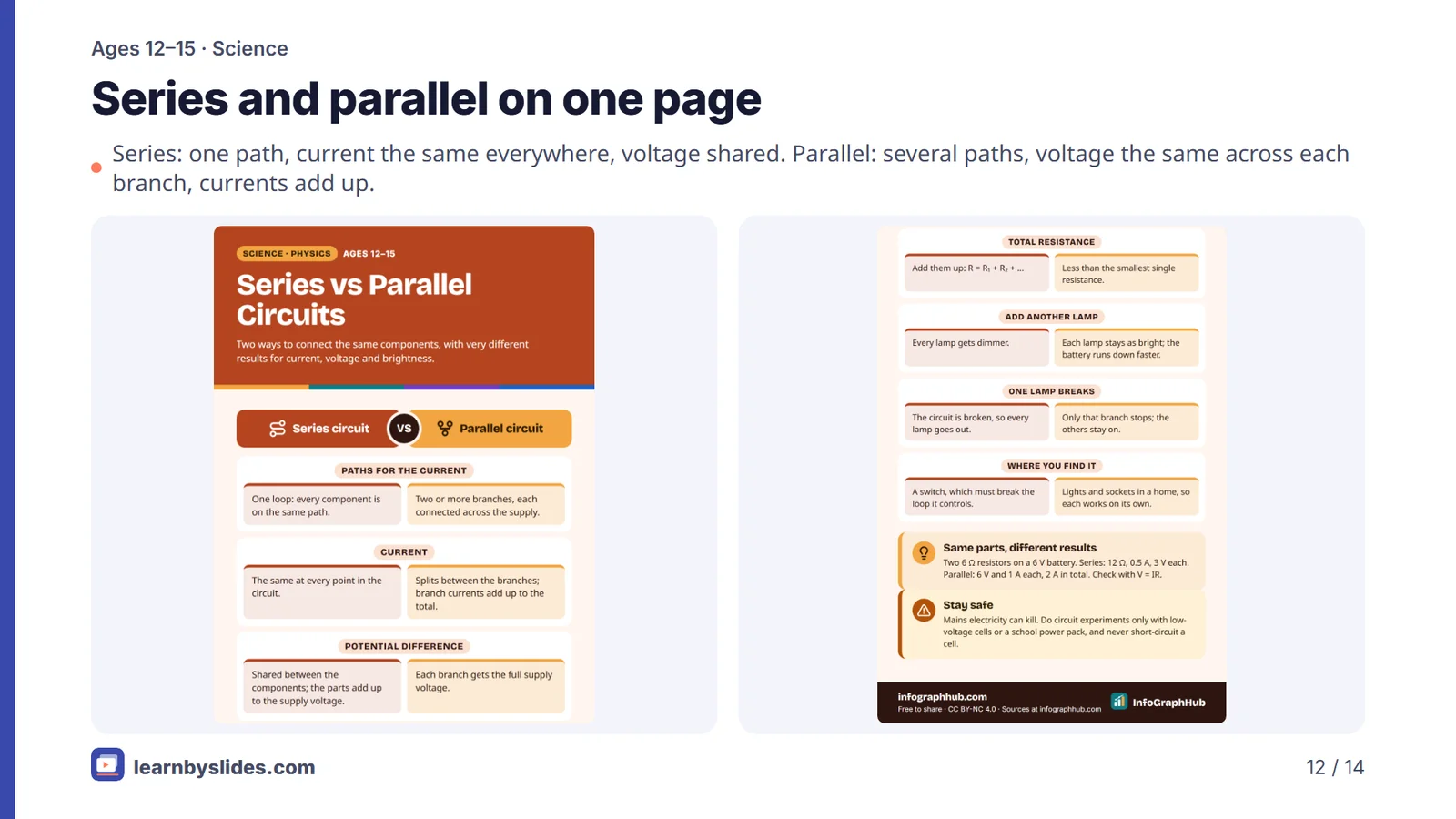
Series: one path, current the same everywhere, voltage shared. Parallel: several paths, voltage the same across each branch, currents add up.
Speaker notes
Use the poster as a recap or print it for the classroom wall. Ask students to cover one column and recall it from memory, then swap with a partner.
13. Quick check
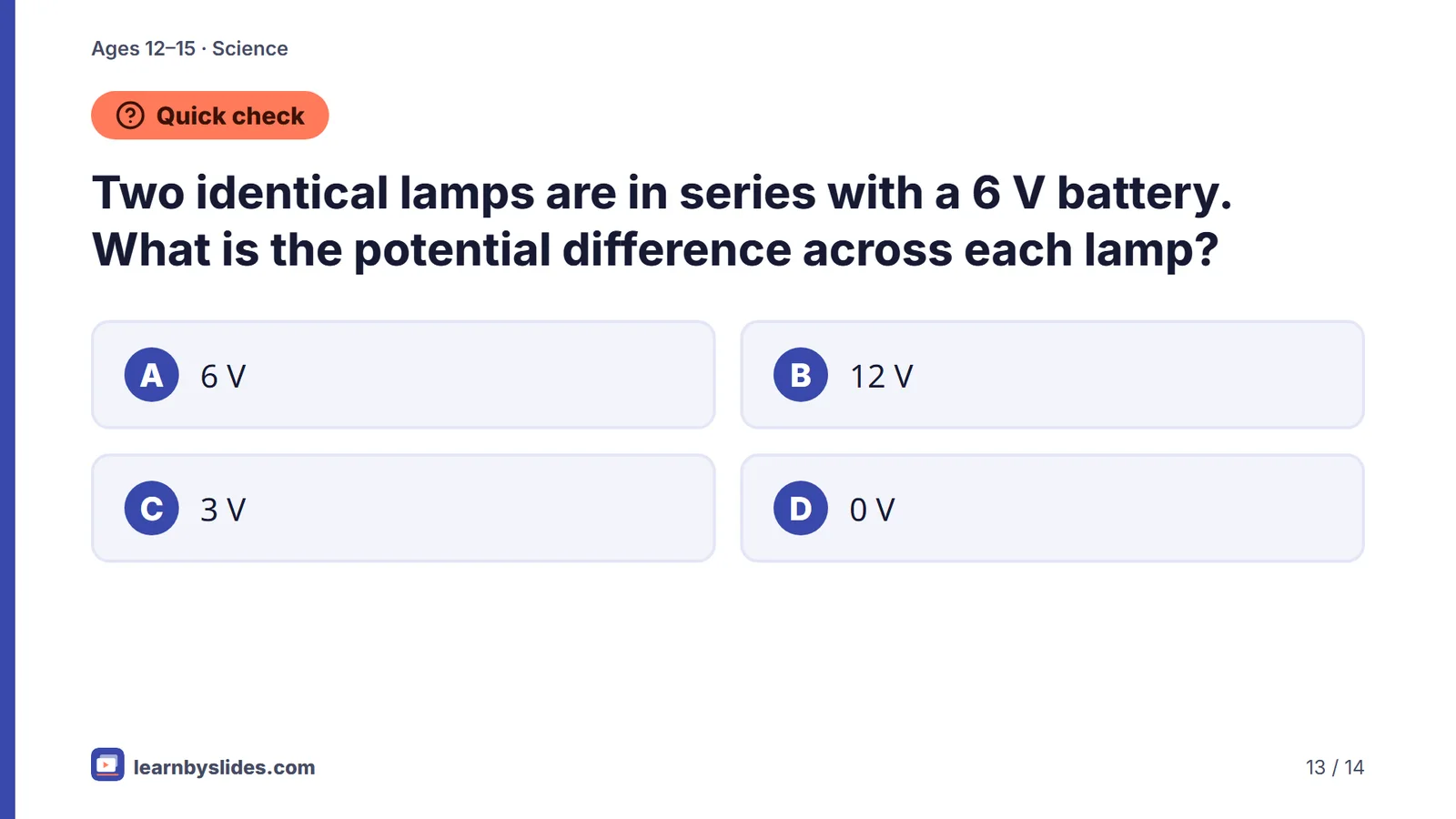
Two identical lamps are in series with a 6 V battery. What is the potential difference across each lamp?
- 6 V
- 12 V
- 3 V
- 0 V
Speaker notes
Answer: C, 3 V. In series the supply voltage is shared, and identical lamps share it equally. Students who chose A are thinking of a parallel circuit; ask them to explain what would change if the lamps were in parallel.
14. Key takeaways
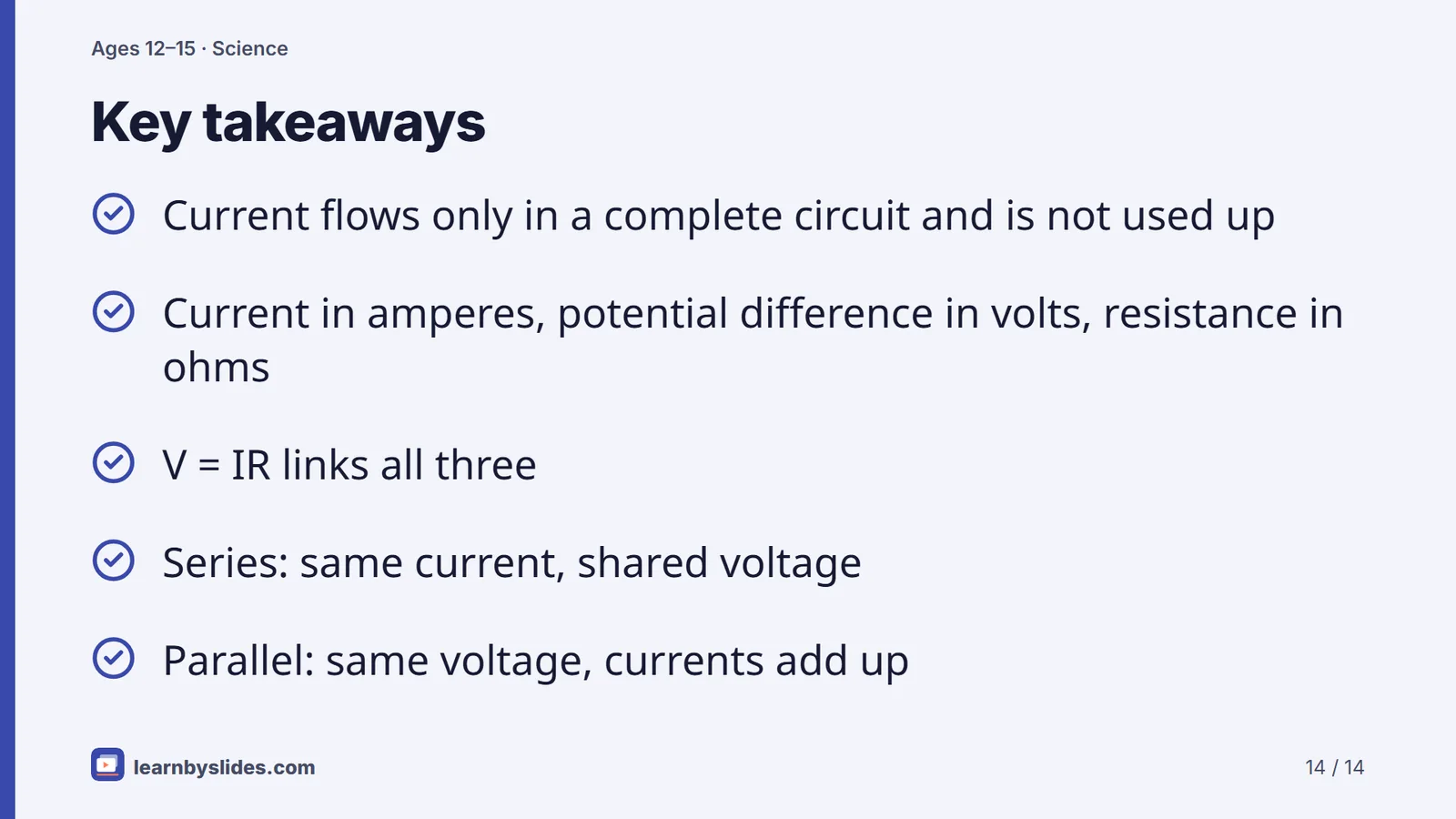
- Current flows only in a complete circuit and is not used up
- Current in amperes, potential difference in volts, resistance in ohms
- V = IR links all three
- Series: same current, shared voltage
- Parallel: same voltage, currents add up
Speaker notes
Return to the opening question about the torch and ask students to answer it again with the words current, potential difference and energy. Then move to the five-question quiz. Homework idea: find three things at home that are switched independently and explain how that shows parallel wiring.
Key terms
- Electric current
- The rate of flow of electric charge, measured in amperes (A) with an ammeter.
- Potential difference (voltage)
- The energy transferred per unit of charge between two points, measured in volts (V) with a voltmeter.
- Resistance
- How much a component opposes the current, measured in ohms (Ω); R = V ÷ I.
- Ohm's law
- For a component at constant temperature, the current is proportional to the potential difference: V = IR.
- Series circuit
- A circuit with one path, where the current is the same everywhere and the voltage is shared.
- Parallel circuit
- A circuit with two or more branches, where each branch has the full supply voltage and the branch currents add up.
- Conventional current
- The agreed direction of current, from the positive to the negative terminal outside the cell; electrons move the opposite way.
Quick quiz
Teacher notes
Suggested 45-minute plan: 5 min opener (what happens inside a torch?), 8 min on complete circuits, current and potential difference (slides 3 and 4), 8 min on resistance, V = IR and the torch example (slides 5 and 6), 14 min on series and parallel circuits, ideally as a practical (slides 7 to 10), 5 min on household wiring and safety, 5 min for the quick check and quiz. Safe practical (12–15 minutes): in pairs, students build a circuit with one lamp, then add a second lamp in series and then in parallel, measuring current with an ammeter at different points and potential difference with a voltmeter across each lamp. Safety: use only low-voltage cells, battery packs or a school power pack set to a low voltage (6 V or less is typical); never use mains sockets or take apart mains appliances; do not connect a wire directly across a cell (a short circuit makes the wire and cell hot); lamps and resistors can get hot, so let them cool before touching; check meters are on the correct range and remove damaged cells or leads. Follow your school's own risk assessment. Common misconceptions: current is used up by lamps; a battery always supplies the same current whatever the circuit; voltage flows through a circuit (it is measured across components); adding more lamps in parallel increases the total resistance. Extension for ages 14–15: use 1/R = 1/R₁ + 1/R₂ to find the total resistance of two resistors in parallel, and explain why it is always less than the smallest resistor.
Frequently asked questions
Is voltage the same as potential difference?
Yes. Potential difference is the energy transferred per unit of charge between two points, and voltage is the everyday name for it. Both are measured in volts. Some courses, including many GCSE specifications, prefer the term potential difference.
Is current used up as it goes round a circuit?
No. In a series circuit, an ammeter shows the same current before and after a lamp. What the lamp uses is energy carried by the charge, not the charge itself.
Why does adding resistors in parallel lower the total resistance?
Each new branch gives the charge another path to flow through, so more current flows for the same supply voltage. More current for the same voltage means a lower total resistance.
Is the series and parallel practical safe for 12-year-olds?
Yes, when it uses low-voltage cells or a school power pack on a low setting, never mains electricity. Students should avoid short-circuiting cells and let lamps and resistors cool before touching them. Always follow your school's own risk assessment.
Sources & methodology
Every fact is checked against the sources below. We write original explanations and draw original graphics; no figures are copied from textbooks. Spotted an error? See our corrections policy.
- Physics, 19.1 Ohm's Law (OpenStax (Rice University), accessed 1 Oct 2026)
- Physics, 19.2 Series Circuits (OpenStax (Rice University), accessed 1 Oct 2026)
- Physics, 19.3 Parallel Circuits (OpenStax (Rice University), accessed 1 Oct 2026)
- College Physics 2e, 21.4 DC Voltmeters and Ammeters (OpenStax (Rice University), accessed 1 Oct 2026)
- What gets used up? (electric circuits misconception) (Institute of Physics (IOPSpark), accessed 1 Oct 2026)
Editorial review pending · Updated
Related lessons
 Science · Ages 12–15
Forces and Newton's Laws of Motion Lesson Slides
A ready-to-teach physics lesson for ages 12–15 on forces: contact and non-contact forces, resultant force, balanced and unbalanced forces, mass and weight, and Newton's three laws of motion, with F = ma worked examples.
 Science · Ages 12–15
Acids, Bases and the pH Scale Lesson Slides
A ready-to-teach chemistry lesson for ages 12–15 on acids, bases and alkalis: the pH scale, litmus and universal indicator, everyday examples, neutralisation and how to name salts, with a safe indicator practical.
 Science · Ages 11–14
States of Matter and the Particle Model Lesson Slides
A ready-to-teach science lesson for ages 11–14 on solids, liquids and gases: how particles are arranged and move, the changes of state, energy in and out, evaporation vs boiling, and gas pressure. Speaker notes on every slide, a 5-question quiz and a worksheet.
 Science · Ages 13–16
Photosynthesis: How Plants Make Food Lesson Slides
A ready-to-teach biology lesson for ages 13–16 on photosynthesis: the word and balanced equations, how a leaf is built for the job, limiting factors and what plants do with glucose. Speaker notes on every slide, a 5-question quiz and a worksheet.
 Science · Ages 11–14
Plant and Animal Cells: Structure and Function Lesson Slides
A ready-to-teach lesson for ages 11–14 on plant and animal cells: the parts they share, the three extra parts plant cells have, and what each part does. Speaker notes on every slide, a microscope example, a 5-question quiz and a worksheet.
 Science · Ages 14–15
Motion: Speed, Velocity, Acceleration & Graphs Lesson Slides
A ready-to-teach physics lesson for ages 14–15 on motion in a straight line: distance and displacement, speed, velocity, acceleration, position–time and velocity–time graphs, the equations of motion and uniform circular motion.
For teachers and parents: new LearnBySlides resources by email
One short email when new free resources go live. For adults (18+) only. No spam, no tracking in emails, unsubscribe anytime.