Photosynthesis: How Plants Make Food Lesson Slides
A ready-to-teach biology lesson for ages 13–16 on photosynthesis: the word and balanced equations, how a leaf is built for the job, limiting factors and what plants do with glucose. Speaker notes on every slide, a 5-question quiz and a worksheet.
Ages 13–16 · Grades 8–10 (US) · Years 9–11 (UK) · Classes 8–10 (India)
- AQA GCSE 4.4.1.1
- AQA GCSE 4.4.1.2
- AQA GCSE 4.4.1.3
- Cambridge IGCSE 0610 6.1
- Cambridge IGCSE 0610 6.2
- England KS3 Years 7–9
- NGSS MS-LS1-6
- NGSS HS-LS1-5
- Australian Curriculum v9 AC9S9U03
- CBSE Class 10
- CBSE Class 7
NGSS is a registered trademark of WestEd. Cambridge and IGCSE are trademarks of Cambridge University Press & Assessment. Names and codes are used only to describe curriculum fit; LearnBySlides is not endorsed by these organisations.
17 slides · 45 min lesson · 5-question quiz · speaker notes
Learning objectives
- Write the word equation and the balanced symbol equation for photosynthesis.
- Explain how light energy is transferred to chemical energy stored in glucose.
- Describe how the structure of a leaf is adapted for photosynthesis.
- Explain how light intensity, carbon dioxide concentration and temperature can limit the rate of photosynthesis.
- Describe how a plant uses the glucose it makes.
What this lesson covers
This deck teaches photosynthesis to students aged 13–16 in a single 45-minute biology lesson. It starts with why photosynthesis matters, works through the word and balanced equations, then shows how a leaf is built for the job. The second half covers limiting factors, the link with respiration and what a plant does with the glucose it makes, and finishes with a greenhouse problem students solve in pairs.
Every slide has speaker notes. A slide on the two stages (the light-dependent reactions and the Calvin cycle) is marked as extension, so you can use the same deck with a younger class or a GCSE or IGCSE group.
The equation and where the energy comes from
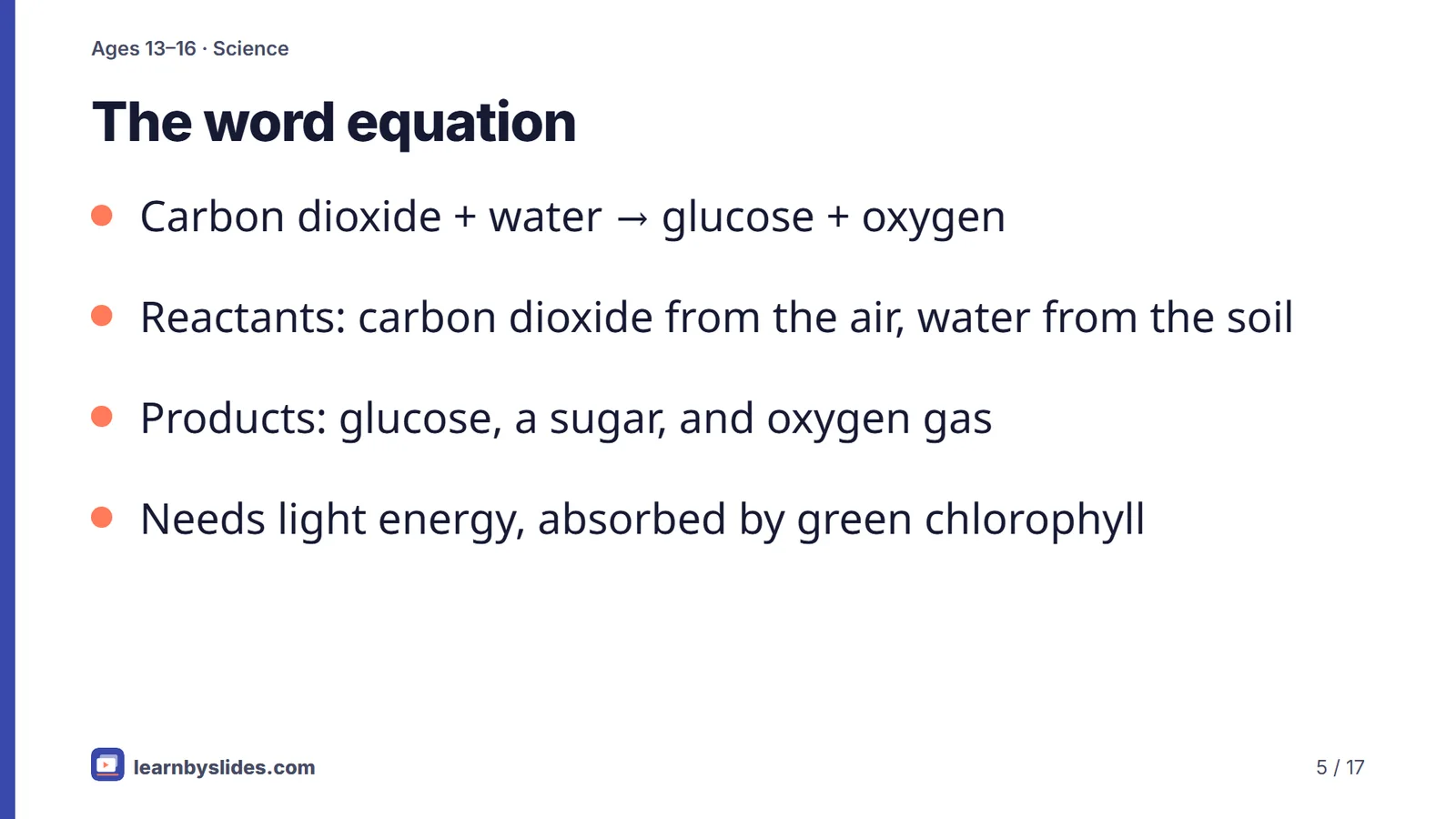
Plants, algae and cyanobacteria make their own food. They take in carbon dioxide from the air and water from the soil and, using light energy absorbed by green chlorophyll, make glucose and release oxygen:
- Word equation: carbon dioxide + water → glucose + oxygen
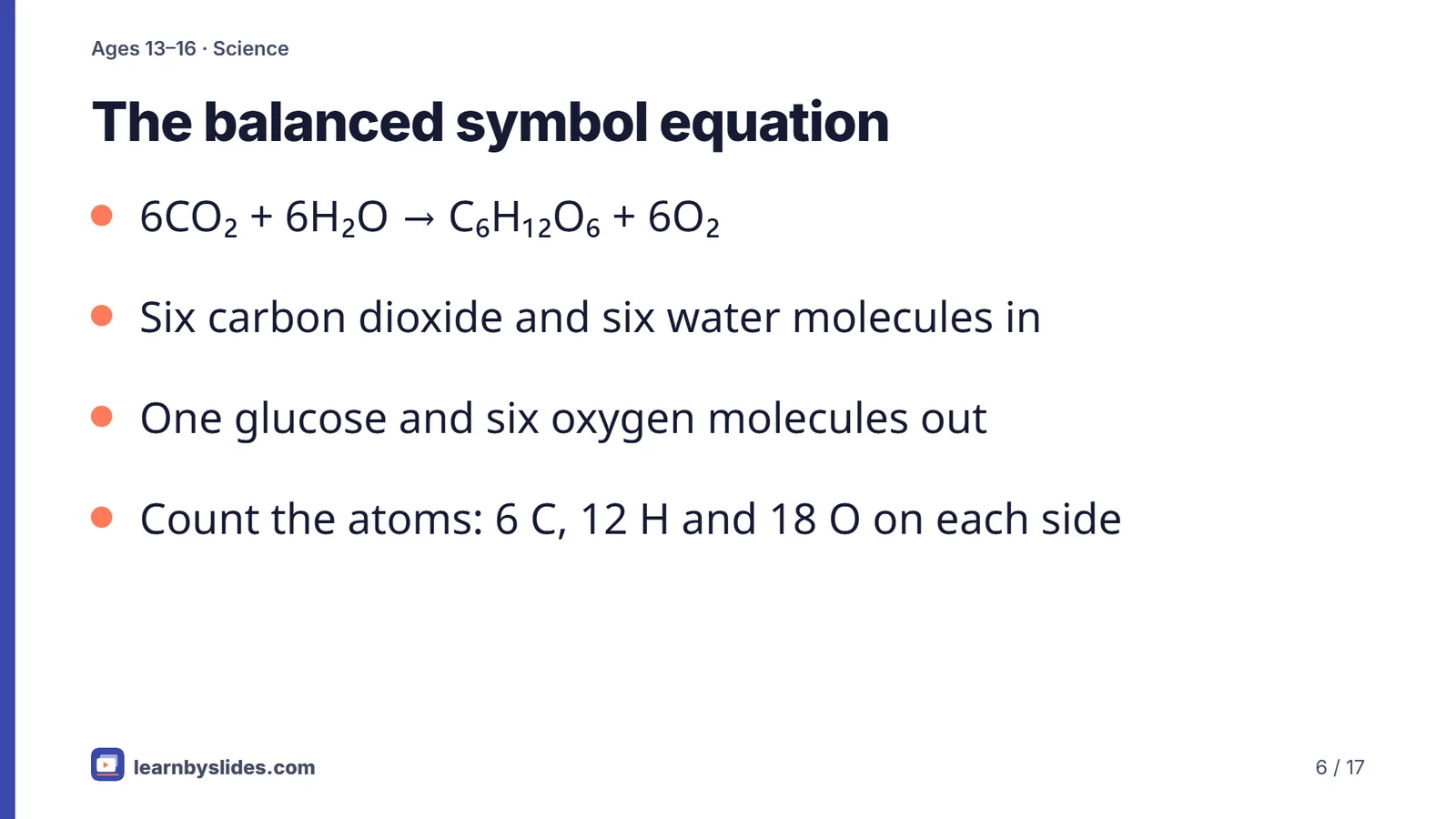
- Balanced equation:
6CO₂ + 6H₂O → C₆H₁₂O₆ + 6O₂
Light is the energy source, not a reactant. Its energy ends up stored as chemical energy in glucose. Almost every food chain on Earth starts here: photosynthesis powers about 99% of Earth's ecosystems.
How a leaf is built for photosynthesis
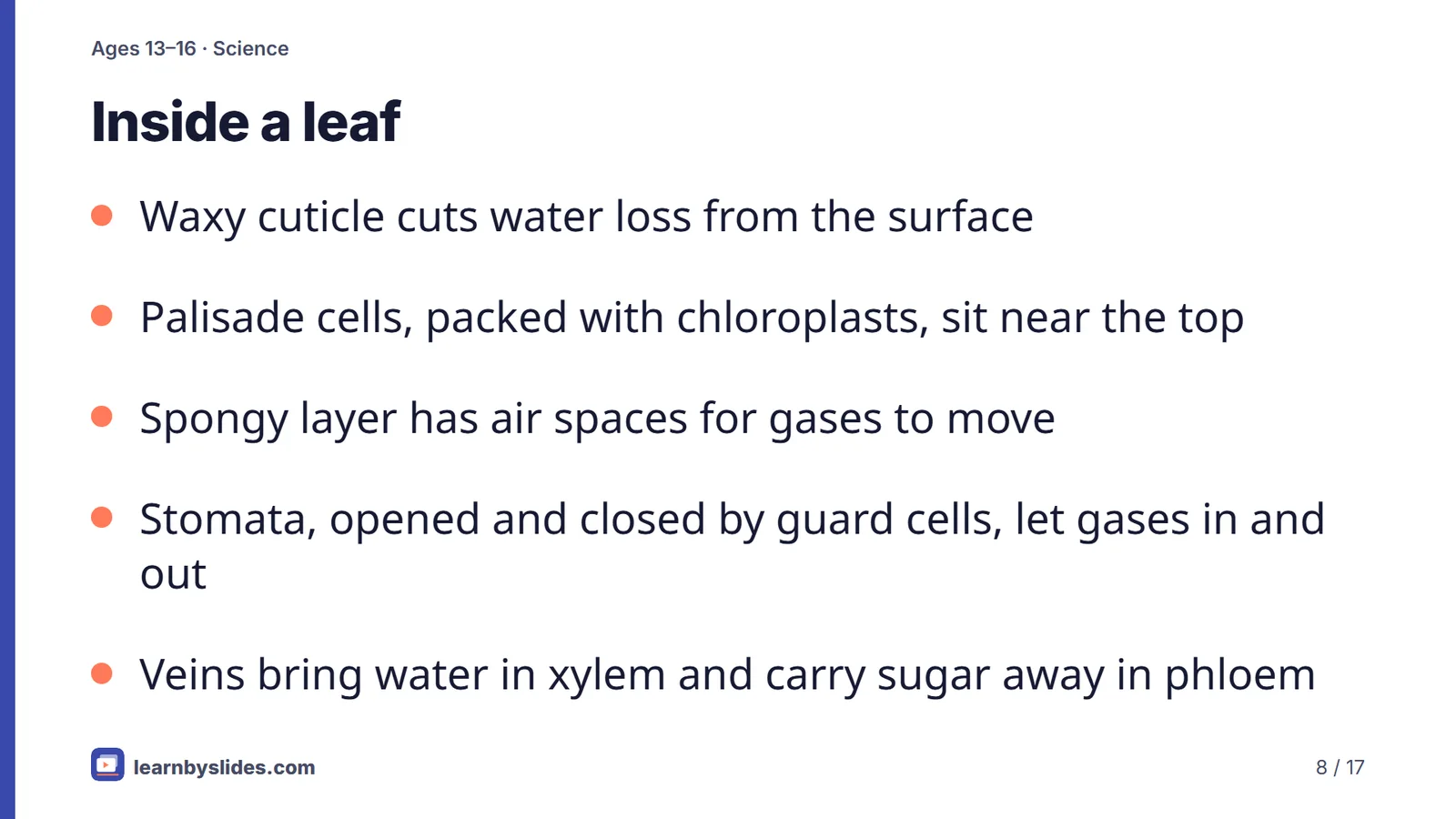
A leaf is broad and flat, which gives a large surface to catch light. A waxy cuticle reduces water loss. Just under the upper surface, column-shaped palisade cells are packed with chloroplasts, where most light arrives. Below them, the spongy layer has air spaces so gases can move between the cells and the stomata, the pores (mostly on the underside) that guard cells open and close. Veins bring water in the xylem and carry sugars away in the phloem.
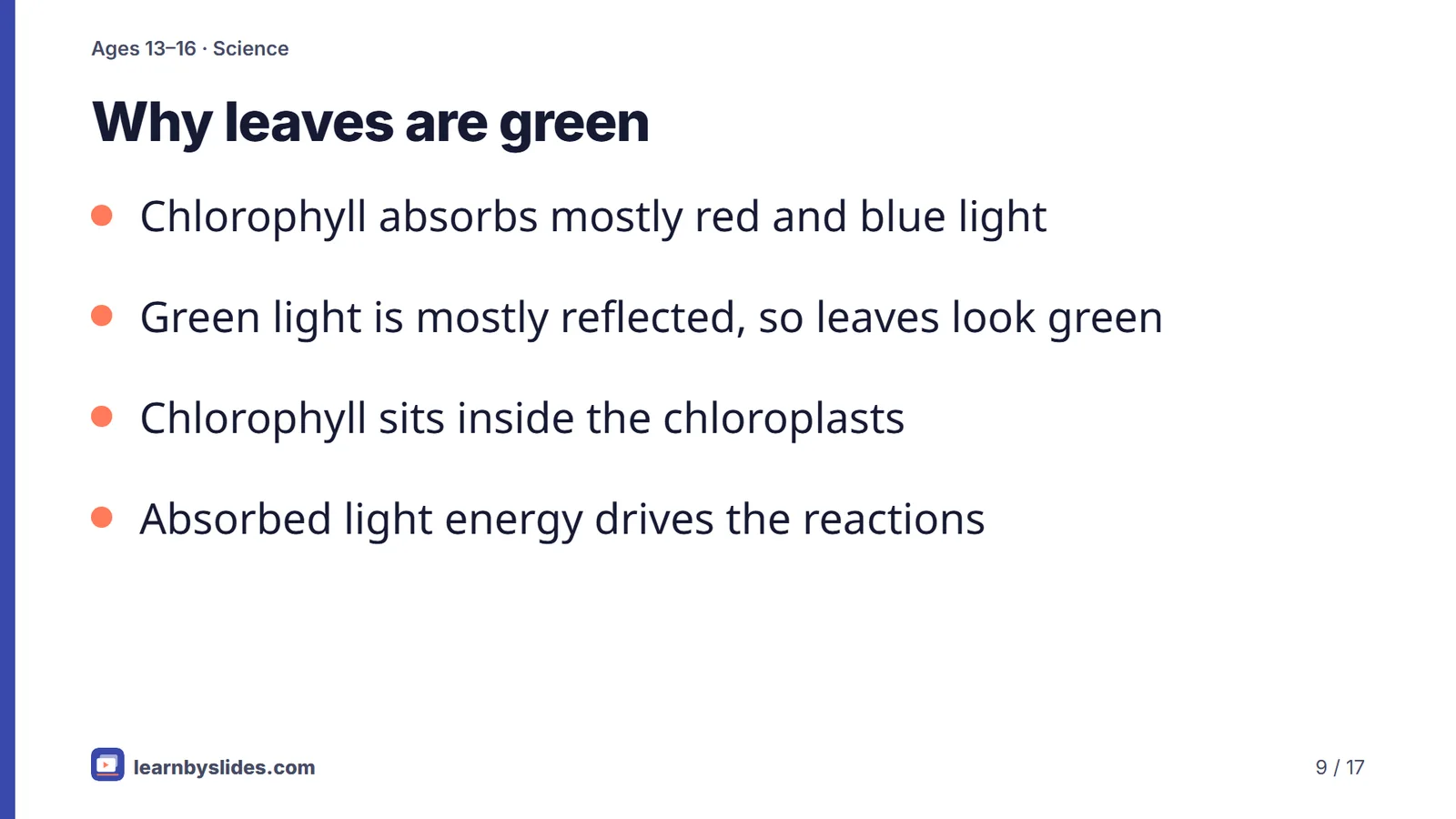
Chlorophyll absorbs mostly red and blue light and reflects green light, which is why leaves look green.
Limiting factors and what happens to the glucose
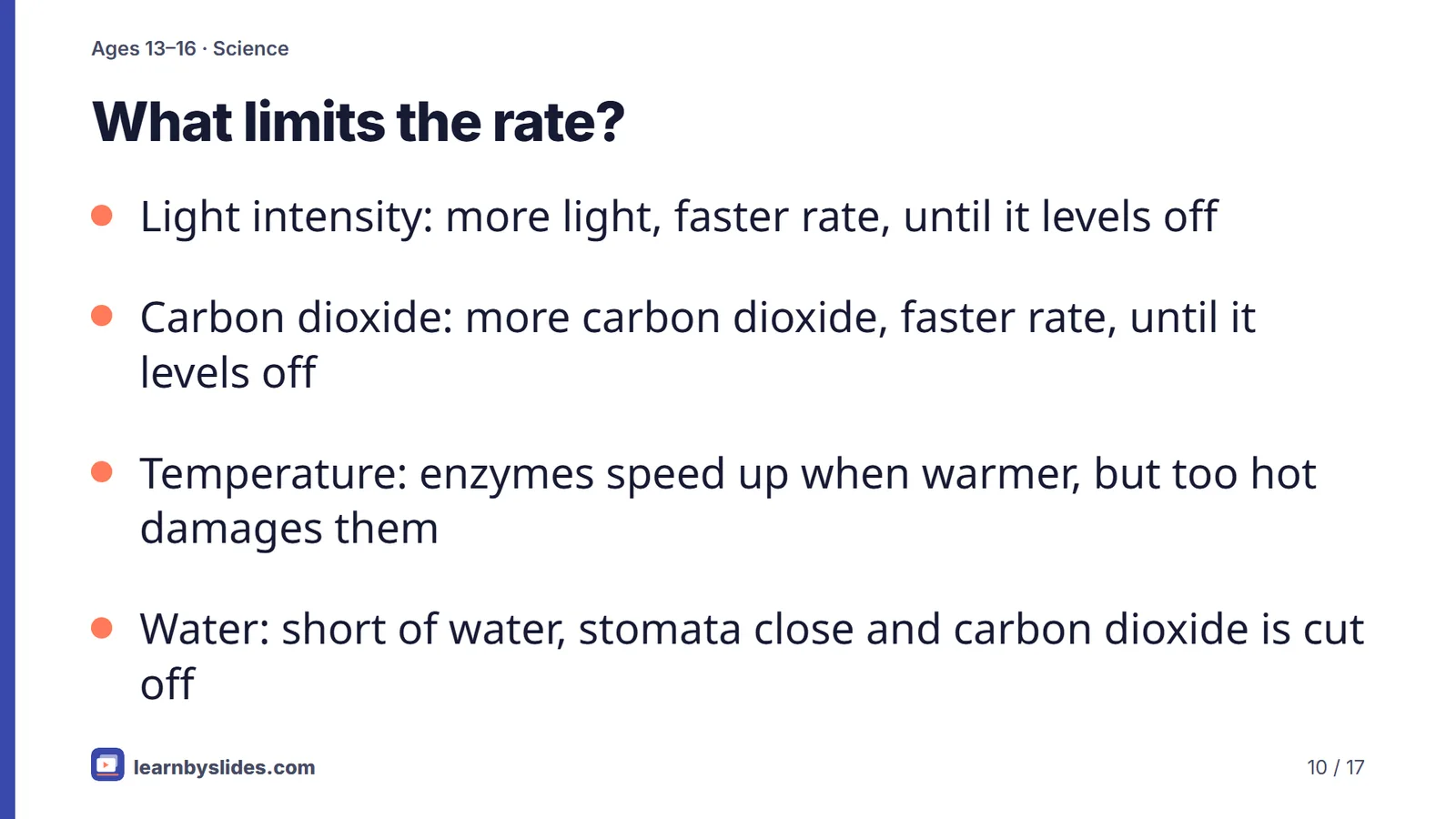
The rate of photosynthesis depends on light intensity, carbon dioxide concentration and temperature. Raising light or carbon dioxide speeds it up until another factor becomes limiting and the rate levels off. Warmth speeds up the enzymes involved, but too much heat damages them and the rate falls. Water matters too: a plant short of water closes its stomata, which also cuts off carbon dioxide.
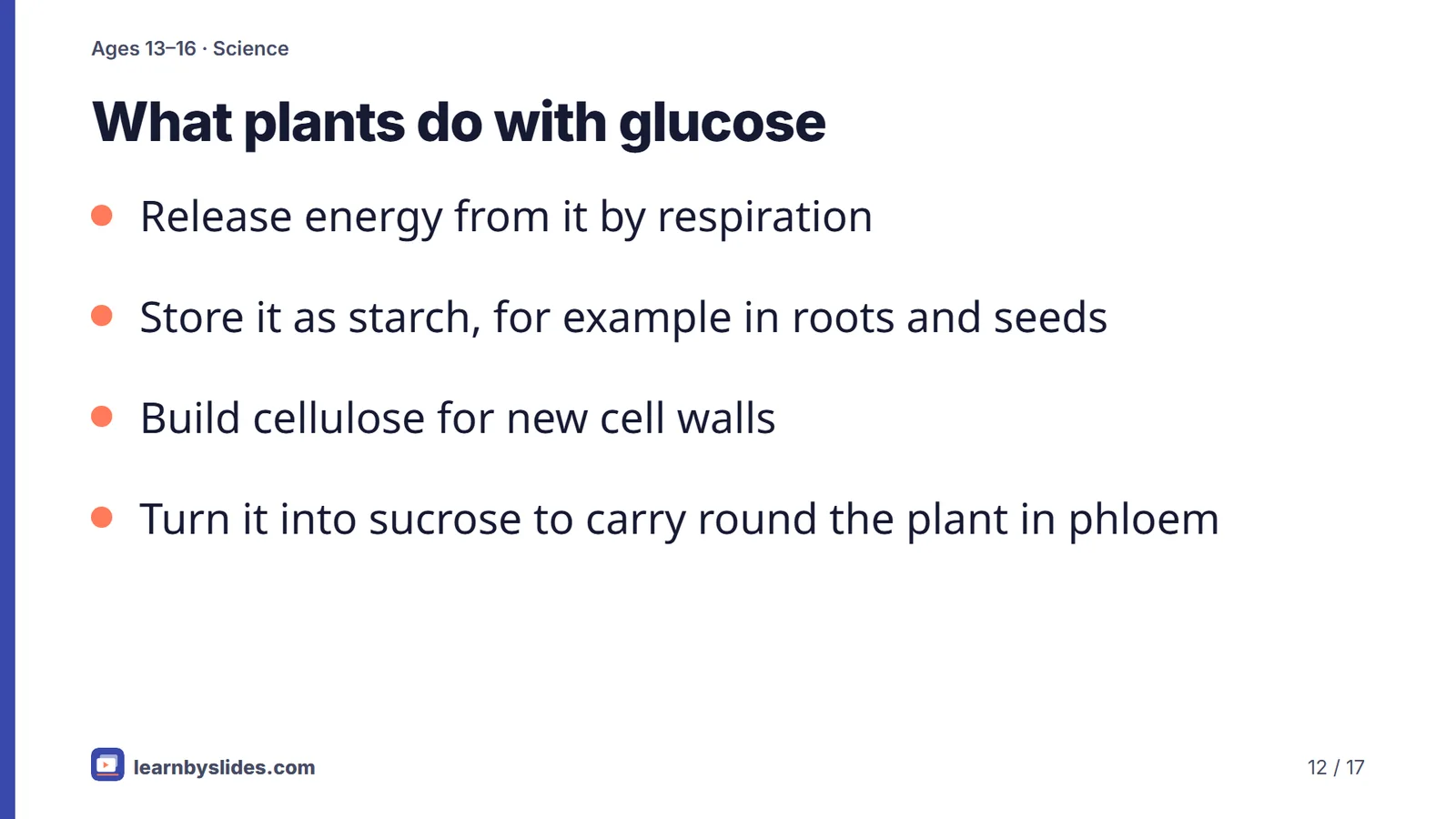
Plants use glucose in several ways. They release energy from it by respiration, which happens all the time, day and night. They store it as starch, build cellulose for cell walls and convert it to sucrose, which is carried in the phloem to roots, seeds and fruits.
How to use these slides
Present the deck with the Present button or download the free PDF for handouts. The editable PowerPoint (PPTX) opens in Google Slides, so you can add your own leaf photos or practical results. Pause at the quick-check slide, then finish with the five-question quiz on this page. The printable worksheet reuses the key terms and quiz, and the matching InfoGraphHub poster shows the process step by step.
Slide-by-slide content
1. Photosynthesis
Biology · How plants turn light into food
Speaker notes
Open with a puzzle: a seed weighing a fraction of a gram grows into a tree weighing tonnes. Where did all that mass come from? Take guesses (soil, water, sunlight, air) and write them on the board. Come back to the answers at the end of the lesson.
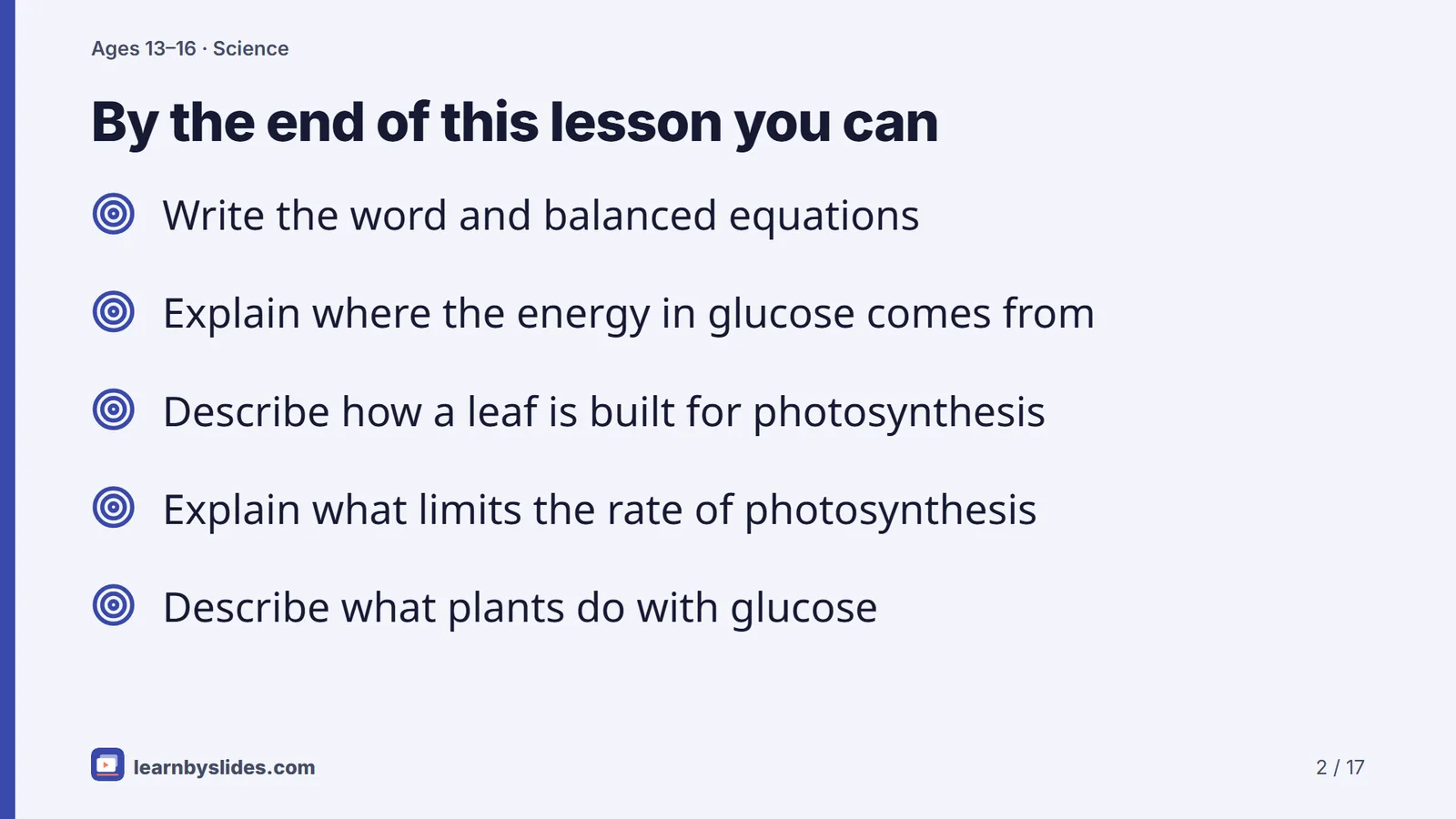
2. By the end of this lesson you can
- Write the word and balanced equations
- Explain where the energy in glucose comes from
- Describe how a leaf is built for photosynthesis
- Explain what limits the rate of photosynthesis
- Describe what plants do with glucose
Speaker notes
Read the objectives aloud. Tell students that the five-question quiz at the end checks one objective each, so they should make a note under each heading as you go.
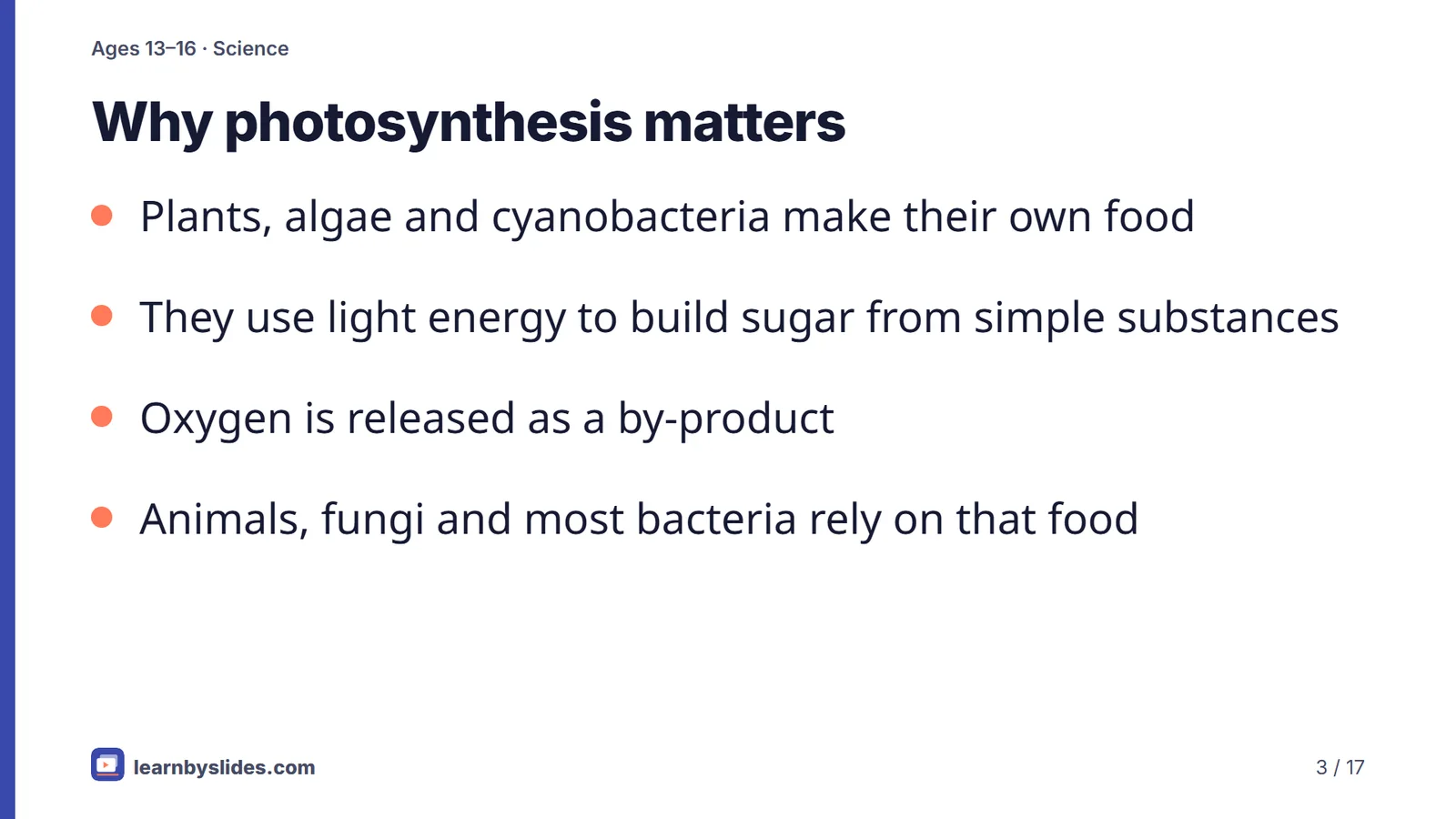
3. Why photosynthesis matters
- Plants, algae and cyanobacteria make their own food
- They use light energy to build sugar from simple substances
- Oxygen is released as a by-product
- Animals, fungi and most bacteria rely on that food
Speaker notes
Introduce the terms producer and consumer if your class has not met them. Organisms that make food using light are called photoautotrophs; organisms that must eat food made by others are heterotrophs. Every food chain students know starts with a photosynthesiser.
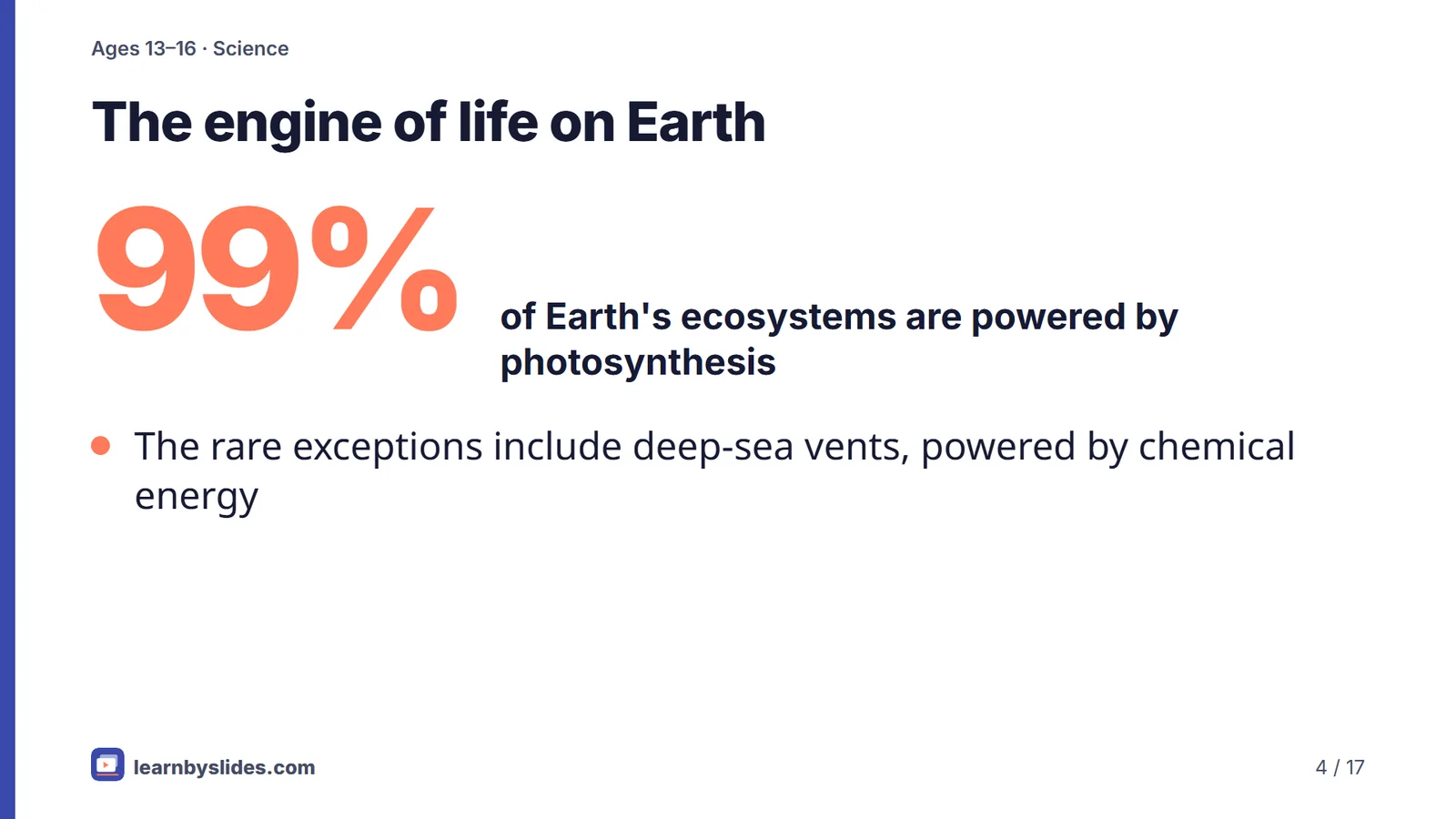
4. The engine of life on Earth
99% of Earth's ecosystems are powered by photosynthesis
- The rare exceptions include deep-sea vents, powered by chemical energy
Speaker notes
The 99 per cent figure comes from the OpenStax Biology textbook. Ask students to trace their breakfast back to a plant: milk comes from a cow that ate grass, bread comes from wheat. Every route ends at photosynthesis.
5. The word equation
- Carbon dioxide + water → glucose + oxygen
- Reactants: carbon dioxide from the air, water from the soil
- Products: glucose, a sugar, and oxygen gas
- Needs light energy, absorbed by green chlorophyll
Speaker notes
Write the equation on the board with 'light' and 'chlorophyll' above the arrow. Stress that light is not a reactant: it is the energy source. Energy is taken in from light and stored as chemical energy in glucose, which is why the plant can later release it by respiration.
6. The balanced symbol equation
- 6CO₂ + 6H₂O → C₆H₁₂O₆ + 6O₂
- Six carbon dioxide and six water molecules in
- One glucose and six oxygen molecules out
- Count the atoms: 6 C, 12 H and 18 O on each side
Speaker notes
For younger or less confident groups, the word equation may be enough; this slide is for students working towards GCSE or IGCSE level. Ask students to check the atom count themselves. Carbon: 6 on each side. Hydrogen: 12 on each side. Oxygen: 12 + 6 = 18 on the left, 6 + 12 = 18 on the right.
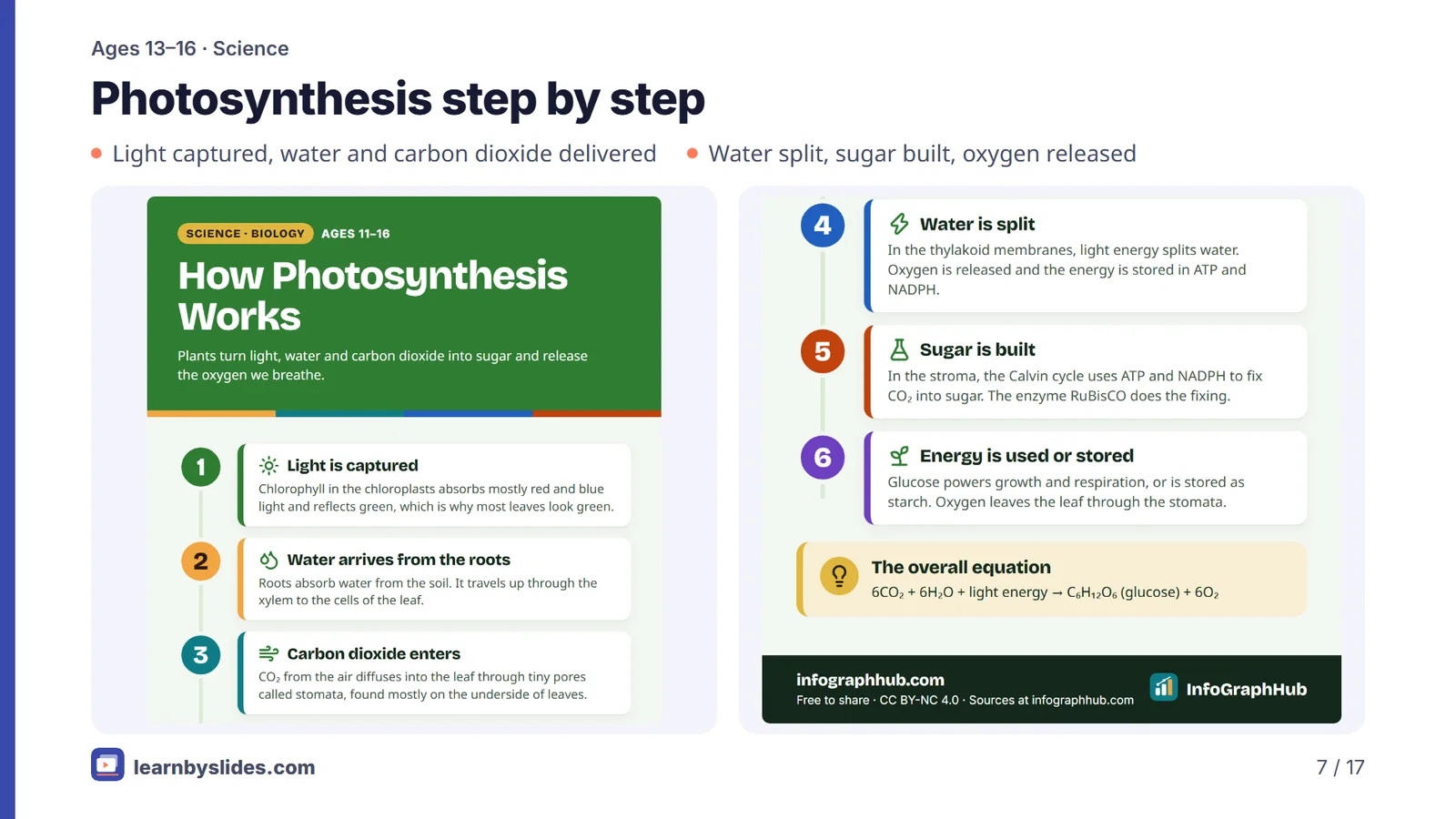
7. Photosynthesis step by step
- Light captured, water and carbon dioxide delivered
- Water split, sugar built, oxygen released
Speaker notes
Walk through the poster from top to bottom. Older students can follow the two stages; younger students only need the inputs and outputs. Point out that the oxygen released comes from the water molecules, not from the carbon dioxide.
8. Inside a leaf
- Waxy cuticle cuts water loss from the surface
- Palisade cells, packed with chloroplasts, sit near the top
- Spongy layer has air spaces for gases to move
- Stomata, opened and closed by guard cells, let gases in and out
- Veins bring water in xylem and carry sugar away in phloem
Speaker notes
Sketch a leaf cross-section on the board as you go, or project a microscope image. Ask: why are palisade cells at the top? (That is where the most light arrives.) Why are most stomata on the underside? (It helps reduce water loss.) A broad, flat leaf gives a large surface to catch light.
9. Why leaves are green
- Chlorophyll absorbs mostly red and blue light
- Green light is mostly reflected, so leaves look green
- Chlorophyll sits inside the chloroplasts
- Absorbed light energy drives the reactions
Speaker notes
A common wrong answer is that plants use green light most. Ask: if leaves reflect green light into our eyes, can they be using much of it? Link back to the chloroplasts in the cells lesson.
10. What limits the rate?
- Light intensity: more light, faster rate, until it levels off
- Carbon dioxide: more carbon dioxide, faster rate, until it levels off
- Temperature: enzymes speed up when warmer, but too hot damages them
- Water: short of water, stomata close and carbon dioxide is cut off
Speaker notes
Define a limiting factor: whichever factor is in shortest supply holds the rate back, so raising another factor makes no difference. Sketch the graphs: light and carbon dioxide rise and then plateau; temperature rises to an optimum and then falls steeply as enzymes are damaged.
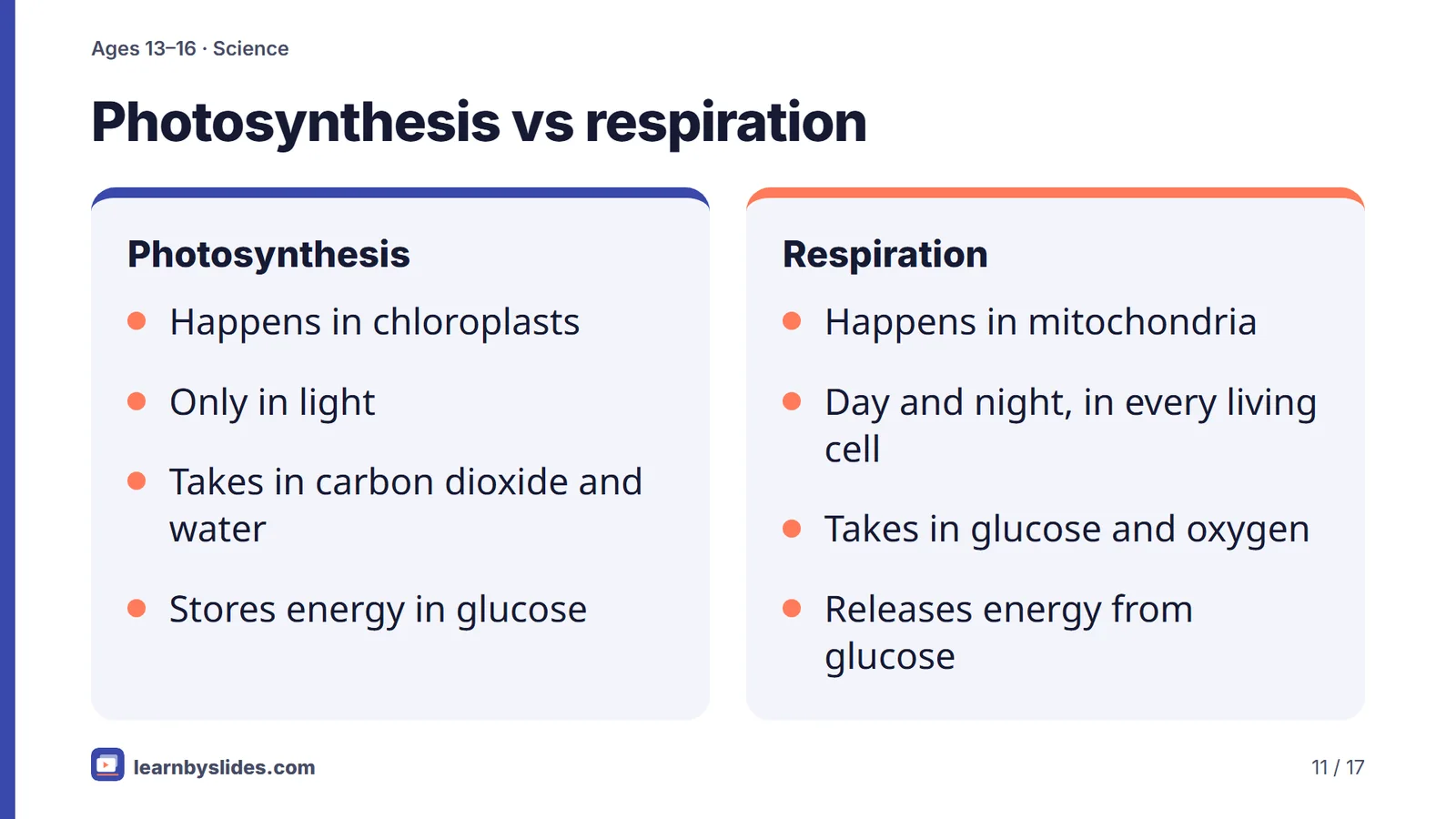
11. Photosynthesis vs respiration
Photosynthesis
- Happens in chloroplasts
- Only in light
- Takes in carbon dioxide and water
- Stores energy in glucose
Respiration
- Happens in mitochondria
- Day and night, in every living cell
- Takes in glucose and oxygen
- Releases energy from glucose
Speaker notes
This is the most important comparison in the lesson. Plants do both: in bright light they photosynthesise faster than they respire, so overall they take in carbon dioxide; in the dark they only respire. The products of one process are the reactants of the other.
12. What plants do with glucose
- Release energy from it by respiration
- Store it as starch, for example in roots and seeds
- Build cellulose for new cell walls
- Turn it into sucrose to carry round the plant in phloem
Speaker notes
Plants turn spare glucose into starch for storage, for example in roots and seeds, and build cellulose from glucose for cell walls. Sucrose is the main sugar moved from leaves to roots, seeds and fruits. Ask students which of these uses they have eaten today: potatoes and rice are starch stores.
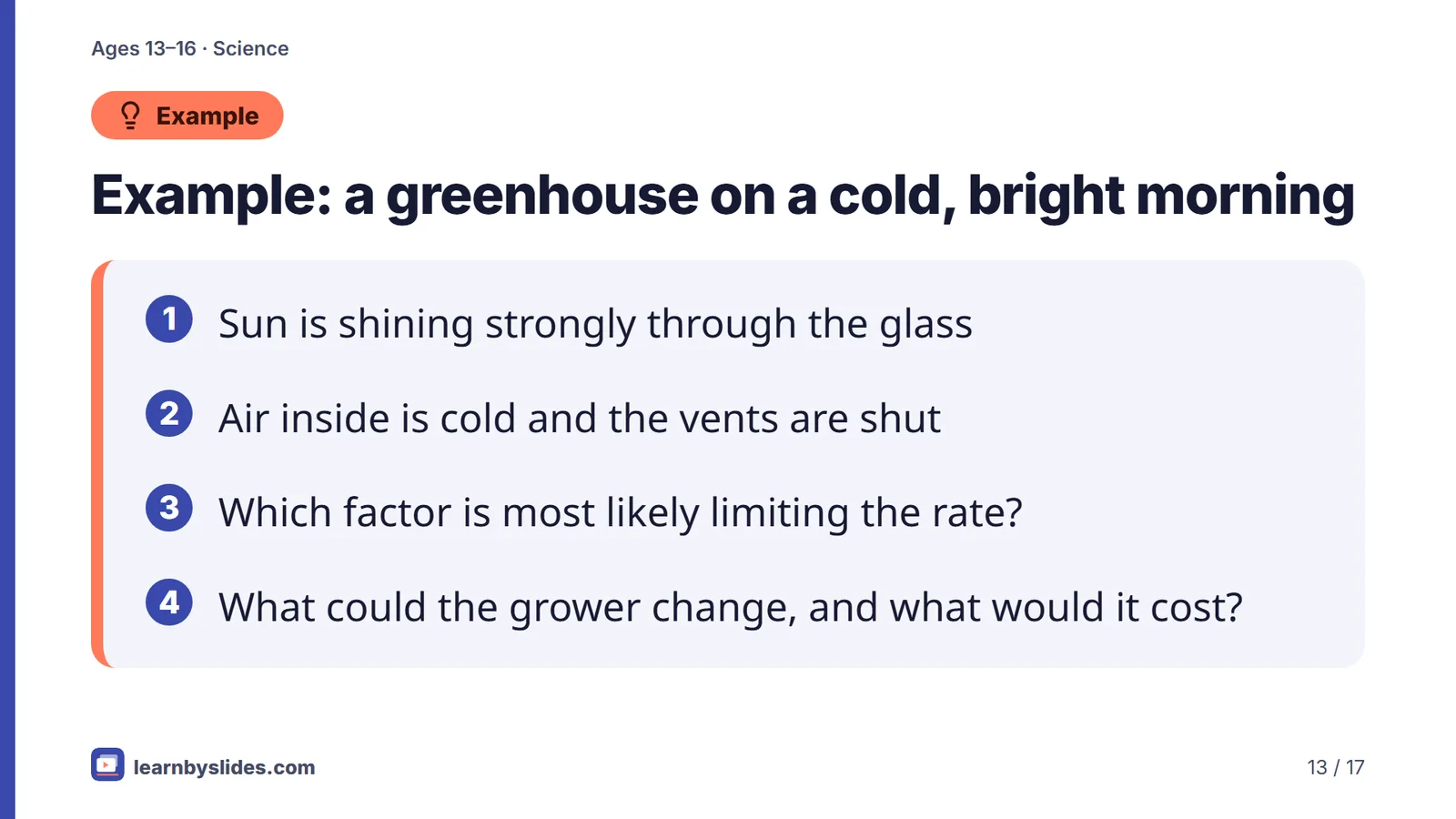
13. Example: a greenhouse on a cold, bright morning
- Sun is shining strongly through the glass
- Air inside is cold and the vents are shut
- Which factor is most likely limiting the rate?
- What could the grower change, and what would it cost?
Speaker notes
Give students two minutes in pairs. With bright light, temperature is the most likely limiting factor in the early morning, so warming the greenhouse would help most. Later in the day, with vents shut, carbon dioxide may become limiting instead. Discuss the trade-off: heating costs money, so growers only pay to raise the factor that is actually limiting.
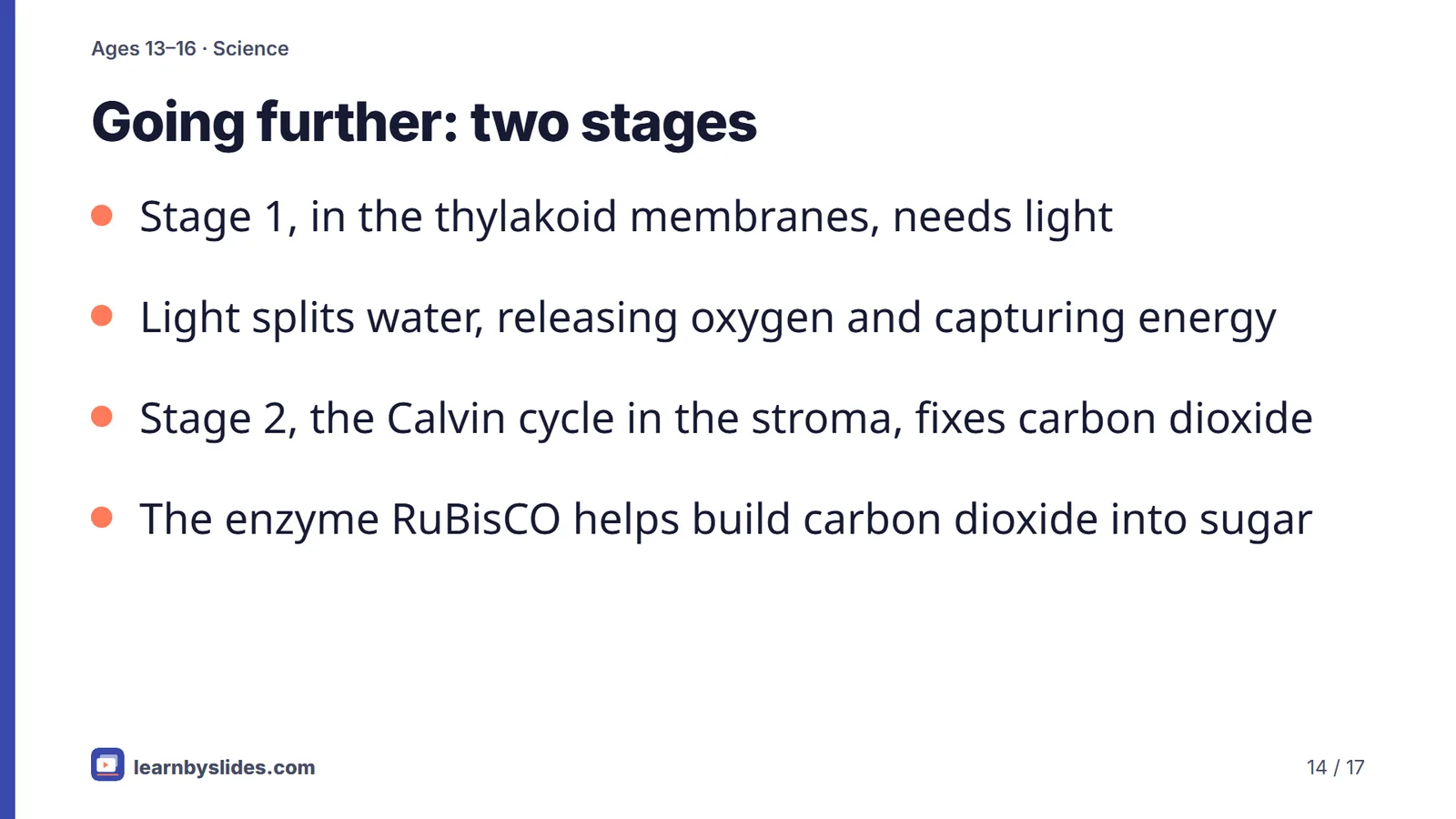
14. Going further: two stages
- Stage 1, in the thylakoid membranes, needs light
- Light splits water, releasing oxygen and capturing energy
- Stage 2, the Calvin cycle in the stroma, fixes carbon dioxide
- The enzyme RuBisCO helps build carbon dioxide into sugar
Speaker notes
This slide is extension for ages 15–16 or for fast finishers; skip it with younger groups. Stage 2 does not use light directly but depends on the energy carriers ATP and NADPH made in stage 1, so it soon stops in the dark.
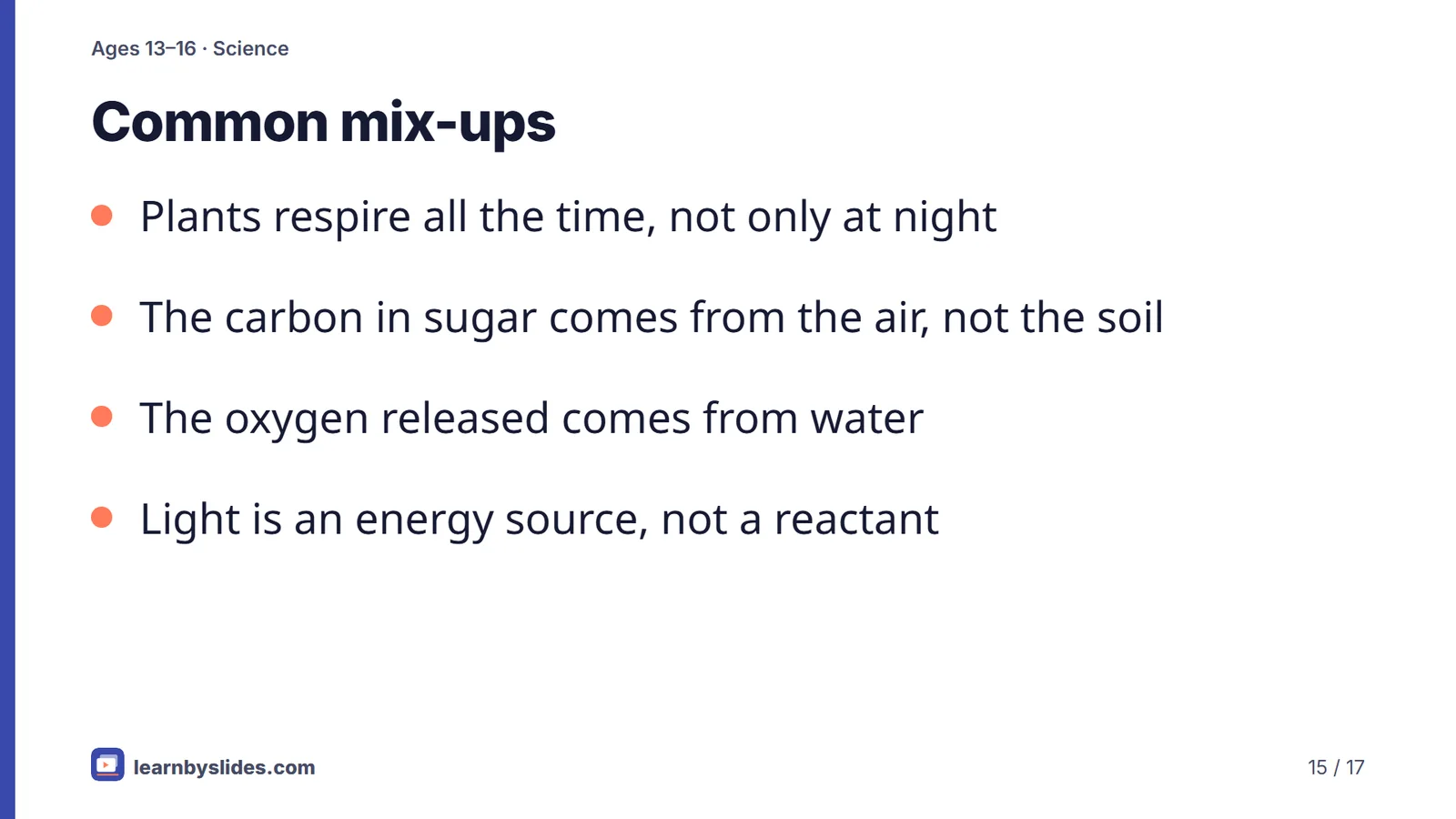
15. Common mix-ups
- Plants respire all the time, not only at night
- The carbon in sugar comes from the air, not the soil
- The oxygen released comes from water
- Light is an energy source, not a reactant
Speaker notes
Return to the opening puzzle: the carbon in a tree's wood and leaves comes from carbon dioxide taken in from the air. Soil supplies water and minerals, not food. Ask students to vote true or false on each statement before you reveal it.
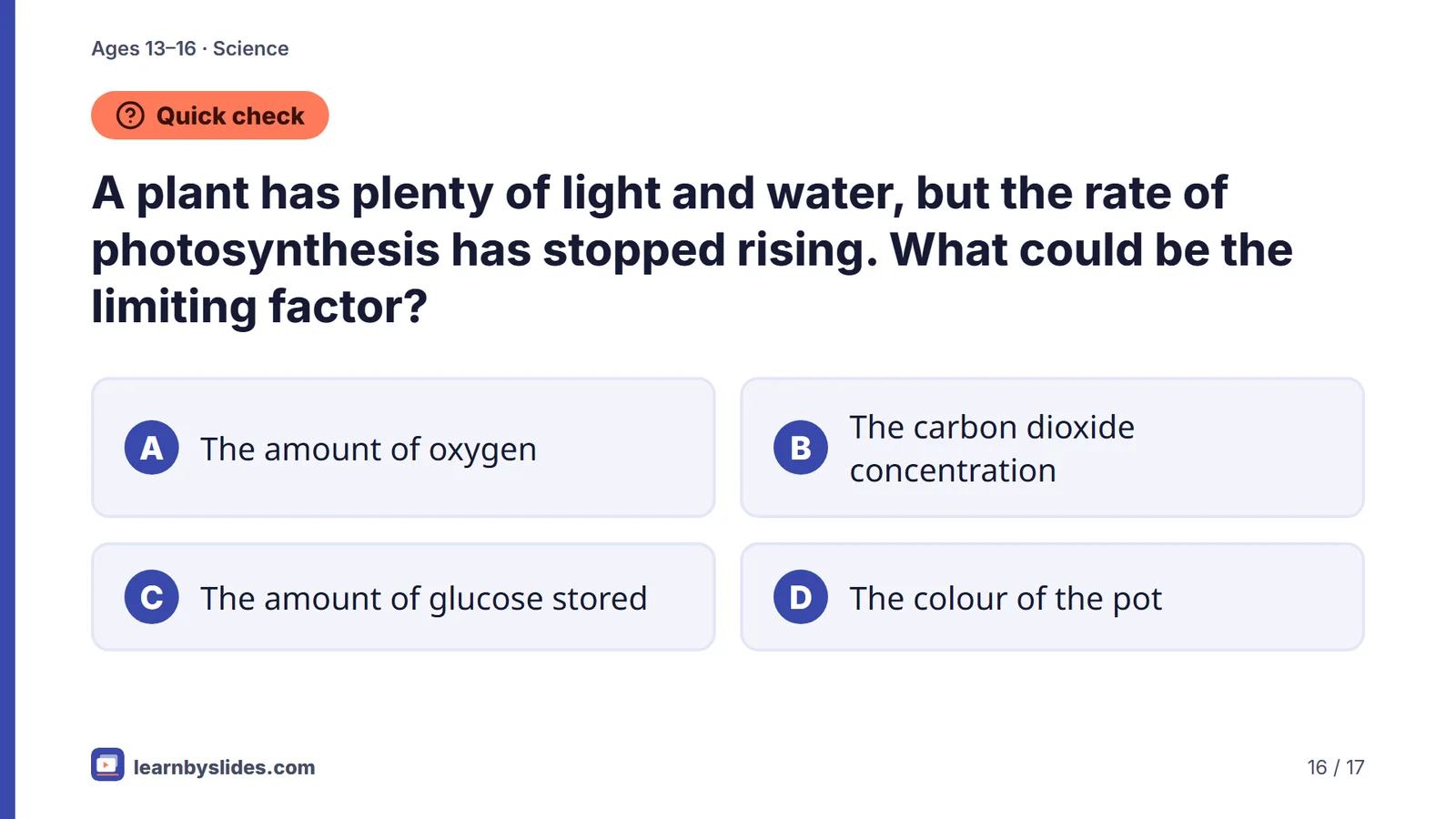
16. Quick check
A plant has plenty of light and water, but the rate of photosynthesis has stopped rising. What could be the limiting factor?
- The amount of oxygen
- The carbon dioxide concentration
- The amount of glucose stored
- The colour of the pot
Speaker notes
Answer: carbon dioxide concentration (temperature would also be a fair answer if it were offered). Oxygen is a product, not a reactant, so adding it does not speed photosynthesis up.
17. Key takeaways
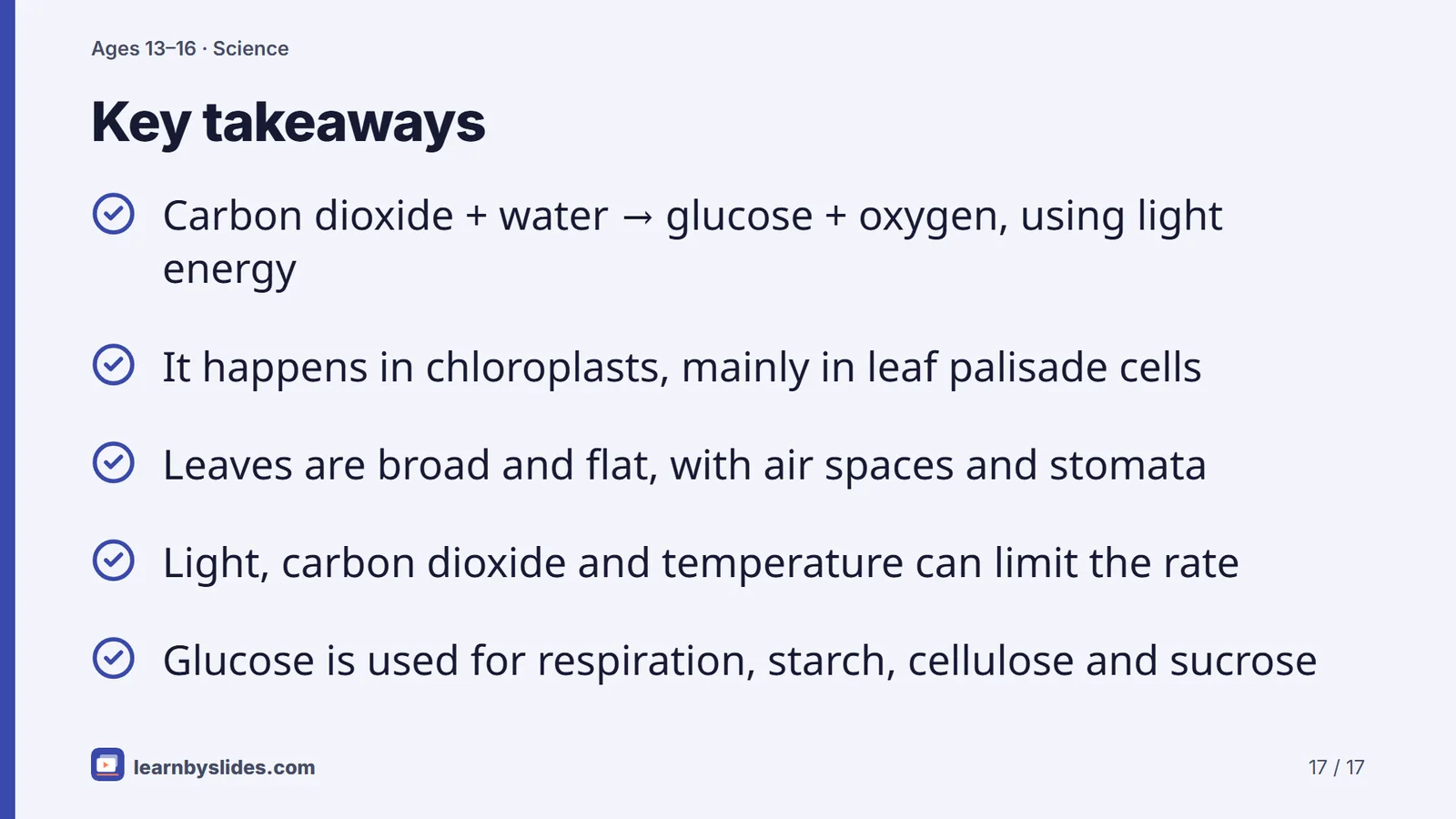
- Carbon dioxide + water → glucose + oxygen, using light energy
- It happens in chloroplasts, mainly in leaf palisade cells
- Leaves are broad and flat, with air spaces and stomata
- Light, carbon dioxide and temperature can limit the rate
- Glucose is used for respiration, starch, cellulose and sucrose
Speaker notes
Go back to the guesses from the opening puzzle and ask students to correct them. Then move to the five-question quiz on the page. Homework idea: draw and annotate a leaf cross-section, explaining how each part helps photosynthesis.
Key terms
- Photosynthesis
- The process in which plants and algae use light energy to make glucose and oxygen from carbon dioxide and water.
- Chlorophyll
- The green pigment in chloroplasts that absorbs light energy, mostly red and blue light.
- Chloroplast
- The structure in plant cells where photosynthesis happens.
- Stomata
- Tiny pores, mostly on the underside of a leaf, that let carbon dioxide in and oxygen and water vapour out; each is opened and closed by two guard cells.
- Palisade cells
- Column-shaped, tightly packed cells near the top of a leaf that contain many chloroplasts.
- Limiting factor
- The factor in shortest supply, which holds back the rate of a process even if other factors are increased.
- Starch
- A carbohydrate that plants make from glucose to store energy, for example in roots and seeds.
- Respiration
- The process in every living cell that releases energy from glucose.
Quick quiz
Teacher notes
Suggested 45-minute plan: 5 min opener (where does a tree's mass come from?), 10 min on why it matters and the equations (slides 3–7), 10 min on leaf structure and chlorophyll (slides 8–9), 10 min on limiting factors, the comparison with respiration and uses of glucose (slides 10–12), 5 min greenhouse example and quick check, 5 min quiz and homework. Slide 14 (two stages) is extension for ages 15–16. Common misconceptions: plants get their food from the soil (soil supplies water and minerals; the carbon comes from the air); plants respire only at night (they respire all the time); light is a reactant (it is the energy source); the oxygen comes from carbon dioxide (it comes from water). Extension: ask students to sketch and explain the shape of a graph of rate against temperature, or to plan a fair test of light intensity on the rate of photosynthesis in pondweed, counting bubbles, using your school's risk assessment.
Frequently asked questions
Which curricula does this lesson fit?
It covers the photosynthesis content taught at ages 13–16 in most English-medium biology courses, including GCSE and IGCSE, with the two-stage detail marked as extension. The curriculum chips at the top of the page list each matching code. Always check against the syllabus your school follows.
Do plants respire as well as photosynthesise?
Yes. Plants respire all the time, in every living cell, to release energy from glucose. In bright light they photosynthesise faster than they respire, so overall they take in carbon dioxide and give out oxygen. In the dark they only respire.
What is a limiting factor?
It is the factor in shortest supply, which holds back the rate of photosynthesis. For example, on a dull day light intensity is limiting, so adding more carbon dioxide makes little difference until there is more light.
Is this lesson suitable for younger students?
Yes, with ages 13–14 you can skip the balanced equation and the two-stages extension slide and focus on the word equation, leaf structure and limiting factors.
Can I edit these slides in Google Slides or PowerPoint?
Yes. Download the PPTX file and open it in PowerPoint, or upload it to Google Drive to edit it in Google Slides. Speaker notes and text boxes stay editable.
Sources & methodology
Every fact is checked against the sources below. We write original explanations and draw original graphics; no figures are copied from textbooks. Spotted an error? See our corrections policy.
- Biology 2e, 8.1 Overview of Photosynthesis (OpenStax (Rice University), accessed 1 Oct 2026)
- Biology 2e, 8.2 The Light-Dependent Reactions of Photosynthesis (OpenStax (Rice University), accessed 1 Oct 2026)
- Biology 2e, 8.3 Using Light Energy to Make Organic Molecules (OpenStax (Rice University), accessed 1 Oct 2026)
- Biology 2e, 30.4 Leaves (OpenStax (Rice University), accessed 1 Oct 2026)
- Biology 2e, 3.2 Carbohydrates (starch and cellulose) (OpenStax (Rice University), accessed 1 Oct 2026)
- Biology 2e, 30.5 Transport of Water and Solutes in Plants (sucrose translocation) (OpenStax (Rice University), accessed 1 Oct 2026)
- Factors affecting photosynthesis (Monash University, accessed 1 Oct 2026)
Editorial review pending · Updated
Related lessons
 Science · Ages 12–15
Acids, Bases and the pH Scale Lesson Slides
A ready-to-teach chemistry lesson for ages 12–15 on acids, bases and alkalis: the pH scale, litmus and universal indicator, everyday examples, neutralisation and how to name salts, with a safe indicator practical.
 Science · Ages 12–15
Electric Circuits: Current, Voltage & Resistance Lesson Slides
A ready-to-teach physics lesson for ages 12–15 on electric circuits: current, potential difference (voltage), resistance and Ohm's law, how to use ammeters and voltmeters, and the rules for series and parallel circuits.
 Science · Ages 12–15
Forces and Newton's Laws of Motion Lesson Slides
A ready-to-teach physics lesson for ages 12–15 on forces: contact and non-contact forces, resultant force, balanced and unbalanced forces, mass and weight, and Newton's three laws of motion, with F = ma worked examples.
 Science · Ages 14–15
Motion: Speed, Velocity, Acceleration & Graphs Lesson Slides
A ready-to-teach physics lesson for ages 14–15 on motion in a straight line: distance and displacement, speed, velocity, acceleration, position–time and velocity–time graphs, the equations of motion and uniform circular motion.
 Science · Ages 15–16
Life Processes: Nutrition, Respiration, Transport & Excretion Slides
A ready-to-teach biology lesson for ages 15–16 on the four life processes: nutrition, respiration, transport and excretion. Original diagrams, speaker notes on every slide, a 5-question quiz and a printable worksheet.
 Science · Ages 11–14
Plant and Animal Cells: Structure and Function Lesson Slides
A ready-to-teach lesson for ages 11–14 on plant and animal cells: the parts they share, the three extra parts plant cells have, and what each part does. Speaker notes on every slide, a microscope example, a 5-question quiz and a worksheet.
For teachers and parents: new LearnBySlides resources by email
One short email when new free resources go live. For adults (18+) only. No spam, no tracking in emails, unsubscribe anytime.