Forces and Newton's Laws of Motion Lesson Slides
A ready-to-teach physics lesson for ages 12–15 on forces: contact and non-contact forces, resultant force, balanced and unbalanced forces, mass and weight, and Newton's three laws of motion, with F = ma worked examples.
Ages 12–15 · Grades 7–9 (US) · Years 8–10 (UK) · Classes 7–9 (India)
- England KS3 Years 7–9
- NGSS MS-PS2-2
- NGSS MS-PS2-1
- Australian Curriculum v9 AC9S7U04
- Australian Curriculum v9 AC9S10U05
- AQA GCSE 4.5.6.2
- AQA GCSE 6.5.4.2
- Cambridge IGCSE 0625 1.5.1
- CBSE Unit III
NGSS is a registered trademark of WestEd. Cambridge and IGCSE are trademarks of Cambridge University Press & Assessment. Names and codes are used only to describe curriculum fit; LearnBySlides is not endorsed by these organisations.
15 slides · 45 min lesson · 5-question quiz · speaker notes
Learning objectives
- Describe a force as a push or a pull, measured in newtons, and classify forces as contact or non-contact.
- Find the resultant force on an object and decide whether the forces on it are balanced or unbalanced.
- State Newton's three laws of motion and use each one to explain an everyday situation.
- Use F = ma and W = mg to calculate force, mass, acceleration and weight in SI units.
- Explain why the two forces in a third-law pair never cancel each other out.
What this lesson covers
This deck teaches students aged 12–15 what forces are and how they change motion, in one 45-minute physics lesson. It starts with pushes and pulls, contact and non-contact forces and the idea of a resultant force, then works through Newton's three laws of motion with everyday examples and two short calculations. Every slide has speaker notes, and the lesson ends with a quick check and a five-question quiz.
Forces and resultant force
A force is a push or a pull. It has a size and a direction, so we draw it as an arrow, and we measure it in newtons (N) with a newton meter. Contact forces, such as friction, air resistance, tension and the normal force from a surface, act only when objects touch. Non-contact forces, such as gravity, magnetism and electrostatic forces, act across a gap.
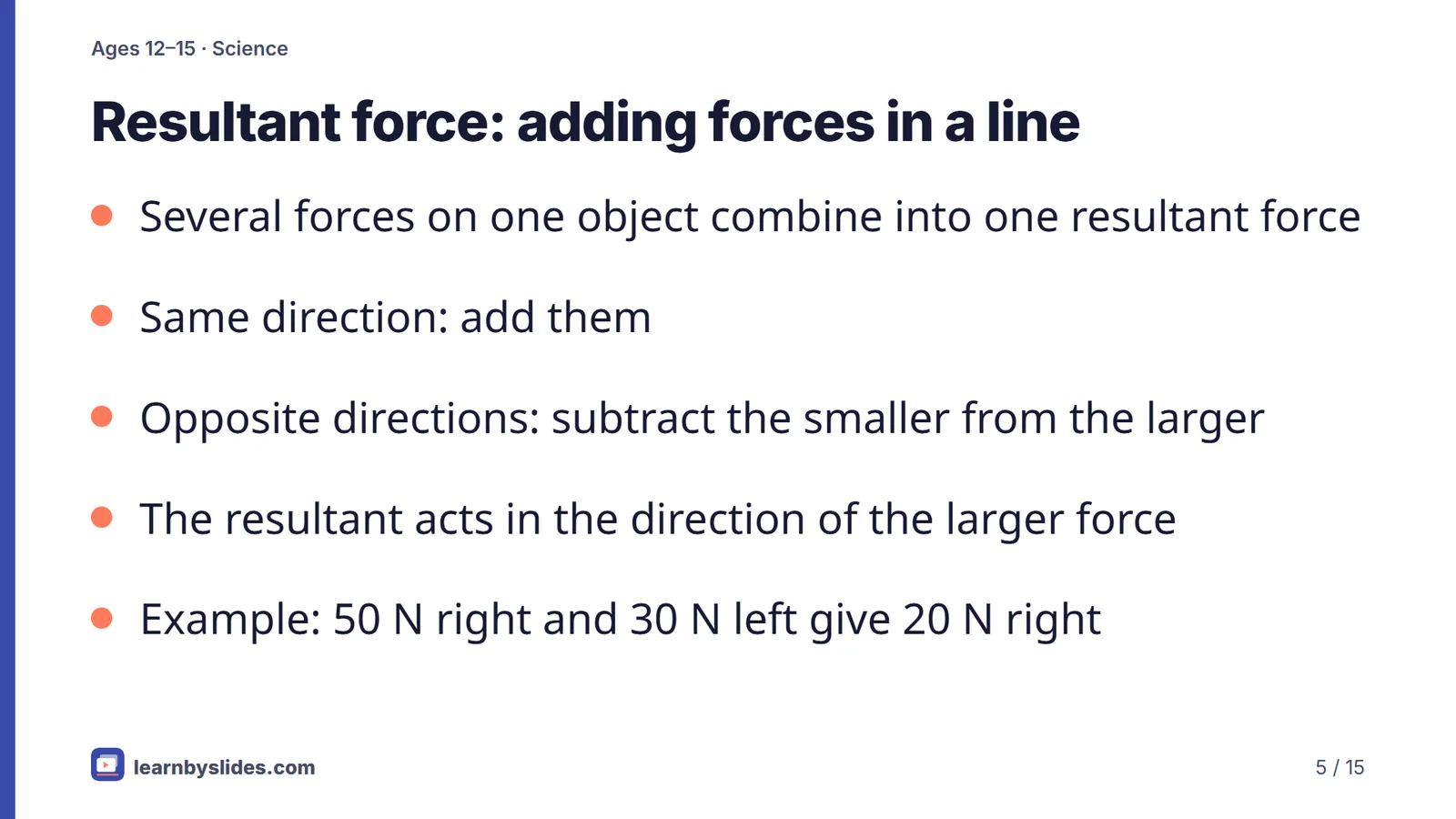
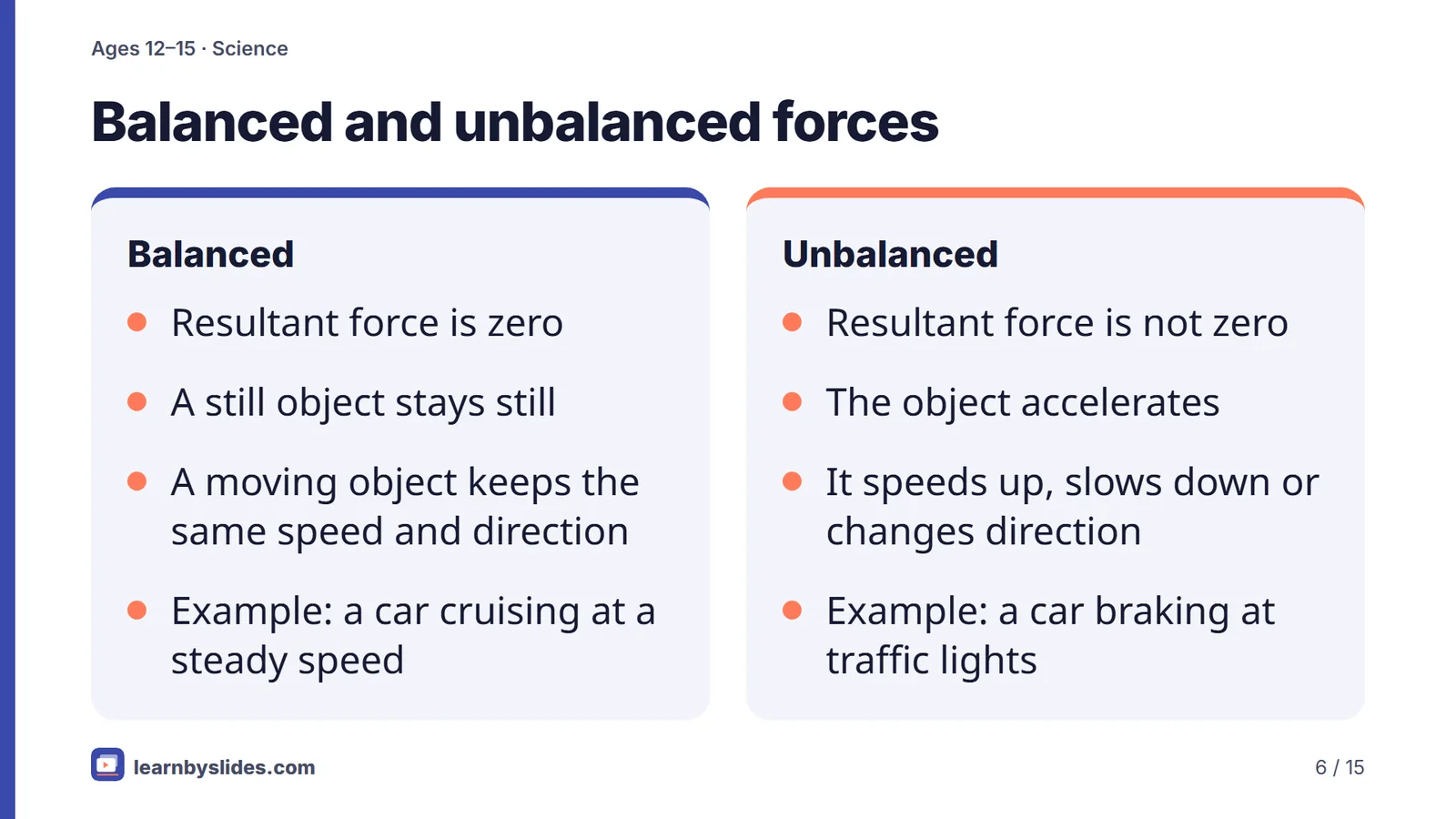
When several forces act on one object along a line, they combine into one resultant force. Forces in the same direction add; forces in opposite directions subtract. If the resultant is zero, the forces are balanced; if not, they are unbalanced.
Newton's first law
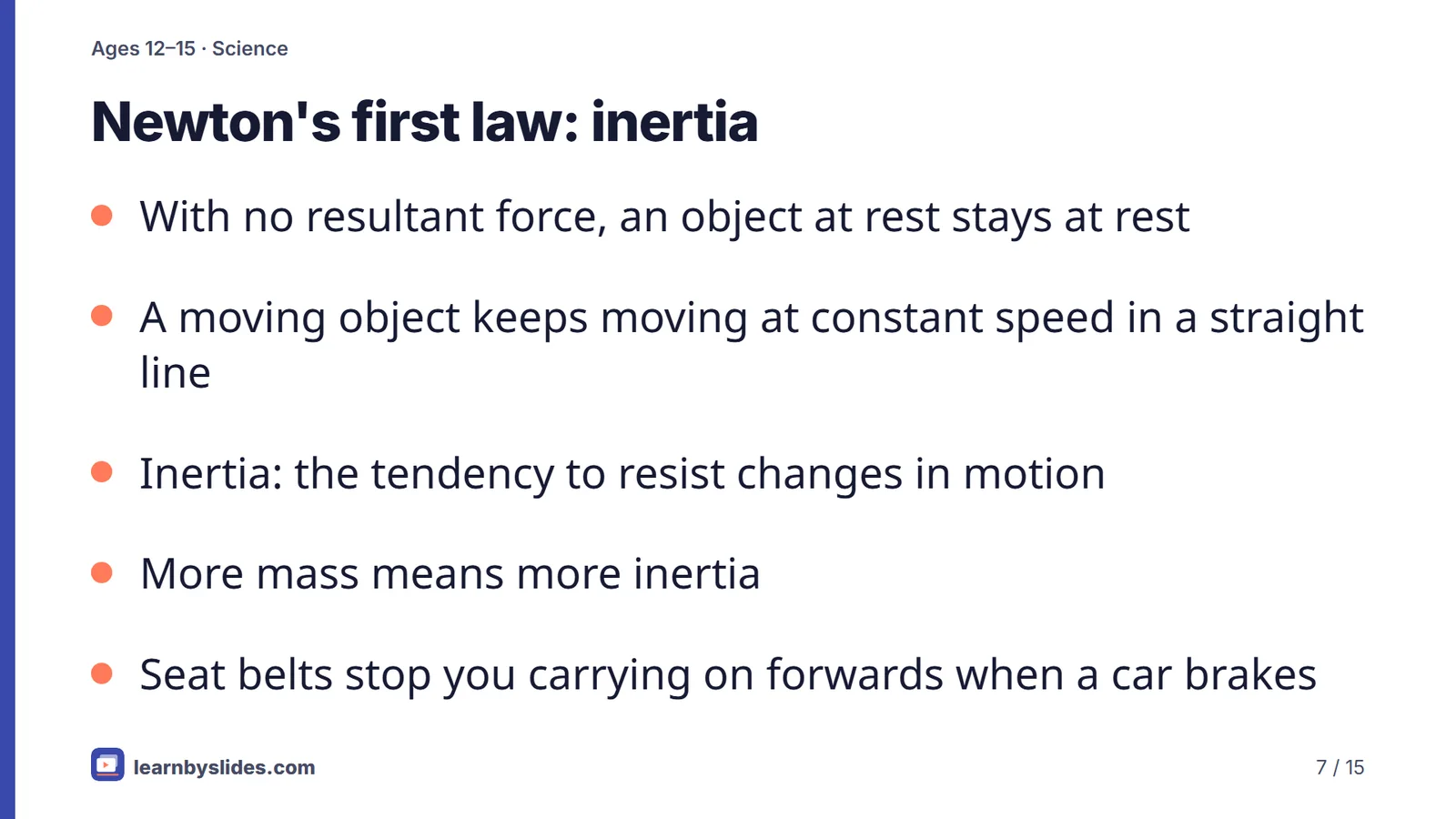
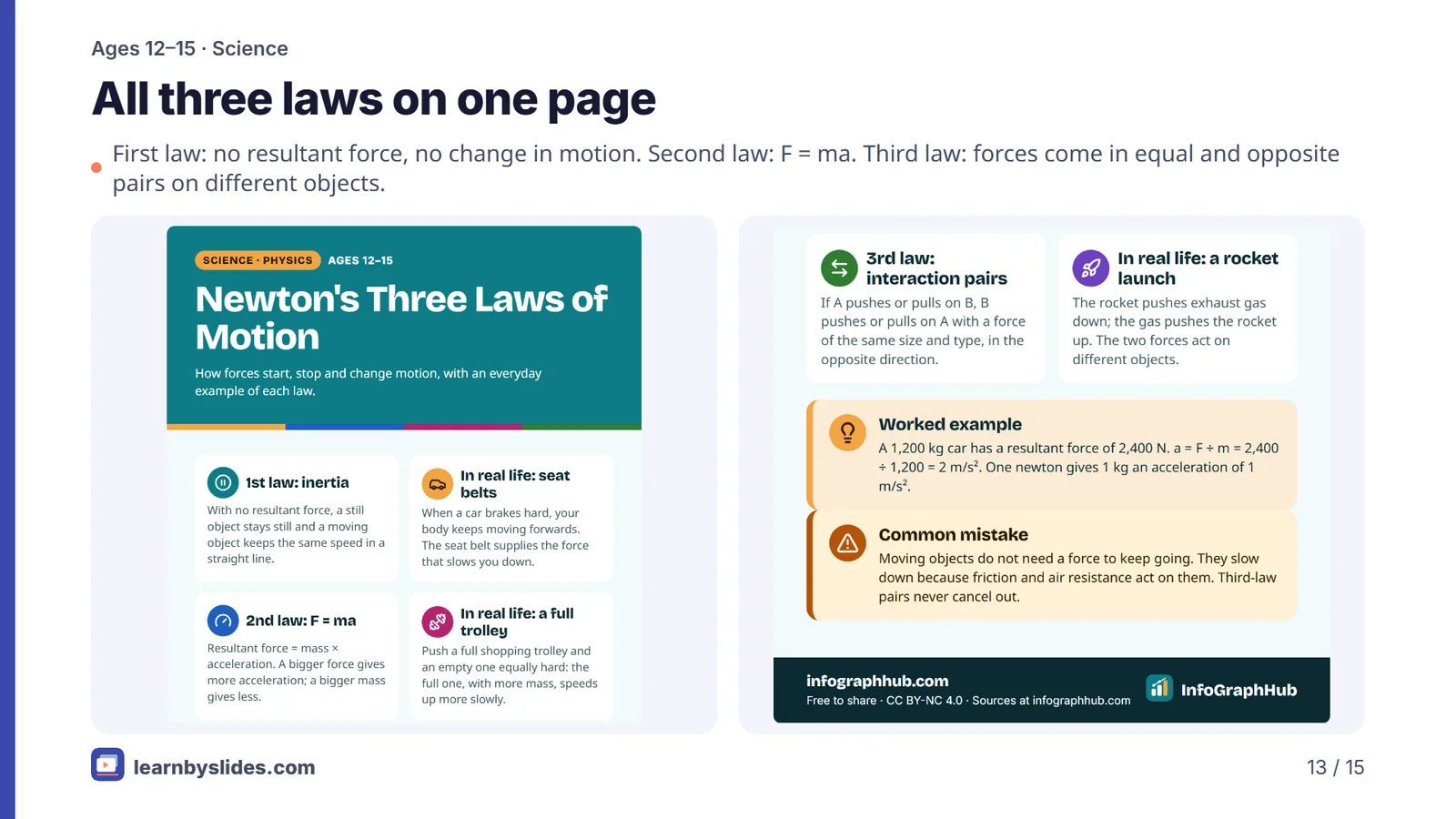
If the resultant force on an object is zero, a still object stays still and a moving object keeps moving at the same speed in a straight line. This tendency to resist a change in motion is called inertia, and objects with more mass have more inertia.
The first law corrects a very common idea: that a moving object needs a force to keep it going. A book sliding across a desk stops because friction acts on it, not because its force runs out. A car cruising at a steady speed has balanced forces: the driving force exactly matches friction and air resistance.
Newton's second law and weight
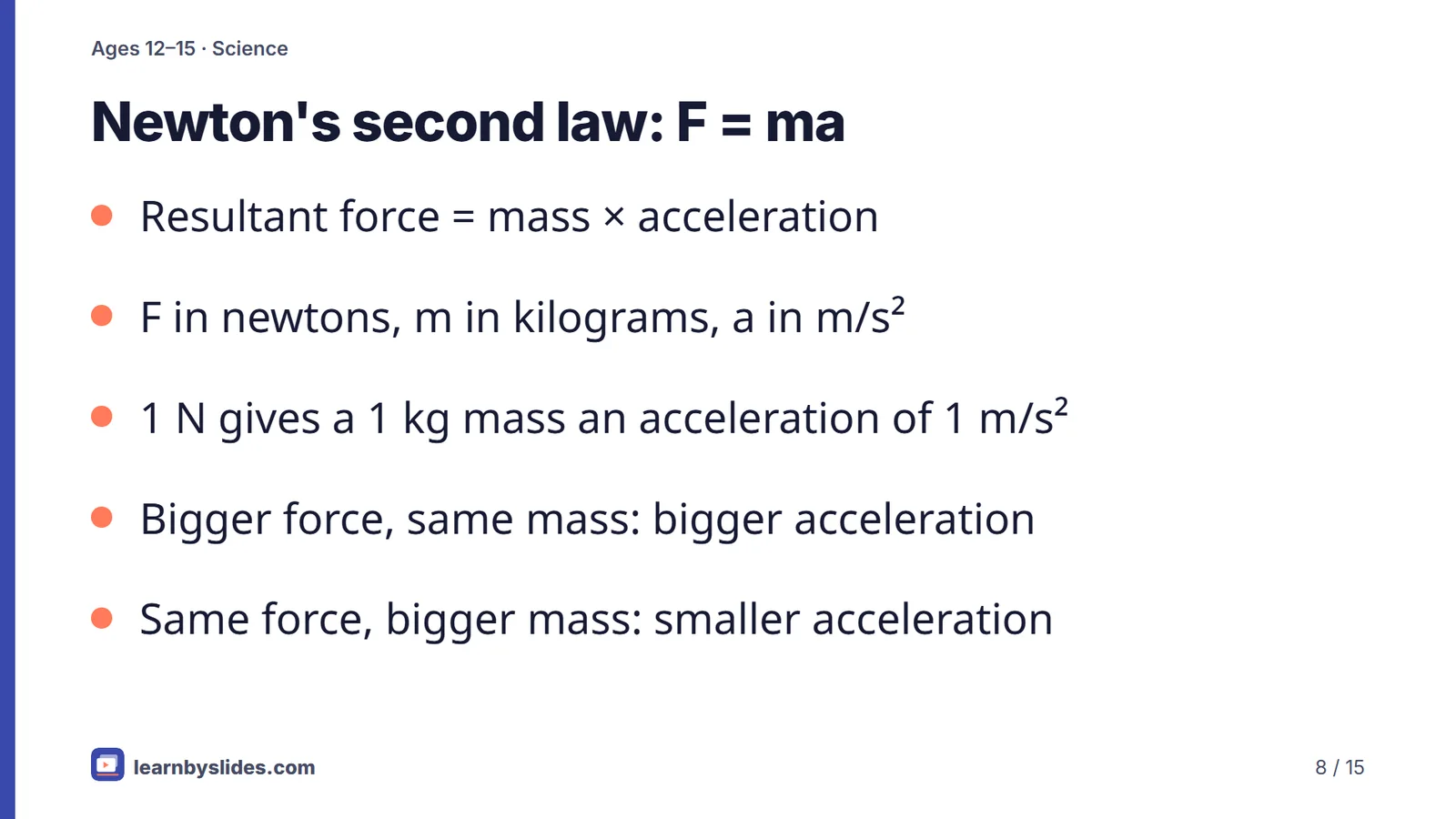
An unbalanced force makes an object accelerate. The second law links the resultant force, the mass and the acceleration:
- F = ma (force in N, mass in kg, acceleration in m/s²)
- 1 N is the force that gives a 1 kg mass an acceleration of 1 m/s²
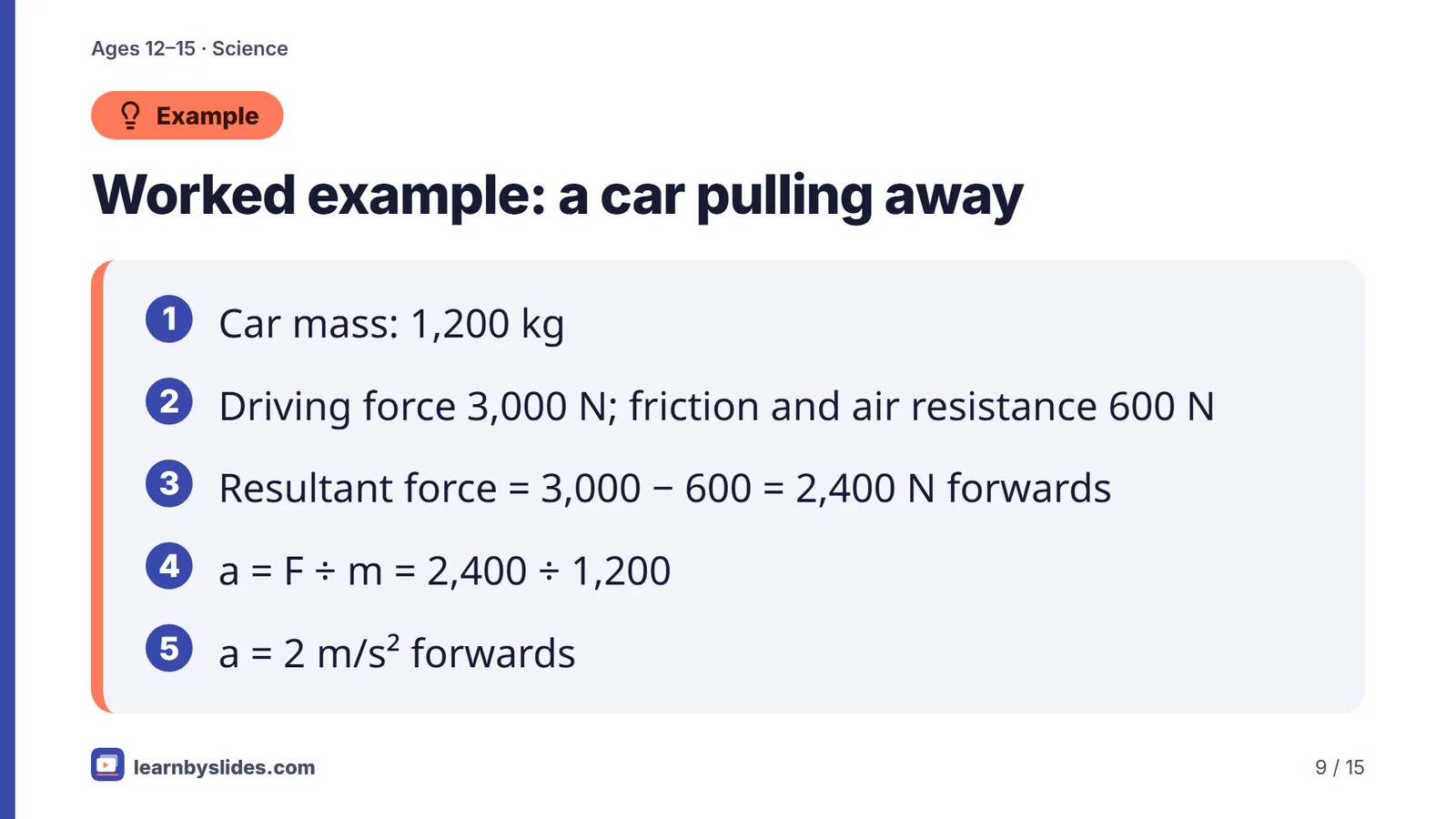
For example, a 1,200 kg car with a driving force of 3,000 N and 600 N of friction and air resistance has a resultant force of 2,400 N, so it accelerates at 2 m/s².
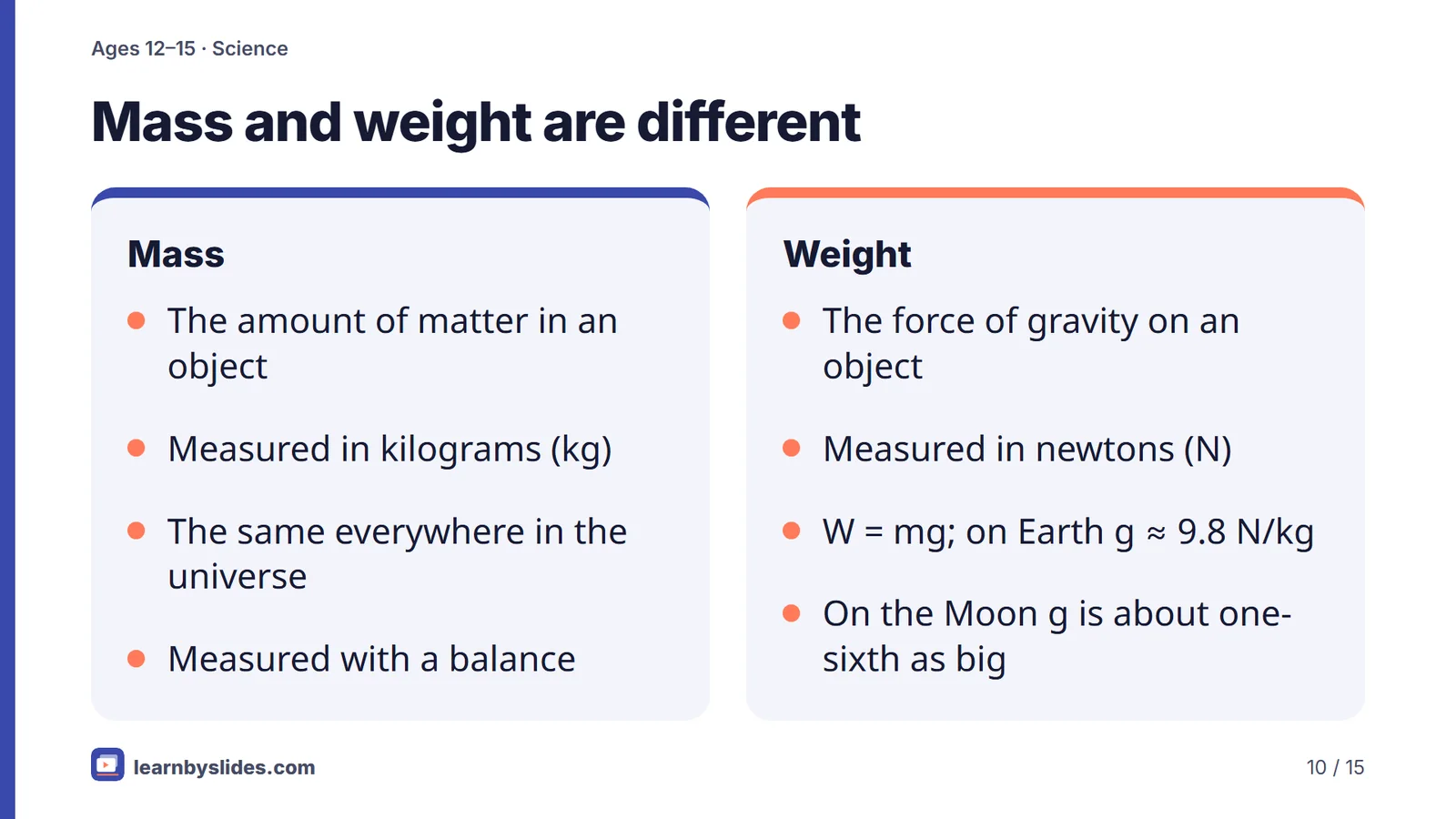
Weight is the force of gravity on a mass: W = mg. On Earth g is about 9.8 N/kg, so a 50 kg student weighs about 490 N. On the Moon, where g is about one-sixth as big, the same student would weigh roughly 80 N, but their mass would still be 50 kg.
Newton's third law
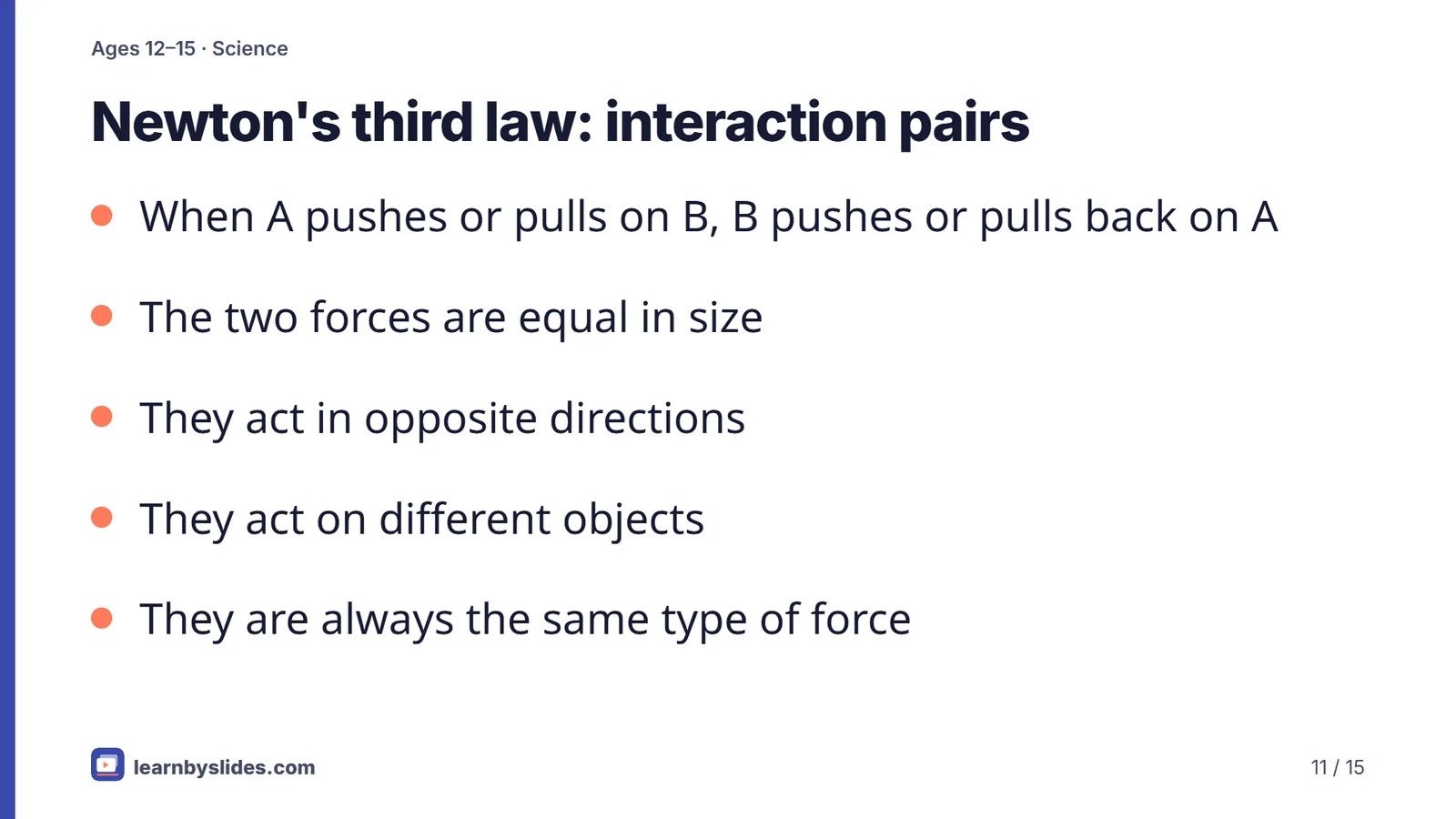
When object A exerts a force on object B, B exerts a force on A that is equal in size and opposite in direction. A swimmer pushes back on the pool wall and the wall pushes the swimmer forwards; a rocket pushes exhaust gas backwards and the gas pushes the rocket forwards.
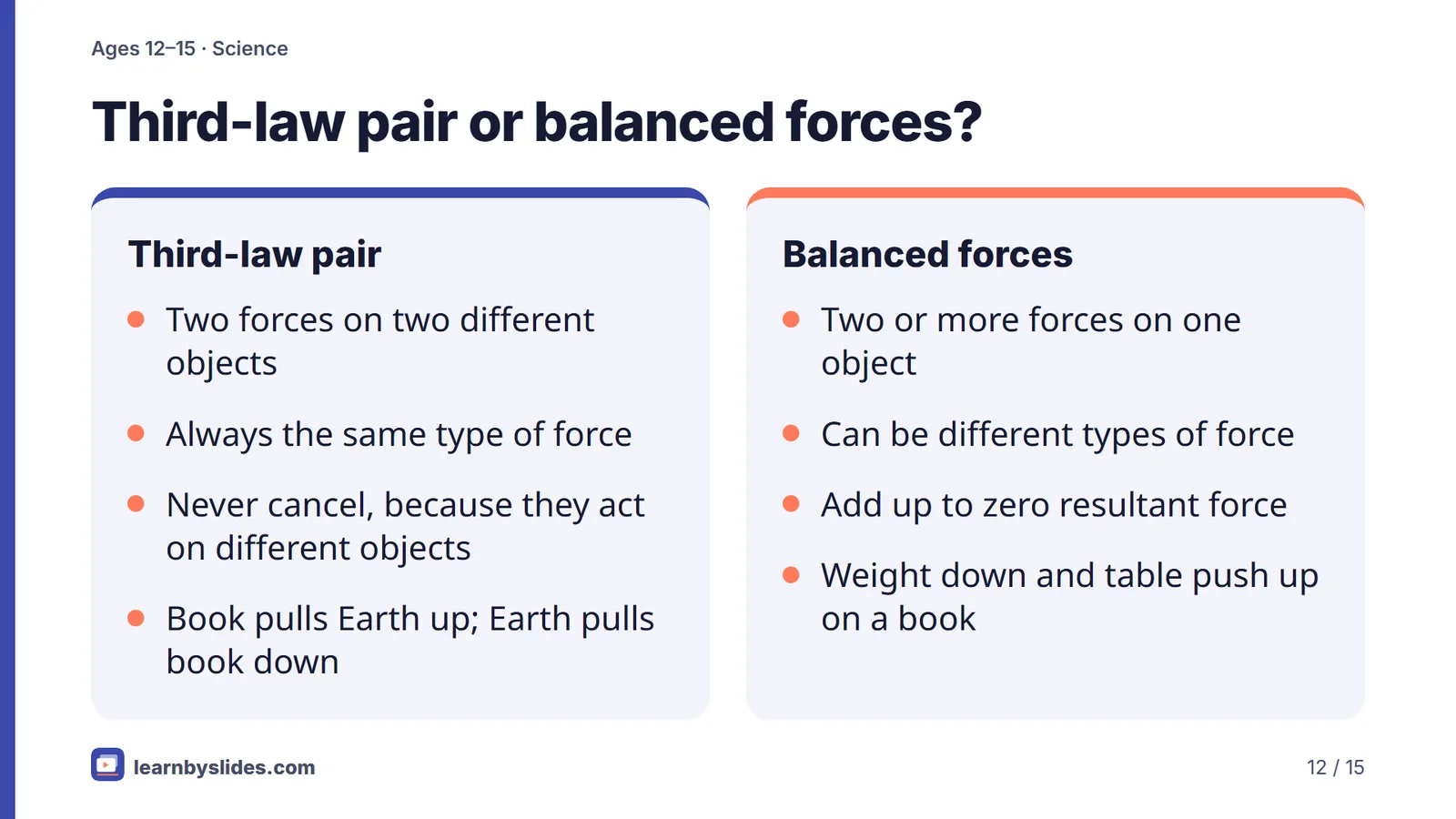
The two forces in a third-law pair act on different objects and are the same type of force, so they never cancel each other. That is why the deck compares a third-law pair with a pair of balanced forces on the same object, such as the weight of a book and the upward push of the table it rests on.
How to use these slides
Present the deck in class, download the editable PowerPoint (PPTX), or make your own copy in Google Slides. The teacher notes include a 45-minute plan, a safe trolley or balloon-rocket demonstration, common misconceptions and an extension task. Pair the lesson with the printable Newton's laws poster from InfoGraphHub for a classroom display or revision handout.
Slide-by-slide content
1. Forces and Newton's Laws of Motion
Physics · Why things start, stop, speed up and change direction
Speaker notes
Slide a book across the desk and let it stop. Ask: why did it stop? Collect answers without judging them; many students will say it 'ran out of force'. Tell them that by the end of the lesson they will be able to explain it with Newton's first law.
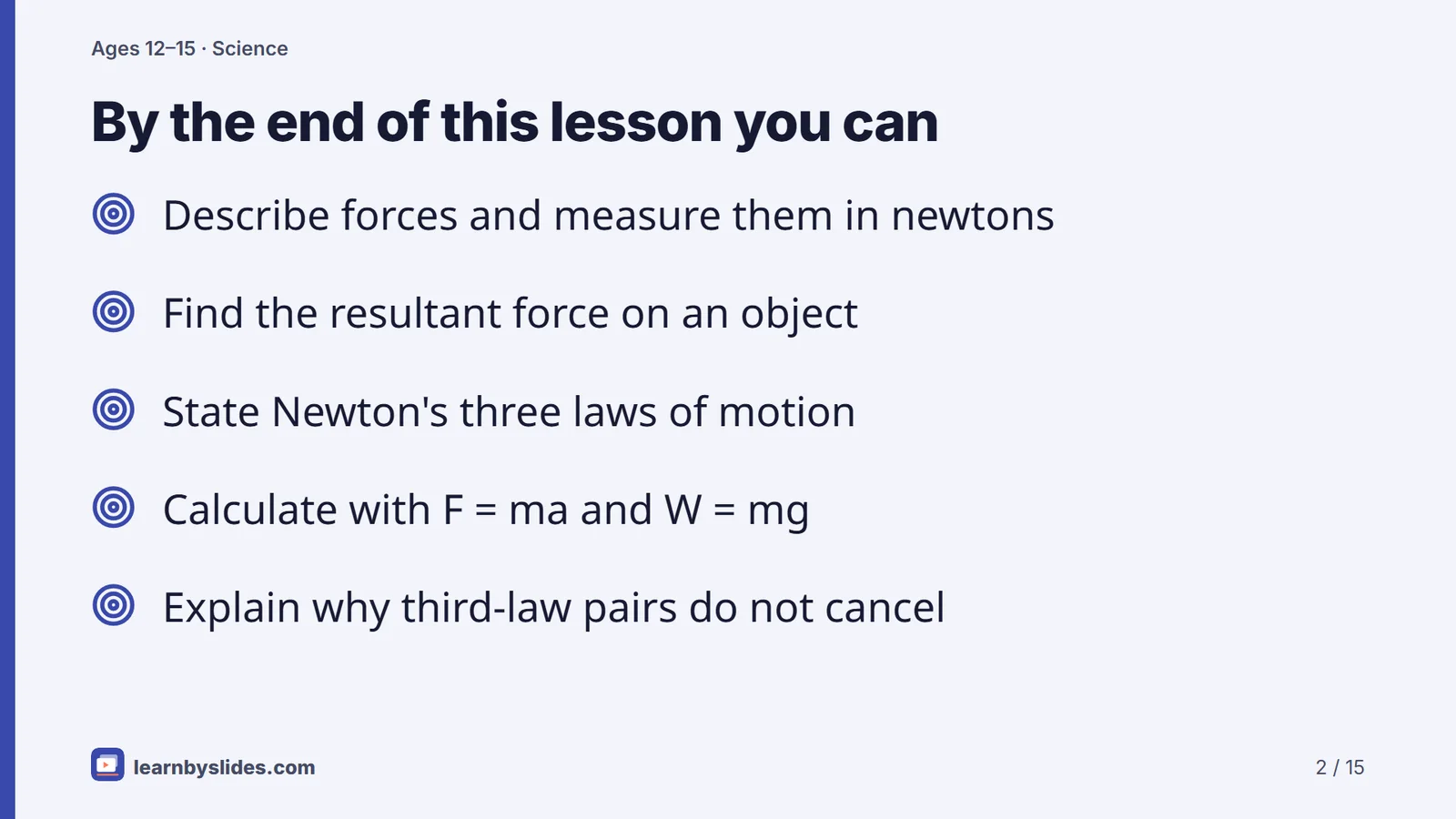
2. By the end of this lesson you can
- Describe forces and measure them in newtons
- Find the resultant force on an object
- State Newton's three laws of motion
- Calculate with F = ma and W = mg
- Explain why third-law pairs do not cancel
Speaker notes
Point out that two of the objectives involve calculations, so calculators are useful later. Ask students which law they have heard of before; most will know 'every action has an equal and opposite reaction', which is a loose version of the third law.
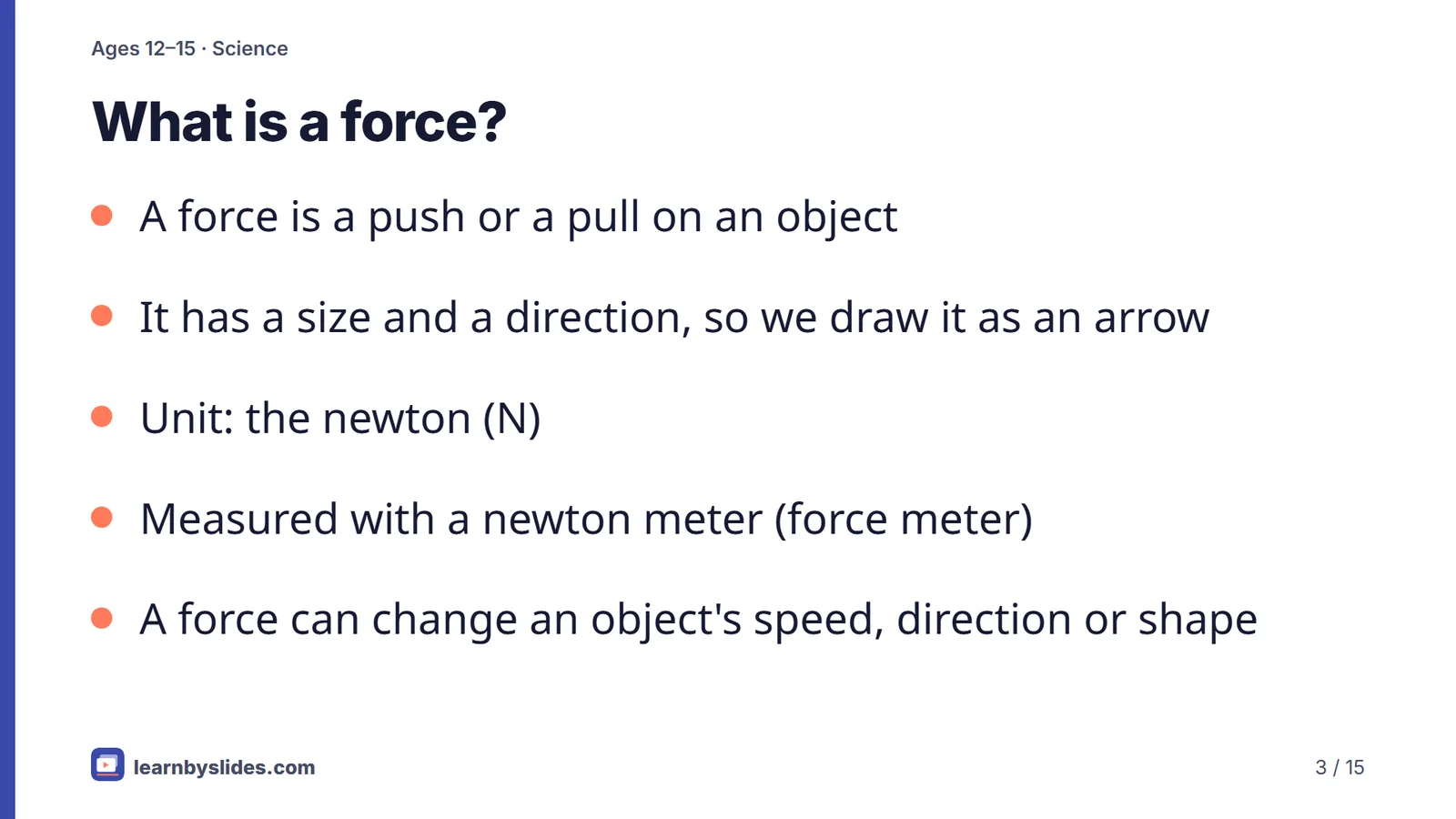
3. What is a force?
- A force is a push or a pull on an object
- It has a size and a direction, so we draw it as an arrow
- Unit: the newton (N)
- Measured with a newton meter (force meter)
- A force can change an object's speed, direction or shape
Speaker notes
A longer arrow means a bigger force. Pass round a newton meter and let students feel 1 N: it is roughly the weight of a 100 g apple, because 0.1 kg × 9.8 N/kg is about 1 N. Ask for one example of a force changing shape (squashing a sponge) and one changing direction (kicking a moving ball).
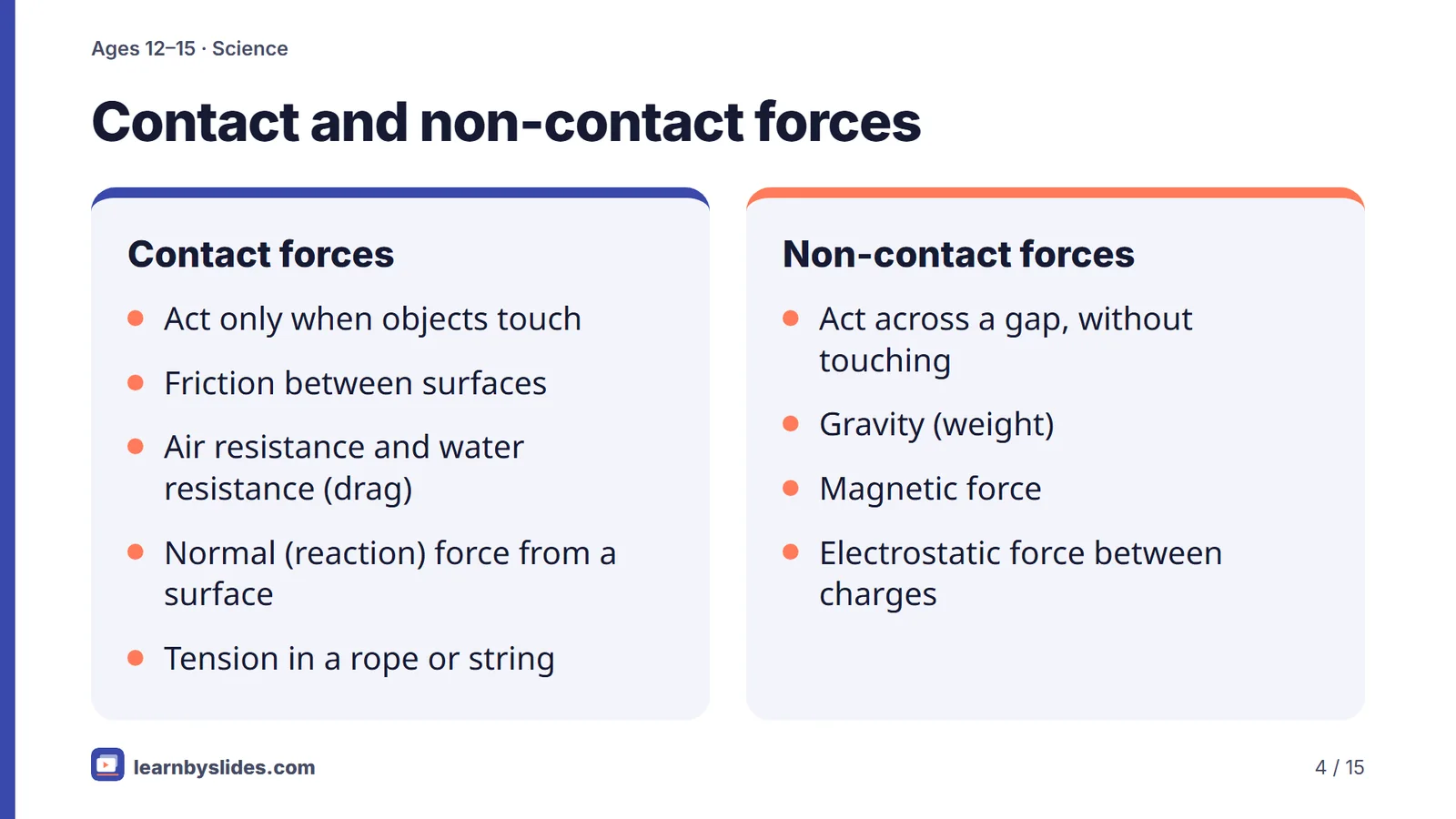
4. Contact and non-contact forces
Contact forces
- Act only when objects touch
- Friction between surfaces
- Air resistance and water resistance (drag)
- Normal (reaction) force from a surface
- Tension in a rope or string
Non-contact forces
- Act across a gap, without touching
- Gravity (weight)
- Magnetic force
- Electrostatic force between charges
Speaker notes
Hold a magnet above a paper clip to show a non-contact force in action. Ask students to name the forces on a book resting on a table: weight (non-contact) down and the normal force from the table (contact) up. Keep this example; it returns when we meet the third law.
5. Resultant force: adding forces in a line
- Several forces on one object combine into one resultant force
- Same direction: add them
- Opposite directions: subtract the smaller from the larger
- The resultant acts in the direction of the larger force
- Example: 50 N right and 30 N left give 20 N right
Speaker notes
Draw a tug of war on the board with arrows of different lengths. Ask: what is the resultant if both teams pull with 400 N? Zero, so nothing changes. At this level we only add forces along one line; adding forces at angles comes later.
6. Balanced and unbalanced forces
Balanced
- Resultant force is zero
- A still object stays still
- A moving object keeps the same speed and direction
- Example: a car cruising at a steady speed
Unbalanced
- Resultant force is not zero
- The object accelerates
- It speeds up, slows down or changes direction
- Example: a car braking at traffic lights
Speaker notes
Stress the surprising half of this slide: balanced forces do not mean 'not moving'. A car at a steady 50 km/h (about 30 mph) on a straight road has balanced forces, because the driving force equals friction plus air resistance. This is the most common misconception in the topic.
7. Newton's first law: inertia
- With no resultant force, an object at rest stays at rest
- A moving object keeps moving at constant speed in a straight line
- Inertia: the tendency to resist changes in motion
- More mass means more inertia
- Seat belts stop you carrying on forwards when a car brakes
Speaker notes
Return to the sliding book: it stopped because friction acted as an unbalanced force, not because its force ran out. In space, far from other objects, a probe keeps moving without its engines. Ask: why is it harder to start pushing a full shopping trolley than an empty one?
8. Newton's second law: F = ma
- Resultant force = mass × acceleration
- F in newtons, m in kilograms, a in m/s²
- 1 N gives a 1 kg mass an acceleration of 1 m/s²
- Bigger force, same mass: bigger acceleration
- Same force, bigger mass: smaller acceleration
Speaker notes
Write the formula triangle if your students use one, and show the rearrangements a = F ÷ m and m = F ÷ a. Make sure students use the resultant force, not just one of the forces. Acceleration is in the same direction as the resultant force.
9. Worked example: a car pulling away
- Car mass: 1,200 kg
- Driving force 3,000 N; friction and air resistance 600 N
- Resultant force = 3,000 − 600 = 2,400 N forwards
- a = F ÷ m = 2,400 ÷ 1,200
- a = 2 m/s² forwards
Speaker notes
Work through each line on the board. Ask what happens to the acceleration as the car speeds up and air resistance grows: the resultant force falls, so the acceleration falls. When air resistance plus friction equals 3,000 N, the forces balance and the car travels at a steady top speed.
10. Mass and weight are different
Mass
- The amount of matter in an object
- Measured in kilograms (kg)
- The same everywhere in the universe
- Measured with a balance
Weight
- The force of gravity on an object
- Measured in newtons (N)
- W = mg; on Earth g ≈ 9.8 N/kg
- On the Moon g is about one-sixth as big
Speaker notes
Example: a 50 kg student weighs 50 × 9.8 = 490 N on Earth, but only about one-sixth of that, roughly 80 N, on the Moon. Their mass is 50 kg in both places. Some courses round g to 10 N/kg; tell students which value your exam uses. Ask: why is 'I weigh 50 kg' not quite right in physics?
11. Newton's third law: interaction pairs
- When A pushes or pulls on B, B pushes or pulls back on A
- The two forces are equal in size
- They act in opposite directions
- They act on different objects
- They are always the same type of force
Speaker notes
Examples: a swimmer pushes backwards on the pool wall and the wall pushes the swimmer forwards; your foot pushes backwards on the ground and the ground pushes you forwards; a rocket pushes gas backwards and the gas pushes the rocket forwards. Ask a pair of students on wheeled chairs (if safe) to push palms: both move apart.
12. Third-law pair or balanced forces?
Third-law pair
- Two forces on two different objects
- Always the same type of force
- Never cancel, because they act on different objects
- Book pulls Earth up; Earth pulls book down
Balanced forces
- Two or more forces on one object
- Can be different types of force
- Add up to zero resultant force
- Weight down and table push up on a book
Speaker notes
This is the hardest idea in the lesson. The book's weight and the table's push are equal and opposite, but they are not a third-law pair: both act on the book and they are different types of force. The partner of the book's weight is the book's gravitational pull on the Earth.
13. All three laws on one page
First law: no resultant force, no change in motion. Second law: F = ma. Third law: forces come in equal and opposite pairs on different objects.
Speaker notes
Use the poster as a recap or print it for the classroom wall. Ask students to add their own everyday example under each law in their books, then share one with a partner. Good examples: a bus passenger lurching forwards (first), a full trolley being harder to accelerate (second), a rowing boat moving forwards as the oars push water back (third).
14. Quick check
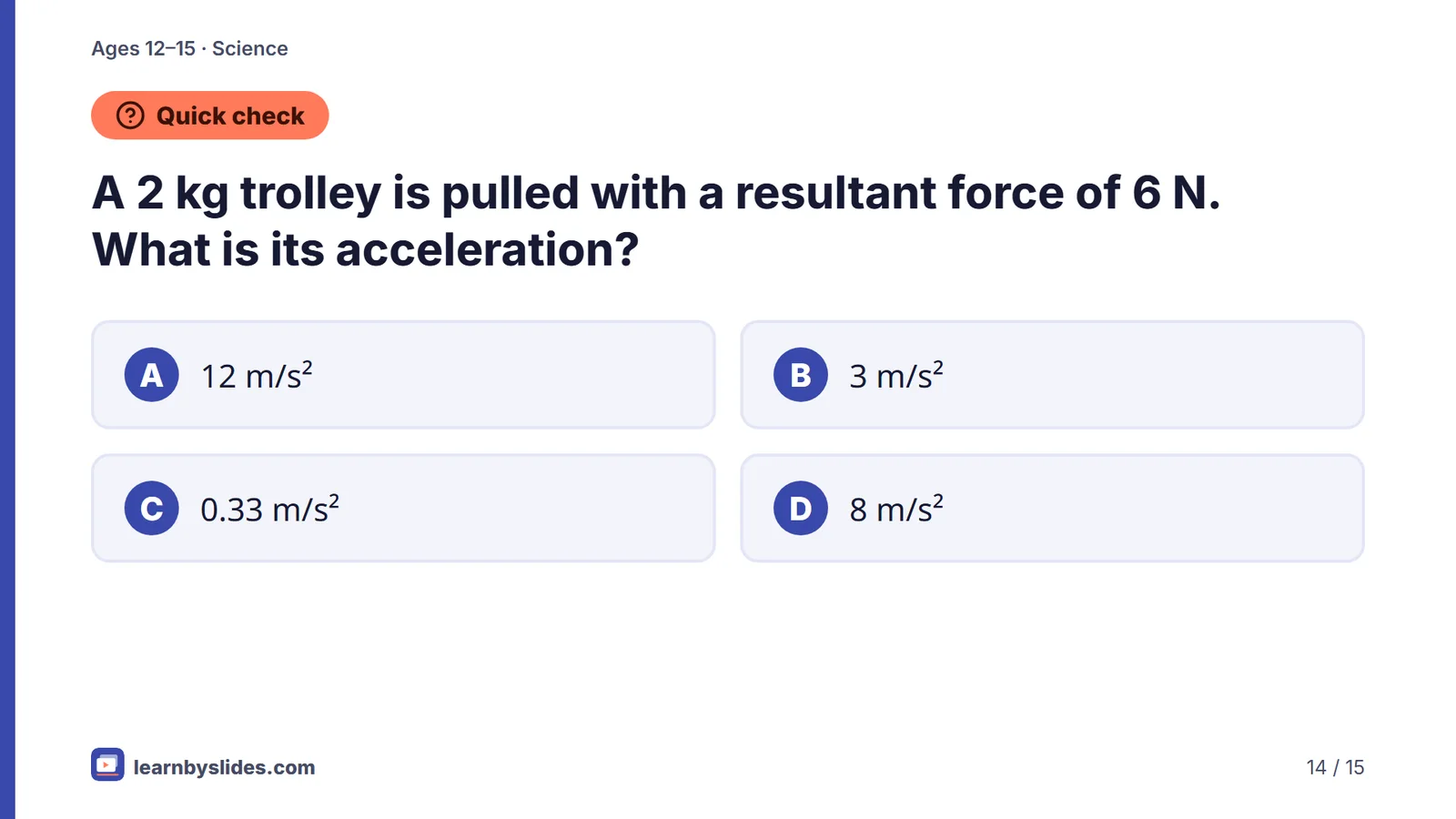
A 2 kg trolley is pulled with a resultant force of 6 N. What is its acceleration?
- 12 m/s²
- 3 m/s²
- 0.33 m/s²
- 8 m/s²
Speaker notes
Answer: B, 3 m/s², from a = F ÷ m = 6 ÷ 2. Students who chose A multiplied instead of dividing; students who chose D added the numbers. Ask one student to explain how they rearranged F = ma.
15. Key takeaways
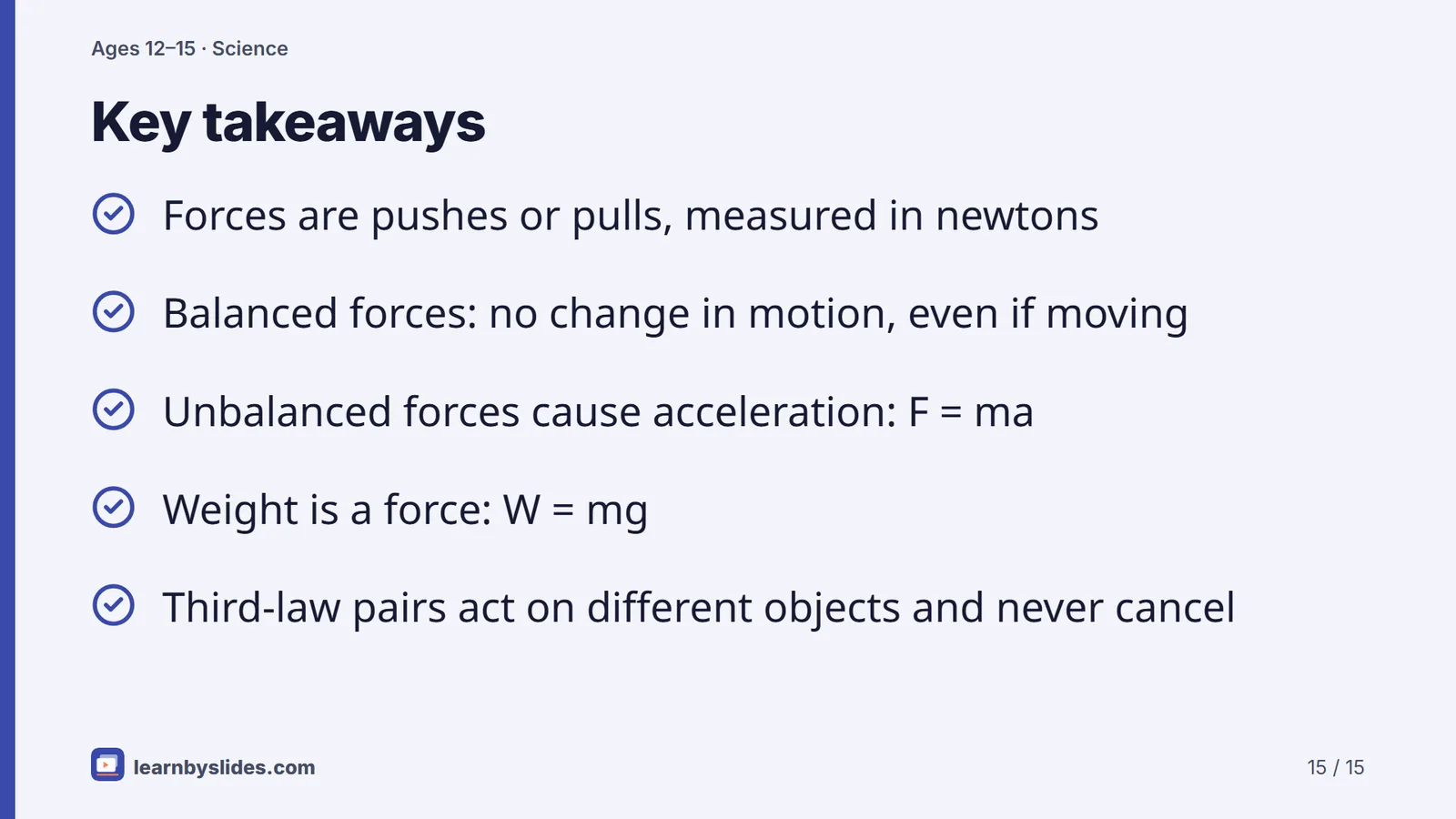
- Forces are pushes or pulls, measured in newtons
- Balanced forces: no change in motion, even if moving
- Unbalanced forces cause acceleration: F = ma
- Weight is a force: W = mg
- Third-law pairs act on different objects and never cancel
Speaker notes
Ask students to explain the sliding book from the start of the lesson using the first law. Then move to the five-question quiz. Homework idea: find three examples of Newton's laws at home or on the way to school and label the forces with arrows.
Key terms
- Force
- A push or a pull on an object, with both size and direction, measured in newtons (N).
- Resultant force
- The single force that has the same effect as all the forces acting on an object combined.
- Balanced forces
- Forces whose resultant is zero, so the object's motion does not change.
- Inertia
- The tendency of an object to keep doing what it is doing: to stay at rest or keep moving at the same velocity.
- Mass
- The amount of matter in an object, measured in kilograms (kg); it is the same everywhere.
- Weight
- The force of gravity on an object, measured in newtons: W = mg.
- Newton's second law
- Resultant force equals mass times acceleration (F = ma).
- Interaction pair
- Two equal and opposite forces of the same type that two objects exert on each other (Newton's third law).
Quick quiz
Teacher notes
Suggested 45-minute plan: 5 min opener (why did the sliding book stop?), 8 min on forces, contact and non-contact forces and resultant force (slides 3 to 5), 7 min on balanced and unbalanced forces and the first law (slides 6 and 7), 12 min on F = ma, the worked example and mass versus weight (slides 8 to 10), 8 min on the third law and the pair-or-balanced comparison (slides 11 to 13), 5 min for the quick check and quiz. Safe practical or demonstration (10 minutes, can replace the worked example): pull a dynamics trolley along the bench with a newton meter, first with one trolley and then with two stacked, keeping the reading the same; students see that more mass gives less acceleration. Safety: use stop blocks or a cushion at the end of the bench so trolleys cannot fall; if you use hanging masses over a pulley instead, clamp the pulley, keep the total mass small and put a box or cushion under the masses so they cannot land on feet. A balloon rocket on a string (third law) is a good alternative: check for latex allergies first and do not over-inflate the balloons. Eye protection is not normally needed for these activities, but follow your school's own risk assessment. Common misconceptions: a moving object needs a force to keep it moving; balanced forces mean the object is not moving; third-law pairs cancel out; mass and weight are the same thing (and are both measured in kg). Extension: ask students to explain, using resultant force, why a skydiver speeds up at first and then falls at a steady terminal velocity, and what changes when the parachute opens.
Frequently asked questions
What age group is this forces lesson for?
It is written for learners aged 12–15, roughly Grades 7–9 in the US, Years 8–10 in the UK and the first years of IGCSE or GCSE courses. Younger classes can skip the F = ma calculations; older classes can add the extension on terminal velocity.
What is the difference between balanced forces and a Newton's third-law pair?
Balanced forces act on the same object and add up to zero, so its motion does not change. A third-law pair is two forces that two objects exert on each other: they are equal and opposite but act on different objects, so they never cancel.
Does a moving object need a force to keep it moving?
No. Newton's first law says an object keeps moving at constant speed in a straight line unless a resultant force acts on it. On Earth, things slow down because friction and air resistance act on them.
Should students use g = 9.8 N/kg or 10 N/kg?
The more precise value near the Earth's surface is about 9.8 N/kg. Some courses and exams round it to 10 N/kg to keep the arithmetic simple, so use the value your syllabus or exam board specifies.
Sources & methodology
Every fact is checked against the sources below. We write original explanations and draw original graphics; no figures are copied from textbooks. Spotted an error? See our corrections policy.
- Physics, 4.1 Force (OpenStax (Rice University), accessed 1 Oct 2026)
- Physics, 4.2 Newton's First Law of Motion: Inertia (OpenStax (Rice University), accessed 1 Oct 2026)
- Physics, 4.3 Newton's Second Law of Motion (OpenStax (Rice University), accessed 1 Oct 2026)
- Physics, 4.4 Newton's Third Law of Motion (OpenStax (Rice University), accessed 1 Oct 2026)
- Newton's Laws of Motion (NASA Glenn Research Center, accessed 1 Oct 2026)
- Force equals motion, motion equals force (misconception) (Institute of Physics (IOPSpark), accessed 1 Oct 2026)
Editorial review pending · Updated
Related lessons
 Science · Ages 12–15
Electric Circuits: Current, Voltage & Resistance Lesson Slides
A ready-to-teach physics lesson for ages 12–15 on electric circuits: current, potential difference (voltage), resistance and Ohm's law, how to use ammeters and voltmeters, and the rules for series and parallel circuits.
 Science · Ages 11–14
States of Matter and the Particle Model Lesson Slides
A ready-to-teach science lesson for ages 11–14 on solids, liquids and gases: how particles are arranged and move, the changes of state, energy in and out, evaporation vs boiling, and gas pressure. Speaker notes on every slide, a 5-question quiz and a worksheet.
 Science · Ages 12–15
Acids, Bases and the pH Scale Lesson Slides
A ready-to-teach chemistry lesson for ages 12–15 on acids, bases and alkalis: the pH scale, litmus and universal indicator, everyday examples, neutralisation and how to name salts, with a safe indicator practical.
 Science · Ages 13–16
Photosynthesis: How Plants Make Food Lesson Slides
A ready-to-teach biology lesson for ages 13–16 on photosynthesis: the word and balanced equations, how a leaf is built for the job, limiting factors and what plants do with glucose. Speaker notes on every slide, a 5-question quiz and a worksheet.
 Science · Ages 11–14
Plant and Animal Cells: Structure and Function Lesson Slides
A ready-to-teach lesson for ages 11–14 on plant and animal cells: the parts they share, the three extra parts plant cells have, and what each part does. Speaker notes on every slide, a microscope example, a 5-question quiz and a worksheet.
 Science · Ages 14–15
Motion: Speed, Velocity, Acceleration & Graphs Lesson Slides
A ready-to-teach physics lesson for ages 14–15 on motion in a straight line: distance and displacement, speed, velocity, acceleration, position–time and velocity–time graphs, the equations of motion and uniform circular motion.
For teachers and parents: new LearnBySlides resources by email
One short email when new free resources go live. For adults (18+) only. No spam, no tracking in emails, unsubscribe anytime.