Acids, Bases and the pH Scale Lesson Slides
A ready-to-teach chemistry lesson for ages 12–15 on acids, bases and alkalis: the pH scale, litmus and universal indicator, everyday examples, neutralisation and how to name salts, with a safe indicator practical.
Ages 12–15 · Grades 7–9 (US) · Years 8–10 (UK) · Classes 7–9 (India)
- England KS3 Years 7–9
- NGSS MS-PS1-2
- Australian Curriculum v9 AC9S10U07
- AQA GCSE 4.4.2.4
- AQA GCSE 4.4.2.2
- AQA GCSE 5.4.2.4
- Cambridge IGCSE 0620 7.1
- CBSE Unit I
NGSS is a registered trademark of WestEd. Cambridge and IGCSE are trademarks of Cambridge University Press & Assessment. Names and codes are used only to describe curriculum fit; LearnBySlides is not endorsed by these organisations.
16 slides · 45 min lesson · 5-question quiz · speaker notes
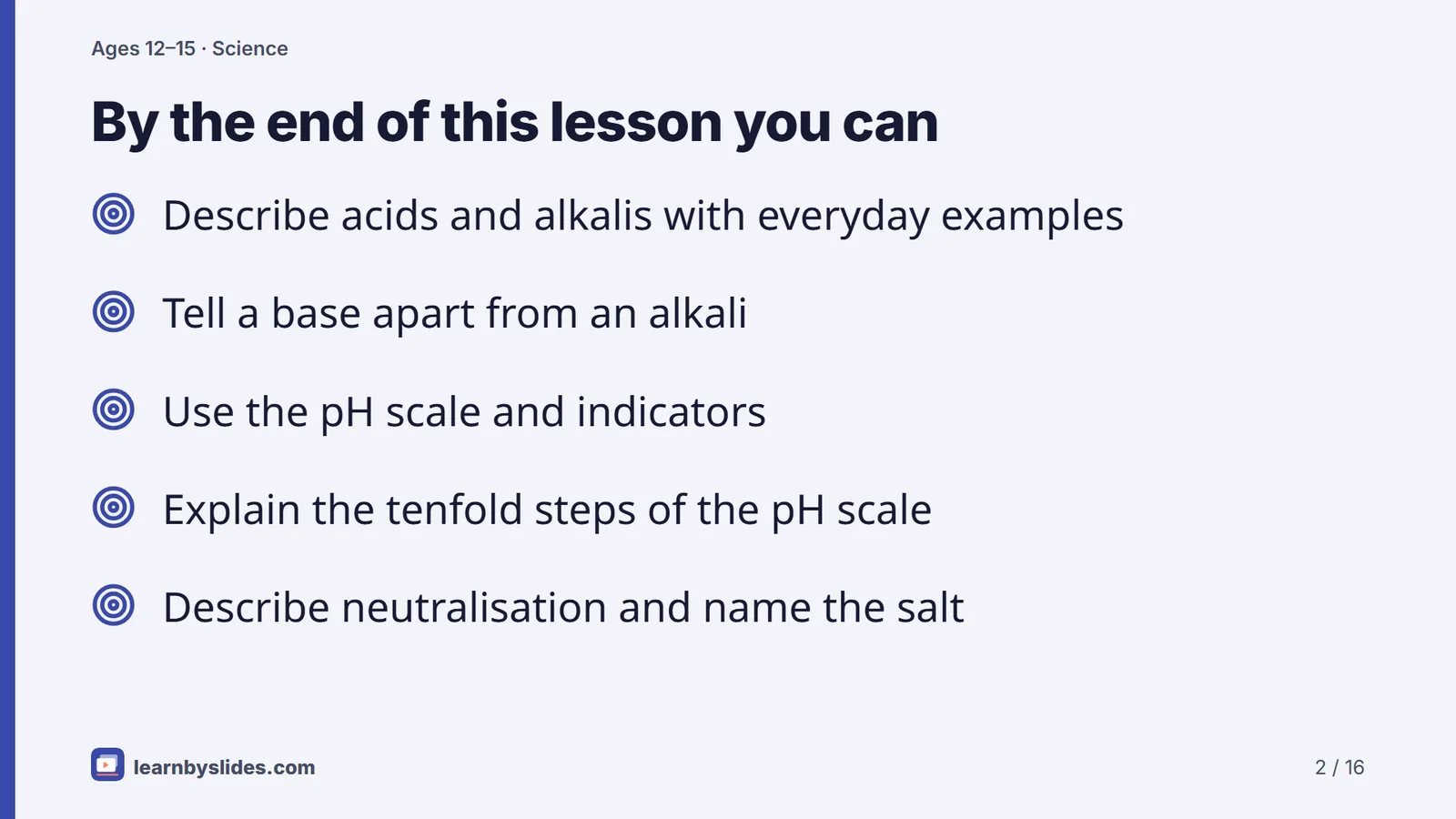
Learning objectives
- Describe the properties of acids and alkalis and give everyday examples of each.
- Explain the difference between a base and an alkali.
- Use the pH scale, litmus and universal indicator to classify solutions as acidic, neutral or alkaline.
- Explain that each step on the pH scale is a tenfold change in acidity.
- Describe neutralisation and name the salt made by an acid and an alkali.
What this lesson covers
This deck teaches students aged 12–15 about acids, bases and alkalis in one 45-minute chemistry lesson. It starts with everyday examples, introduces the pH scale and indicators, explains why each step on the scale is a tenfold change, and finishes with neutralisation and naming salts. Every slide has speaker notes, the teacher notes include a safe indicator practical, and the lesson ends with a quick check and a five-question quiz.
Acids, bases and alkalis
Acids are common in everyday life: lemon juice contains citric acid, vinegar contains ethanoic (acetic) acid, and the stomach makes hydrochloric acid to help digest food. Acids have a pH below 7 and turn blue litmus paper red.
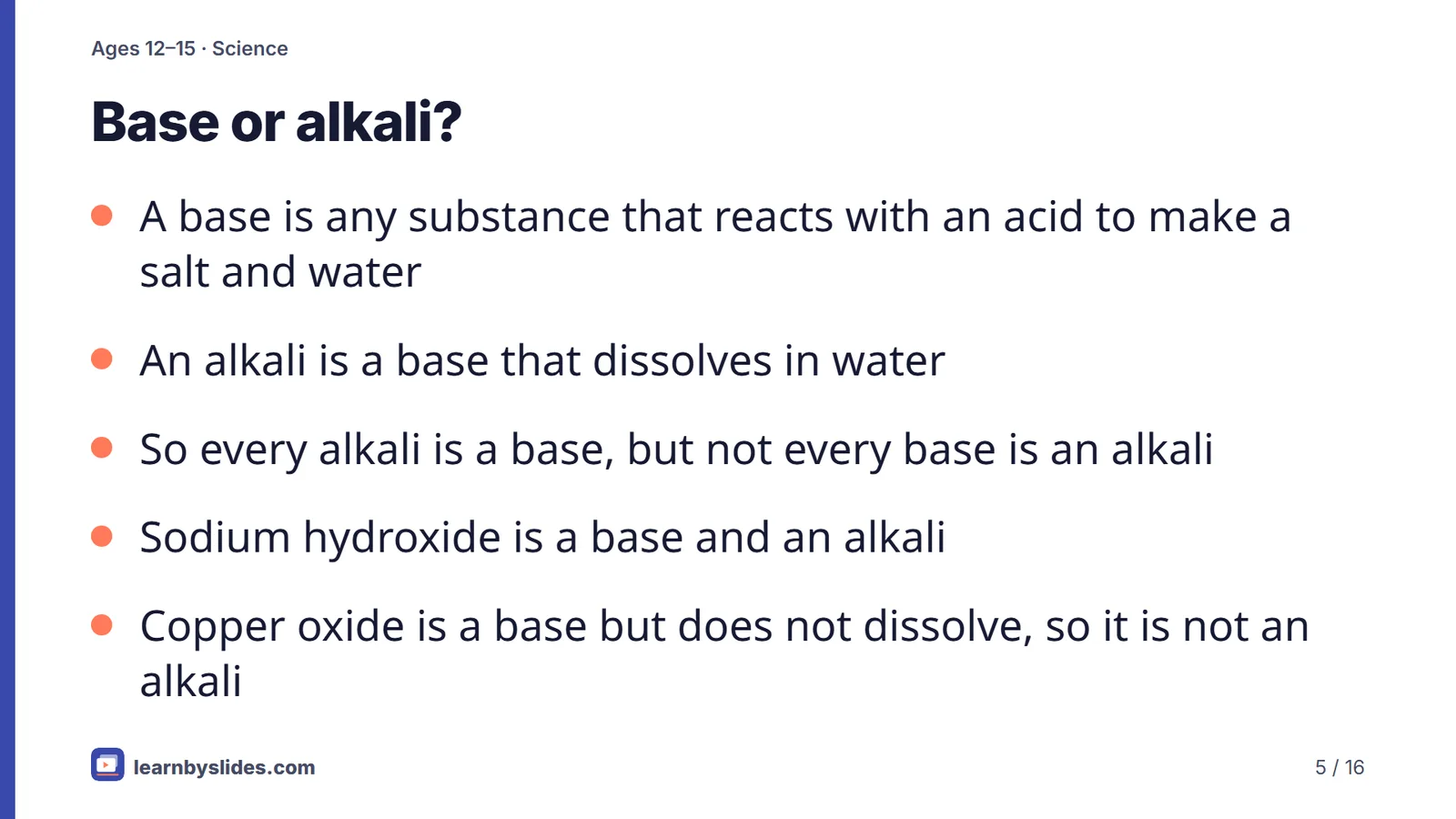
A base is any substance that reacts with an acid to make a salt and water. An alkali is a base that dissolves in water, so every alkali is a base but not every base is an alkali. Alkaline solutions have a pH above 7 and turn red litmus paper blue. Both concentrated acids and concentrated alkalis are corrosive.
The pH scale
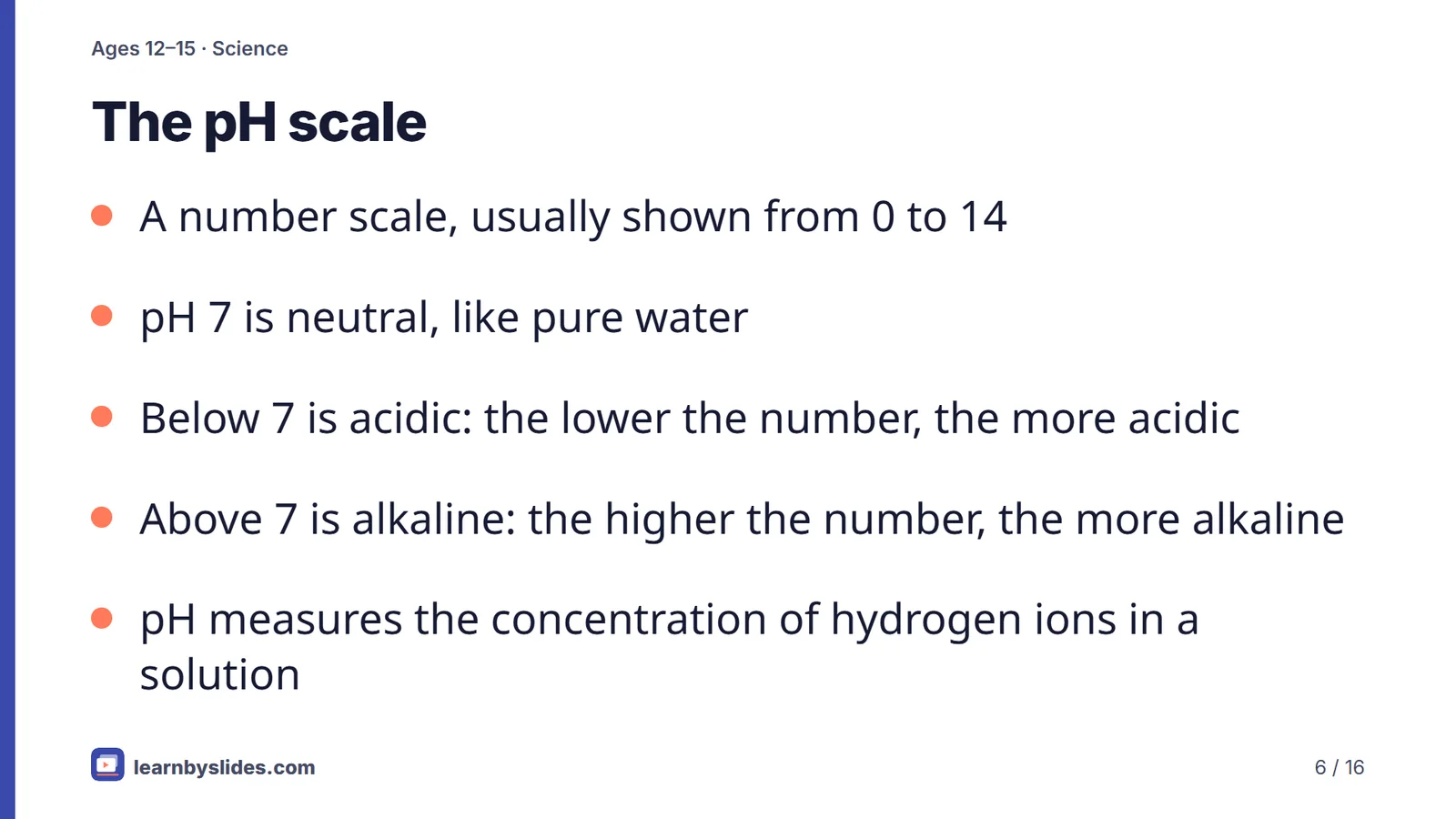
The pH scale shows how acidic or alkaline a solution is. It usually runs from 0 to 14:
- pH 7 is neutral, like pure water at 25 °C.
- Below 7 is acidic: the lower the number, the more acidic.
- Above 7 is alkaline: the higher the number, the more alkaline.
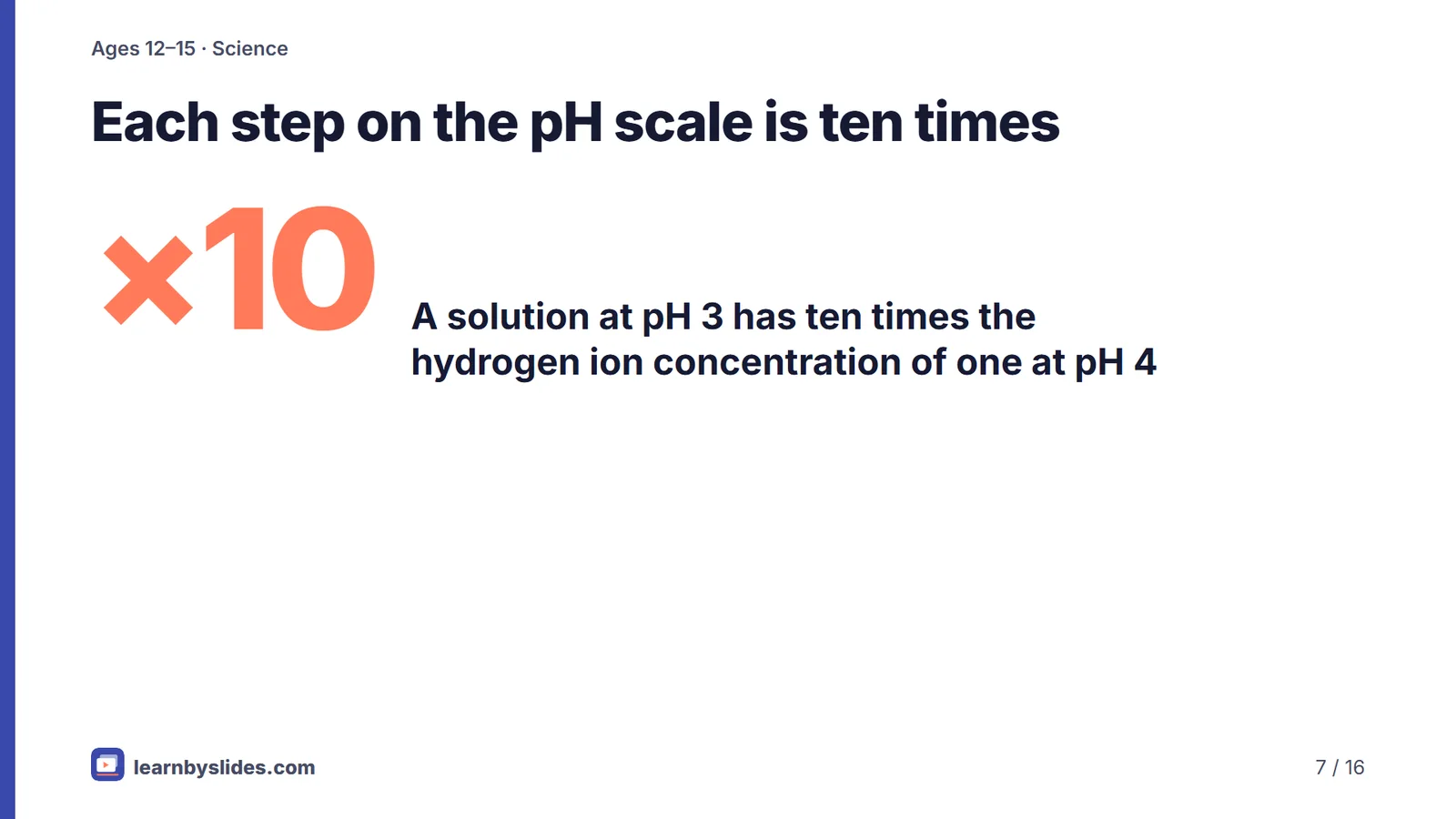
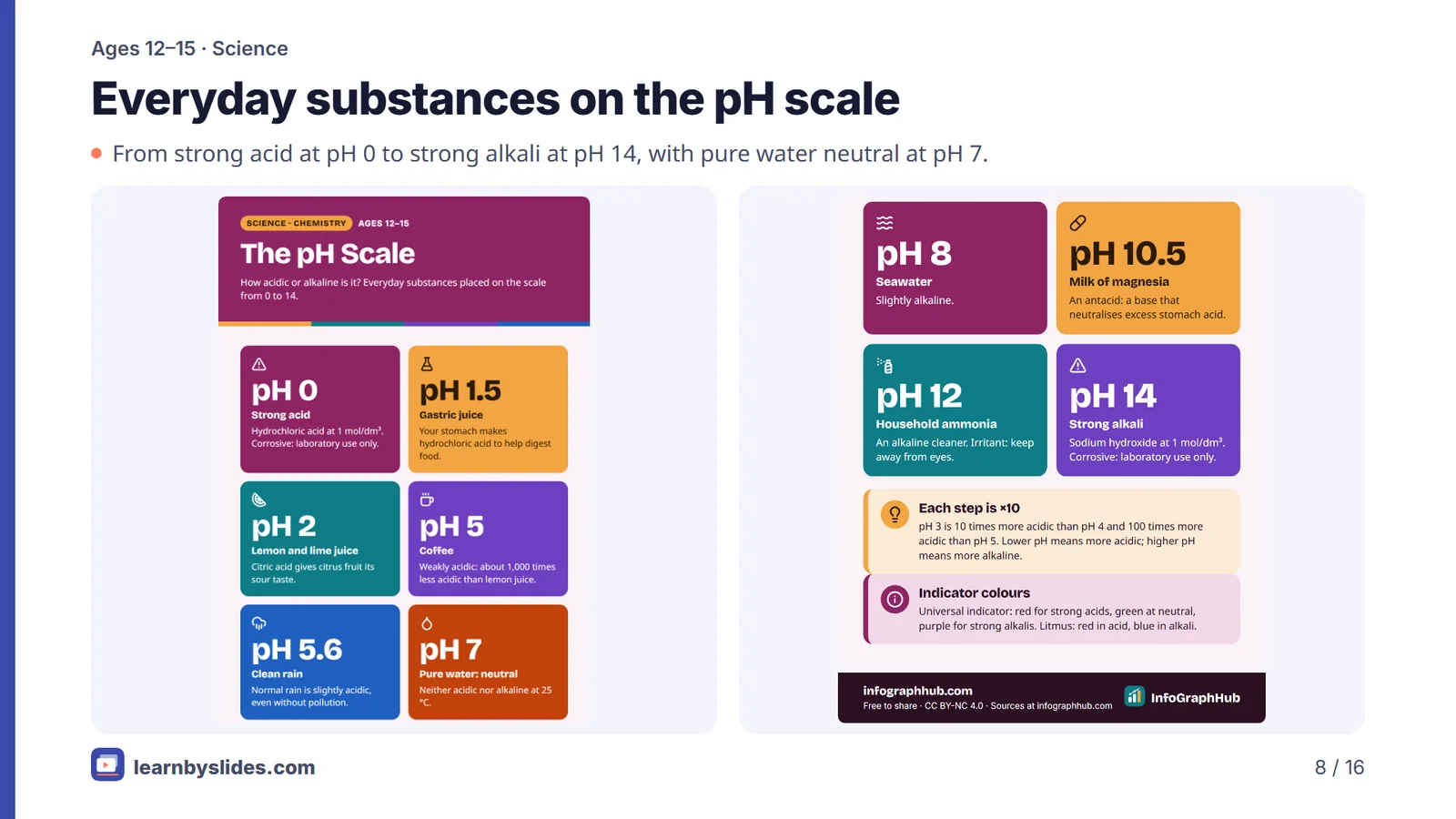
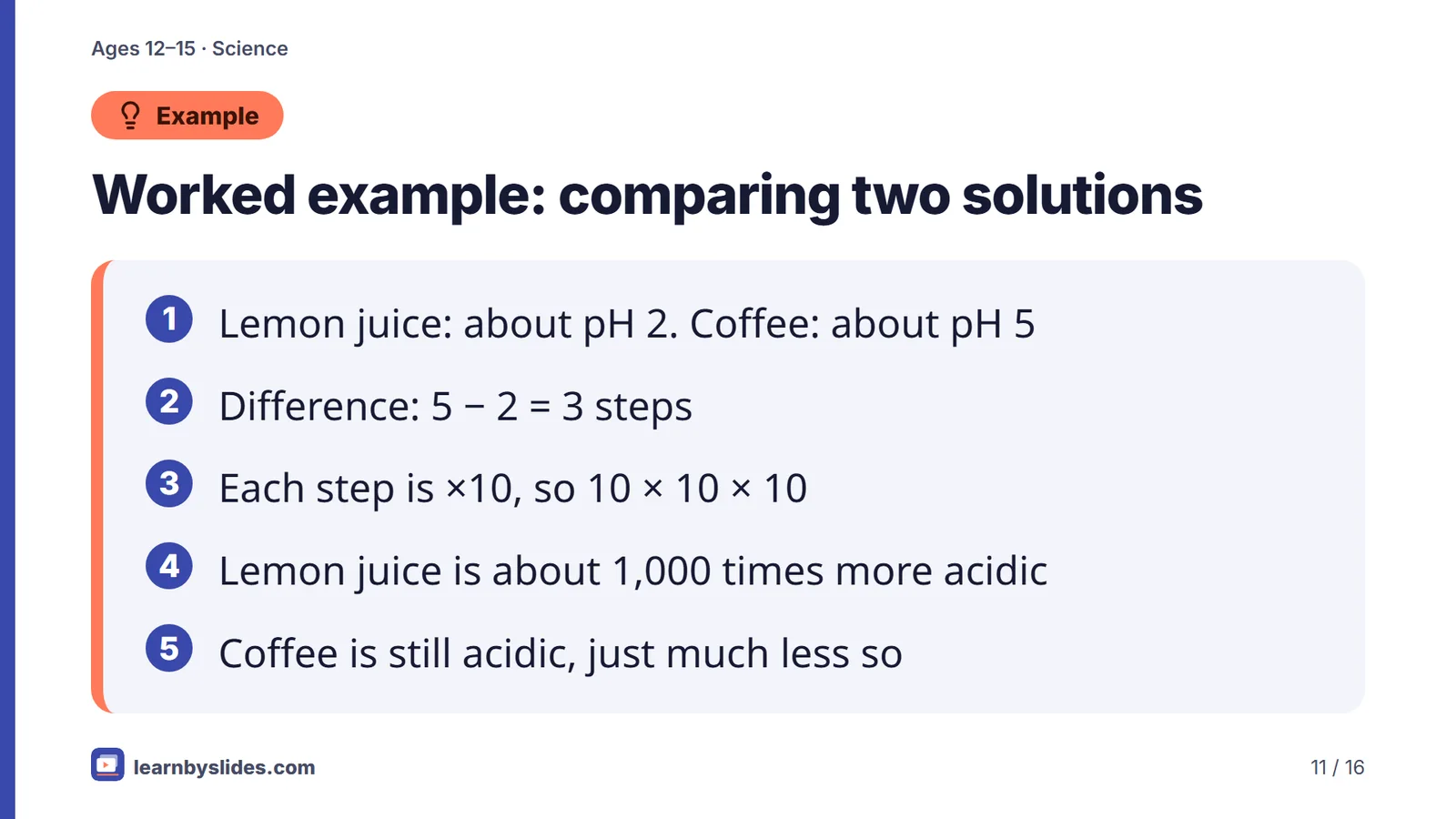
The scale is not like a ruler. Each step is a tenfold change in the concentration of hydrogen ions, so lemon juice at about pH 2 is roughly 1,000 times more acidic than coffee at about pH 5. Clean rain is slightly acidic, at about pH 5.6, and seawater is slightly alkaline, at about pH 8.
Indicators and pH meters
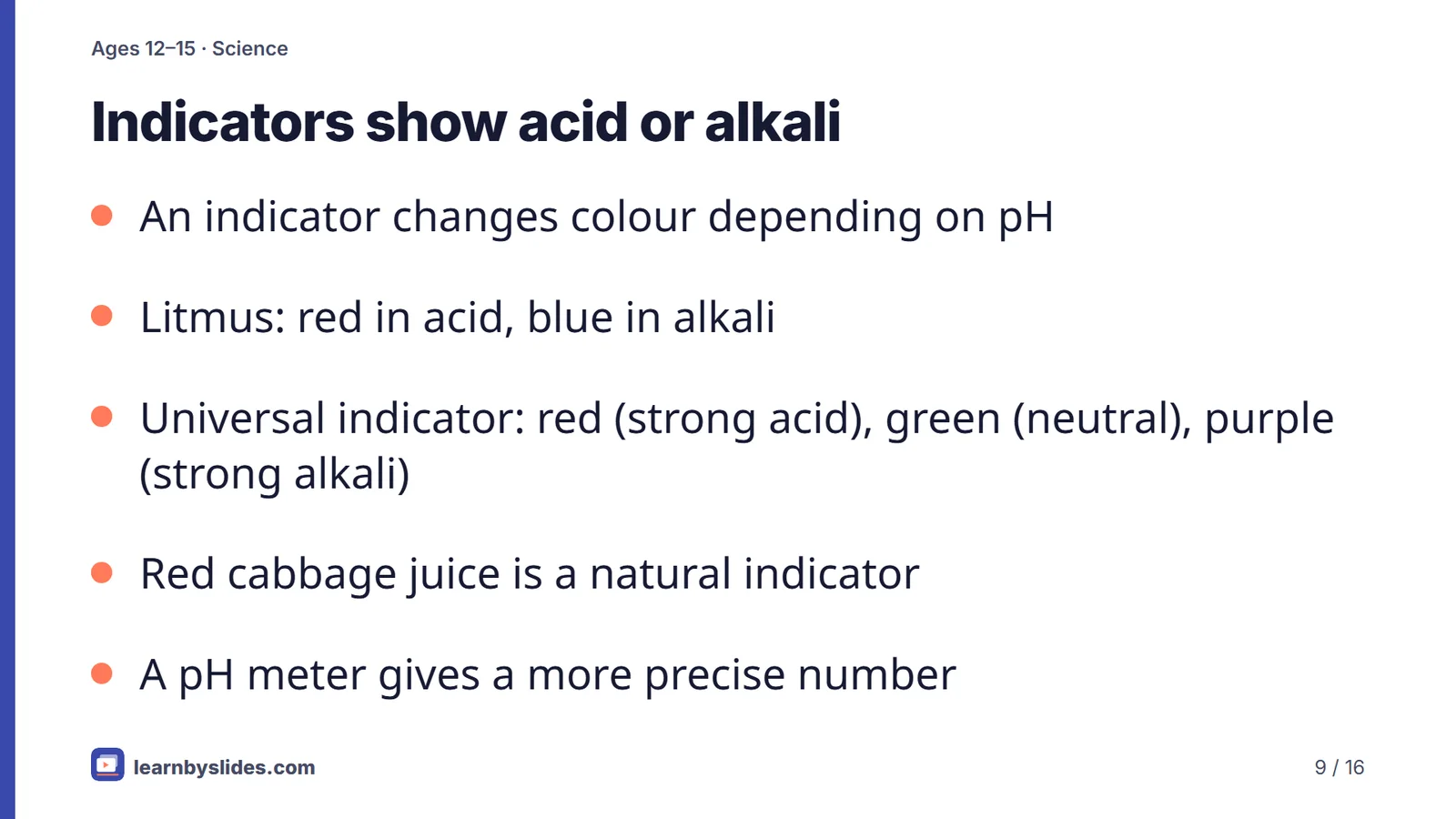
An indicator changes colour depending on pH. Litmus has only two colours, red in acid and blue in alkali, so it shows whether a solution is acidic or alkaline but not how strongly. Universal indicator is a mixture of indicators that runs from red for a strong acid, through green at neutral, to purple for a strong alkali, so it gives an approximate pH. Red cabbage juice works as a natural indicator, and a pH meter gives a more precise reading, which helps with coloured liquids.
Neutralisation
When an acid reacts with a base, the two cancel each other out in a neutralisation reaction:
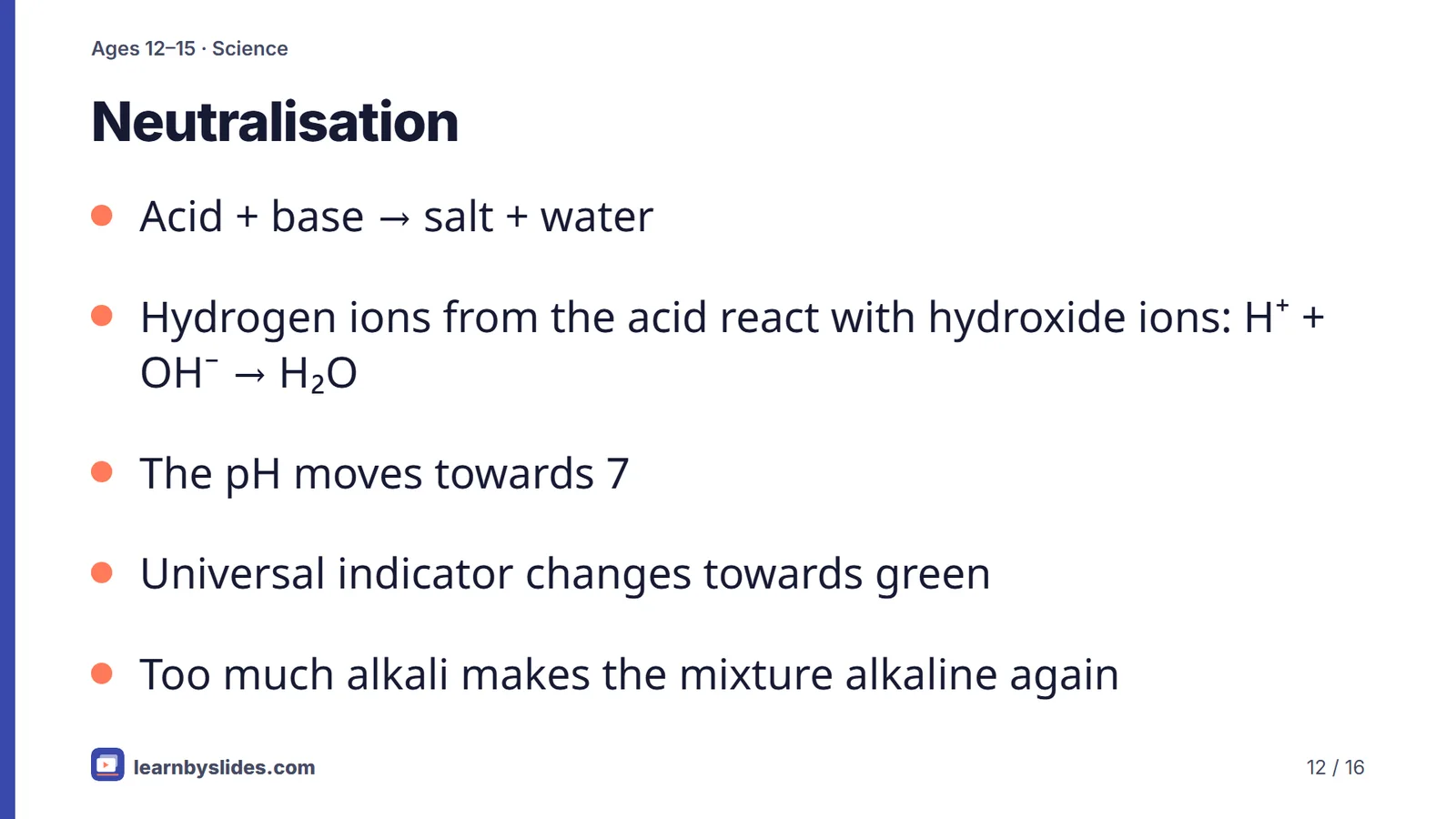
acid + base → salt + water
Hydrogen ions from the acid join hydroxide ions from the alkali to make water, and the pH moves towards 7. The salt takes its first name from the base and its second from the acid: hydrochloric acid and sodium hydroxide make sodium chloride, while sulfuric acid makes sulfates and nitric acid makes nitrates. Indigestion remedies work this way: bases such as magnesium hydroxide or calcium carbonate neutralise excess stomach acid.
How to use these slides
Present the deck in class, download the editable PowerPoint (PPTX), or make your own copy in Google Slides. The diagram slide uses the printable pH scale poster from InfoGraphHub, which also works as a classroom display or revision handout.
Slide-by-slide content
1. Acids, Bases and the pH Scale
Chemistry · Measuring how acidic or alkaline a solution is
Speaker notes
Hold up a lemon, a bottle of vinegar and a packet of indigestion tablets. Ask: what could these three things have in common? Accept guesses, then tell students that two are acids and one is a base, and by the end of the lesson they will be able to say which is which and why the tablets work.
2. By the end of this lesson you can
- Describe acids and alkalis with everyday examples
- Tell a base apart from an alkali
- Use the pH scale and indicators
- Explain the tenfold steps of the pH scale
- Describe neutralisation and name the salt
Speaker notes
Tell students there is a short practical in the middle of the lesson, so eye protection will be needed. Ask what they already know about the word 'acid'; many will associate it only with danger, which this lesson will broaden.
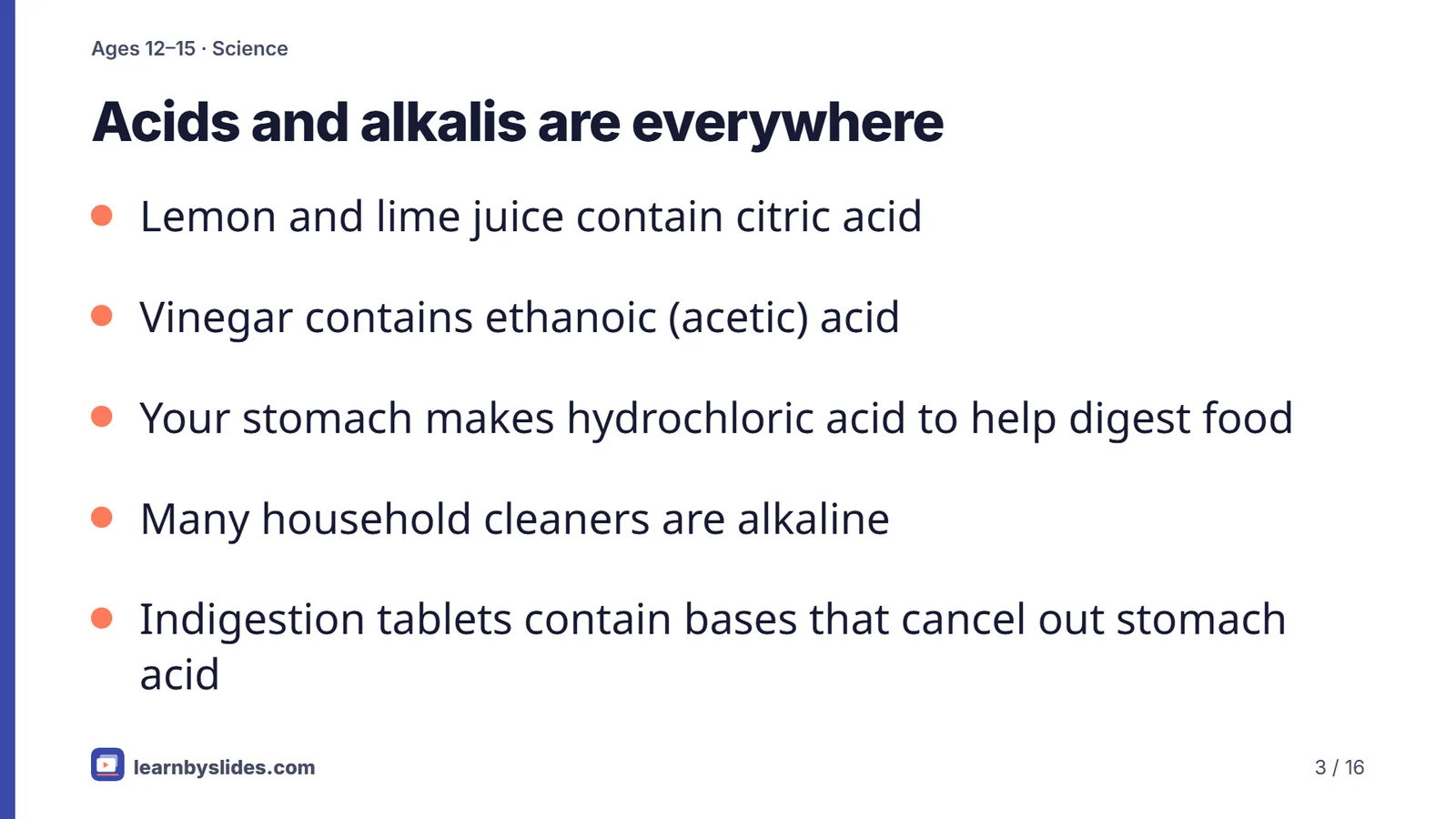
3. Acids and alkalis are everywhere
- Lemon and lime juice contain citric acid
- Vinegar contains ethanoic (acetic) acid
- Your stomach makes hydrochloric acid to help digest food
- Many household cleaners are alkaline
- Indigestion tablets contain bases that cancel out stomach acid
Speaker notes
Edible acids taste sour, but in the laboratory you must never taste anything to test it. Ask students to sort a list of kitchen and bathroom items into 'probably acid' and 'probably alkali'; keep the list to test later with indicator.
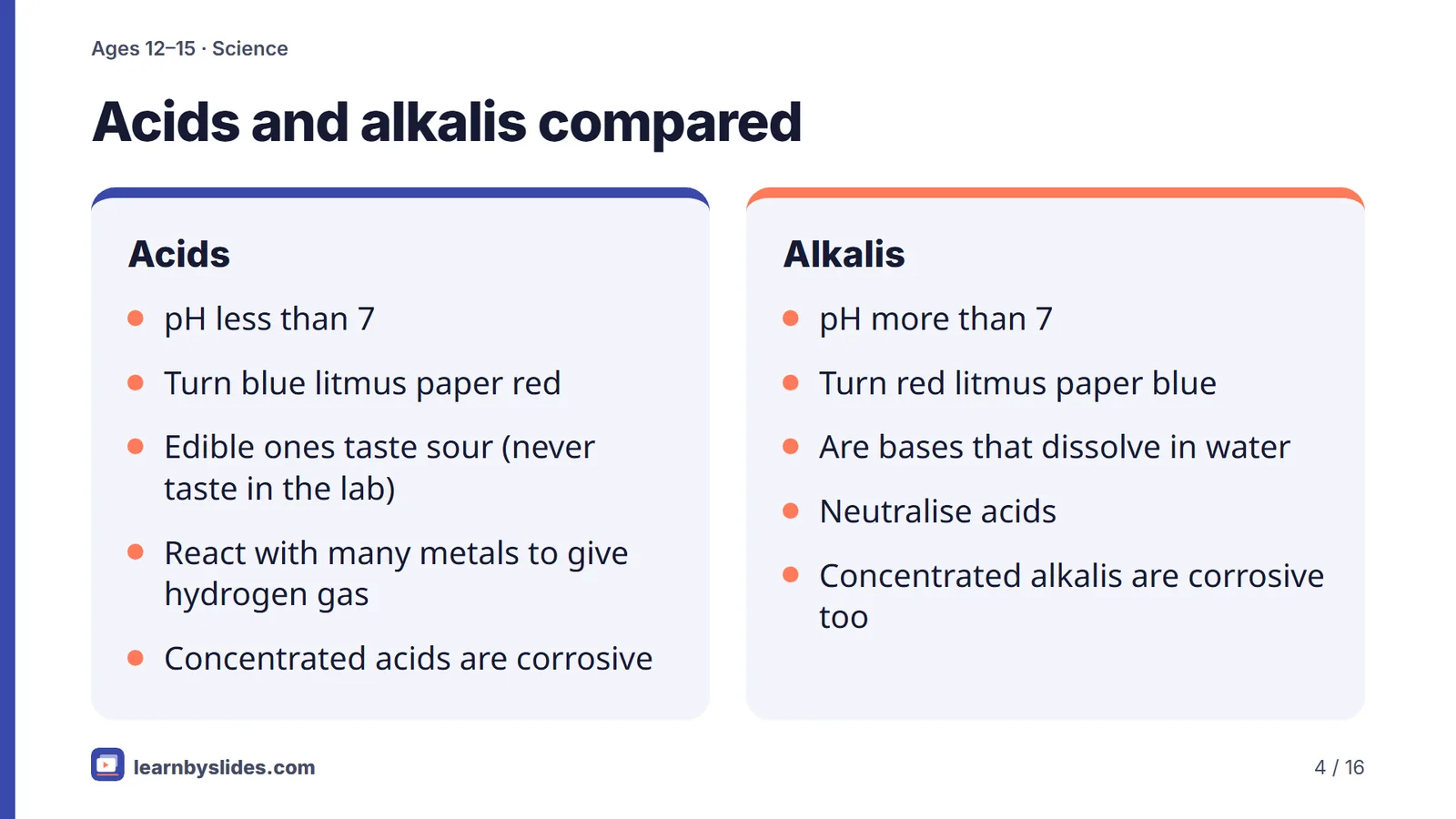
4. Acids and alkalis compared
Acids
- pH less than 7
- Turn blue litmus paper red
- Edible ones taste sour (never taste in the lab)
- React with many metals to give hydrogen gas
- Concentrated acids are corrosive
Alkalis
- pH more than 7
- Turn red litmus paper blue
- Are bases that dissolve in water
- Neutralise acids
- Concentrated alkalis are corrosive too
Speaker notes
Point out the symmetry: acids and alkalis are opposites that cancel each other out. A common misconception is that only acids are dangerous; concentrated alkalis such as oven cleaner and drain cleaner can cause serious burns, especially to the eyes.
5. Base or alkali?
- A base is any substance that reacts with an acid to make a salt and water
- An alkali is a base that dissolves in water
- So every alkali is a base, but not every base is an alkali
- Sodium hydroxide is a base and an alkali
- Copper oxide is a base but does not dissolve, so it is not an alkali
Speaker notes
Draw a big circle labelled 'bases' with a smaller circle inside labelled 'alkalis'. Ask students where magnesium hydroxide in an antacid suspension would go: it is a base that is only slightly soluble, which is why it is sold as a cloudy 'milk'.
6. The pH scale
- A number scale, usually shown from 0 to 14
- pH 7 is neutral, like pure water
- Below 7 is acidic: the lower the number, the more acidic
- Above 7 is alkaline: the higher the number, the more alkaline
- pH measures the concentration of hydrogen ions in a solution
Speaker notes
Stress that a lower pH means more acidic; students often assume a bigger number means a stronger acid. Values below 0 and above 14 are possible for very concentrated solutions, but 0 to 14 covers almost everything met at school. Neutral is exactly pH 7 at 25 °C.
7. Each step on the pH scale is ten times
×10 A solution at pH 3 has ten times the hydrogen ion concentration of one at pH 4
Speaker notes
So pH 3 is 10 times more acidic than pH 4, and 100 times more acidic than pH 5. This is why a small change in pH can matter a lot, for example in a fish tank or in the blood. Ask: how many times more acidic is pH 2 than pH 5? Answer: 10 × 10 × 10 = 1,000 times.
8. Everyday substances on the pH scale
From strong acid at pH 0 to strong alkali at pH 14, with pure water neutral at pH 7.
Speaker notes
Use the poster to place everyday substances on the scale: gastric juice about 1.5, lemon juice about 2, coffee about 5, clean rain about 5.6, pure water 7, seawater about 8, milk of magnesia about 10.5, household ammonia about 12. Ask students to predict where their sorted kitchen items will go before they test them.
9. Indicators show acid or alkali
- An indicator changes colour depending on pH
- Litmus: red in acid, blue in alkali
- Universal indicator: red (strong acid), green (neutral), purple (strong alkali)
- Red cabbage juice is a natural indicator
- A pH meter gives a more precise number
Speaker notes
Universal indicator is a mixture of several indicators, which is why it shows a whole rainbow of colours instead of just two. Coloured liquids such as cola can hide the indicator colour, which is one reason a pH meter is useful. Universal indicator solution is flammable, so keep it away from Bunsen flames.
10. Litmus or universal indicator?
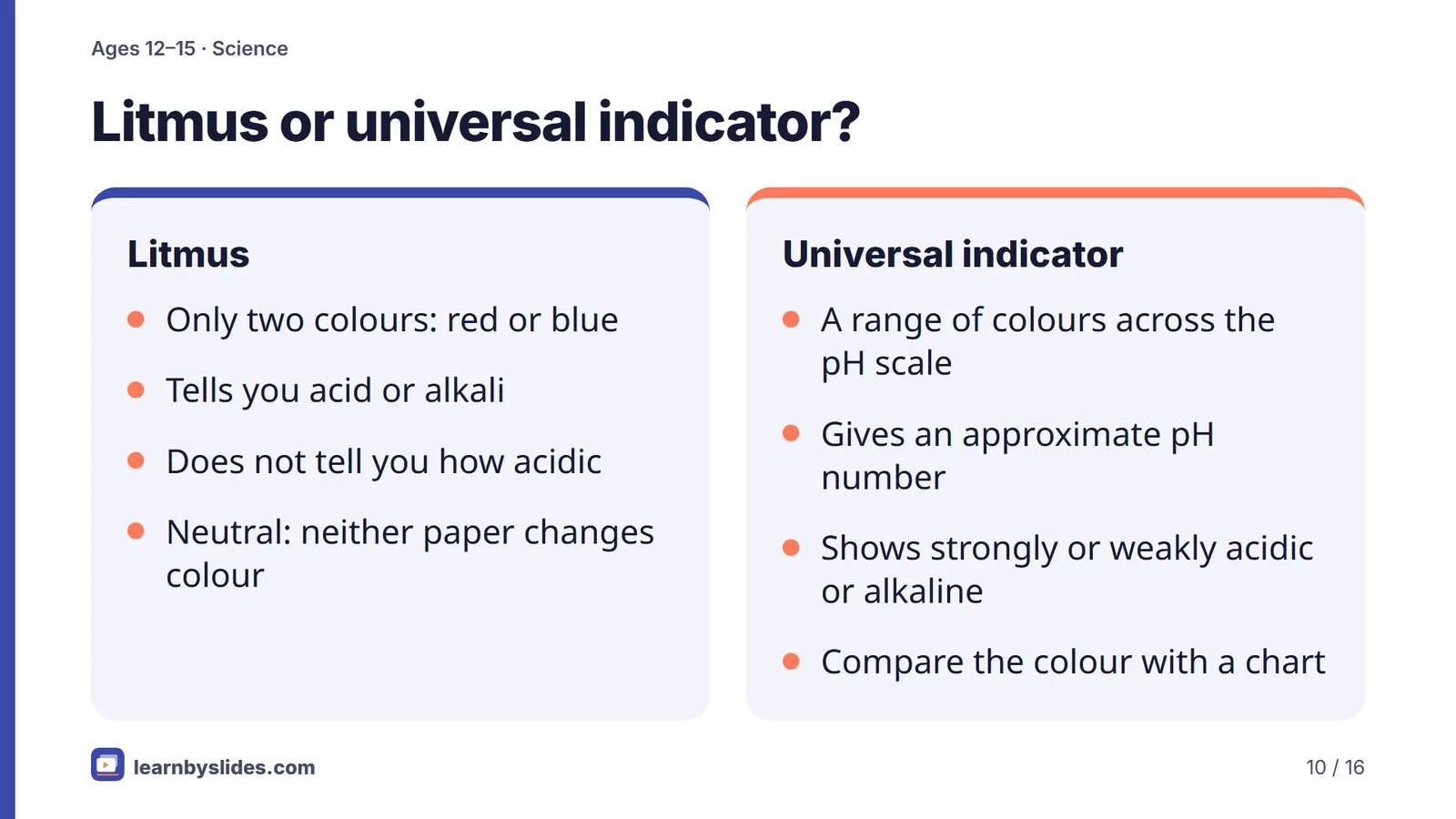
Litmus
- Only two colours: red or blue
- Tells you acid or alkali
- Does not tell you how acidic
- Neutral: neither paper changes colour
Universal indicator
- A range of colours across the pH scale
- Gives an approximate pH number
- Shows strongly or weakly acidic or alkaline
- Compare the colour with a chart
Speaker notes
Common confusion: students expect a positive litmus test always to involve a colour change. Teach the phrases 'turns red', 'stays red', 'turns blue' and 'stays blue'. An acid turns blue litmus red but leaves red litmus red.
11. Worked example: comparing two solutions
- Lemon juice: about pH 2. Coffee: about pH 5
- Difference: 5 − 2 = 3 steps
- Each step is ×10, so 10 × 10 × 10
- Lemon juice is about 1,000 times more acidic
- Coffee is still acidic, just much less so
Speaker notes
Work through each line on the board, then give a second pair to try: seawater (about pH 8) and household ammonia (about pH 12). Ammonia is about 10,000 times more alkaline. Remind students that these values are approximate; real samples vary.
12. Neutralisation
- Acid + base → salt + water
- Hydrogen ions from the acid react with hydroxide ions: H⁺ + OH⁻ → H₂O
- The pH moves towards 7
- Universal indicator changes towards green
- Too much alkali makes the mixture alkaline again
Speaker notes
In chemistry, 'salt' means a whole family of compounds, not just table salt. Ask students to predict what happens to the colour of universal indicator as alkali is added drop by drop to an acid: red, orange, yellow, then green at neutral, then blue and purple if too much alkali is added.
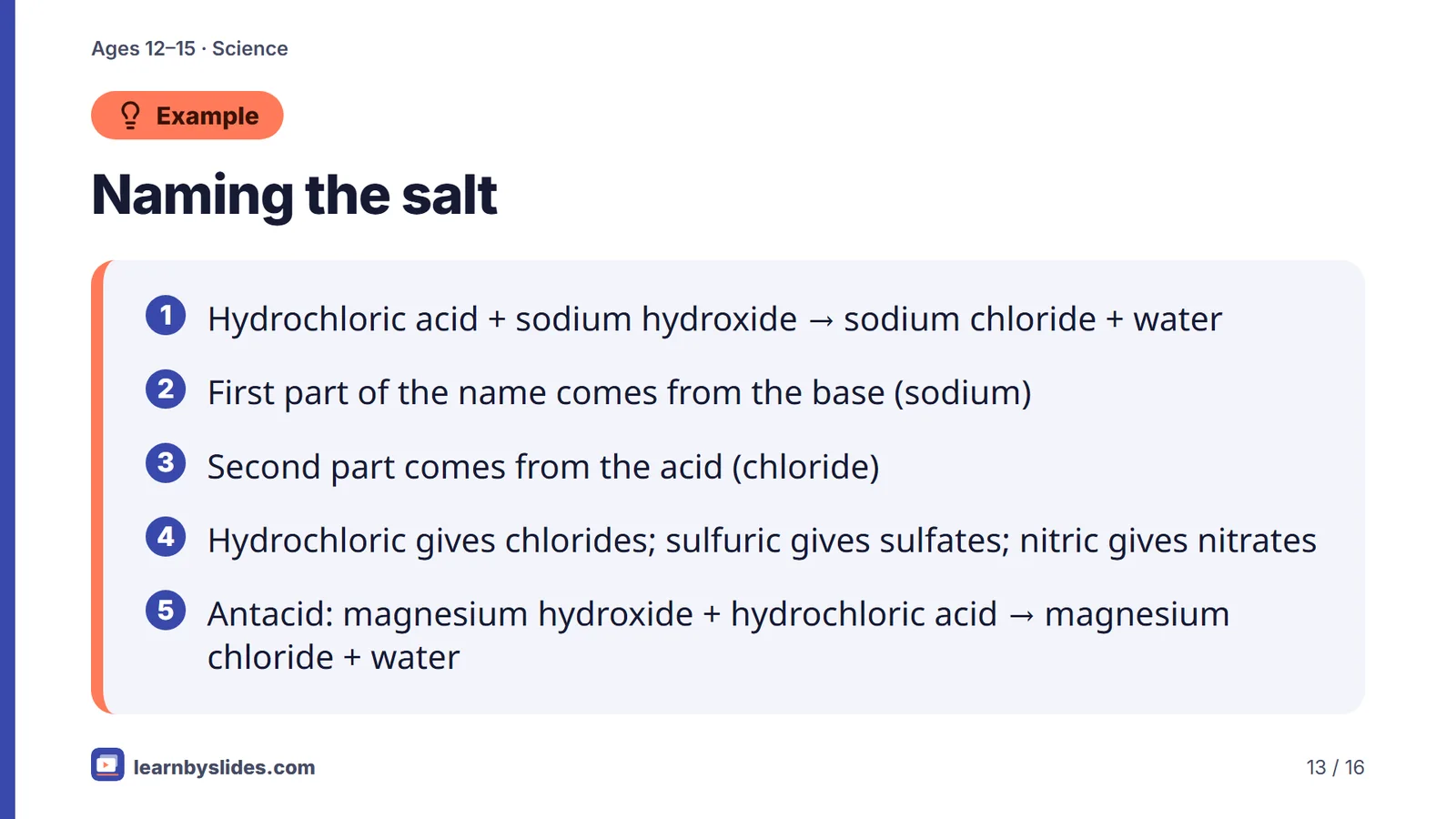
13. Naming the salt
- Hydrochloric acid + sodium hydroxide → sodium chloride + water
- First part of the name comes from the base (sodium)
- Second part comes from the acid (chloride)
- Hydrochloric gives chlorides; sulfuric gives sulfates; nitric gives nitrates
- Antacid: magnesium hydroxide + hydrochloric acid → magnesium chloride + water
Speaker notes
Give students three more to name: potassium hydroxide with nitric acid (potassium nitrate), sodium hydroxide with sulfuric acid (sodium sulfate), calcium hydroxide with hydrochloric acid (calcium chloride). Older students can write the balanced symbol equation, for example HCl + NaOH → NaCl + H₂O.
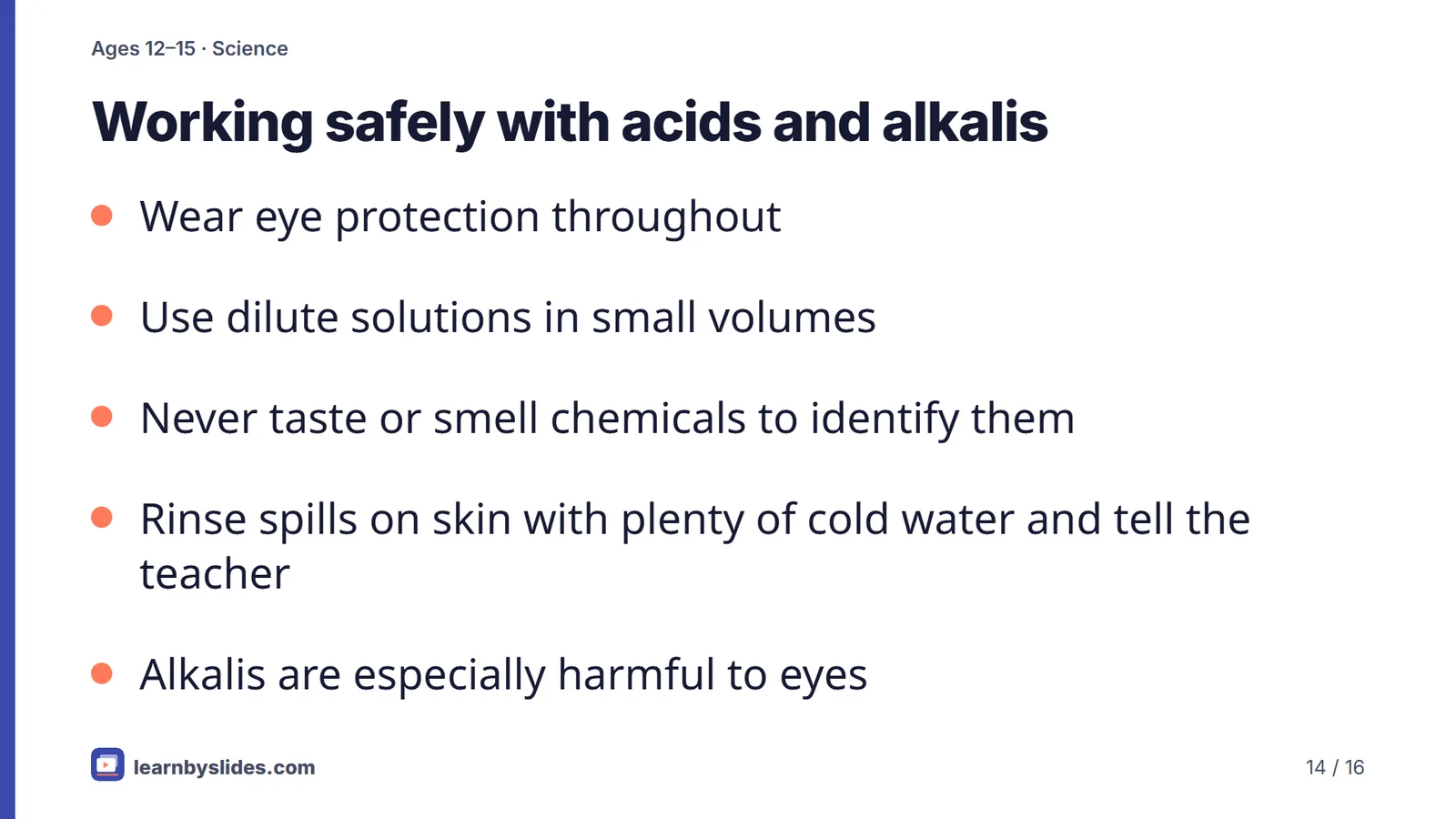
14. Working safely with acids and alkalis
- Wear eye protection throughout
- Use dilute solutions in small volumes
- Never taste or smell chemicals to identify them
- Rinse spills on skin with plenty of cold water and tell the teacher
- Alkalis are especially harmful to eyes
Speaker notes
Show the hazard symbols on the bottles you will use. Explain that 'dilute' and 'concentrated' describe how much acid is dissolved, while 'strong' and 'weak' describe how fully the acid releases hydrogen ions; older students meet this difference at GCSE and IGCSE level.
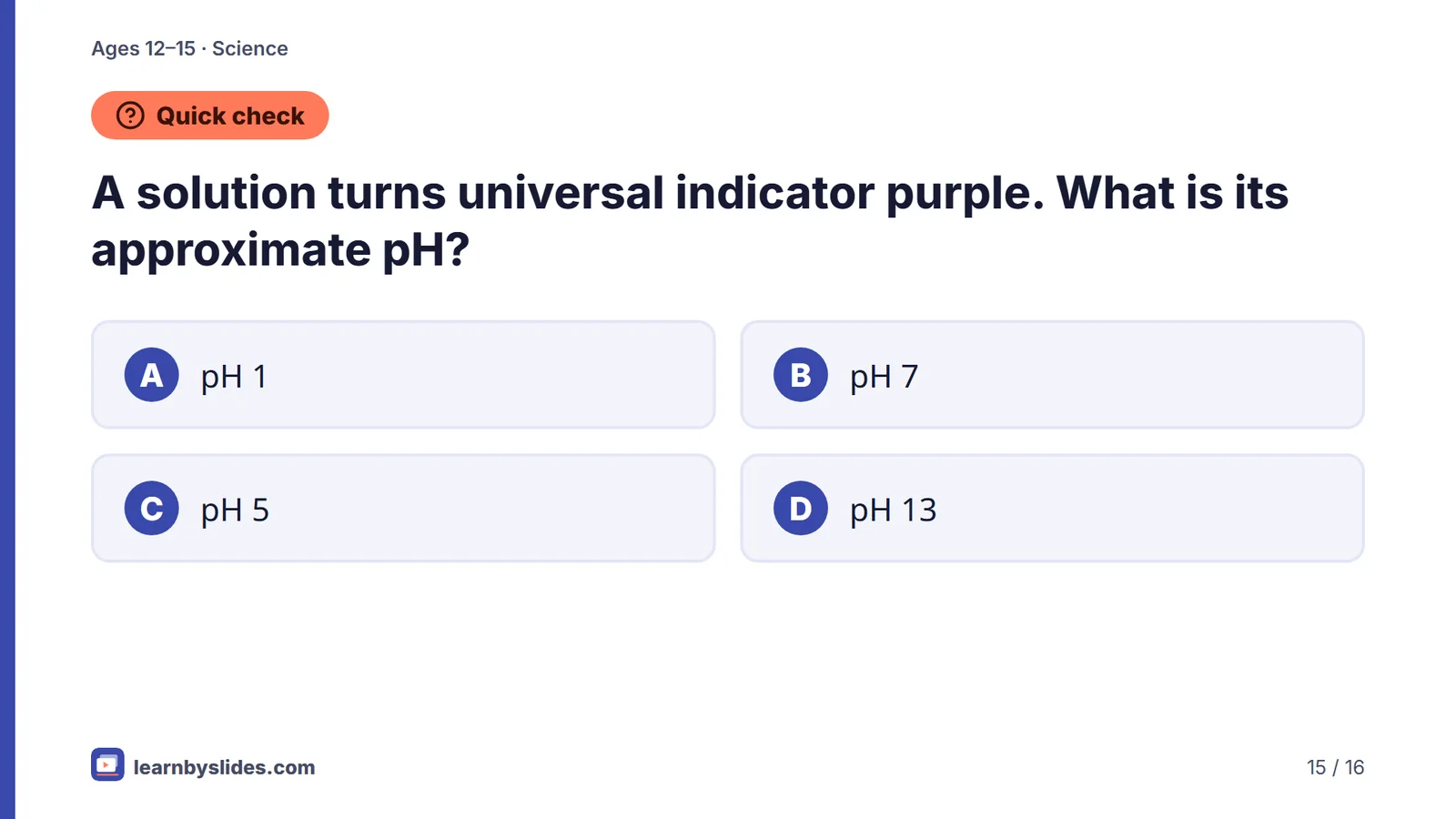
15. Quick check
A solution turns universal indicator purple. What is its approximate pH?
- pH 1
- pH 7
- pH 5
- pH 13
Speaker notes
Answer: D, pH 13. Purple means strongly alkaline. Students who chose A have mixed up the two ends of the scale; ask them which colour a strong acid gives (red).
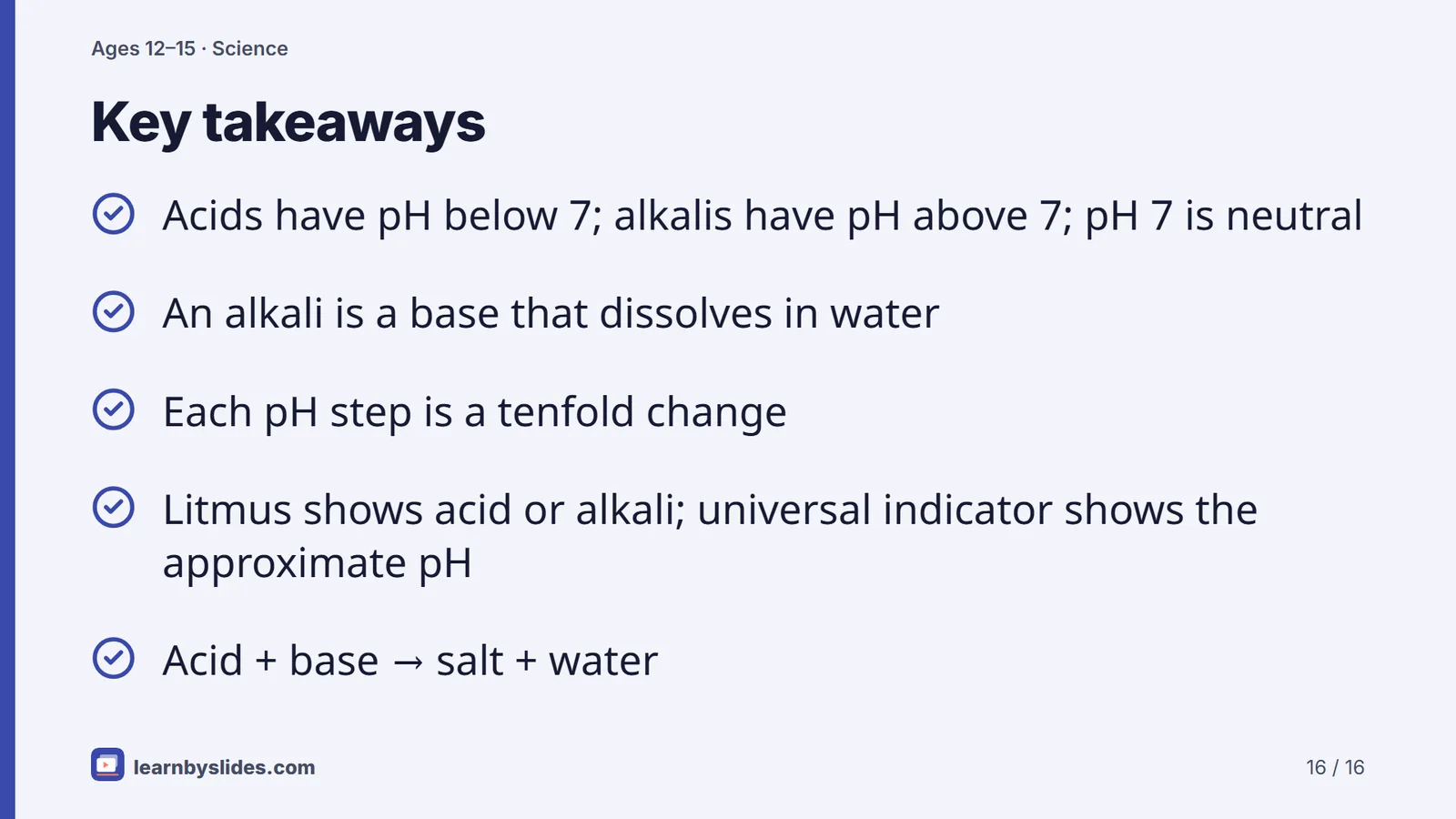
16. Key takeaways
- Acids have pH below 7; alkalis have pH above 7; pH 7 is neutral
- An alkali is a base that dissolves in water
- Each pH step is a tenfold change
- Litmus shows acid or alkali; universal indicator shows the approximate pH
- Acid + base → salt + water
Speaker notes
Return to the lemon, vinegar and indigestion tablets and ask students to explain how the tablets work, using the word neutralisation. Then move to the five-question quiz. Homework idea: research one use of neutralisation in farming, medicine or industry and explain it in three sentences.
Key terms
- Acid
- A substance that forms hydrogen ions (H⁺) in water and has a pH below 7.
- Base
- A substance that reacts with an acid to form a salt and water.
- Alkali
- A base that dissolves in water, forming hydroxide ions (OH⁻); its solution has a pH above 7.
- pH scale
- A scale, usually 0 to 14, that measures how acidic or alkaline a solution is; pH 7 is neutral.
- Indicator
- A substance that changes colour depending on whether a solution is acidic, neutral or alkaline.
- Universal indicator
- A mixture of indicators that shows a range of colours across the pH scale, giving an approximate pH.
- Neutralisation
- The reaction between an acid and a base that forms a salt and water and moves the pH towards 7.
- Salt
- A compound formed when the hydrogen in an acid is replaced by a metal (or ammonium), for example sodium chloride.
Quick quiz
Teacher notes
Suggested 45-minute plan: 5 min opener (lemon, vinegar, indigestion tablets), 8 min on acids, alkalis and bases (slides 3 to 5), 7 min on the pH scale and the tenfold rule (slides 6 to 8), 12 min indicator practical (slides 9 and 10), 8 min on neutralisation and naming salts (slides 11 to 13), 5 min for the quick check and quiz. Safe practical (12 minutes): in small groups, students add a few drops of universal indicator solution (or use universal indicator paper) to small samples in a spotting tile or test tubes, then record the colour and approximate pH. Suitable samples: lemon juice, vinegar, a dilute solution of bicarbonate of soda, tap water, a dilute washing-up liquid solution, and the teacher's dilute hydrochloric acid and sodium hydroxide (about 0.1 mol/dm³ or weaker). Red cabbage indicator is a cheap alternative; prepare the extract in advance from hot water so students do not need to boil anything. Safety: eye protection throughout; never taste or smell samples; do not use bleach, oven cleaner, drain cleaner or other concentrated household products; keep universal indicator solution away from flames, because it is flammable; mop up spills with plenty of water; wash hands at the end. Check hazards against your national guidance (for example CLEAPSS in the UK) and your school's risk assessment. Common misconceptions: a higher pH means a stronger acid; all acids are dangerous and all alkalis are safe; 'salt' only means table salt; neutralisation always gives exactly pH 7; a litmus test only counts if the colour changes. Extension: ask students to explain the difference between a strong acid and a concentrated acid, or to plan how they would find the volume of alkali needed to neutralise 10 cm³ of an acid using universal indicator.
Frequently asked questions
What is the difference between a base and an alkali?
A base is any substance that neutralises an acid to form a salt and water. An alkali is a base that dissolves in water. Sodium hydroxide is both a base and an alkali; copper oxide is a base but not an alkali because it does not dissolve.
Why is each step on the pH scale ten times more acidic?
pH is based on the concentration of hydrogen ions, measured on a logarithmic scale. A drop of one pH unit means ten times as many hydrogen ions, so pH 3 is ten times more acidic than pH 4 and a hundred times more acidic than pH 5.
Which household substances are safe to test in class?
Lemon juice, vinegar, dilute bicarbonate of soda solution, tap water and dilute washing-up liquid are suitable with eye protection. Avoid bleach, oven cleaner and drain cleaner, which are corrosive. Always follow your school's risk assessment.
Does neutralisation always give exactly pH 7?
Only if exactly the right amounts of acid and alkali react. With too much acid the mixture stays acidic, and with too much alkali it becomes alkaline, which is why indicators or a pH meter are used to find the end point.
Sources & methodology
Every fact is checked against the sources below. We write original explanations and draw original graphics; no figures are copied from textbooks. Spotted an error? See our corrections policy.
- Chemistry 2e, 14.2 pH and pOH (OpenStax (Rice University), accessed 1 Oct 2026)
- Chemistry 2e, 4.2 Classifying Chemical Reactions (acid-base reactions) (OpenStax (Rice University), accessed 1 Oct 2026)
- pH and Water (U.S. Geological Survey, accessed 1 Oct 2026)
- Making a pH indicator using red cabbage (Royal Society of Chemistry (RSC Education), accessed 1 Oct 2026)
- Neutralisation circles (Royal Society of Chemistry (RSC Education), accessed 1 Oct 2026)
- pH scale and universal indicator solution (KS3) (Oak National Academy, accessed 1 Oct 2026)
Editorial review pending · Updated
Related lessons
 Science · Ages 12–15
Electric Circuits: Current, Voltage & Resistance Lesson Slides
A ready-to-teach physics lesson for ages 12–15 on electric circuits: current, potential difference (voltage), resistance and Ohm's law, how to use ammeters and voltmeters, and the rules for series and parallel circuits.
 Science · Ages 11–14
States of Matter and the Particle Model Lesson Slides
A ready-to-teach science lesson for ages 11–14 on solids, liquids and gases: how particles are arranged and move, the changes of state, energy in and out, evaporation vs boiling, and gas pressure. Speaker notes on every slide, a 5-question quiz and a worksheet.
 Science · Ages 12–15
Forces and Newton's Laws of Motion Lesson Slides
A ready-to-teach physics lesson for ages 12–15 on forces: contact and non-contact forces, resultant force, balanced and unbalanced forces, mass and weight, and Newton's three laws of motion, with F = ma worked examples.
 Science · Ages 13–16
Photosynthesis: How Plants Make Food Lesson Slides
A ready-to-teach biology lesson for ages 13–16 on photosynthesis: the word and balanced equations, how a leaf is built for the job, limiting factors and what plants do with glucose. Speaker notes on every slide, a 5-question quiz and a worksheet.
 Science · Ages 11–14
Plant and Animal Cells: Structure and Function Lesson Slides
A ready-to-teach lesson for ages 11–14 on plant and animal cells: the parts they share, the three extra parts plant cells have, and what each part does. Speaker notes on every slide, a microscope example, a 5-question quiz and a worksheet.
 Science · Ages 15–16
Chemical Reactions and Equations: Lesson Slides & Worksheet
A ready-to-teach chemistry lesson for ages 15–16 on chemical reactions and equations: writing and balancing equations, the main reaction types, exothermic and endothermic changes, oxidation, reduction, corrosion and rancidity.
For teachers and parents: new LearnBySlides resources by email
One short email when new free resources go live. For adults (18+) only. No spam, no tracking in emails, unsubscribe anytime.