How to Study Effectively: Spaced Repetition and Active Recall
Research-based slides on studying smarter: why rereading and highlighting fade, how self-testing and spaced reviews work, the 10–20% spacing rule, and a 30-day exam plan, with notes and a quiz.
16 slides · 40 min lesson · 5-question quiz · speaker notes
Learning objectives
- Explain why rereading and highlighting create an illusion of knowing.
- Use active recall in every study session through self-testing.
- Plan spaced reviews using the 10–20% rule for a real exam date.
- Write flashcards and self-tests that support retrieval.
- Compare high-, moderate- and low-utility study techniques.
The short answer
If you want to remember what you study, test yourself and spread your reviews out over time. In a major review of ten popular study techniques, Dunlosky and colleagues (2013) gave only two a "high utility" rating: practice testing and distributed practice. Both work for learners of different ages and abilities and across many kinds of test. Rereading, highlighting and summarising were rated low utility. This deck turns those findings into habits any student, from Class 9 to a UPSC aspirant, can use from tomorrow.
Why rereading and highlighting disappoint
Rereading makes a page feel familiar, and familiarity is easily mistaken for knowing. In Roediger and Karpicke's 2006 experiments, repeated studying even increased students' confidence that they would remember, yet they remembered less a week later than students who had tested themselves. Exams ask you to produce an answer from memory, so the useful question is not "does this look familiar?" but "can I recall it with the book closed?"
Active recall: the testing effect
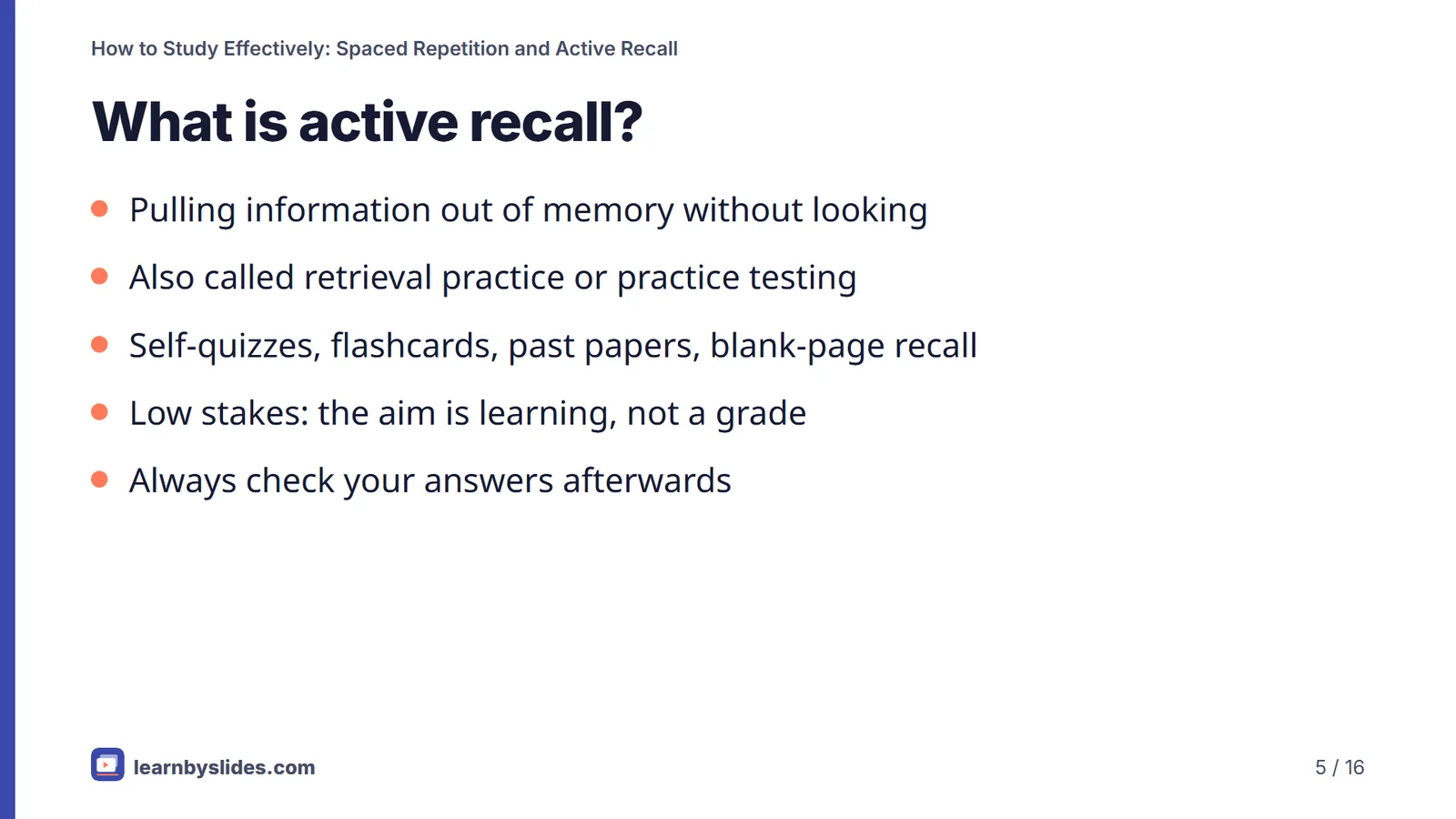
Active recall, also called retrieval practice, means pulling information out of memory: answering questions, using flashcards, attempting past papers or writing everything you remember on a blank page. Researchers call its benefit the testing effect.
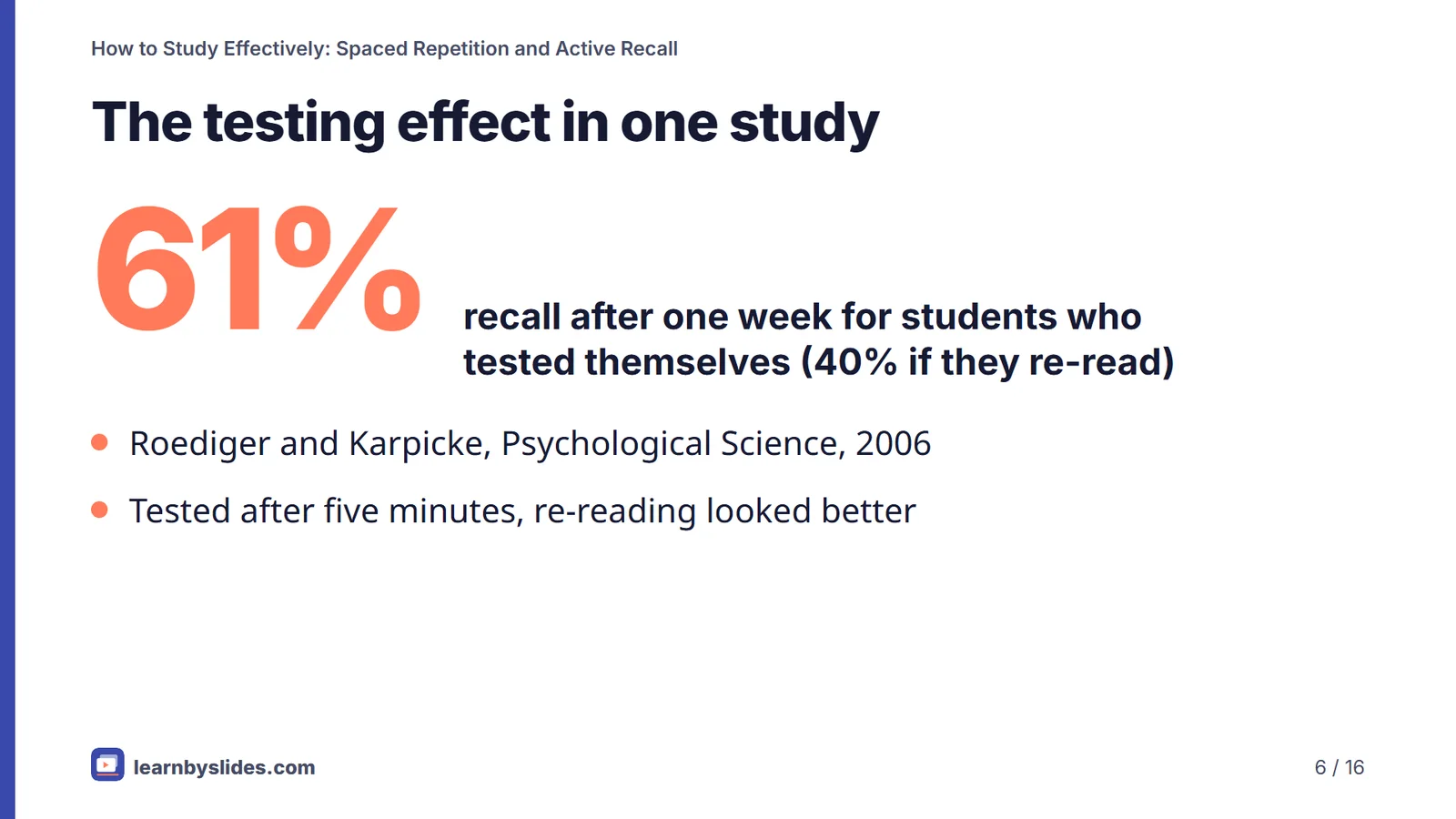
In Roediger and Karpicke's second experiment, students who repeatedly tested themselves recalled 61% of a passage after one week, against 40% for students who only re-read it, even though the re-readers had read the passage far more often. Tested after only five minutes, re-reading looked better, which is exactly why cramming feels effective the night before.
Spaced repetition: how far apart?
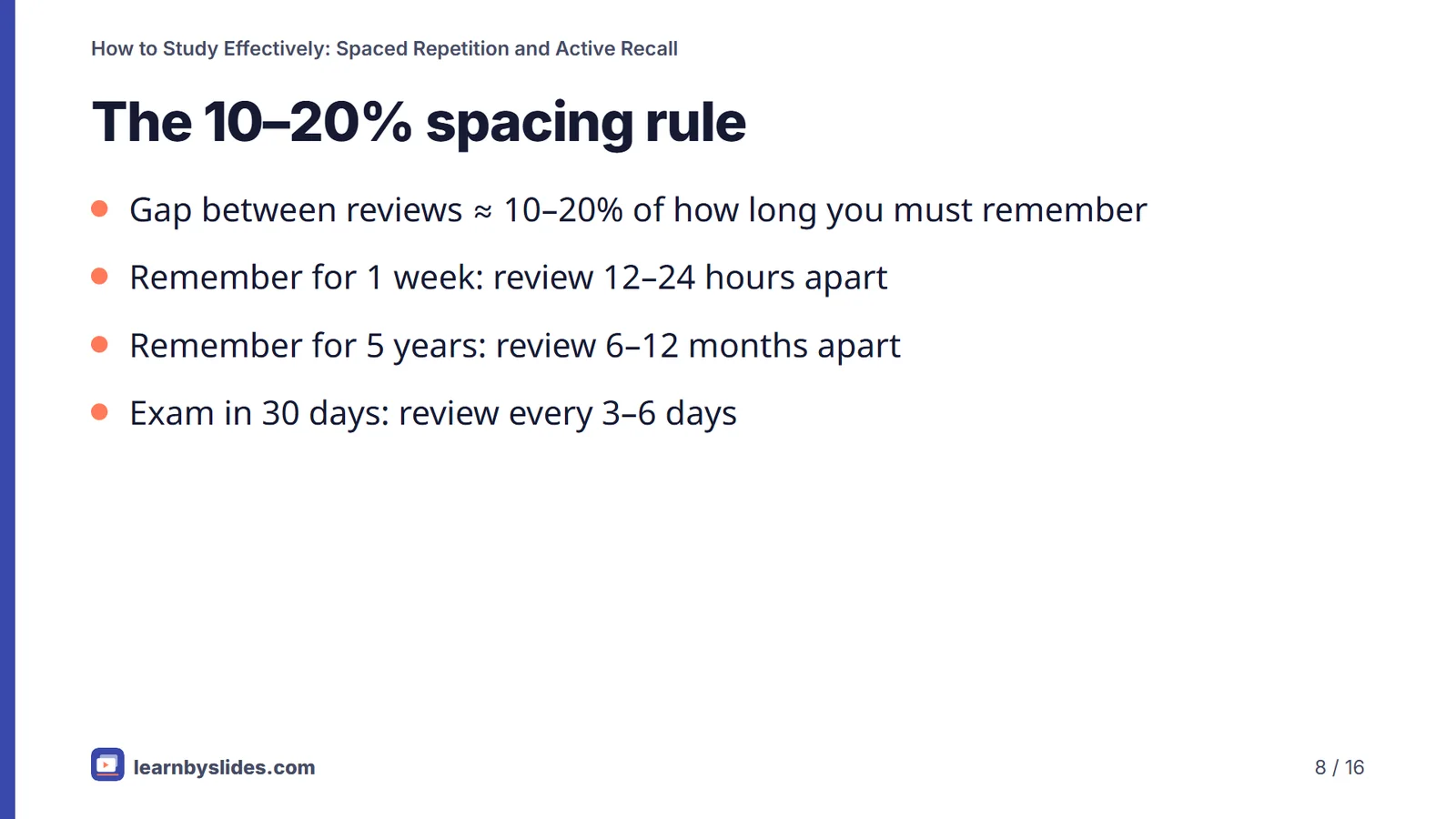
Distributed (spaced) practice means reviewing the same material in several sessions separated by gaps, instead of one long block. Dunlosky and colleagues summarise a large internet study by Cepeda and colleagues (2008): the best gap between sessions was about 10–20% of how long you need to remember. To remember something for a week, space sessions 12 to 24 hours apart; for five years, 6 to 12 months apart. For an exam 30 days away, that suggests reviewing a topic every three to six days.
Putting it together
Combine the two techniques. After a lesson, close the book and recall the key points. Turn each point into a question or flashcard. Revisit the questions after a few days, check your answers, and spend extra time on the ones you missed. Mix different types of problems in one session (interleaving) and explain steps in your own words (self-explanation); both were rated moderate utility, useful but with less evidence so far. Expect it to feel harder than rereading: that effort is part of what makes the memory last.
How to use these slides
Use the deck as a 40-minute study-skills lesson at the start of a term, or as a quick refresher a month before board or entrance exams. Run the blank-page recall activity live so students feel the difference between recognising and recalling. Then ask each student to build a 30-day plan for one real chapter and bring it to the next class. The five-question quiz on this page doubles as a first practice test.
Slide-by-slide content
1. How to Study Effectively
Active recall and spaced repetition: what the research says and how to use it
Speaker notes
Ask the room: how many of you reread a chapter and felt sure you knew it, then went blank in the exam? Tell them today's session explains why that happens and what research says works better.
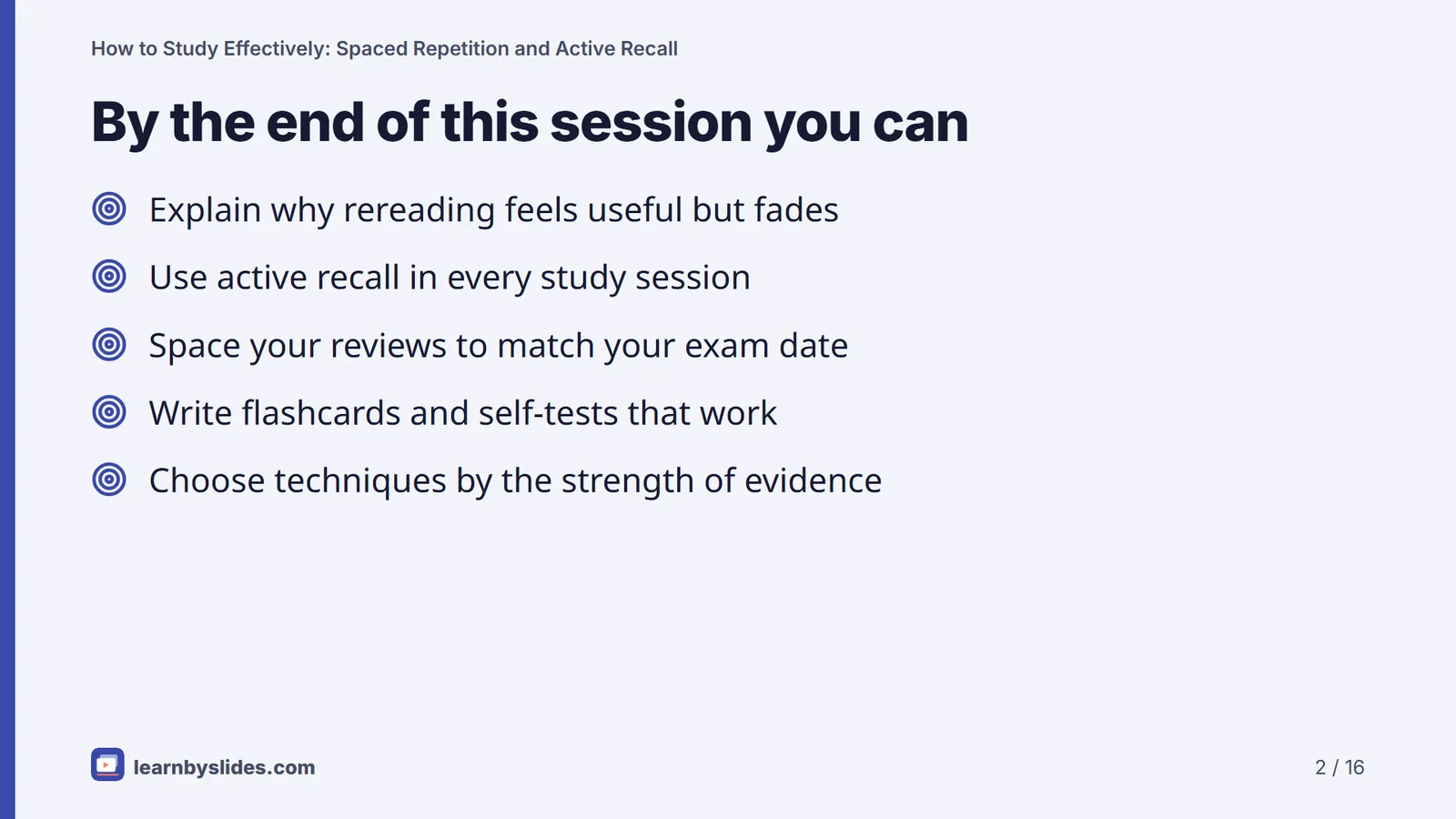
2. By the end of this session you can
- Explain why rereading feels useful but fades
- Use active recall in every study session
- Space your reviews to match your exam date
- Write flashcards and self-tests that work
- Choose techniques by the strength of evidence
Speaker notes
Read the objectives aloud. Point out that these methods apply to any subject, from Class 7 maths to UPSC polity, because they are about how memory works.
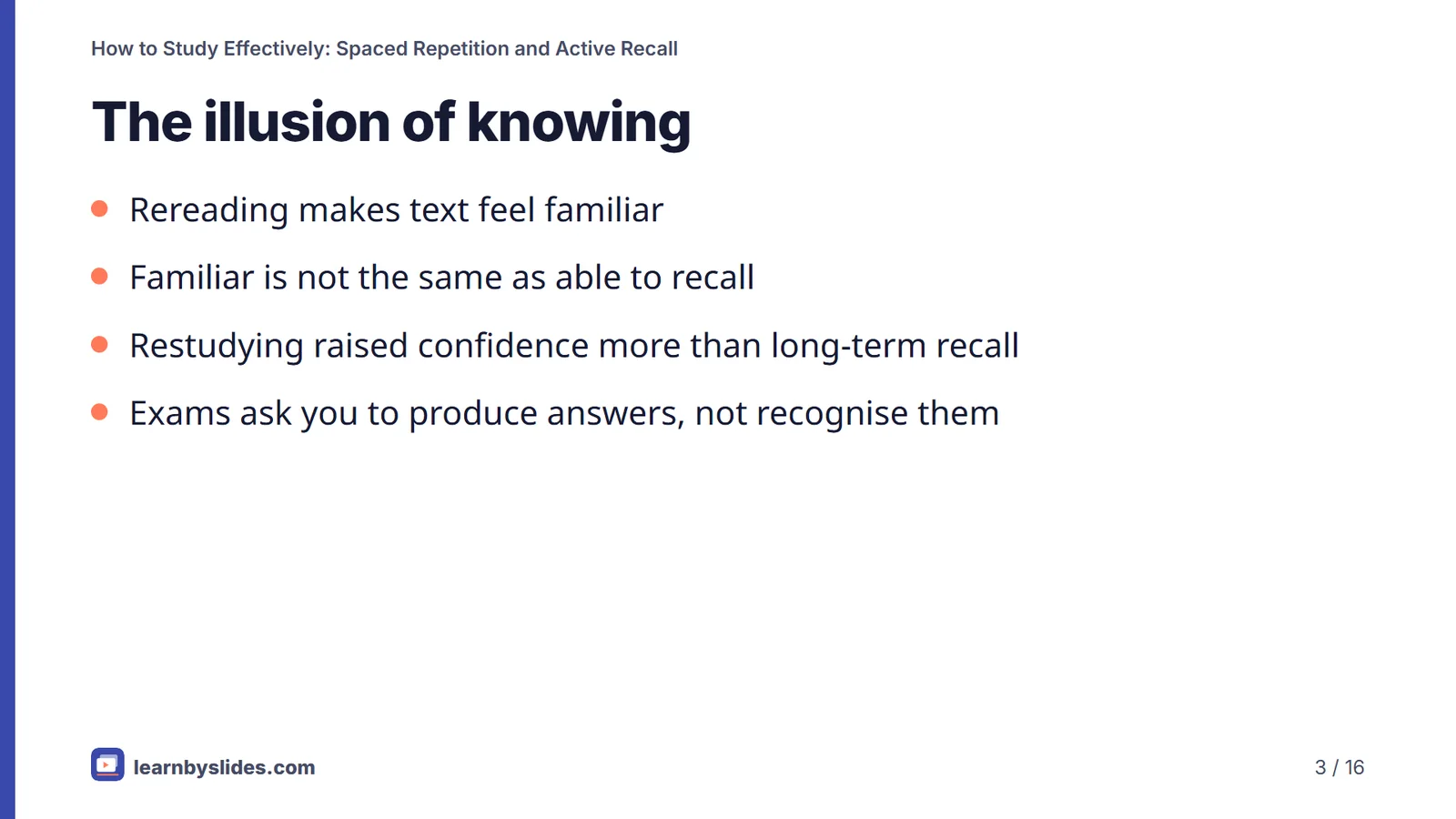
3. The illusion of knowing
- Rereading makes text feel familiar
- Familiar is not the same as able to recall
- Restudying raised confidence more than long-term recall
- Exams ask you to produce answers, not recognise them
Speaker notes
Ask: can you recognise a friend's phone number when you see it? Can you write it down from memory? That gap is the illusion of knowing. A common misconception is that a lesson that feels easy has been learned well.
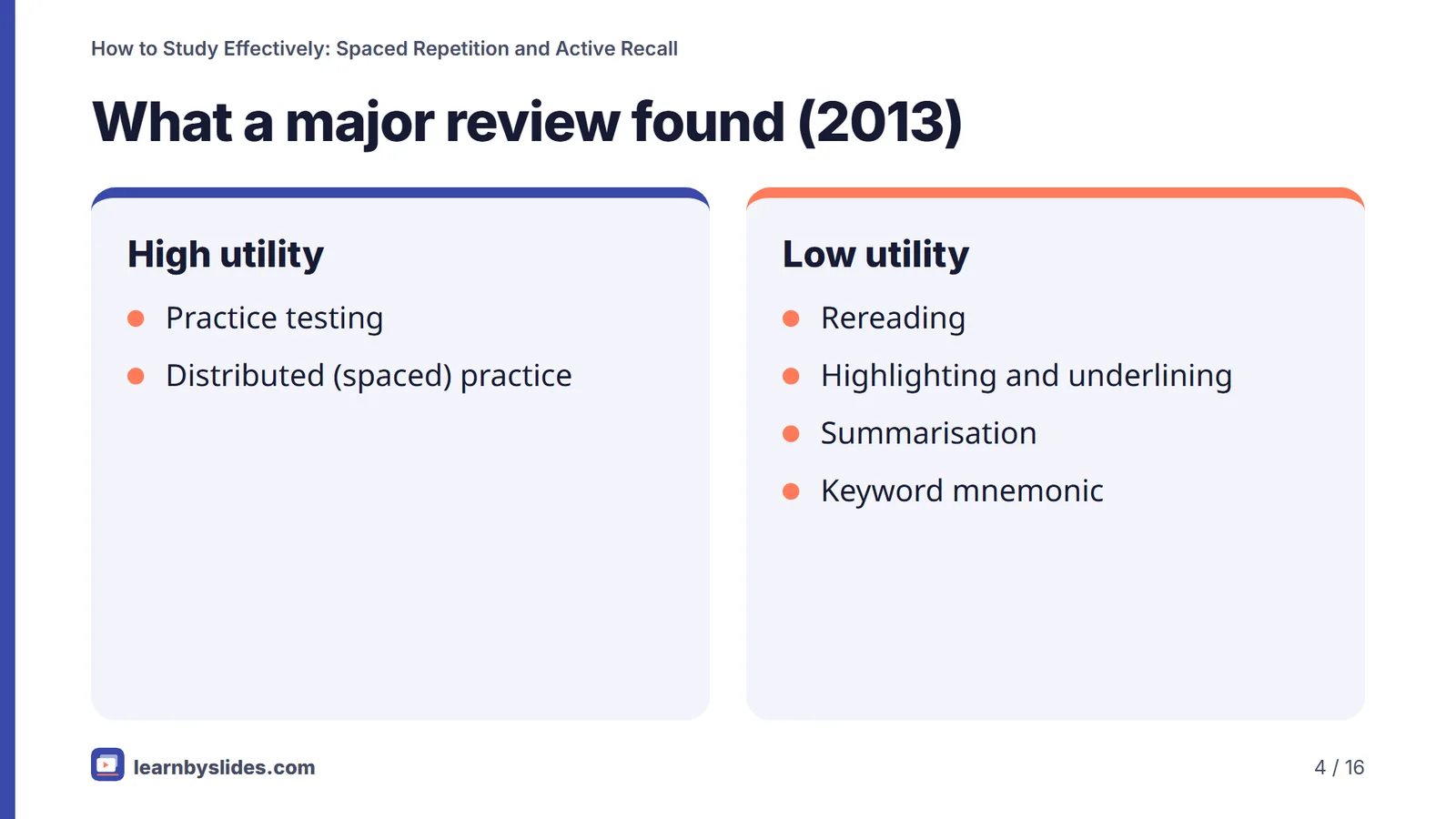
4. What a major review found (2013)
High utility
- Practice testing
- Distributed (spaced) practice
Low utility
- Rereading
- Highlighting and underlining
- Summarisation
- Keyword mnemonic
Speaker notes
This comes from Dunlosky and colleagues' review of ten techniques in Psychological Science in the Public Interest. Elaborative interrogation, self-explanation and interleaving were rated moderate. Ask: which of these do you use most often?
5. What is active recall?
- Pulling information out of memory without looking
- Also called retrieval practice or practice testing
- Self-quizzes, flashcards, past papers, blank-page recall
- Low stakes: the aim is learning, not a grade
- Always check your answers afterwards
Speaker notes
Demonstrate blank-page recall: give everyone two minutes to write what they remember from the last slide. Ask: did that feel harder than rereading? That effort is the point.
6. The testing effect in one study
61% recall after one week for students who tested themselves (40% if they re-read)
- Roediger and Karpicke, Psychological Science, 2006
- Tested after five minutes, re-reading looked better
Speaker notes
In the experiment, the self-testing group read the passage about 3.4 times and the re-reading group about 14.2 times, yet the testers remembered more a week later. Ask: why might cramming feel effective the night before a test?
7. Forgetting, and why spacing helps
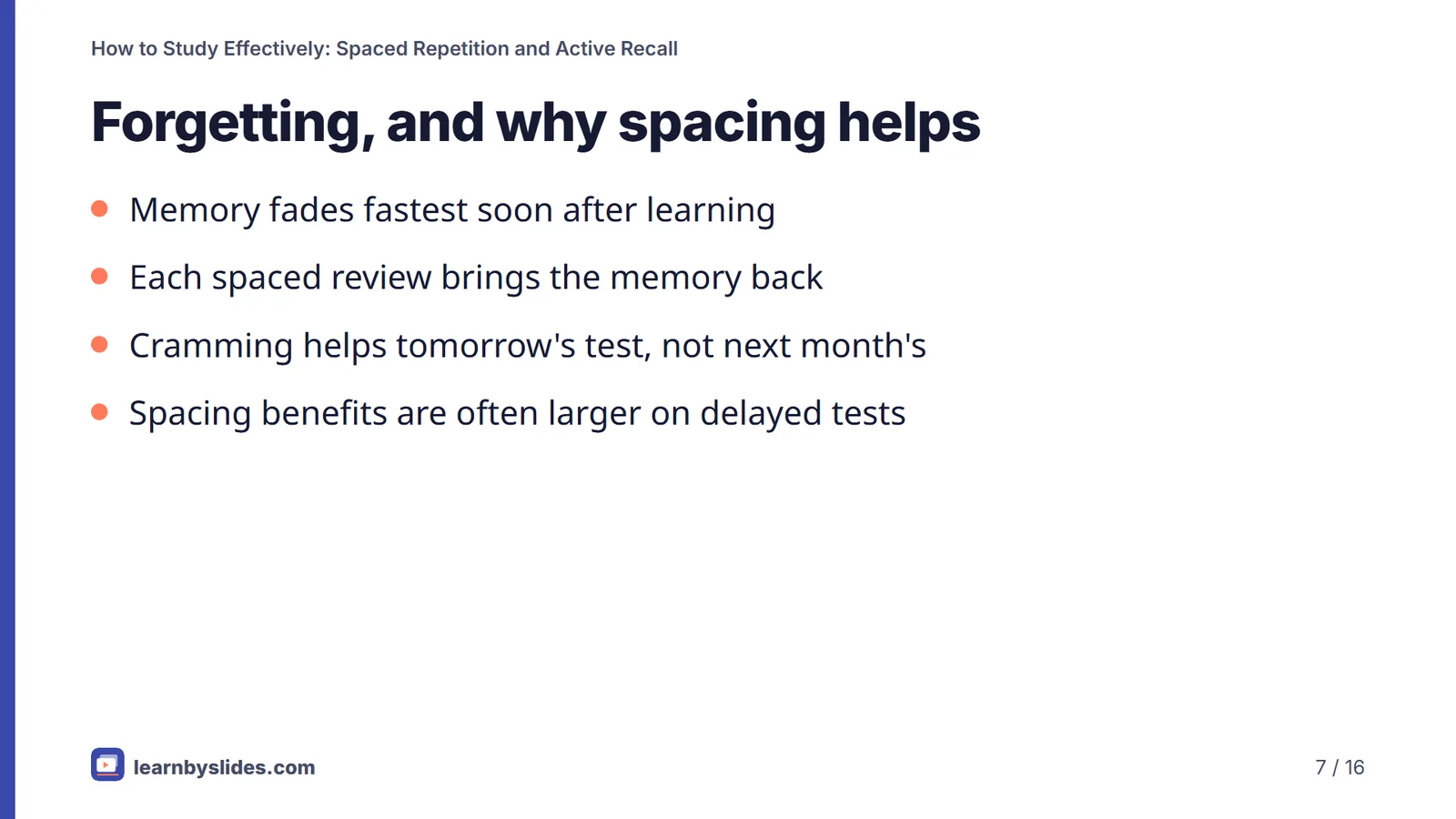
- Memory fades fastest soon after learning
- Each spaced review brings the memory back
- Cramming helps tomorrow's test, not next month's
- Spacing benefits are often larger on delayed tests
Speaker notes
Sketch a forgetting curve that drops steeply and then levels off, the pattern first described by Hermann Ebbinghaus. Ask: when would a review be most useful, just after class or a few days later? A few days later, when recall takes effort.
8. The 10–20% spacing rule
- Gap between reviews ≈ 10–20% of how long you must remember
- Remember for 1 week: review 12–24 hours apart
- Remember for 5 years: review 6–12 months apart
- Exam in 30 days: review every 3–6 days
Speaker notes
The rule comes from a large study by Cepeda and colleagues (2008), summarised in the Dunlosky review. Ask students to work out the gap for an exam 60 days away: 6 to 12 days.
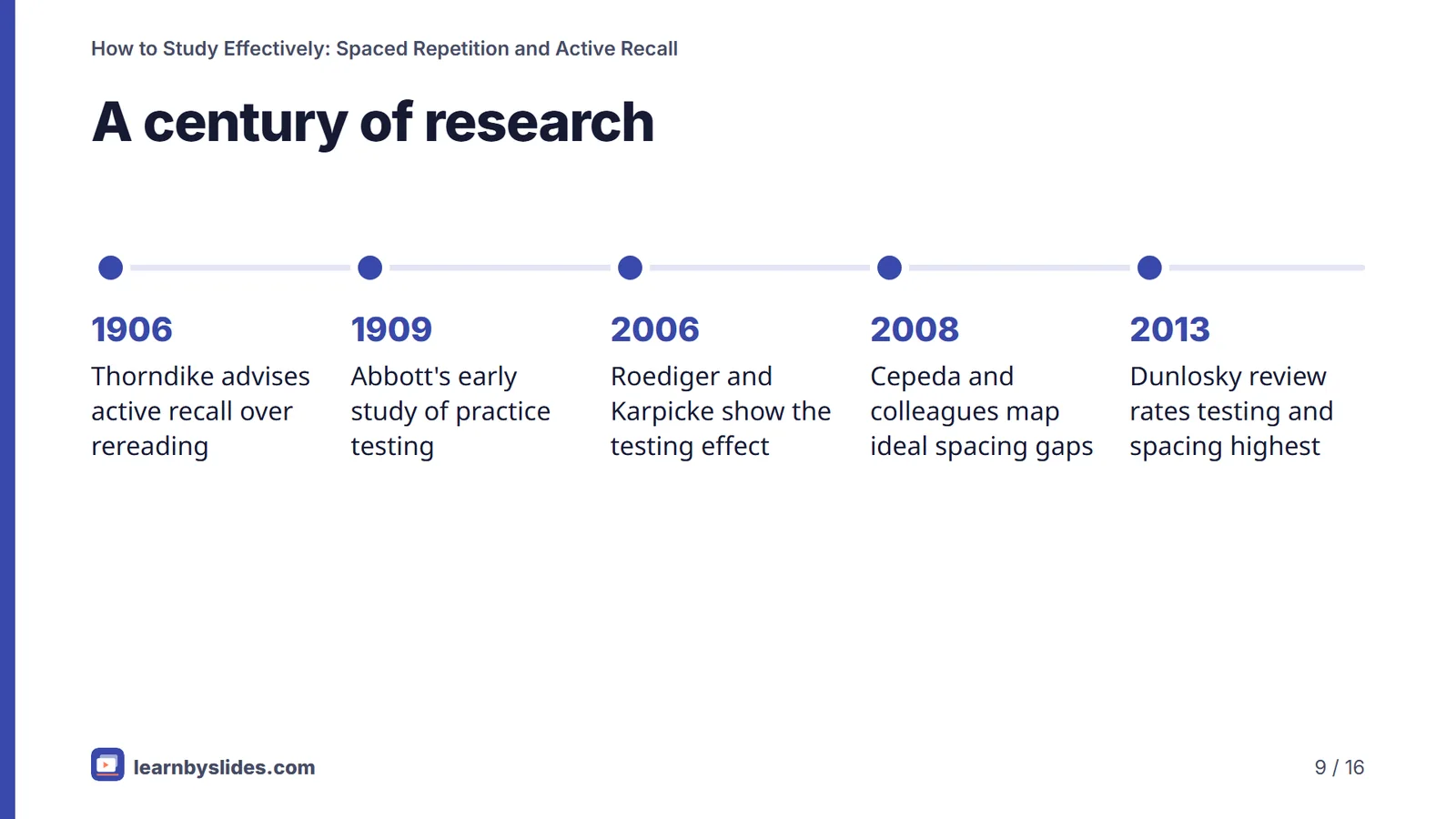
9. A century of research
- 1906: Thorndike advises active recall over rereading
- 1909: Abbott's early study of practice testing
- 2006: Roediger and Karpicke show the testing effect
- 2008: Cepeda and colleagues map ideal spacing gaps
- 2013: Dunlosky review rates testing and spacing highest
Speaker notes
Stress that these ideas are not a new trend: the Dunlosky review describes more than 100 years of research on practice testing. Ask: why might schools still rely mostly on rereading and notes?
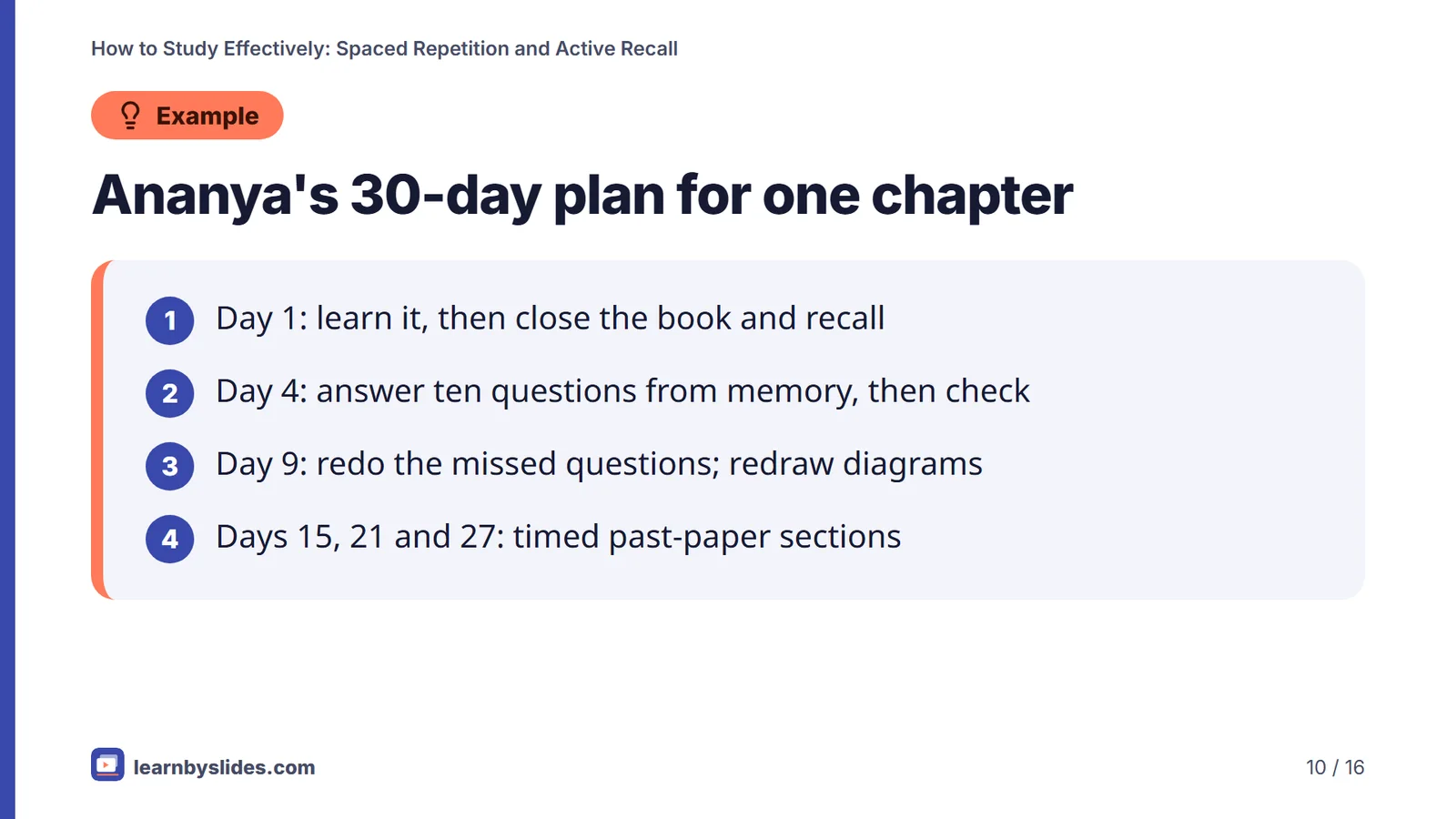
10. Ananya's 30-day plan for one chapter
- Day 1: learn it, then close the book and recall
- Day 4: answer ten questions from memory, then check
- Day 9: redo the missed questions; redraw diagrams
- Days 15, 21 and 27: timed past-paper sections
Speaker notes
The gaps of three to six days follow the 10–20% rule for a 30-day exam. Ask students to draft the same plan for one chapter of their own. A common mistake is to reread on review days instead of testing.
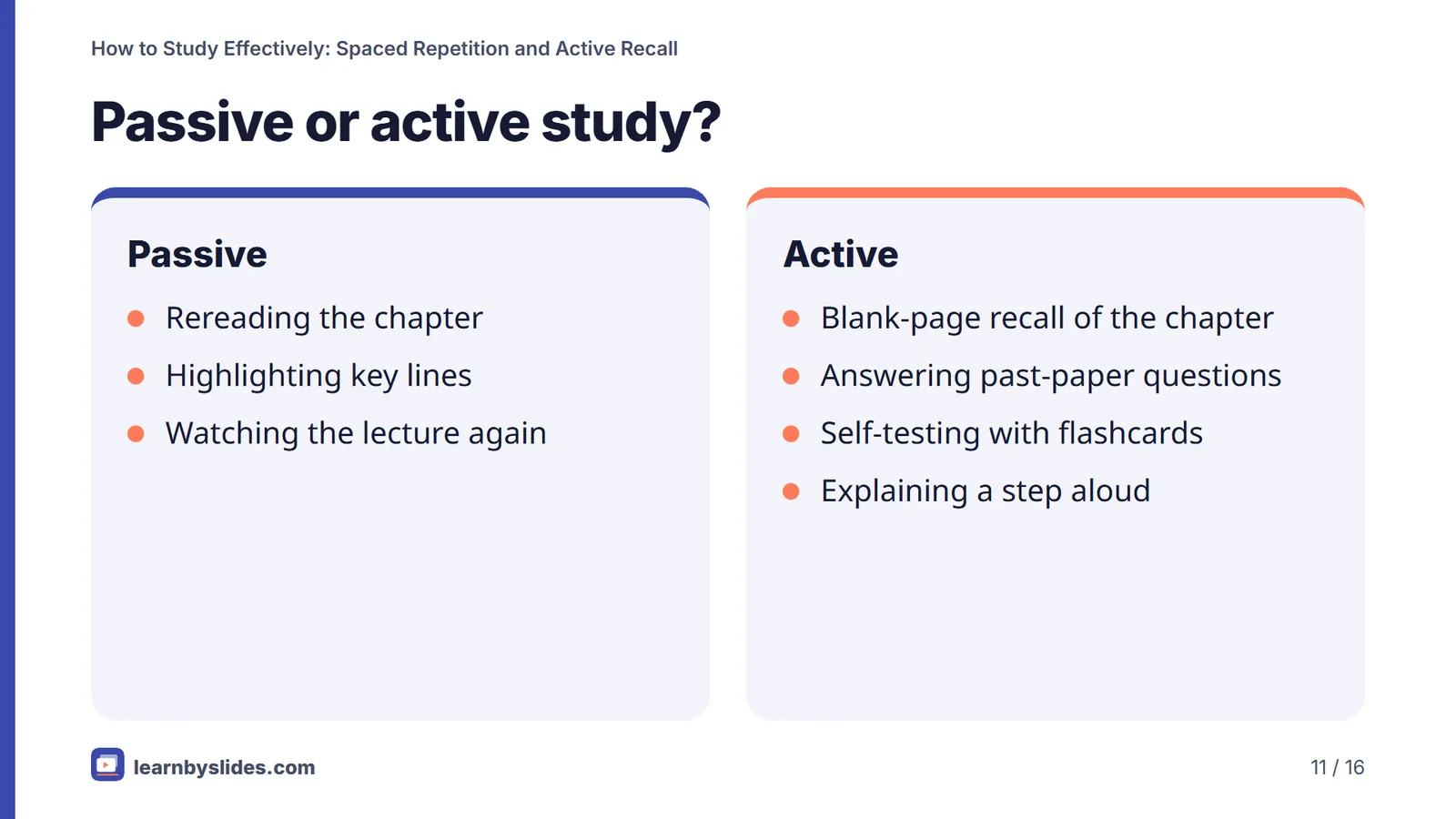
11. Passive or active study?
Passive
- Rereading the chapter
- Highlighting key lines
- Watching the lecture again
Active
- Blank-page recall of the chapter
- Answering past-paper questions
- Self-testing with flashcards
- Explaining a step aloud
Speaker notes
Ask students to convert one passive habit into an active one, for example turning highlights into questions. Passive methods feel smoother, which is why they are so popular.
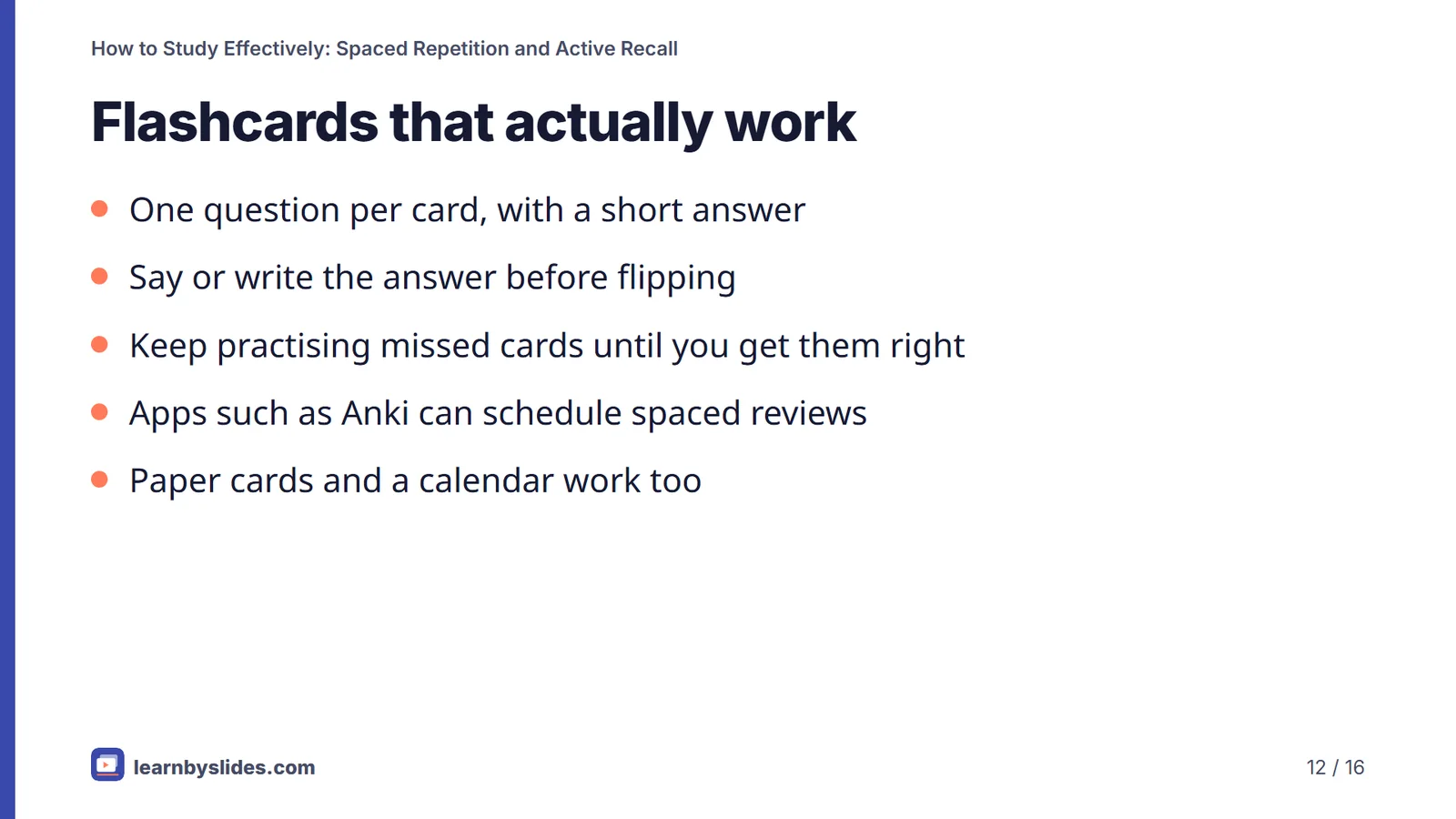
12. Flashcards that actually work
- One question per card, with a short answer
- Say or write the answer before flipping
- Keep practising missed cards until you get them right
- Apps such as Anki can schedule spaced reviews
- Paper cards and a calendar work too
Speaker notes
Show one bad card (a whole paragraph) and one good card (a single question). Ask: why does answering before flipping matter? Flipping first turns recall back into rereading.
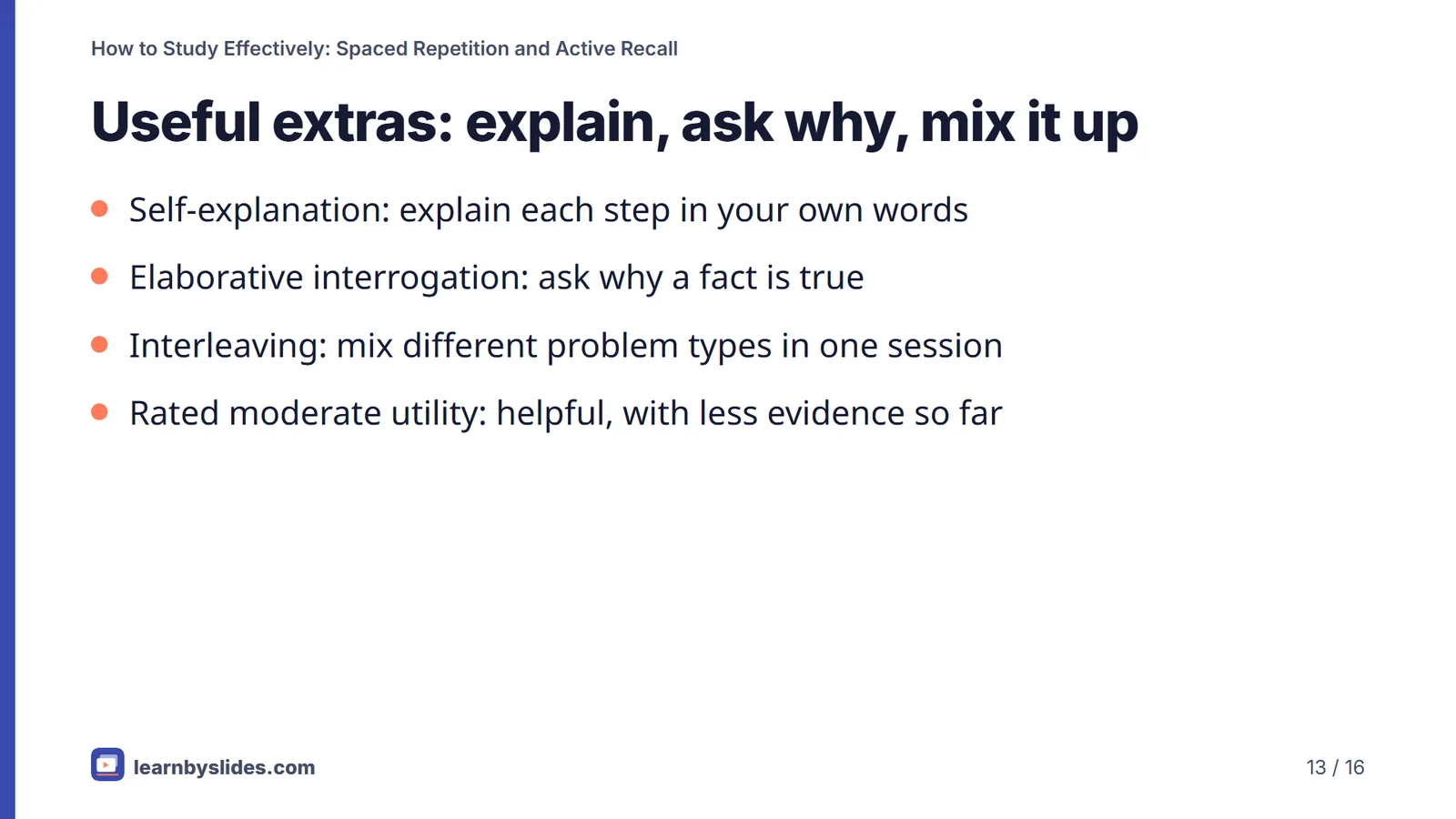
13. Useful extras: explain, ask why, mix it up
- Self-explanation: explain each step in your own words
- Elaborative interrogation: ask why a fact is true
- Interleaving: mix different problem types in one session
- Rated moderate utility: helpful, with less evidence so far
Speaker notes
In maths, interleaving means mixing questions from several chapters instead of doing twenty of one kind. Ask: why might mixed practice feel harder but help in an exam? You must first decide which method a question needs.
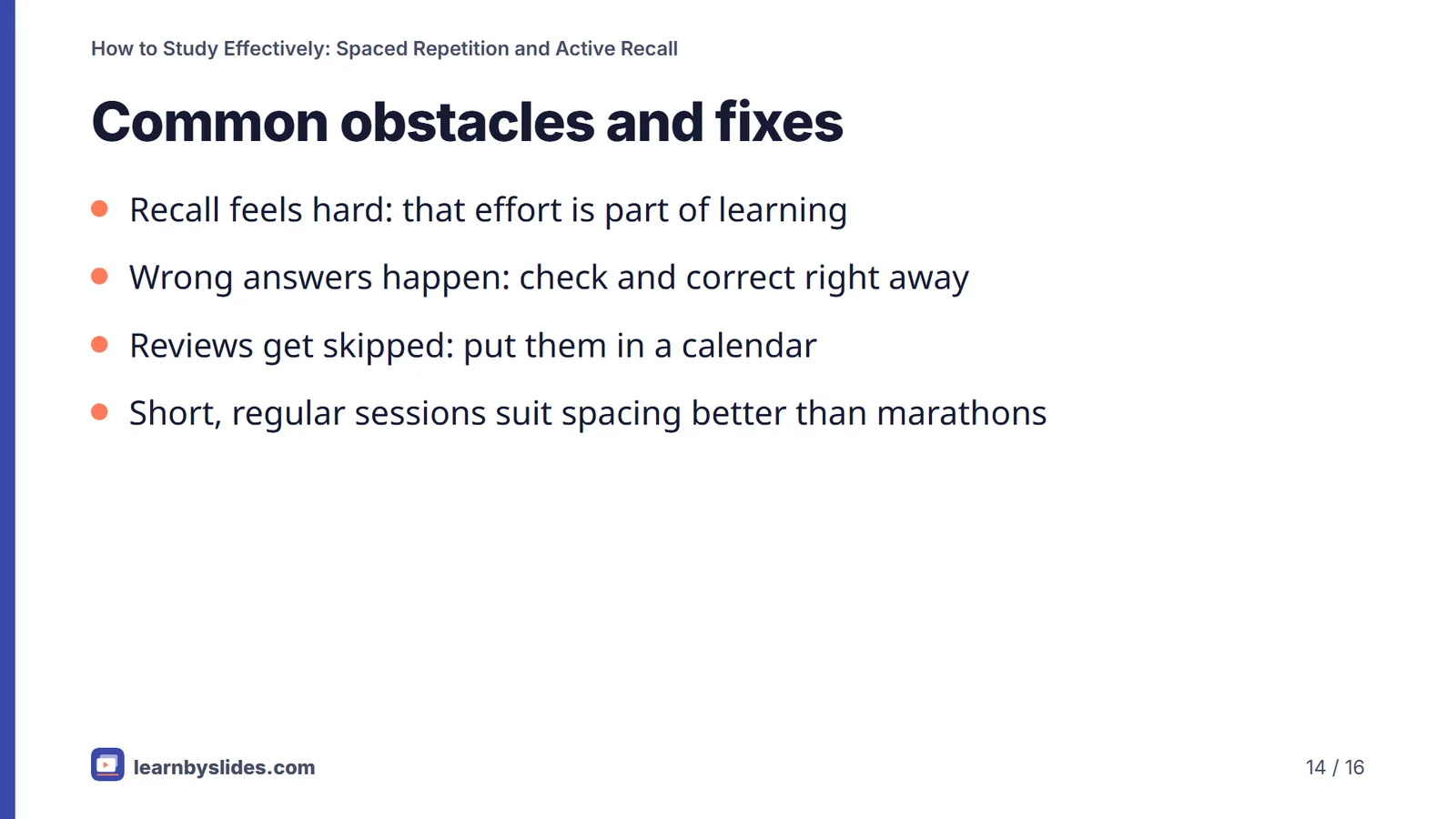
14. Common obstacles and fixes
- Recall feels hard: that effort is part of learning
- Wrong answers happen: check and correct right away
- Reviews get skipped: put them in a calendar
- Short, regular sessions suit spacing better than marathons
Speaker notes
Reassure students that forgetting a card is normal and useful feedback. Ask each student to name one obstacle they expect and one fix they will try this week.
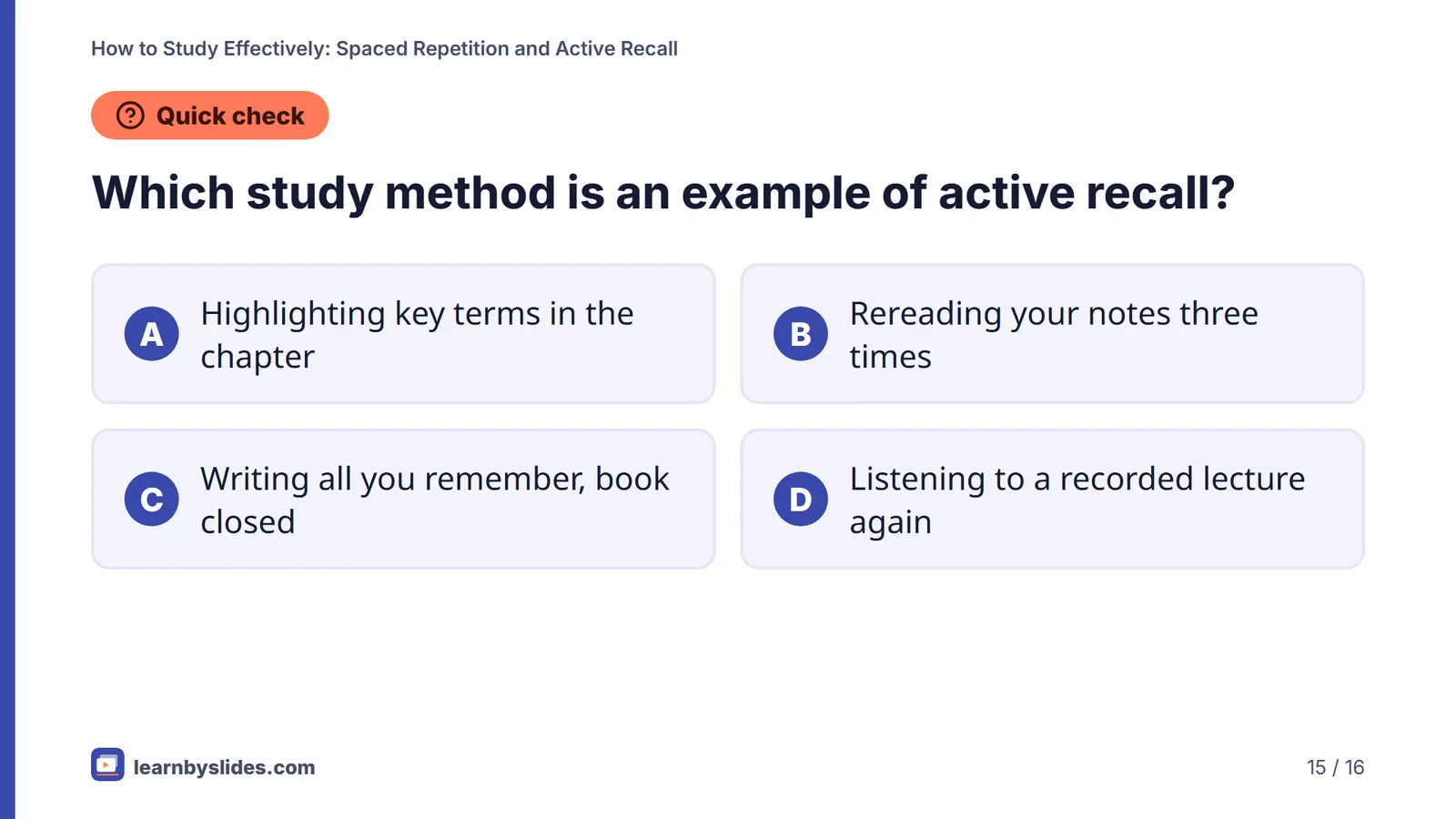
15. Quick check
Which study method is an example of active recall?
- Highlighting key terms in the chapter
- Rereading your notes three times
- Writing all you remember, book closed
- Listening to a recorded lecture again
Speaker notes
Answer: C, writing everything you remember with the book closed. The other three are passive review. Take a show of hands before revealing the answer.
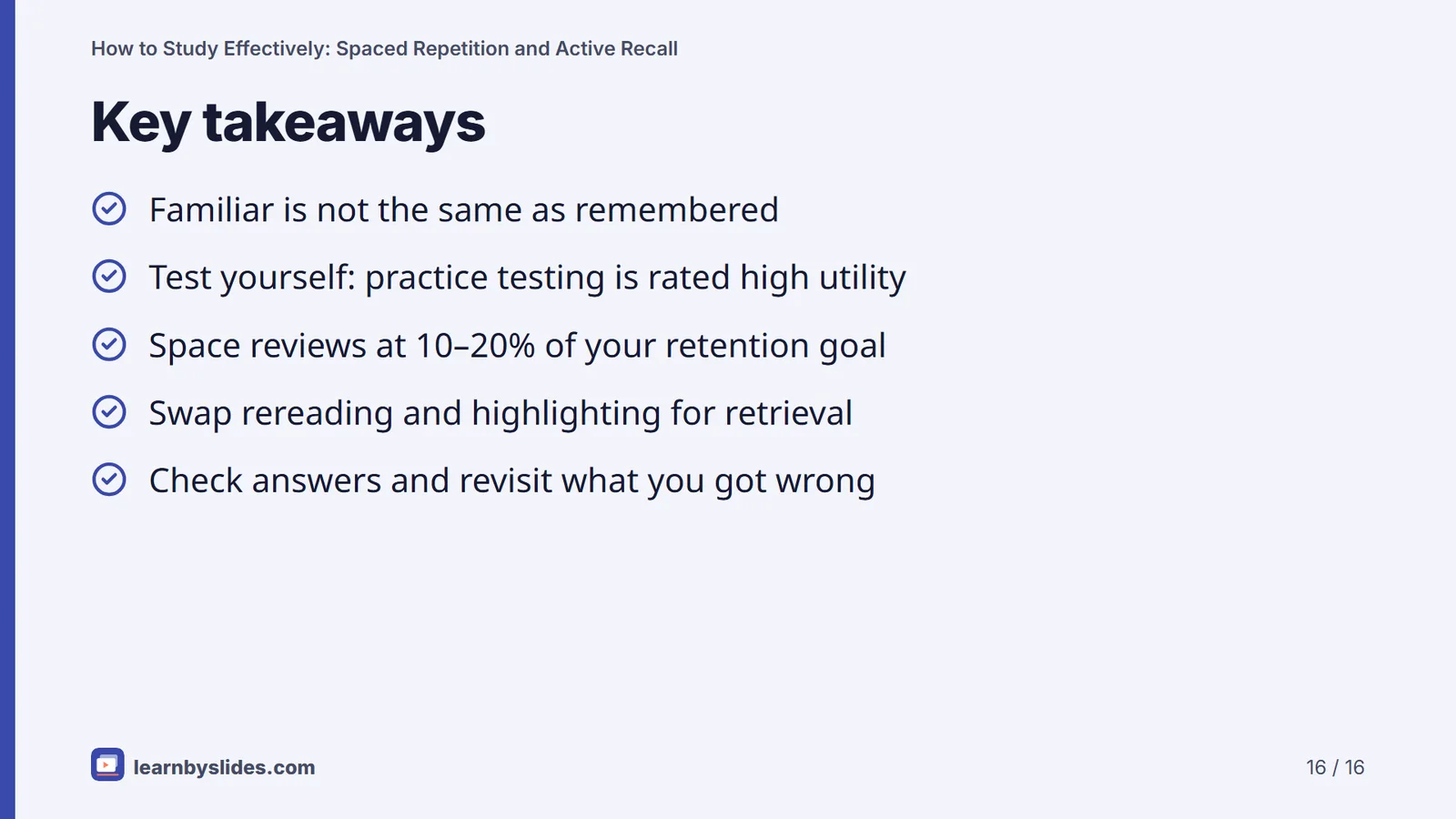
16. Key takeaways
- Familiar is not the same as remembered
- Test yourself: practice testing is rated high utility
- Space reviews at 10–20% of your retention goal
- Swap rereading and highlighting for retrieval
- Check answers and revisit what you got wrong
Speaker notes
Ask every student to write three recall questions on today's session and answer them tomorrow without notes. Then take the five-question quiz on the page.
Key terms
- Active recall
- Retrieving information from memory without looking, for example by self-testing; also called retrieval practice.
- Practice testing
- Low-stakes self-testing or practice tests done to learn, rather than to be graded.
- Distributed practice
- Spreading study of the same material across several sessions separated by gaps; also called spacing.
- Testing effect
- The finding that retrieving information improves later memory more than restudying it.
- Illusion of knowing
- Mistaking familiarity with material for the ability to recall or use it.
- Interleaving
- Mixing different topics or problem types within one study session.
- Self-explanation
- Explaining in your own words how new information or each step of a solution fits together.
Quick quiz
Teacher notes
Suggested 40-minute plan: 5 minutes on the illusion of knowing, 10 minutes on the evidence (the Dunlosky ratings and the testing-effect study), 10 minutes on spacing and the 10–20% rule, 10 minutes building a 30-day plan and flashcards, 5 minutes for the quick check and quiz. Common misconceptions: learning should feel easy; cramming works because it feels effective the night before; highlighting is studying. Run a live blank-page recall so students feel the difference. Extension: students keep a two-week log of study sessions, noting which were active and which were passive.
Frequently asked questions
Is cramming ever useful?
Cramming is better than not studying at all and can help on a test the next morning. But given the same total study time, spreading it over several sessions typically leads to better long-term memory, which matters for board exams, entrance exams and later courses.
How often should I review my flashcards?
Use the 10–20% rule as a guide: the gap between reviews should be about a tenth to a fifth of how long you need to remember. For an exam in 30 days, review each topic every three to six days. Apps such as Anki can schedule the gaps for you, or you can use paper cards and a calendar.
What if active recall feels too difficult?
That is normal. Recall feels harder than rereading, but the effort is what strengthens memory. Start with easier questions, always check your answers straight away, and go back to the ones you missed in the next session.
Does highlighting help at all?
The 2013 review by Dunlosky and colleagues rated highlighting and underlining as low utility. If you like to highlight, use it only to mark what you will turn into questions later, then spend your time answering those questions.
Sources & methodology
Every fact is checked against the sources below. We write original explanations and draw original graphics; no figures are copied from textbooks. Spotted an error? See our corrections policy.
- Improving Students' Learning With Effective Learning Techniques (Dunlosky et al., Psychological Science in the Public Interest 14(1), 4–58, 2013; practice testing from p. 29, distributed practice from p. 35, spacing rule p. 37) (Association for Psychological Science, accessed 30 Sept 2026)
- Test-Enhanced Learning: Taking Memory Tests Improves Long-Term Retention (Roediger and Karpicke, Psychological Science 17(3), 249–255, 2006; results pp. 251–253) (Purdue University Learning and Memory Lab (author copy), accessed 30 Sept 2026)
- Improving Students' Learning With Effective Learning Techniques (PubMed record 26173288) (US National Library of Medicine, accessed 30 Sept 2026)
Reviewed by Claude (pending owner check) · Updated
Related lessons
 Class 7 · Maths
Integers: Class 7 Maths Lesson Slides
Ready-to-teach Class 7 slides on integers: the number line, adding and subtracting, sign rules for multiplying and dividing, and key properties, with lifts, temperatures, money, speaker notes and a quiz.
 UPSC · Polity
Fundamental Rights: UPSC Polity Revision Slides
Exam-ready revision slides on Part III of the Constitution (Articles 12–35): six categories of rights, citizen-only rights, Article 32 and the five writs, key amendments and emergency rules, with a quiz.
 UPSC · Geography
Monsoon in India: UPSC Geography Revision Slides
UPSC revision slides on the Indian monsoon: ITCZ and jet streams, IMD's normal onset and withdrawal dates, the two branches, breaks, October heat, El Niño and the Indian Ocean Dipole, with a quiz.
 Topic
TopicPython Variables and Data Types: Beginner Lesson Slides
Beginner Python slides on variables and data types: naming rules, int, float, str, bool, None, list, tuple, dict and set, type(), dynamic typing and conversion, with tested code, notes and a quiz.
 Class 10 · Science
Chemical Reactions and Equations: Class 10 Science Slides
A ready-to-teach CBSE Class 10 Science deck on Chemical Reactions and Equations: writing and balancing equations, the main reaction types, exothermic and endothermic changes, oxidation, reduction, corrosion and rancidity.
 Class 8 · Science
Crop Production and Management: Class 8 Science Slides
A ready-to-teach Class 8 Science deck on Crop Production and Management: kharif and rabi crops, soil preparation, sowing, manure and fertilisers, irrigation, weed control, harvesting and safe storage of grain.
Get new LearnBySlides resources by email
One short email when new free resources go live. No spam, unsubscribe anytime.