Integers: Class 7 Maths Lesson Slides
Ready-to-teach Class 7 slides on integers: the number line, adding and subtracting, sign rules for multiplying and dividing, and key properties, with lifts, temperatures, money, speaker notes and a quiz.
17 slides · 40 min lesson · 5-question quiz · speaker notes · Chapter : Operations with Integers
Learning objectives
- Represent and compare integers on a number line.
- Add and subtract integers using sign rules and the additive inverse.
- Multiply and divide integers using the sign rules.
- Apply closure, commutative, associative and distributive properties.
- Solve everyday problems with lifts, temperatures, money and marks.
What this lesson covers
This deck teaches operations with integers for Class 7 in one 40-minute period. It starts with a quick recap of the number line and of adding and subtracting integers, then moves to the main new ideas for this year: the sign rules for multiplication and division, and the properties that make calculations easier.
Every idea is anchored in something students already know: a lift that goes below the ground floor, a winter temperature falling below 0 °C, money you owe, and negative marking in a test. Speaker notes on each slide give the teacher a question to ask and a common mistake to watch for.
Integers and the number line
Integers are the numbers …, −3, −2, −1, 0, 1, 2, 3, … : the whole numbers together with their negatives. Zero is neither positive nor negative. Numbers such as 2.5 or ½ are not integers.
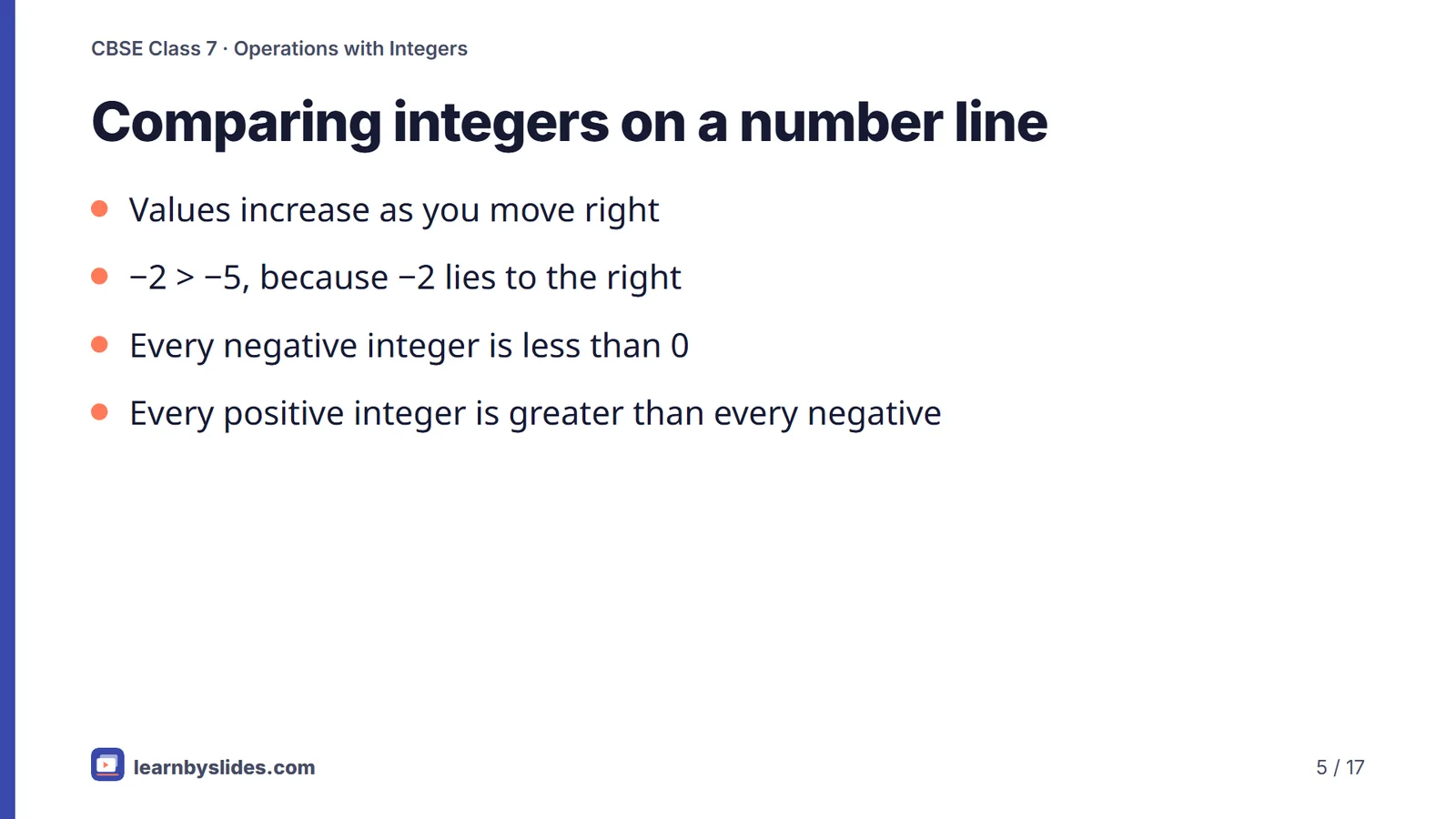
On a number line, zero sits in the middle, positive integers lie to the right and negative integers to the left. Values always increase as you move right. So −2 is greater than −5, because −2 lies to the right of −5. A quick check that works for most students: −2 °C is warmer than −5 °C.
Adding and subtracting integers
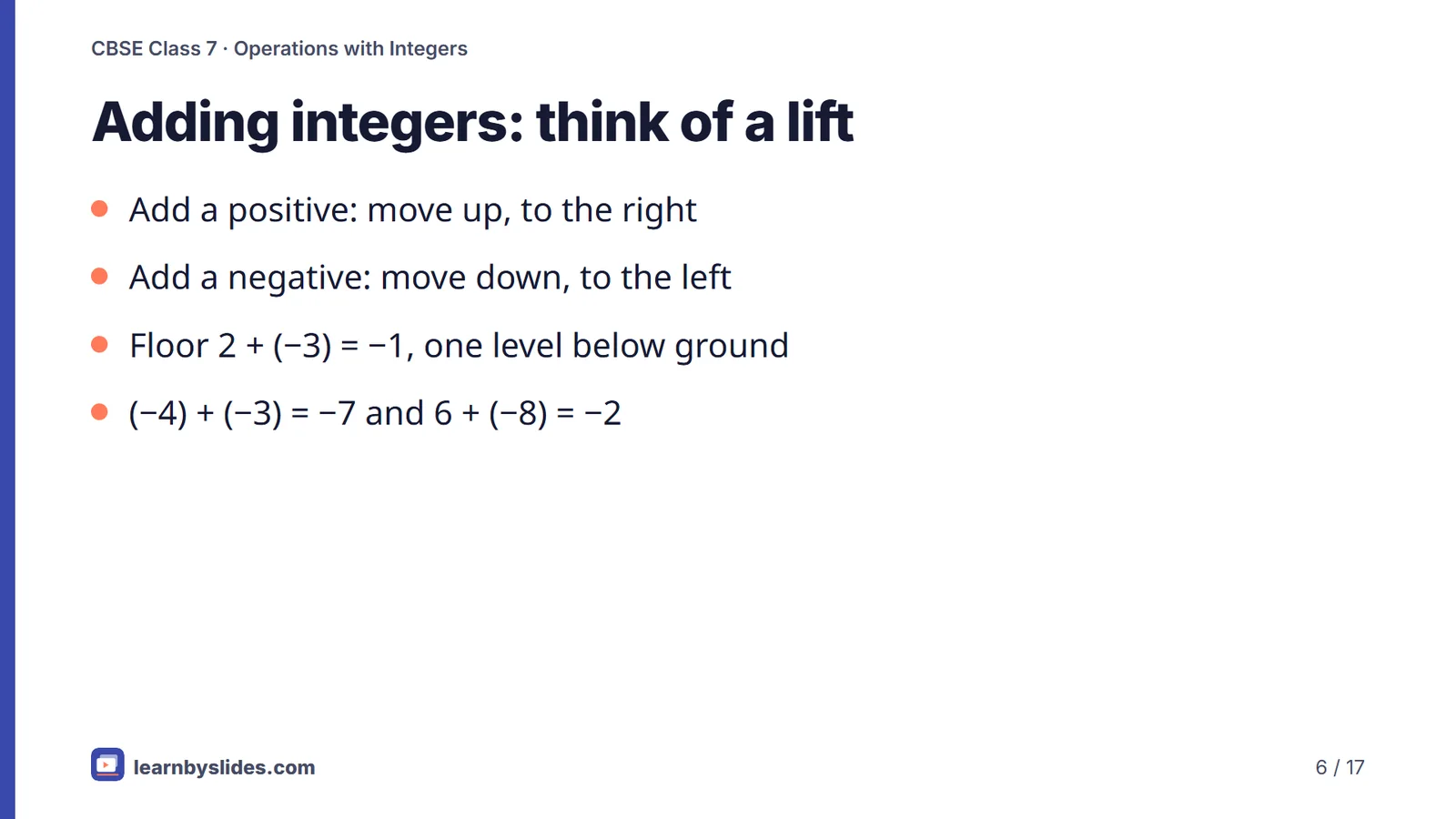
Think of a lift. Adding a positive integer moves you up (to the right); adding a negative integer moves you down (to the left). Starting on floor 2 and going down 3 floors gives 2 + (−3) = −1, one level below the ground floor.
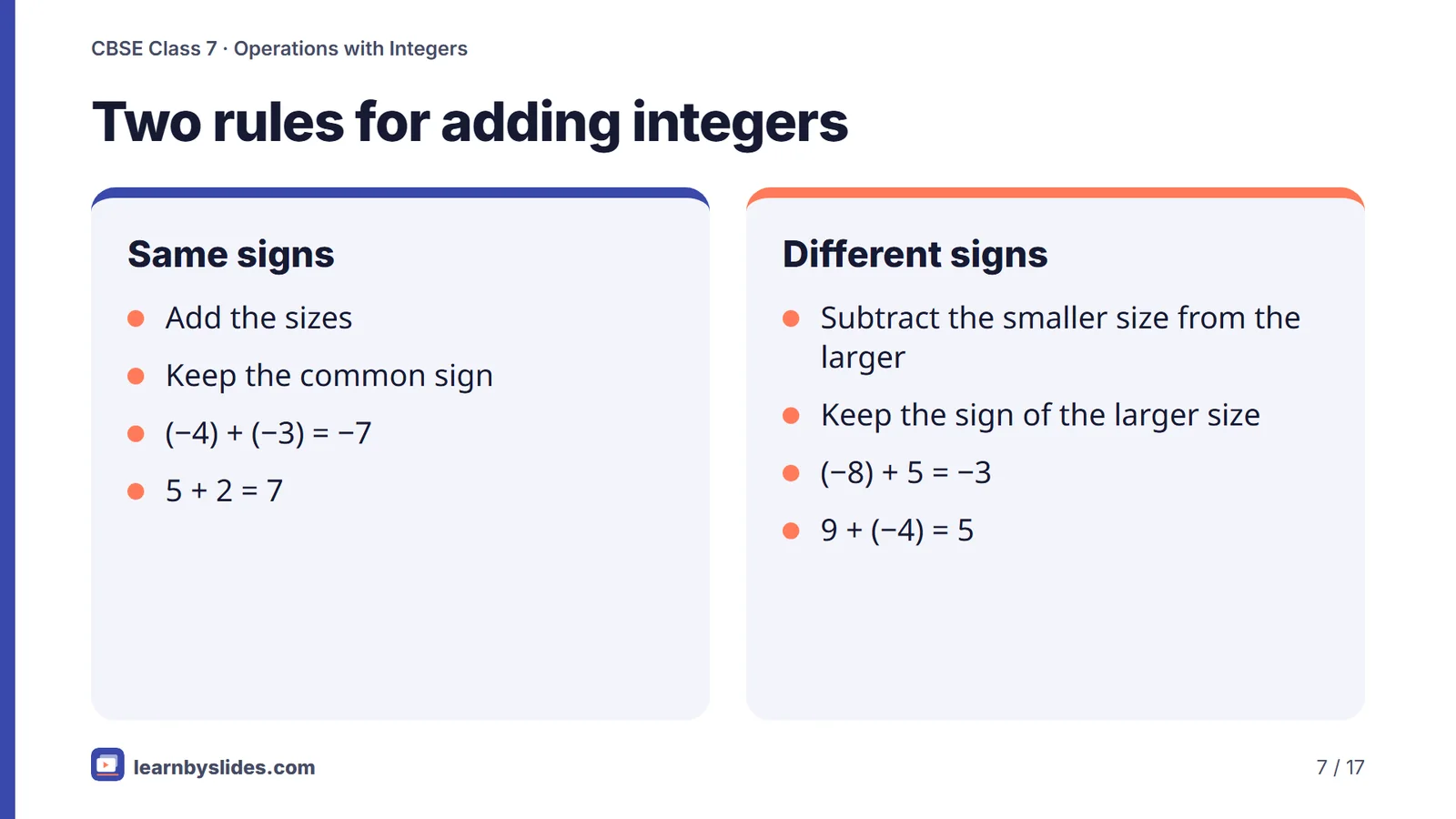
Two rules summarise addition. Same signs: add the sizes and keep the sign, so (−4) + (−3) = −7. Different signs: subtract the smaller size from the larger and keep the sign of the larger, so (−8) + 5 = −3.
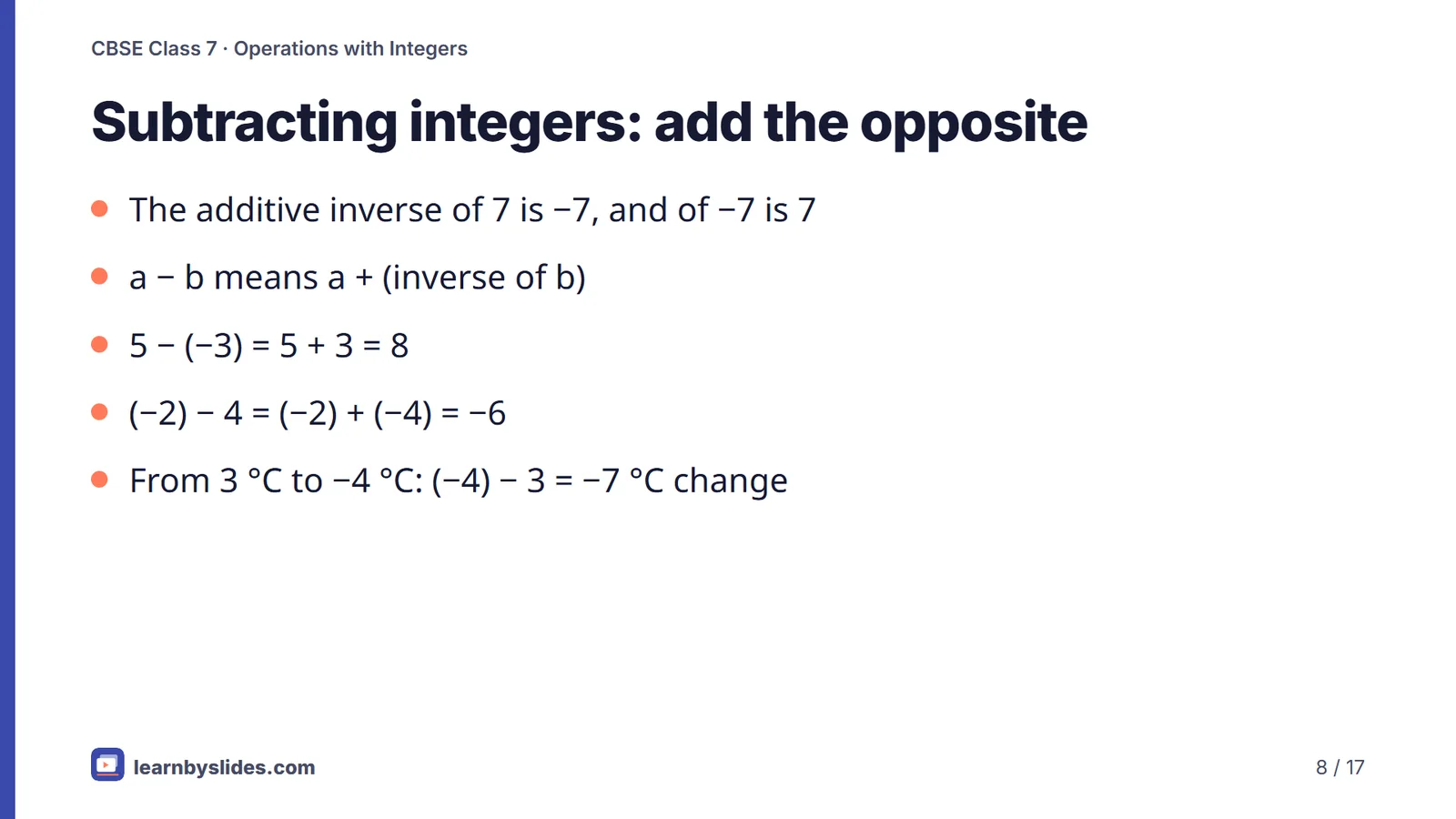
To subtract, add the additive inverse (the opposite): 5 − (−3) = 5 + 3 = 8, and (−2) − 4 = (−2) + (−4) = −6.
Multiplying and dividing integers
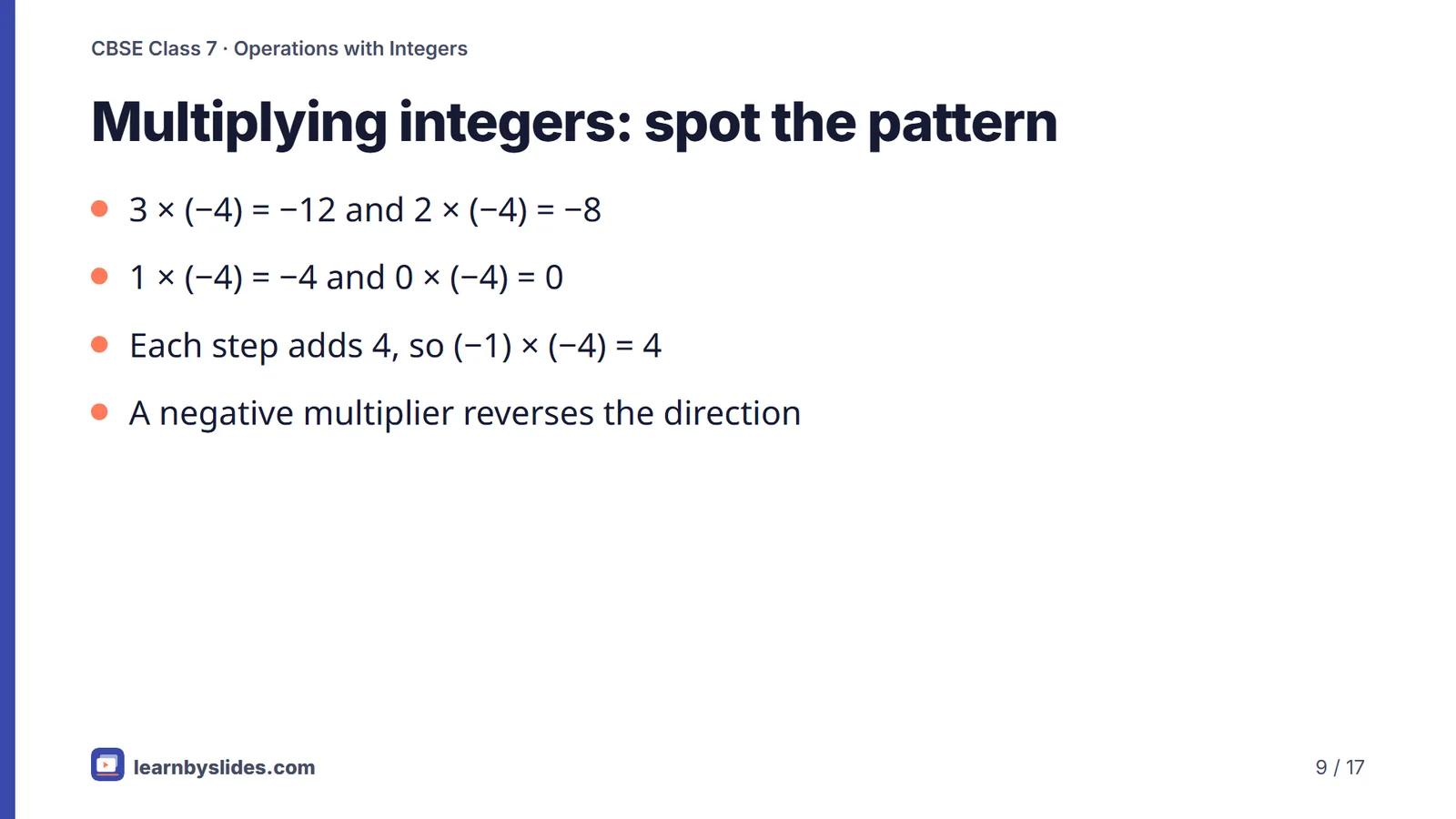
Multiplication is repeated addition, so 3 × (−2) = (−2) + (−2) + (−2) = −6. A pattern shows why a negative times a negative is positive: 3 × (−4) = −12, 2 × (−4) = −8, 1 × (−4) = −4, 0 × (−4) = 0. Each step adds 4, so (−1) × (−4) = 4.
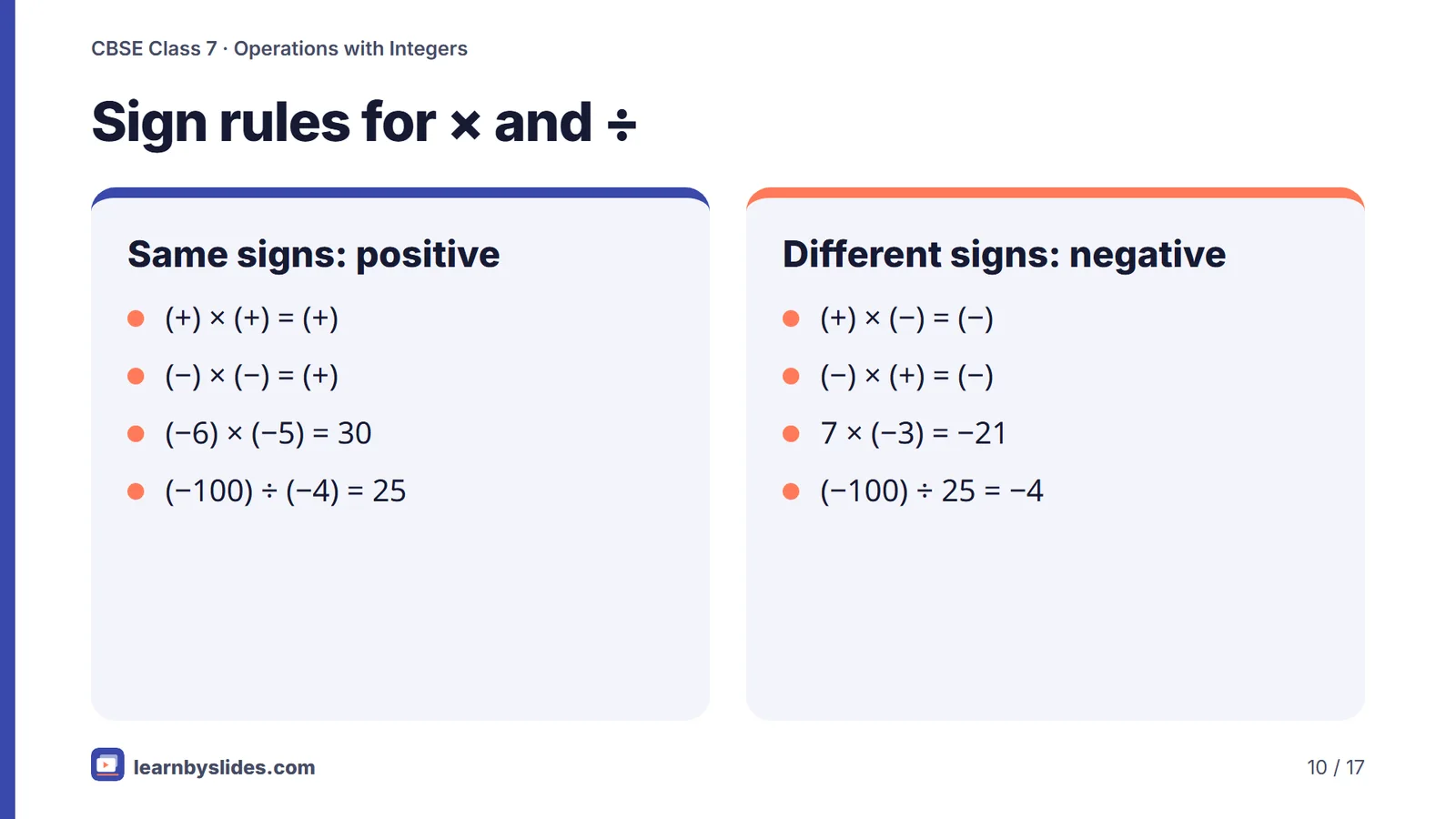
The sign rules are the same for multiplication and division. Same signs give a positive answer; different signs give a negative answer. For example, (−6) × (−5) = 30, 7 × (−3) = −21 and (−100) ÷ 25 = −4. Division by zero is not defined.
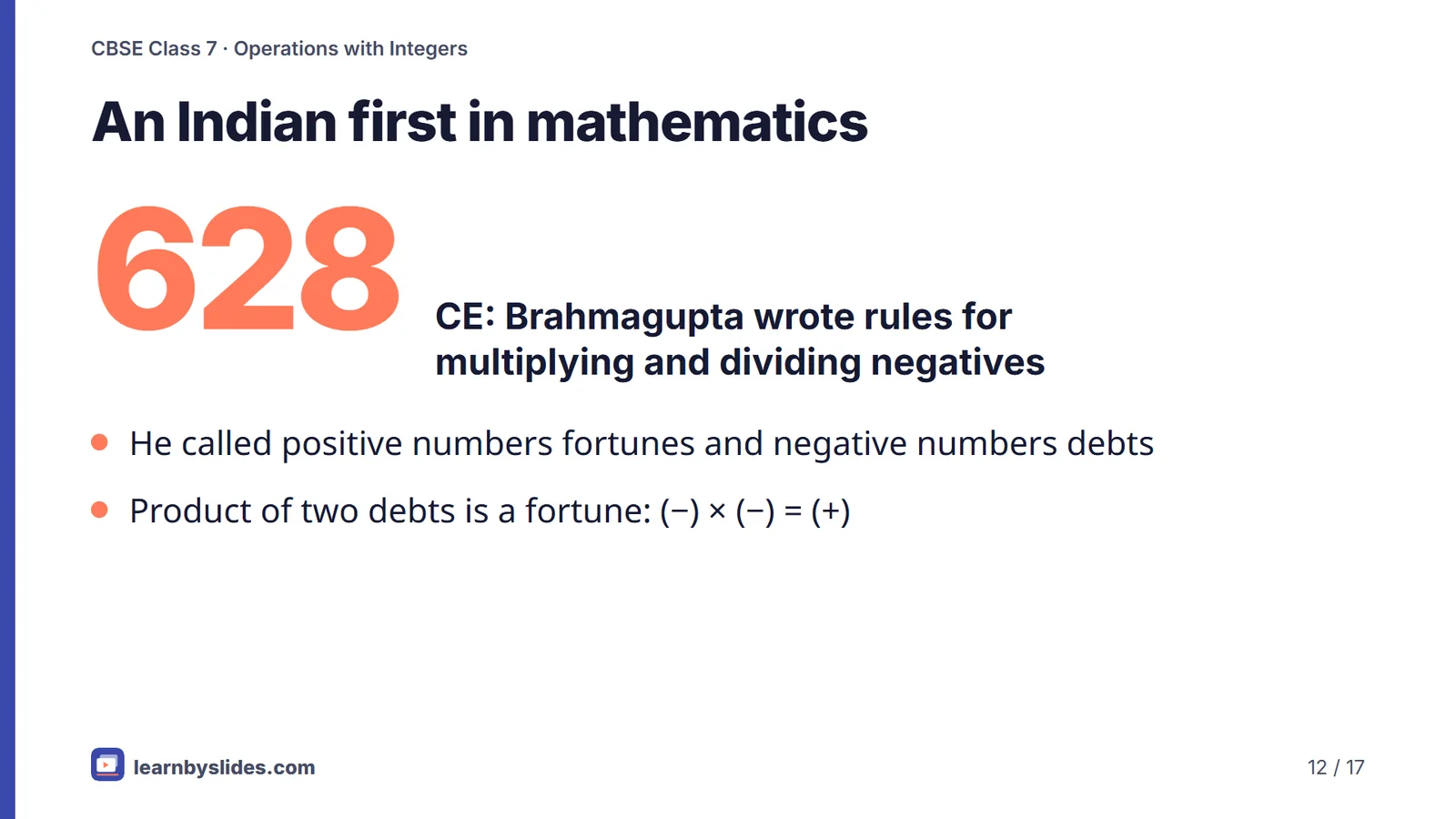
The NCERT textbook notes that Brahmagupta stated rules for multiplying and dividing positive and negative numbers in his Brāhmasphuṭasiddhānta (628 CE), describing positives as fortunes and negatives as debts.
Properties to remember
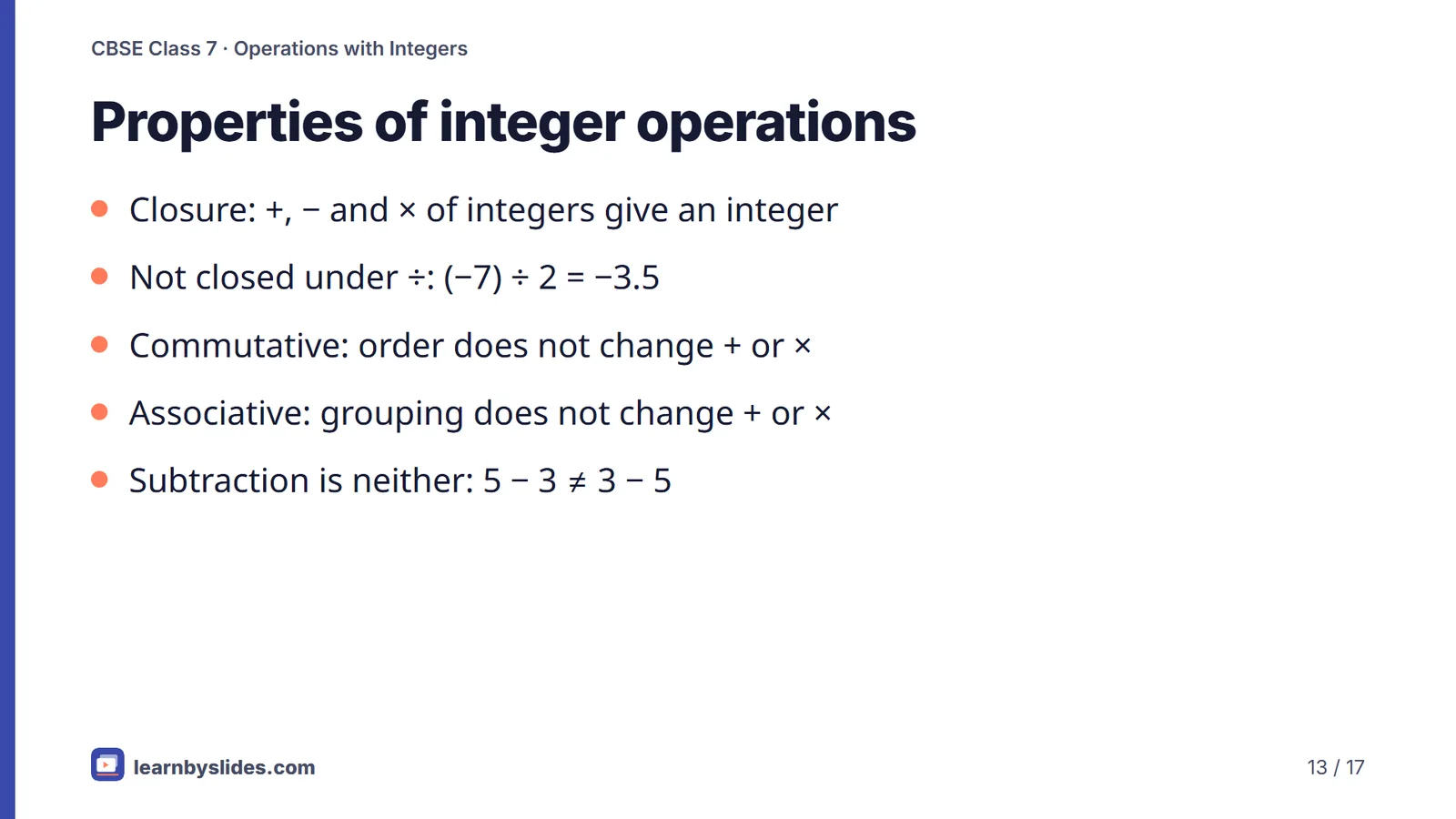
Integers are closed under addition, subtraction and multiplication: the result is always an integer. They are not closed under division, because (−7) ÷ 2 = −3.5.
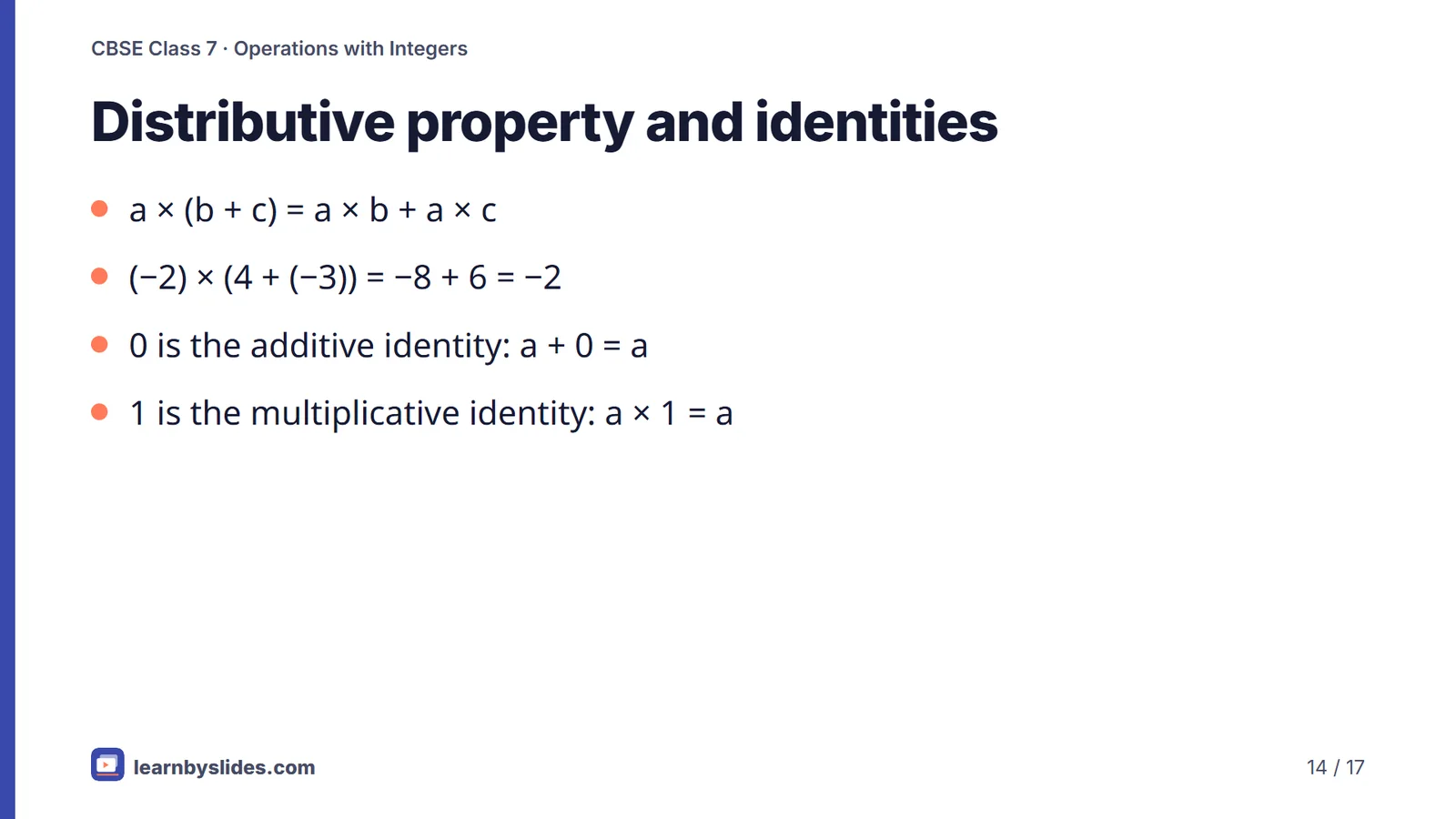
Addition and multiplication are commutative (a + b = b + a, a × b = b × a) and associative (the grouping does not matter). Subtraction is neither: 5 − 3 = 2 but 3 − 5 = −2. Multiplication is distributive over addition: a × (b + c) = a × b + a × c. Zero is the additive identity and 1 is the multiplicative identity.
How to use these slides
Present the deck in class, or download the PDF to print handouts. Pause at the quick-check slide for a show of hands, then use the five-question quiz on this page. The premium PPTX is fully editable, so you can swap in local examples such as the temperature in your own town this winter.
Slide-by-slide content
1. Integers
Class 7 Maths · Number line, the four operations and key properties
Speaker notes
Ask the class: which floor is below the ground floor in a mall, and what number would you give it? Collect answers such as B1 or minus one. Tell students that today we learn how such numbers behave when we add, subtract, multiply and divide them.
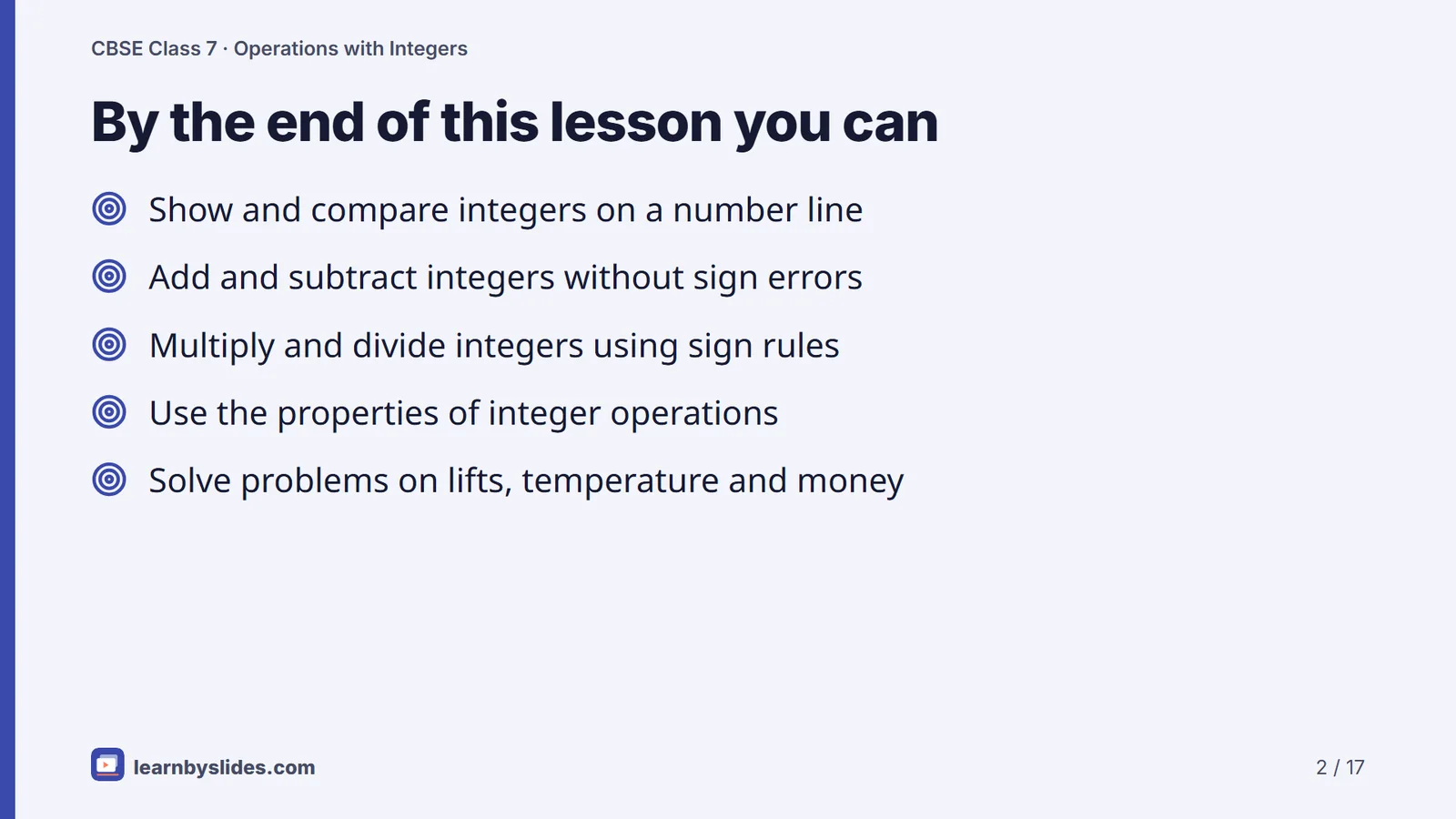
2. By the end of this lesson you can
- Show and compare integers on a number line
- Add and subtract integers without sign errors
- Multiply and divide integers using sign rules
- Use the properties of integer operations
- Solve problems on lifts, temperature and money
Speaker notes
Read the objectives aloud. Tell students there is a five-question quiz at the end, so they should note one rule from each part of the lesson.
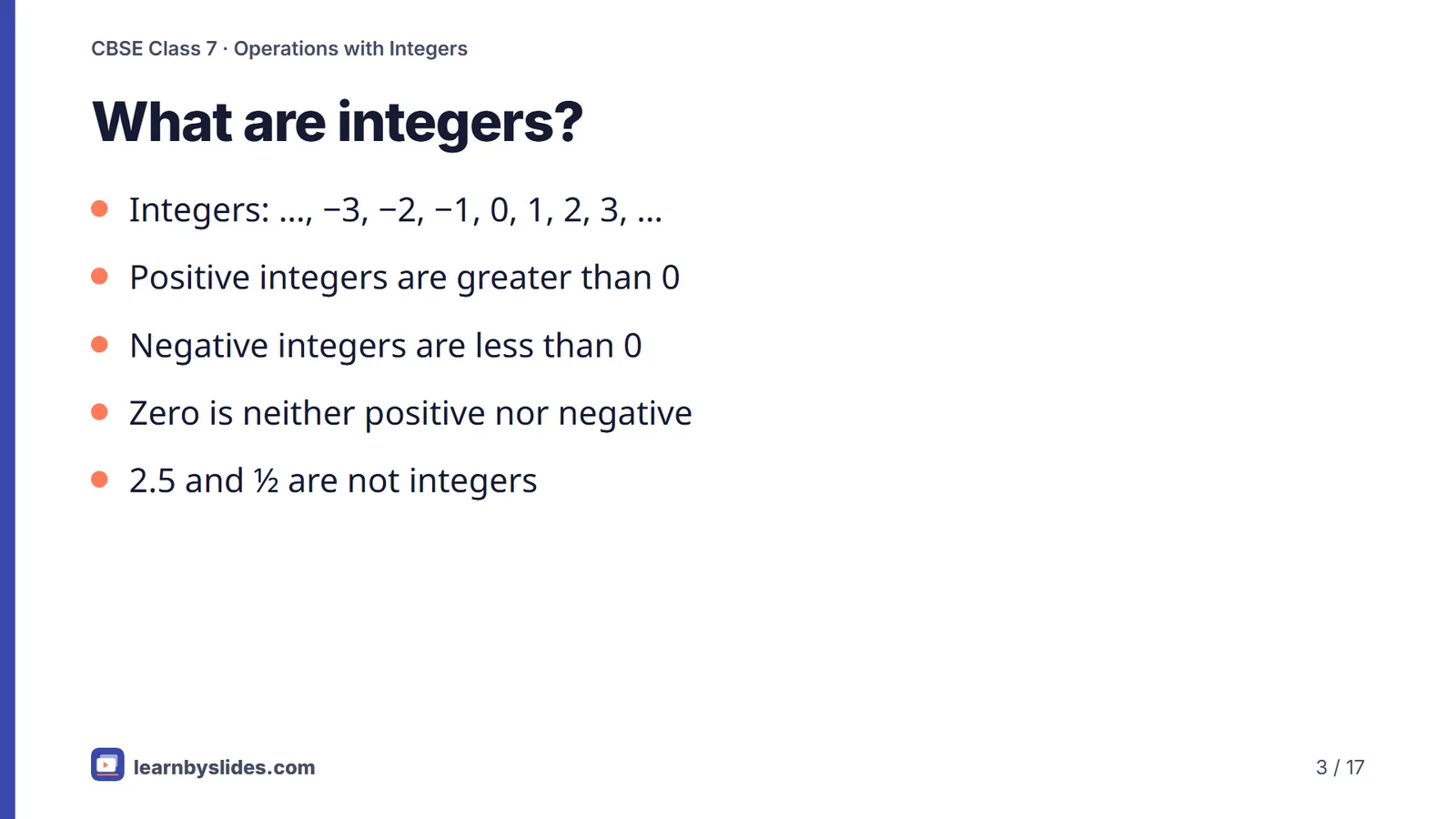
3. What are integers?
- Integers: …, −3, −2, −1, 0, 1, 2, 3, …
- Positive integers are greater than 0
- Negative integers are less than 0
- Zero is neither positive nor negative
- 2.5 and ½ are not integers
Speaker notes
Write the list on the board with dots on both sides to show it never ends. Ask: is −0 different from 0? A common mistake is to think fractions such as −½ are integers; they are not.
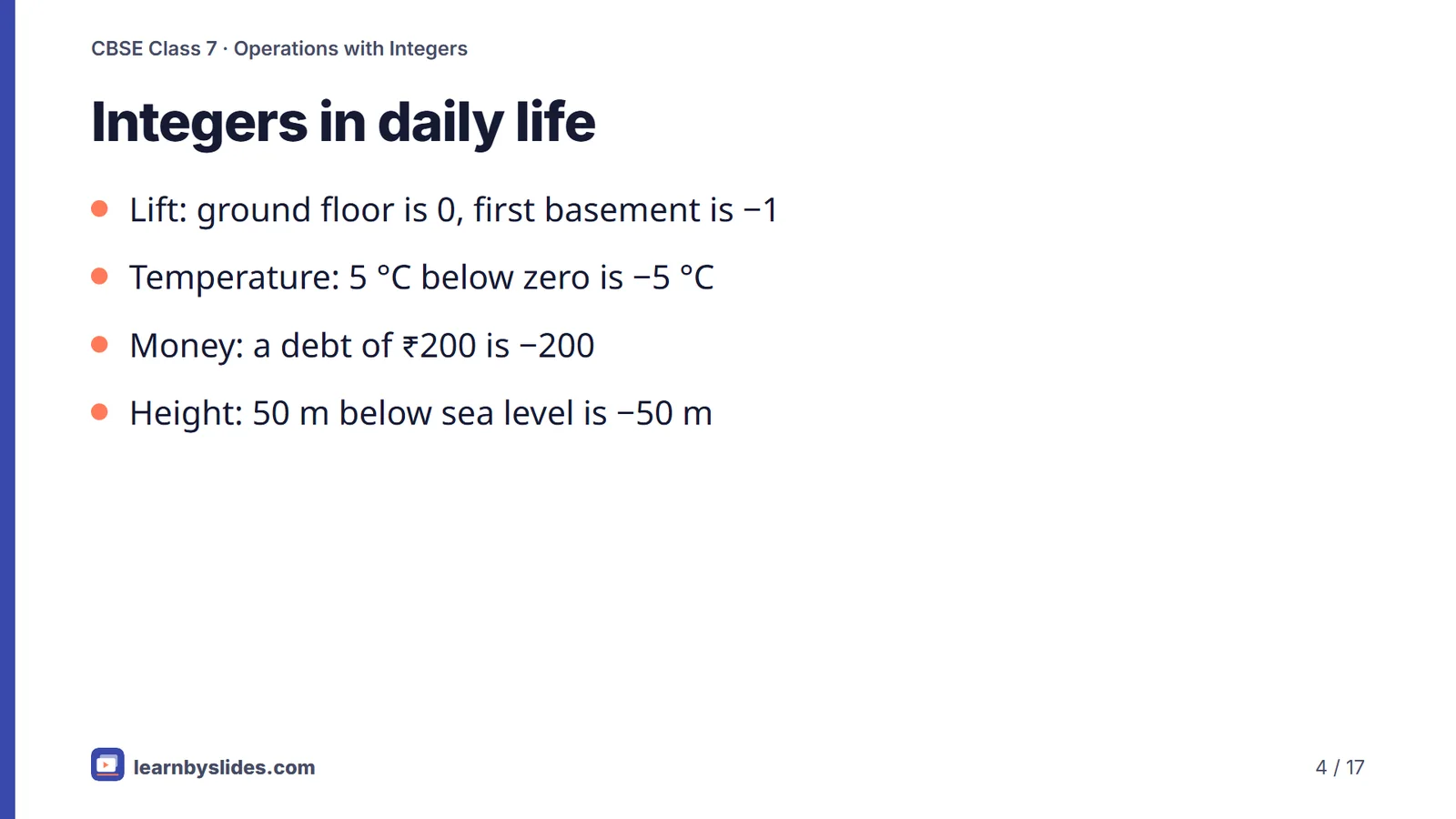
4. Integers in daily life
- Lift: ground floor is 0, first basement is −1
- Temperature: 5 °C below zero is −5 °C
- Money: a debt of ₹200 is −200
- Height: 50 m below sea level is −50 m
Speaker notes
Ask students for one more situation where a negative number makes sense, such as a loss in a shop. Point out that every example has a natural zero: ground floor, freezing point, no money owed, sea level.
5. Comparing integers on a number line
- Values increase as you move right
- −2 > −5, because −2 lies to the right
- Every negative integer is less than 0
- Every positive integer is greater than every negative
Speaker notes
Draw a number line from −6 to 6. Ask: which is colder, −2 °C or −5 °C? Many students say −2 is smaller because 2 is smaller than 5; the temperature question fixes this misconception quickly.
6. Adding integers: think of a lift
- Add a positive: move up, to the right
- Add a negative: move down, to the left
- Floor 2 + (−3) = −1, one level below ground
- (−4) + (−3) = −7 and 6 + (−8) = −2
Speaker notes
Act it out with a vertical number line drawn like a lift shaft. Ask a student to start at floor 2 and press minus 3. Stress that adding a negative number gives a smaller result.
7. Two rules for adding integers
Same signs
- Add the sizes
- Keep the common sign
- (−4) + (−3) = −7
- 5 + 2 = 7
Different signs
- Subtract the smaller size from the larger
- Keep the sign of the larger size
- (−8) + 5 = −3
- 9 + (−4) = 5
Speaker notes
Size means the value without its sign (the absolute value). Ask students to copy both rules into a box in their notebooks. Check with the number line: from −8, move 5 steps right and you land on −3.
8. Subtracting integers: add the opposite
- The additive inverse of 7 is −7, and of −7 is 7
- a − b means a + (inverse of b)
- 5 − (−3) = 5 + 3 = 8
- (−2) − 4 = (−2) + (−4) = −6
- From 3 °C to −4 °C: (−4) − 3 = −7 °C change
Speaker notes
Repeat the phrase: subtracting means adding the opposite. Ask: why does 5 − (−3) give more than 5? Taking away a debt of 3 leaves you better off by 3. The temperature change is final minus initial.
9. Multiplying integers: spot the pattern
- 3 × (−4) = −12 and 2 × (−4) = −8
- 1 × (−4) = −4 and 0 × (−4) = 0
- Each step adds 4, so (−1) × (−4) = 4
- A negative multiplier reverses the direction
Speaker notes
Build the table on the board and let students predict the next line before you write it. Ask: what is (−2) × (−4)? The pattern gives 8. A frequent mistake is to use the addition rule, giving −8.
10. Sign rules for × and ÷
Same signs: positive
- (+) × (+) = (+)
- (−) × (−) = (+)
- (−6) × (−5) = 30
- (−100) ÷ (−4) = 25
Different signs: negative
- (+) × (−) = (−)
- (−) × (+) = (−)
- 7 × (−3) = −21
- (−100) ÷ 25 = −4
Speaker notes
Stress that the same rules work for division because division undoes multiplication. Ask: what is the sign of (−2) × (−3) × (−4)? Three negatives give a negative answer, −24.
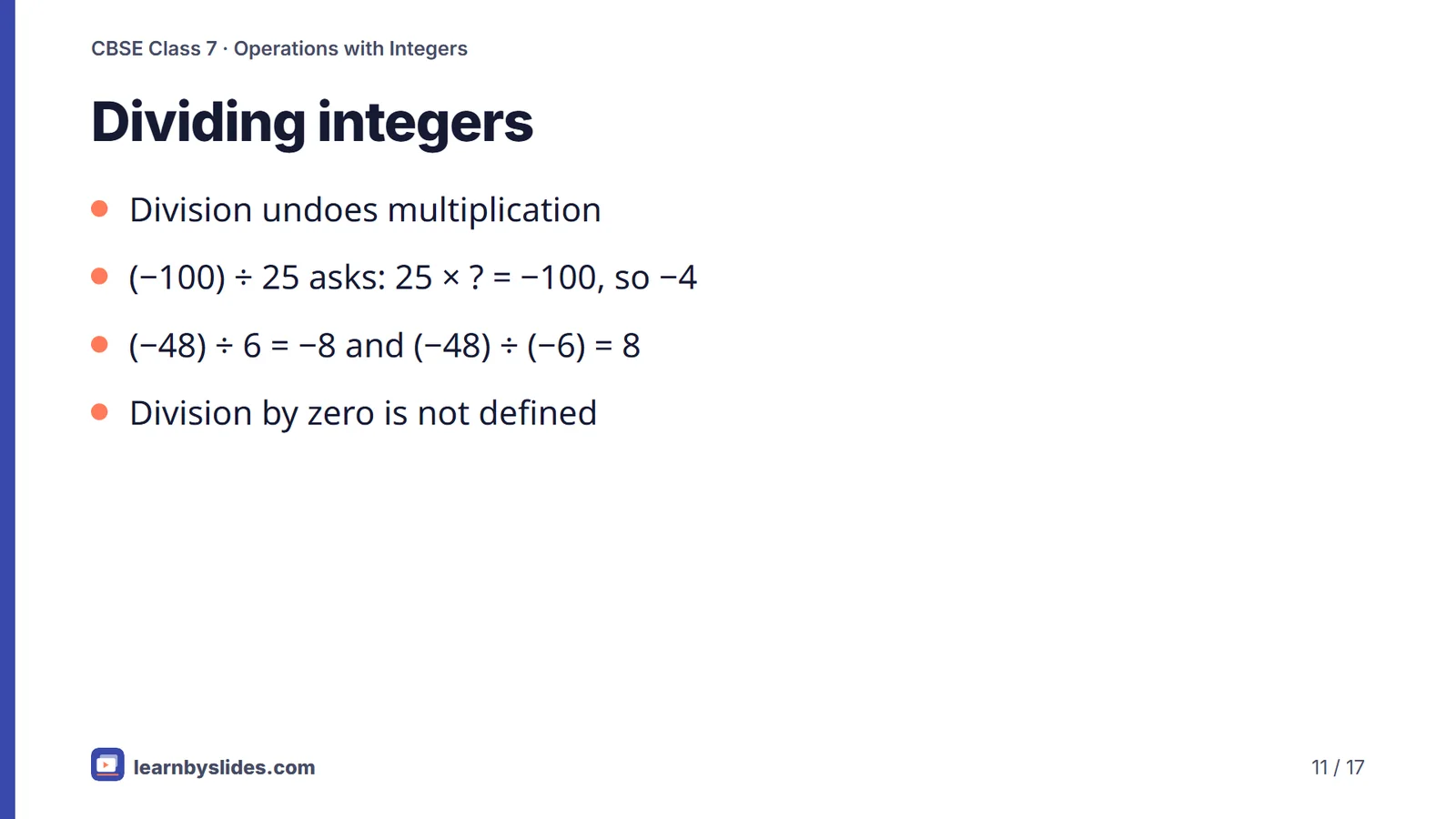
11. Dividing integers
- Division undoes multiplication
- (−100) ÷ 25 asks: 25 × ? = −100, so −4
- (−48) ÷ 6 = −8 and (−48) ÷ (−6) = 8
- Division by zero is not defined
Speaker notes
Turn each division into a missing-number multiplication. Ask: what is 0 ÷ (−5)? It is 0. Then ask why (−5) ÷ 0 has no answer: no number times 0 gives −5.
12. An Indian first in mathematics
628 CE: Brahmagupta wrote rules for multiplying and dividing negatives
- He called positive numbers fortunes and negative numbers debts
- Product of two debts is a fortune: (−) × (−) = (+)
Speaker notes
The NCERT Class 7 textbook quotes Brahmagupta's Brahmasphutasiddhanta, written in 628 CE. Ask students to restate his rule for a debt times a fortune; the answer is a debt, a negative number.
13. Properties of integer operations
- Closure: +, − and × of integers give an integer
- Not closed under ÷: (−7) ÷ 2 = −3.5
- Commutative: order does not change + or ×
- Associative: grouping does not change + or ×
- Subtraction is neither: 5 − 3 ≠ 3 − 5
Speaker notes
Test each property with small numbers on the board, such as (−2) + 5 and 5 + (−2). Ask students to find one example that shows subtraction is not associative, for instance (8 − 5) − 2 and 8 − (5 − 2).
14. Distributive property and identities
- a × (b + c) = a × b + a × c
- (−2) × (4 + (−3)) = −8 + 6 = −2
- 0 is the additive identity: a + 0 = a
- 1 is the multiplicative identity: a × 1 = a
Speaker notes
Show that both sides of the distributive example give −2. Ask: how does the property help with 99 × (−5)? Write it as 100 × (−5) − 1 × (−5) = −500 + 5 = −495.
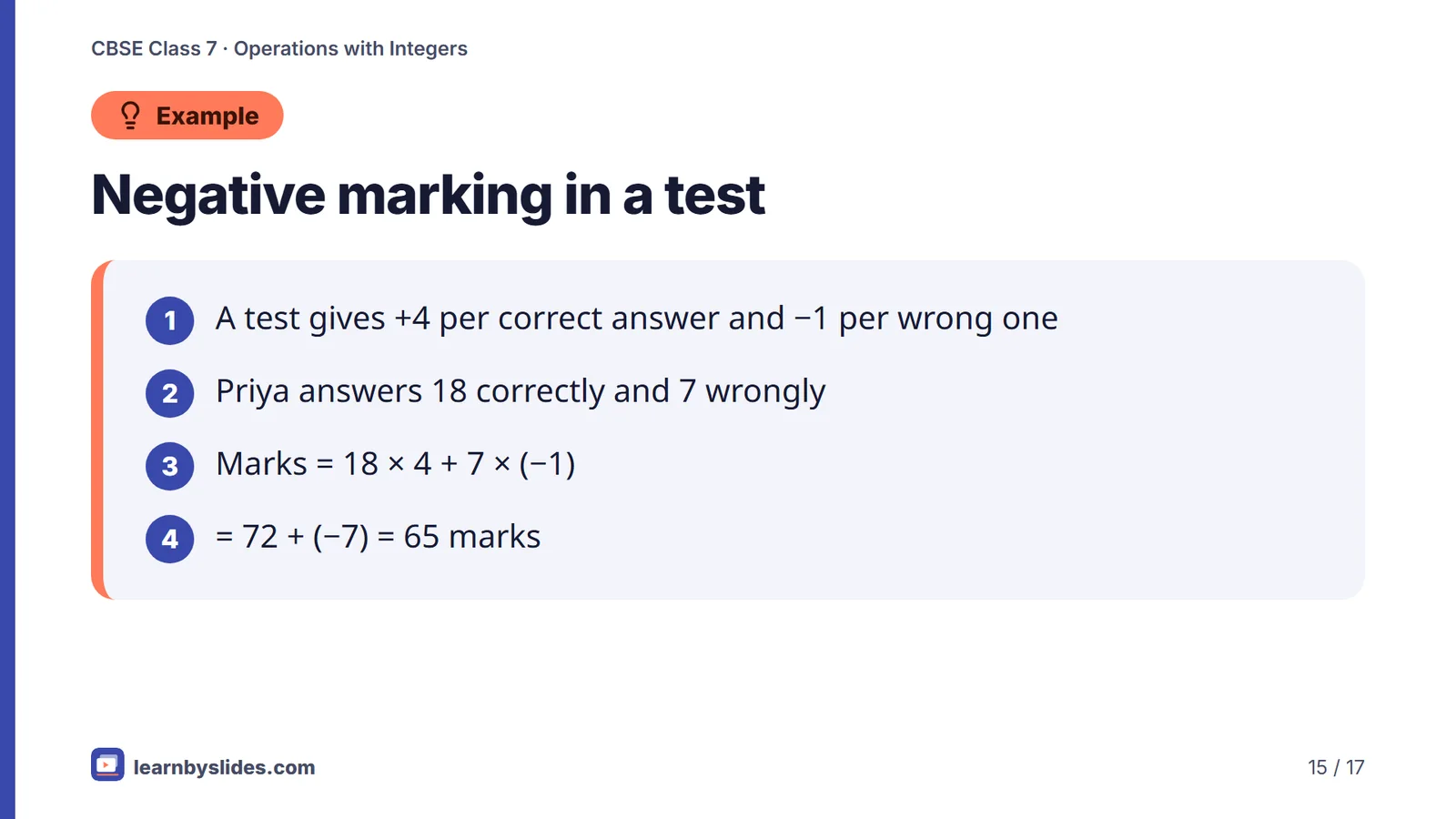
15. Negative marking in a test
- A test gives +4 per correct answer and −1 per wrong one
- Priya answers 18 correctly and 7 wrongly
- Marks = 18 × 4 + 7 × (−1)
- = 72 + (−7) = 65 marks
Speaker notes
Many Indian entrance exams use negative marking, so this example feels real. Ask: how many marks would Priya lose if she guessed 10 more questions wrongly? Each wrong answer adds −1, so 10 × (−1) = −10.
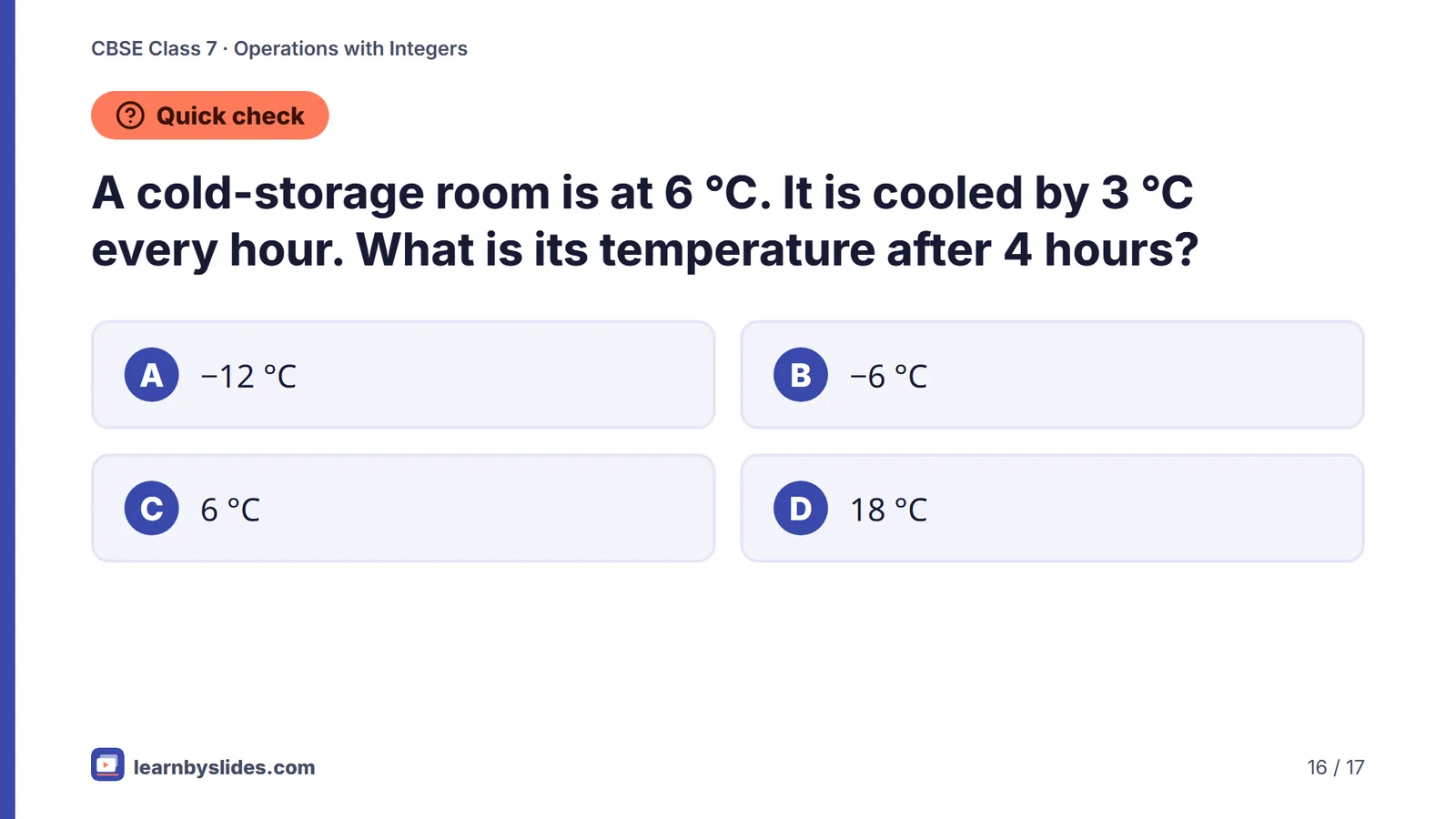
16. Quick check
A cold-storage room is at 6 °C. It is cooled by 3 °C every hour. What is its temperature after 4 hours?
- −12 °C
- −6 °C
- 6 °C
- 18 °C
Speaker notes
Answer: B, −6 °C. The change is 4 × (−3) = −12, and 6 + (−12) = −6. Students who pick −12 °C forgot the starting temperature.
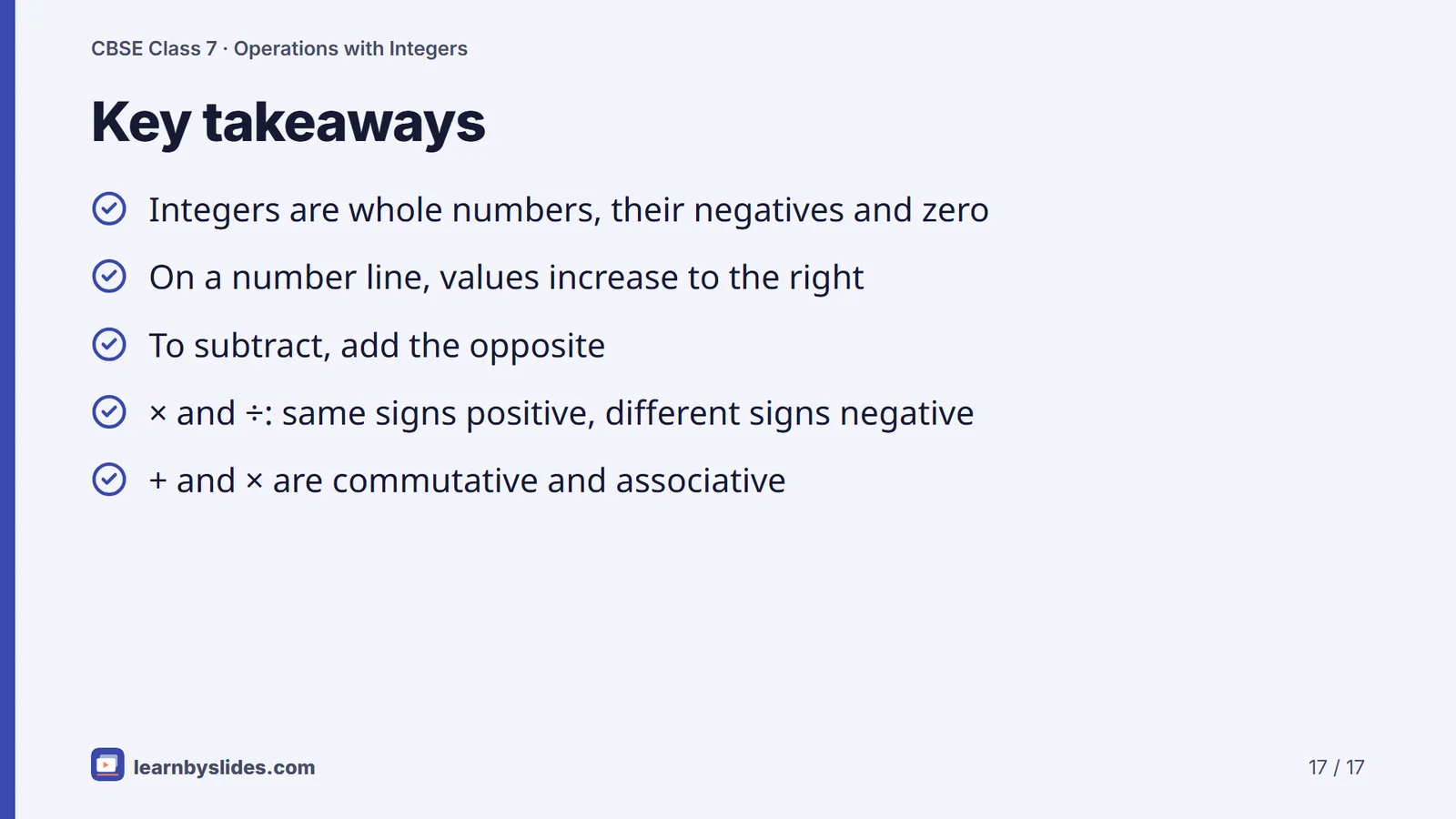
17. Key takeaways
- Integers are whole numbers, their negatives and zero
- On a number line, values increase to the right
- To subtract, add the opposite
- × and ÷: same signs positive, different signs negative
- + and × are commutative and associative
Speaker notes
Recap one rule per bullet with a quick oral example. Then move to the five-question quiz on the page and set practice from the textbook exercise on integer operations.
Key terms
- Integer
- Any of the numbers …, −3, −2, −1, 0, 1, 2, 3, …: whole numbers and their negatives.
- Number line
- A line with integers marked at equal gaps; values increase from left to right.
- Additive inverse
- The number that adds to a given number to give zero; the additive inverse of −5 is 5.
- Absolute value
- The size of an integer without its sign; the absolute value of −8 is 8.
- Closure property
- Combining two integers by an operation always gives an integer; true for +, − and ×, not for ÷.
- Distributive property
- a × (b + c) = a × b + a × c for any integers a, b and c.
- Additive identity
- Zero, because adding 0 to any integer leaves it unchanged.
Quick quiz
Teacher notes
Suggested 40-minute plan: 5 minutes on the number line and everyday examples, 10 minutes recapping addition and subtraction, 15 minutes on multiplication, division and properties, 10 minutes for the quick check and quiz. Common misconceptions: −2 is less than −5 because 2 is less than 5; subtracting always makes a number smaller; the product of two negatives is negative, which comes from mixing up addition and multiplication rules. Let students check every rule on a number line before they memorise it. Extension: ask students to record the minimum temperature of three Indian cities for a week and calculate the daily changes.
Frequently asked questions
Which chapter covers integers in the current NCERT Class 7 Maths book?
In NCERT's new Class 7 textbook, Ganita Prakash, integers appear as Chapter 2, 'Operations with Integers', in Part 2. Older NCERT Class 7 books had a chapter simply called 'Integers'. Chapter numbers change between editions, so check the syllabus and book your school currently uses.
Why is a negative times a negative positive?
Look at the pattern 2 × (−4) = −8, 1 × (−4) = −4, 0 × (−4) = 0. Each time the first number drops by 1, the answer goes up by 4. Continuing the pattern gives (−1) × (−4) = 4. Multiplying by a negative number reverses direction on the number line, and reversing twice brings you back to the positive side.
Is zero a positive or a negative integer?
Neither. Zero is the dividing point between the positive integers on the right of the number line and the negative integers on the left.
How can students avoid mistakes when subtracting a negative number?
Teach one habit: rewrite every subtraction as adding the opposite. So 12 − (−8) becomes 12 + 8 = 20. Checking on a number line or with a temperature story catches most sign errors.
Sources & methodology
Every fact is checked against the sources below. We write original explanations and draw original graphics; no figures are copied from textbooks. Spotted an error? See our corrections policy.
- Ganita Prakash, Grade 7 Part 2, Chapter 2: Operations with Integers (NCERT, accessed 30 Sept 2026)
- Ganita Prakash, Grade 7 Part 2: Prelims and Contents (NCERT, accessed 30 Sept 2026)
- Ganita Prakash, Grade 6, Chapter 10: The Other Side of Zero (NCERT, accessed 30 Sept 2026)
Reviewed by Claude (pending owner check) · Updated
Related lessons
 Topic
TopicHow to Study Effectively: Spaced Repetition and Active Recall
Research-based slides on studying smarter: why rereading and highlighting fade, how self-testing and spaced reviews work, the 10–20% spacing rule, and a 30-day exam plan, with notes and a quiz.
 Class 9 · Science
Motion: Class 9 Science Lesson Slides
A ready-to-teach CBSE Class 9 Science deck on motion in a straight line: position, distance and displacement, speed, velocity, acceleration, position-time and velocity-time graphs, kinematic equations and uniform circular motion.
 Topic
TopicPython Variables and Data Types: Beginner Lesson Slides
Beginner Python slides on variables and data types: naming rules, int, float, str, bool, None, list, tuple, dict and set, type(), dynamic typing and conversion, with tested code, notes and a quiz.
 Class 10 · Science
Chemical Reactions and Equations: Class 10 Science Slides
A ready-to-teach CBSE Class 10 Science deck on Chemical Reactions and Equations: writing and balancing equations, the main reaction types, exothermic and endothermic changes, oxidation, reduction, corrosion and rancidity.
 Class 8 · Science
Crop Production and Management: Class 8 Science Slides
A ready-to-teach Class 8 Science deck on Crop Production and Management: kharif and rabi crops, soil preparation, sowing, manure and fertilisers, irrigation, weed control, harvesting and safe storage of grain.
 Class 10 · Science
Life Processes: Class 10 Science Lesson Slides
A ready-to-teach deck on the four life processes in CBSE Class 10 Science: nutrition, respiration, transportation and excretion, with original diagrams, a 5-question quiz and speaker notes for every slide.
Get new LearnBySlides resources by email
One short email when new free resources go live. No spam, unsubscribe anytime.