Chemical Reactions and Equations: Class 10 Science Slides
A ready-to-teach CBSE Class 10 Science deck on Chemical Reactions and Equations: writing and balancing equations, the main reaction types, exothermic and endothermic changes, oxidation, reduction, corrosion and rancidity.
16 slides · 45 min lesson · 5-question quiz · speaker notes · Chapter 1: Chemical Reactions and Equations
Learning objectives
- Identify the observable signs that a chemical reaction has taken place.
- Write and balance chemical equations, adding state symbols and conditions.
- Classify reactions as combination, decomposition, displacement or double displacement.
- Distinguish exothermic from endothermic reactions with examples.
- Explain oxidation and reduction, and relate them to corrosion and rancidity.
What this lesson covers
This deck teaches Chemical Reactions and Equations, the first chapter of CBSE Class 10 Science, in one 45-minute period. Students learn to recognise a chemical reaction, describe it with a balanced equation, sort it into a type, and connect oxidation to problems they see at home, such as a rusting gate or stale namkeen.
Each slide has speaker notes with a question to ask and a common mistake to watch for, so the deck works for classroom teaching and for self-study.
Recognising and writing reactions
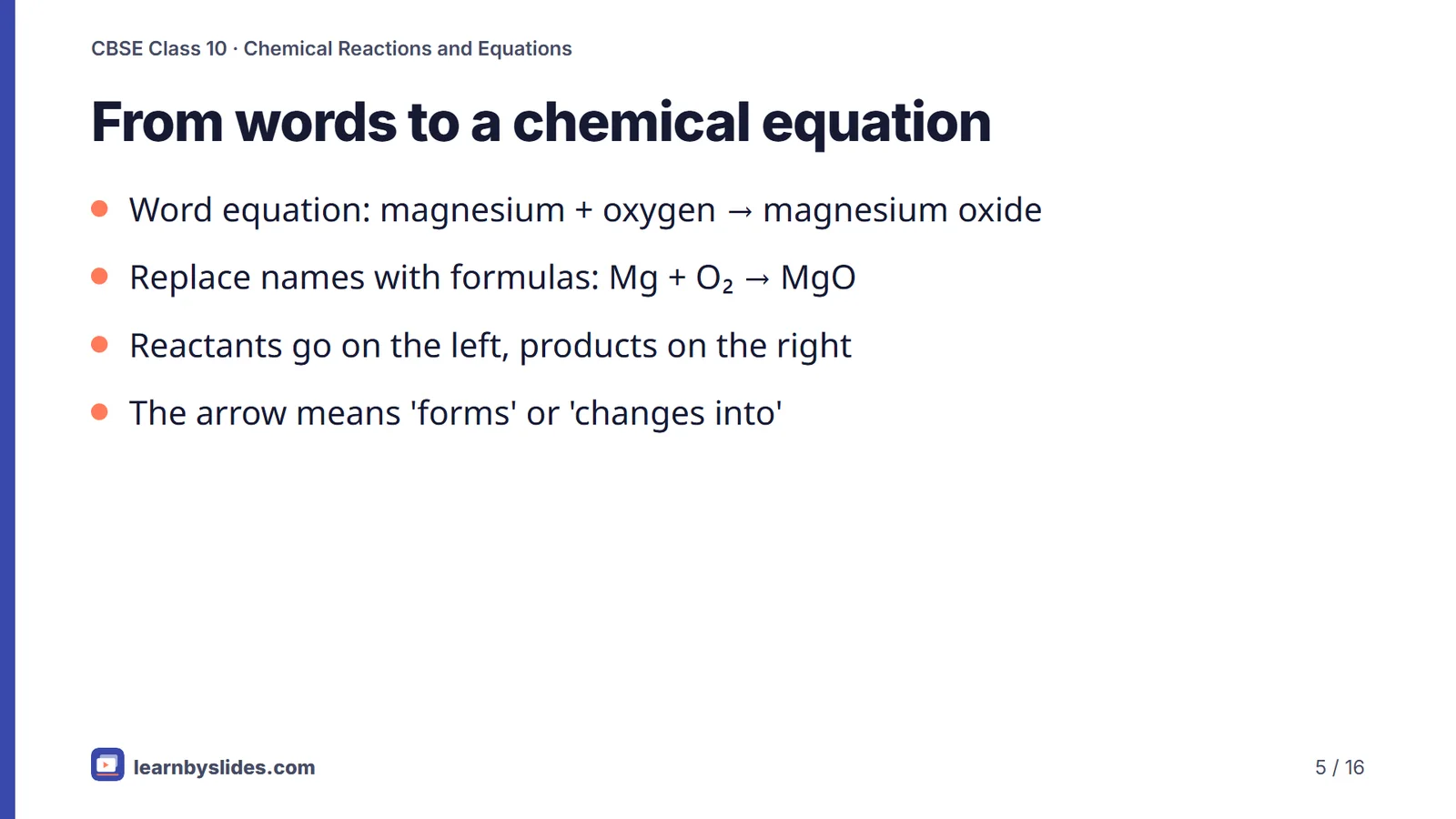
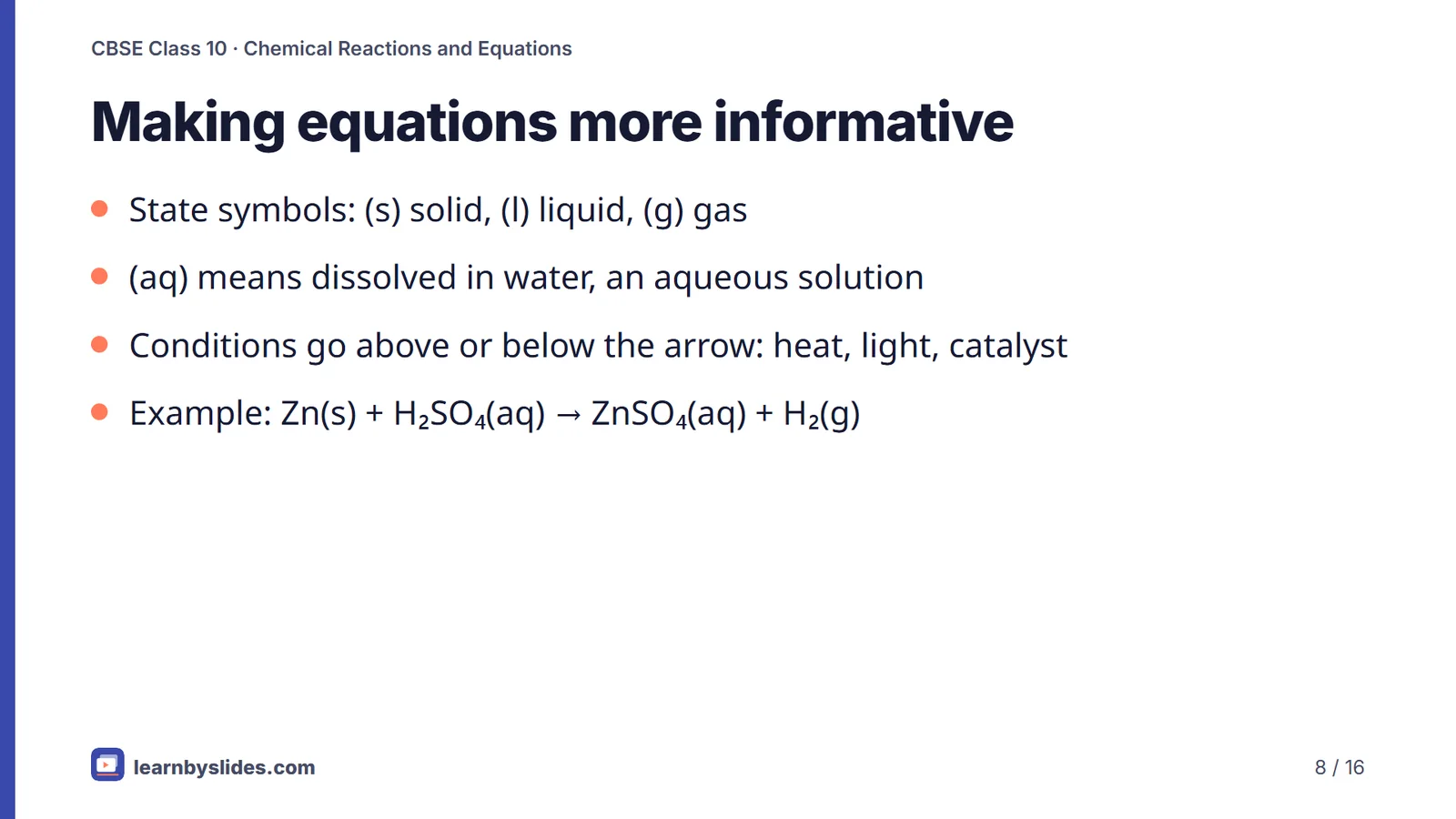
A chemical reaction turns reactants into products with new properties. Clues include a colour change, gas bubbles, a temperature change or a solid precipitate. Students first write a word equation (magnesium + oxygen → magnesium oxide) and then a chemical equation using formulas. State symbols such as (s), (l), (g) and (aq), and conditions written on the arrow, such as heat or sunlight, make an equation more precise.
Balancing equations
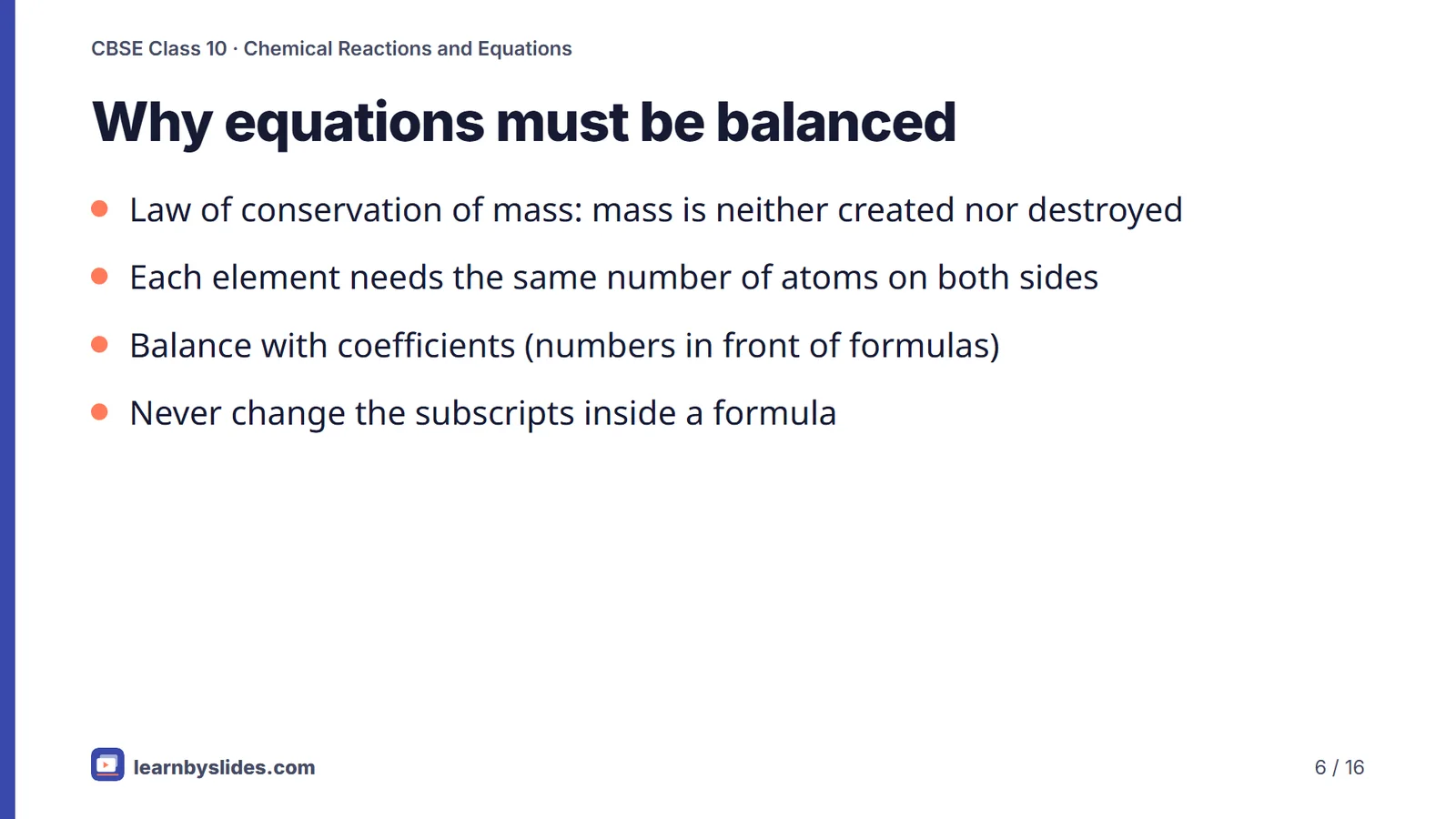
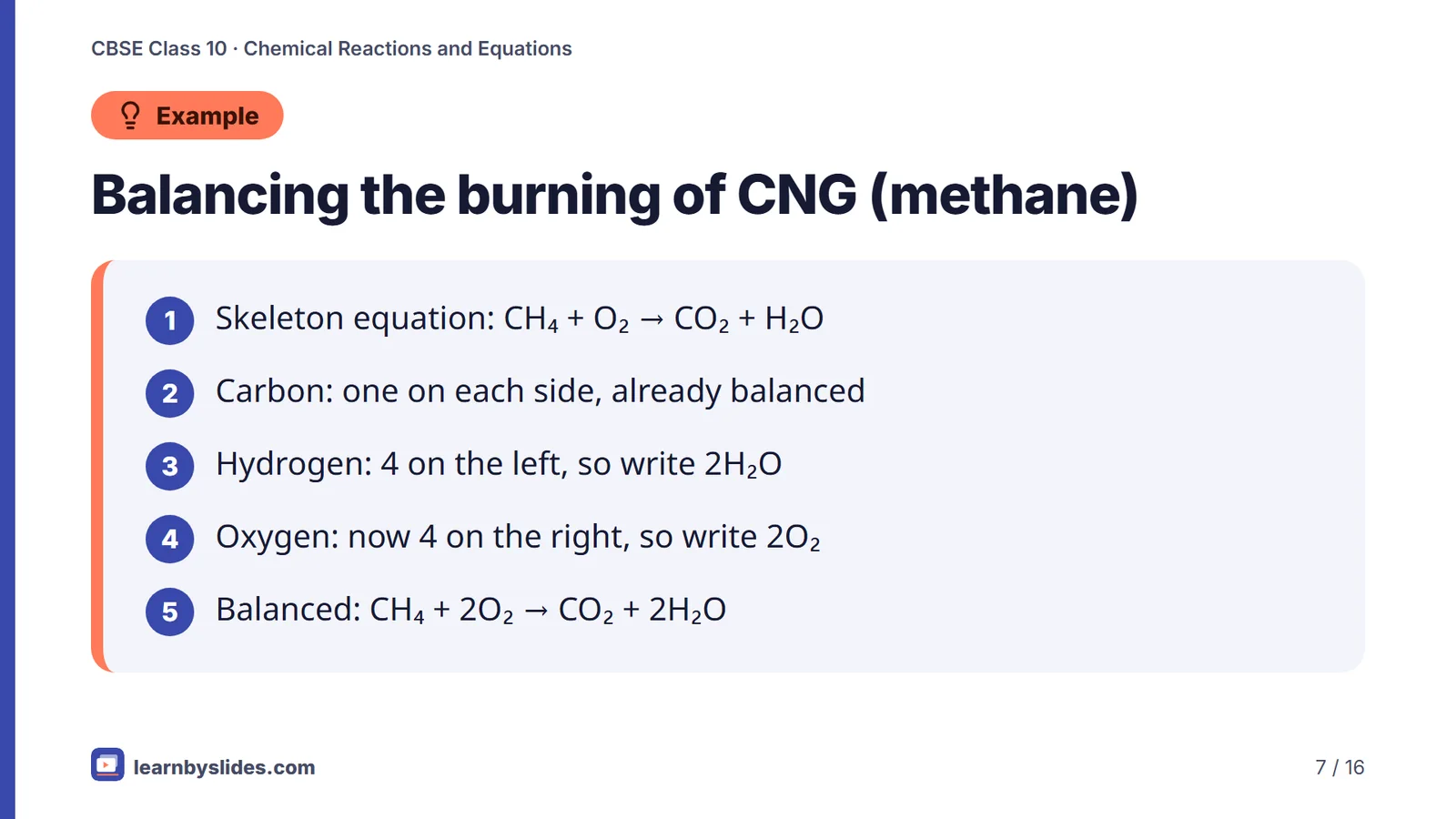
Because mass is conserved, every element must have the same number of atoms on both sides. Students balance an equation by placing coefficients in front of formulas, never by changing the formulas themselves. The worked example is the burning of methane, the main gas in CNG: the skeleton CH₄ + O₂ → CO₂ + H₂O becomes CH₄ + 2O₂ → CO₂ + 2H₂O once hydrogen and then oxygen are balanced. Counting every element again at the end is the habit that prevents most errors.
Types of reactions and energy changes
The deck compares four types:
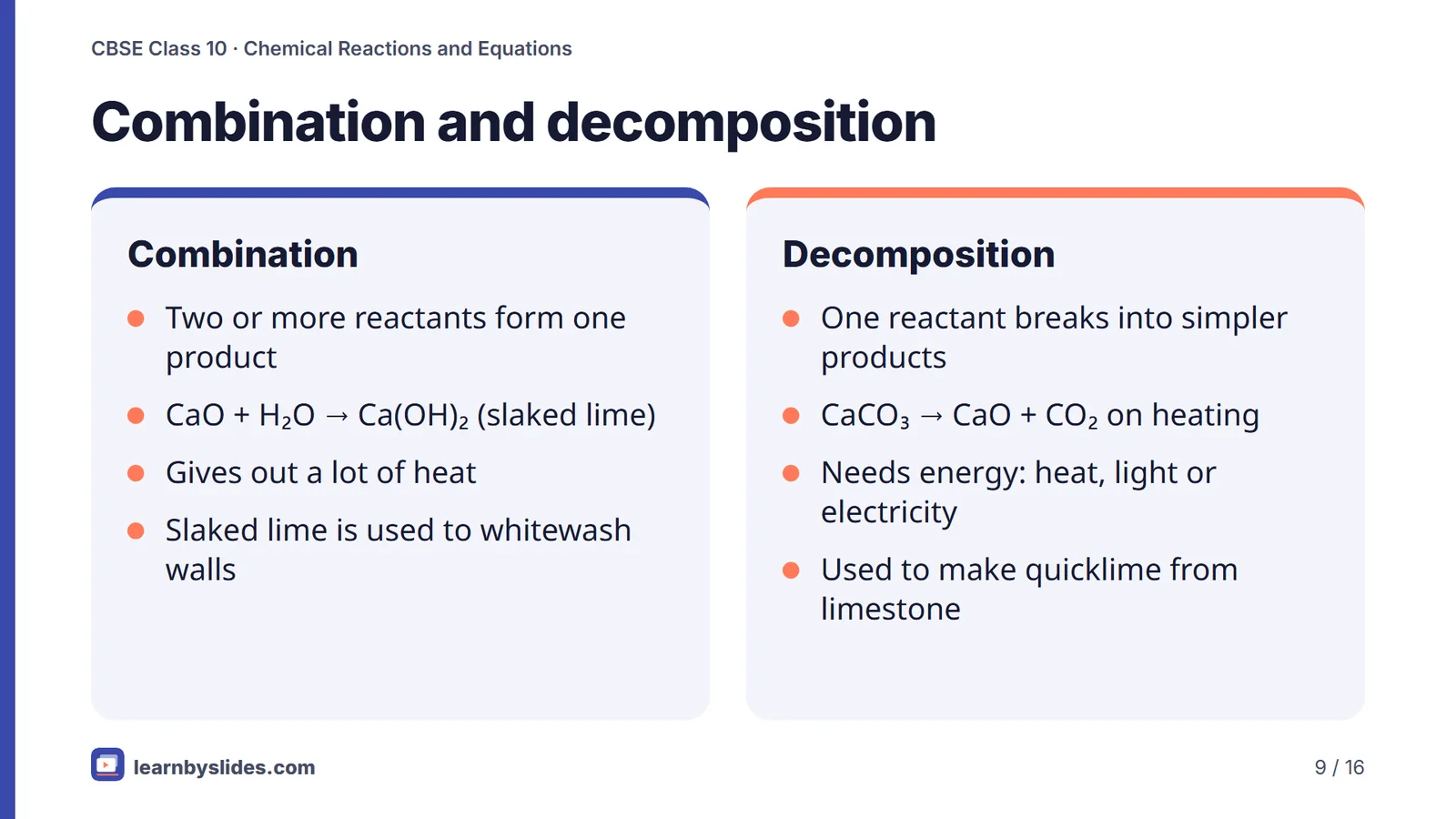
- Combination: quicklime and water form slaked lime, CaO + H₂O → Ca(OH)₂, giving out heat.
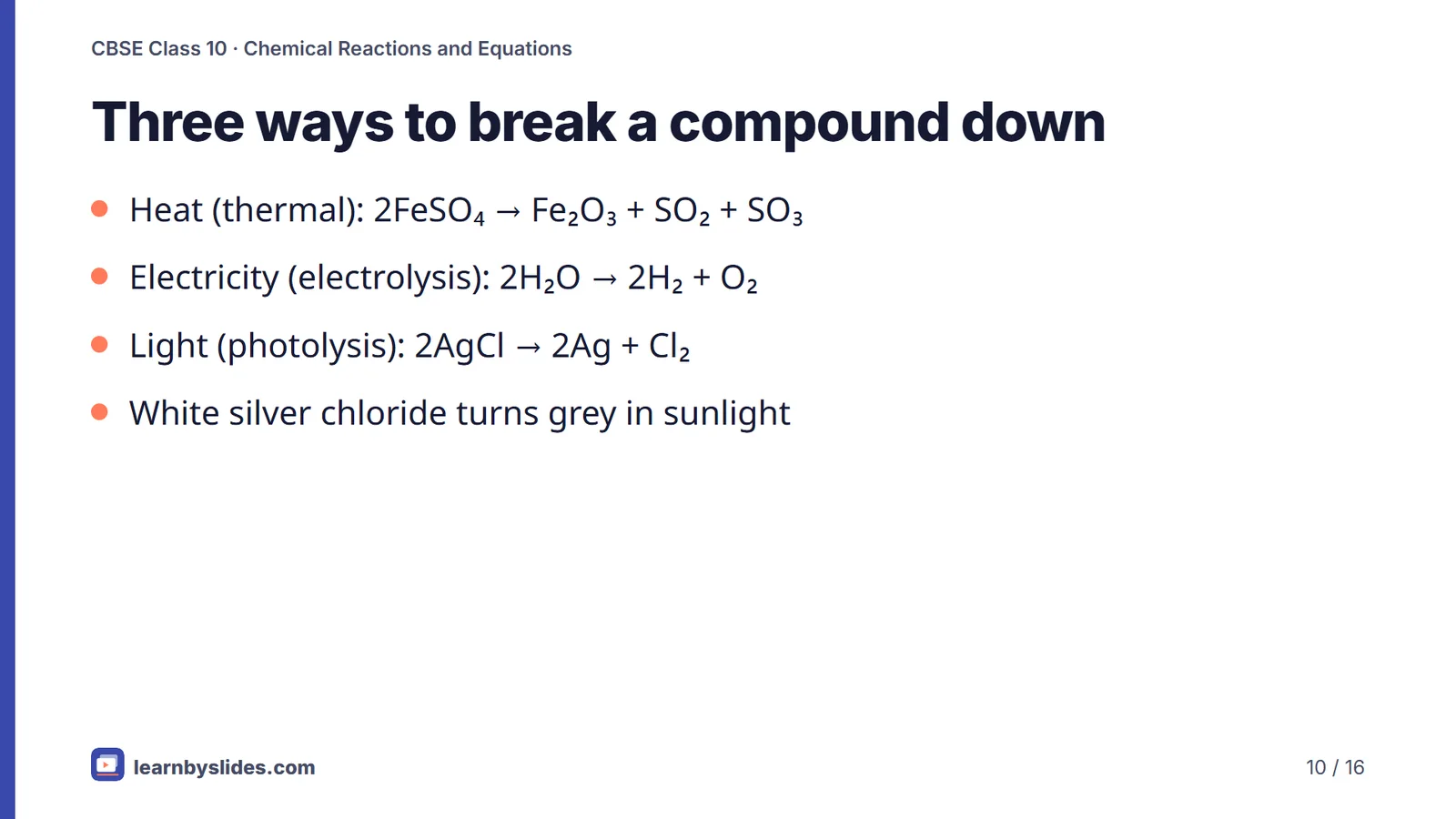
- Decomposition: heat, electricity or light breaks a compound down, as in CaCO₃ → CaO + CO₂, 2H₂O → 2H₂ + O₂ and 2AgCl → 2Ag + Cl₂.
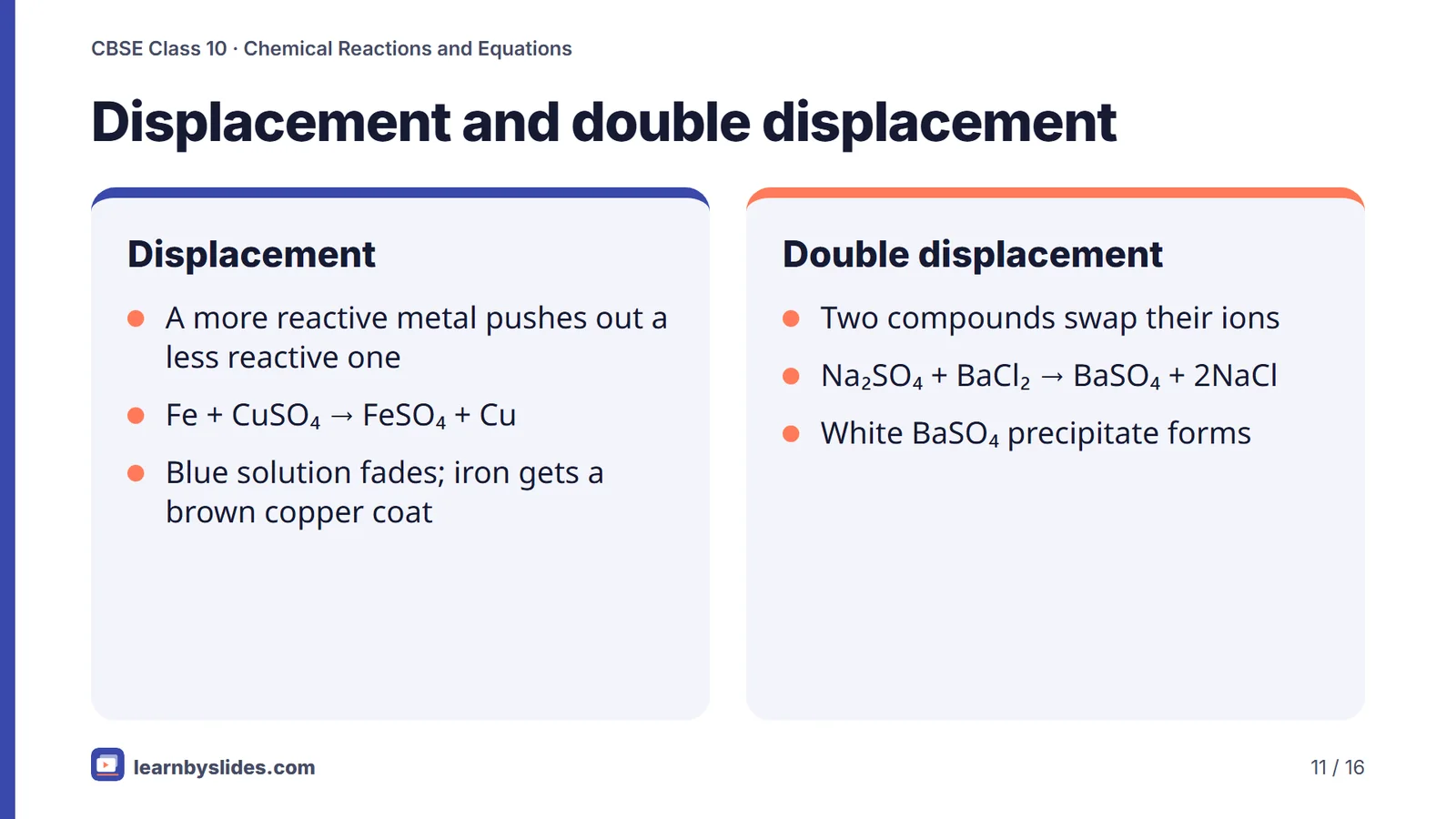
- Displacement: a more reactive metal replaces a less reactive one, as in Fe + CuSO₄ → FeSO₄ + Cu.
- Double displacement: two compounds exchange ions, often forming a precipitate, as in Na₂SO₄ + BaCl₂ → BaSO₄ + 2NaCl.
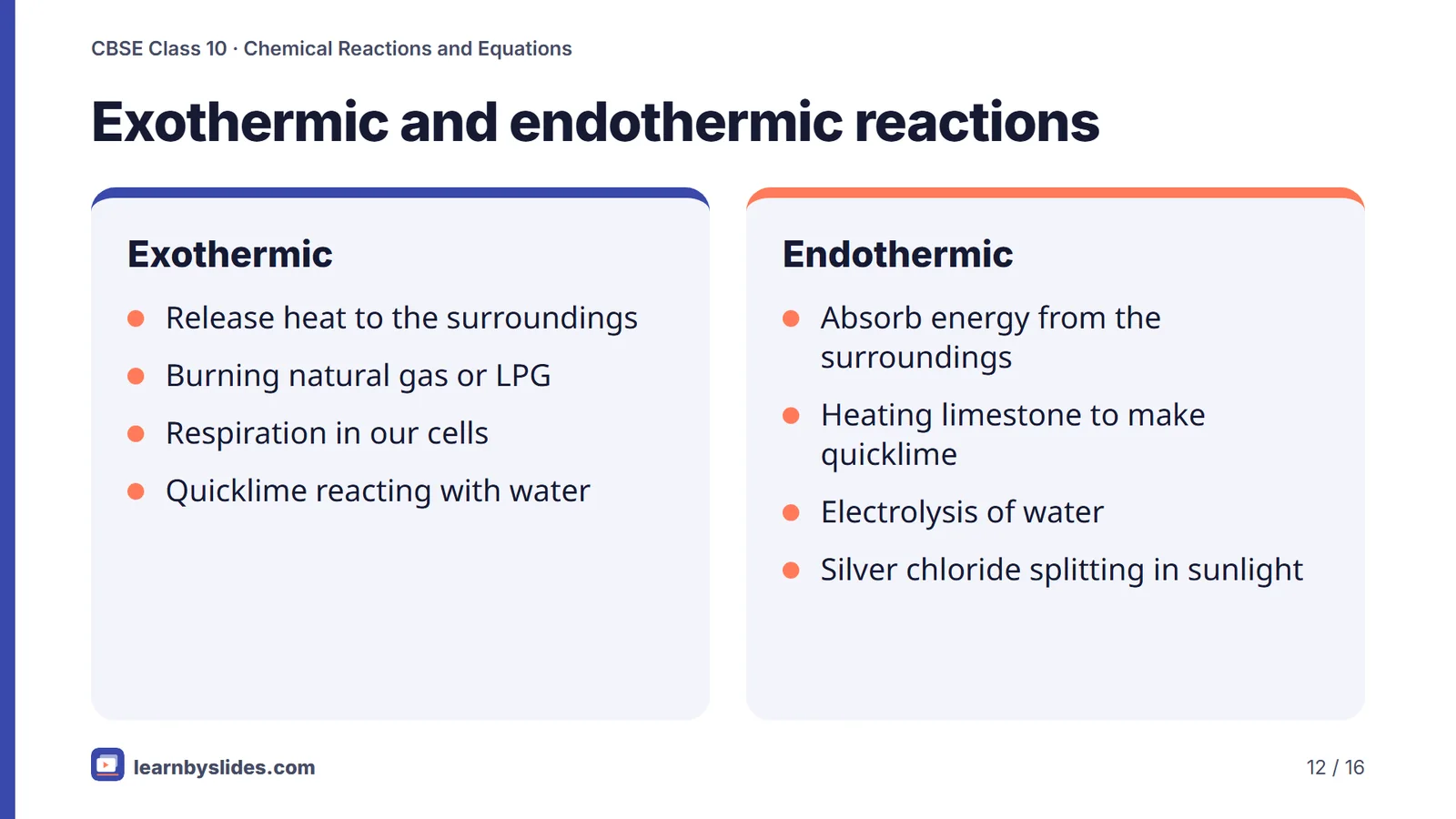
Reactions that release heat, such as respiration and burning fuel, are exothermic; those that absorb energy, such as most decompositions, are endothermic.
Oxidation, reduction and everyday effects
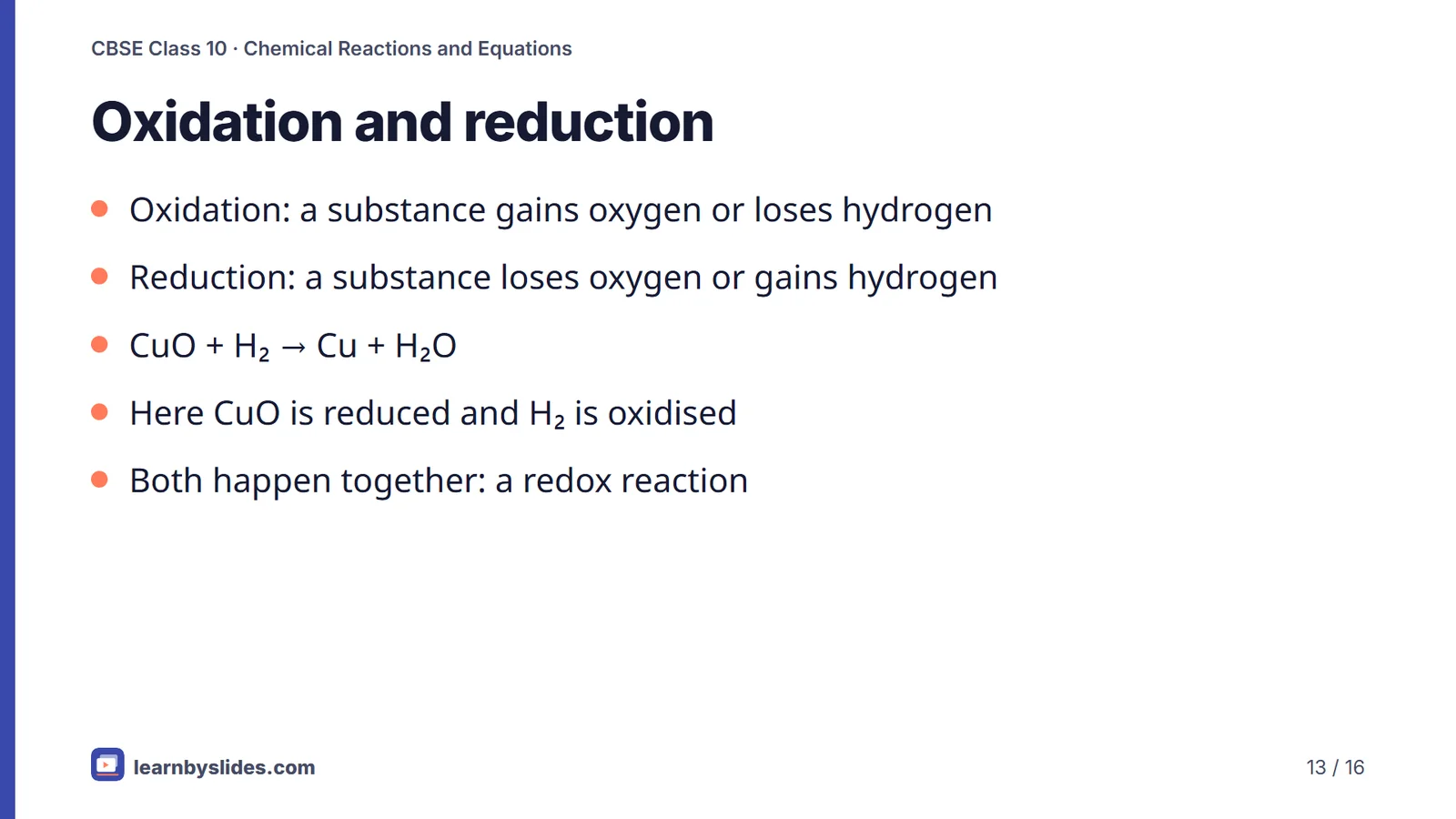
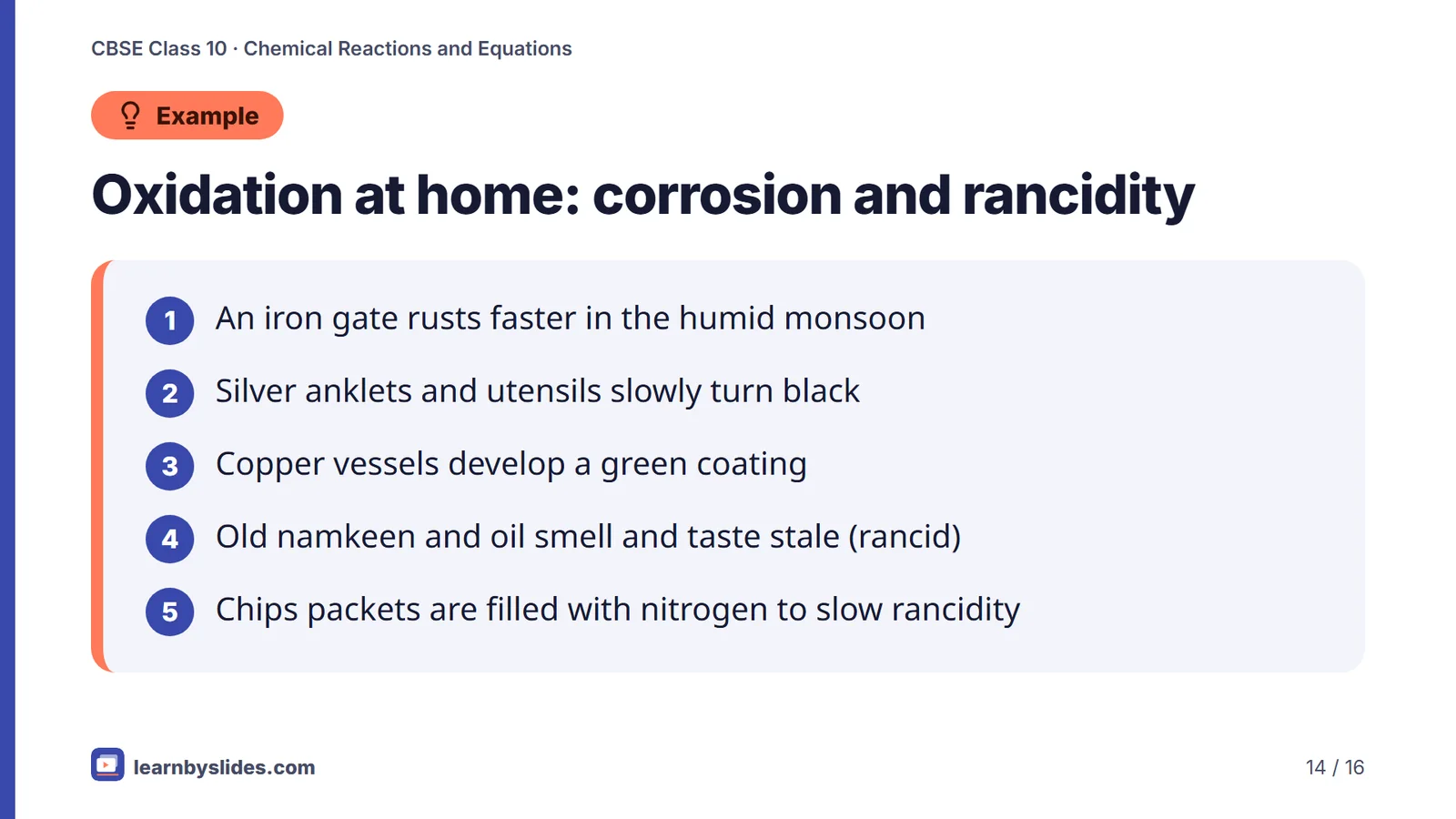
Oxidation is the gain of oxygen or loss of hydrogen; reduction is the loss of oxygen or gain of hydrogen. They always occur together, as in CuO + H₂ → Cu + H₂O, where copper oxide is reduced and hydrogen is oxidised. Two everyday results of oxidation close the lesson: corrosion, such as rust on iron, the black layer on silver and the green coat on copper, and rancidity, the stale taste of oxidised fats and oils, which is slowed by airtight storage, antioxidants and nitrogen-filled packets.
How to use these slides
Present the deck in class or download the free PDF for handouts. Pause at the quick-check slide for a class vote, then finish with the five-question quiz on this page. The editable PPTX lets you swap in your own examples and demonstrations. Burning magnesium, heating ferrous sulphate and electrolysis should be shown as teacher demonstrations with proper safety precautions.
Slide-by-slide content
1. Chemical Reactions and Equations
CBSE Class 10 Science · Writing, balancing and classifying reactions
Speaker notes
Open with a quick question: what changes when milk turns into curd, or when an iron gate rusts? Collect answers and point out that in both cases a new substance forms. Tell the class that today they will learn to describe such changes in the short, exact language of chemistry.
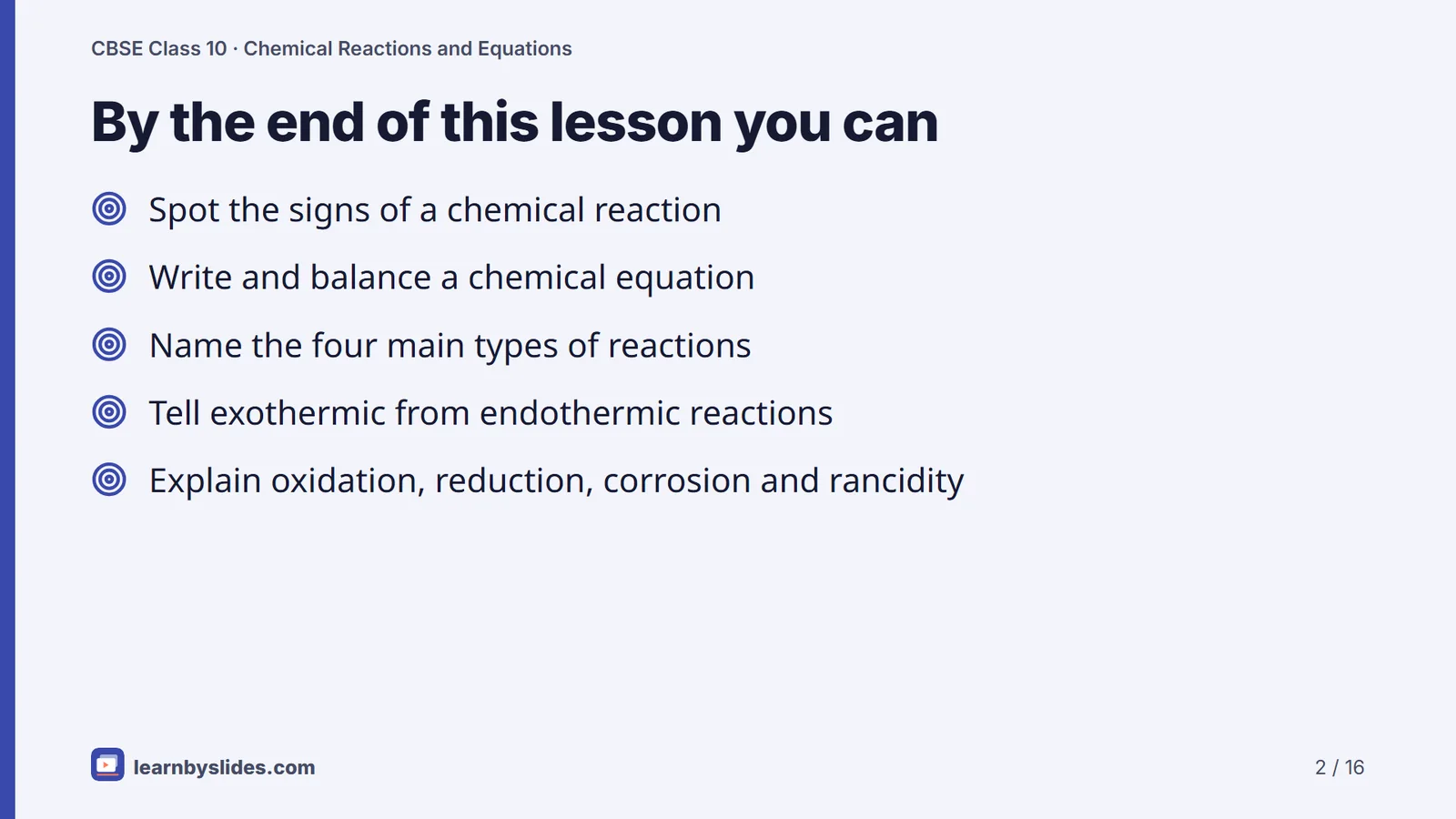
2. By the end of this lesson you can
- Spot the signs of a chemical reaction
- Write and balance a chemical equation
- Name the four main types of reactions
- Tell exothermic from endothermic reactions
- Explain oxidation, reduction, corrosion and rancidity
Speaker notes
Read the objectives aloud and ask students which one sounds hardest. Promise that balancing, usually the scariest, will be done step by step with a familiar example.
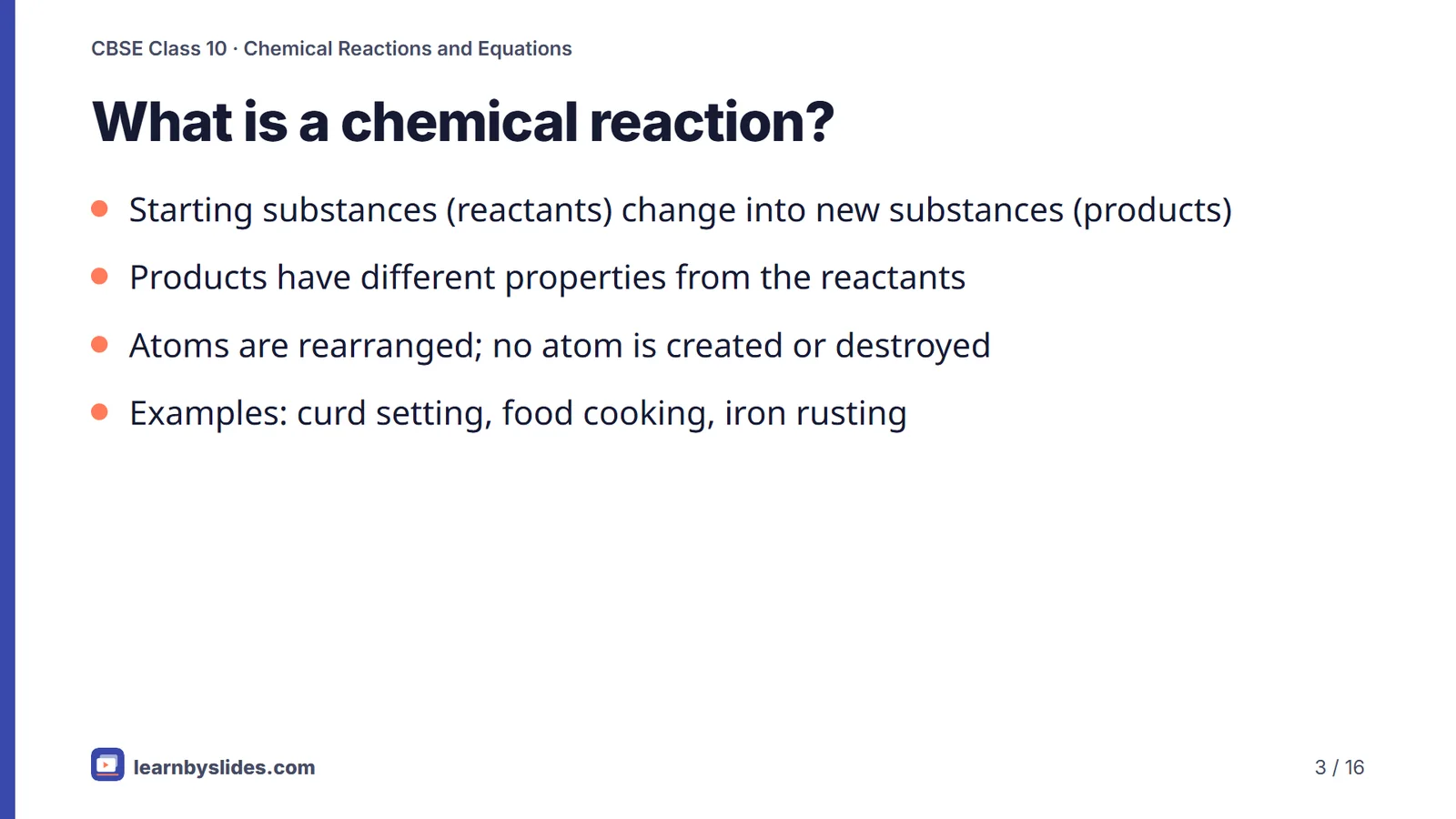
3. What is a chemical reaction?
- Starting substances (reactants) change into new substances (products)
- Products have different properties from the reactants
- Atoms are rearranged; no atom is created or destroyed
- Examples: curd setting, food cooking, iron rusting
Speaker notes
Contrast with a physical change such as ice melting, where no new substance forms. Ask: is dissolving sugar in water a chemical reaction? It is not, because the sugar can be recovered by evaporating the water.
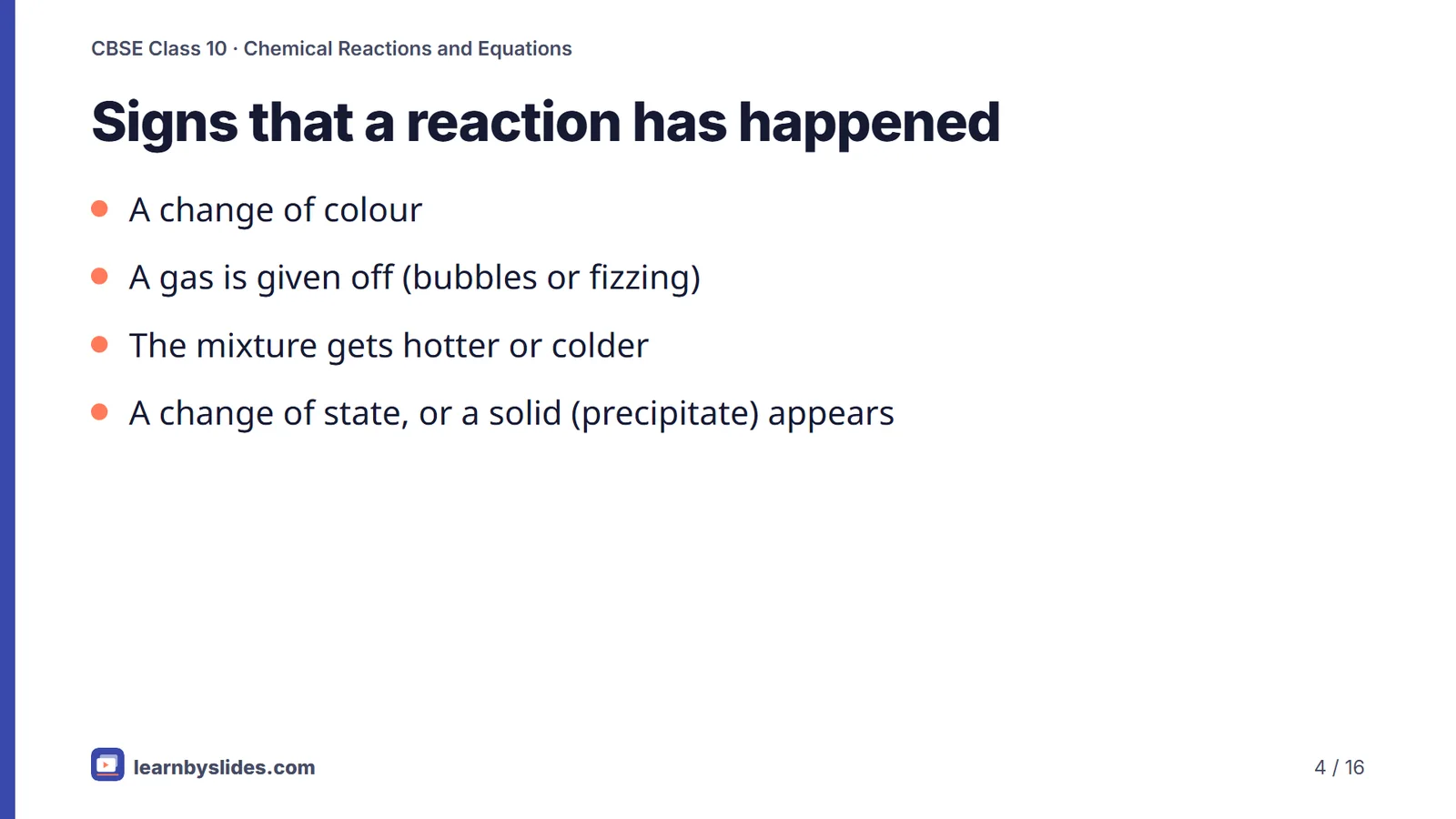
4. Signs that a reaction has happened
- A change of colour
- A gas is given off (bubbles or fizzing)
- The mixture gets hotter or colder
- A change of state, or a solid (precipitate) appears
Speaker notes
Burn a small magnesium ribbon only as a teacher demonstration with tongs and eye protection: it gives a dazzling white flame and leaves white magnesium oxide. Warn students never to look straight at the flame. A sign such as a colour change hints at a reaction but does not prove one on its own.
5. From words to a chemical equation
- Word equation: magnesium + oxygen → magnesium oxide
- Replace names with formulas: Mg + O₂ → MgO
- Reactants go on the left, products on the right
- The arrow means 'forms' or 'changes into'
Speaker notes
Show that the formula version is shorter and tells us exactly which atoms are involved. Ask a student to count the oxygen atoms on each side of Mg + O₂ → MgO; they will find two on the left and one on the right, which sets up the next slide.
6. Why equations must be balanced
- Law of conservation of mass: mass is neither created nor destroyed
- Each element needs the same number of atoms on both sides
- Balance with coefficients (numbers in front of formulas)
- Never change the subscripts inside a formula
Speaker notes
Balanced form: 2Mg + O₂ → 2MgO. Explain that changing O₂ to O or MgO to MgO₂ would describe different substances, which is why only coefficients may change. A common mistake is to write the coefficient as a subscript.
7. Balancing the burning of CNG (methane)
- Skeleton equation: CH₄ + O₂ → CO₂ + H₂O
- Carbon: one on each side, already balanced
- Hydrogen: 4 on the left, so write 2H₂O
- Oxygen: now 4 on the right, so write 2O₂
- Balanced: CH₄ + 2O₂ → CO₂ + 2H₂O
Speaker notes
CNG autos and buses in many Indian cities run mainly on methane, so this reaction happens inside their engines every second. Work through each step on the board and recount every element at the end. Ask students to balance H₂ + O₂ → H₂O on their own before moving on.
8. Making equations more informative
- State symbols: (s) solid, (l) liquid, (g) gas
- (aq) means dissolved in water, an aqueous solution
- Conditions go above or below the arrow: heat, light, catalyst
- Example: Zn(s) + H₂SO₄(aq) → ZnSO₄(aq) + H₂(g)
Speaker notes
State symbols are optional in the textbook unless a question asks for them, but they make an equation much clearer. Ask: in the zinc example, which product would you see as bubbles? The answer is hydrogen gas.
9. Combination and decomposition
Combination
- Two or more reactants form one product
- CaO + H₂O → Ca(OH)₂ (slaked lime)
- Gives out a lot of heat
- Slaked lime is used to whitewash walls
Decomposition
- One reactant breaks into simpler products
- CaCO₃ → CaO + CO₂ on heating
- Needs energy: heat, light or electricity
- Used to make quicklime from limestone
Speaker notes
Point out that one reaction is roughly the reverse pattern of the other: many things combine into one, or one thing splits into many. Adding quicklime to water must be done carefully because the mixture gets very hot. Ask students to classify 2Mg + O₂ → 2MgO; it is a combination reaction.
10. Three ways to break a compound down
- Heat (thermal): 2FeSO₄ → Fe₂O₃ + SO₂ + SO₃
- Electricity (electrolysis): 2H₂O → 2H₂ + O₂
- Light (photolysis): 2AgCl → 2Ag + Cl₂
- White silver chloride turns grey in sunlight
Speaker notes
In the electrolysis of water, the volume of hydrogen collected is twice that of oxygen, which matches the 2 : 1 ratio in the equation. The action of light on silver salts was the basis of black-and-white photography. Heating ferrous sulphate gives off gases with a sharp smell, so it should be done only under supervision.
11. Displacement and double displacement
Displacement
- A more reactive metal pushes out a less reactive one
- Fe + CuSO₄ → FeSO₄ + Cu
- Blue solution fades; iron gets a brown copper coat
Double displacement
- Two compounds swap their ions
- Na₂SO₄ + BaCl₂ → BaSO₄ + 2NaCl
- White BaSO₄ precipitate forms
Speaker notes
Iron is more reactive than copper, so it displaces copper from copper sulphate solution. A reaction that produces an insoluble solid is also called a precipitation reaction. Ask: would copper displace iron from iron sulphate? No, because copper is less reactive.
12. Exothermic and endothermic reactions
Exothermic
- Release heat to the surroundings
- Burning natural gas or LPG
- Respiration in our cells
- Quicklime reacting with water
Endothermic
- Absorb energy from the surroundings
- Heating limestone to make quicklime
- Electrolysis of water
- Silver chloride splitting in sunlight
Speaker notes
Respiration is exothermic: glucose reacts with oxygen and releases the energy our body uses. Most decomposition reactions are endothermic because energy is needed to break the reactant apart. Ask students which type a burning candle is.
13. Oxidation and reduction
- Oxidation: a substance gains oxygen or loses hydrogen
- Reduction: a substance loses oxygen or gains hydrogen
- CuO + H₂ → Cu + H₂O
- Here CuO is reduced and H₂ is oxidised
- Both happen together: a redox reaction
Speaker notes
Heating copper powder in air forms black copper oxide, 2Cu + O₂ → 2CuO, which is oxidation. Passing hydrogen over hot copper oxide turns it back to brown copper. A common misconception is that oxidation always needs oxygen gas; losing hydrogen also counts.
14. Oxidation at home: corrosion and rancidity
- An iron gate rusts faster in the humid monsoon
- Silver anklets and utensils slowly turn black
- Copper vessels develop a green coating
- Old namkeen and oil smell and taste stale (rancid)
- Chips packets are filled with nitrogen to slow rancidity
Speaker notes
Corrosion is the slow damage of a metal by air, moisture or chemicals around it; rusting of iron is the most costly example. Rancidity is the oxidation of fats and oils in food. Ask students how their families prevent these: painting and oiling gates, storing food in airtight containers, and adding antioxidants.
15. Quick check
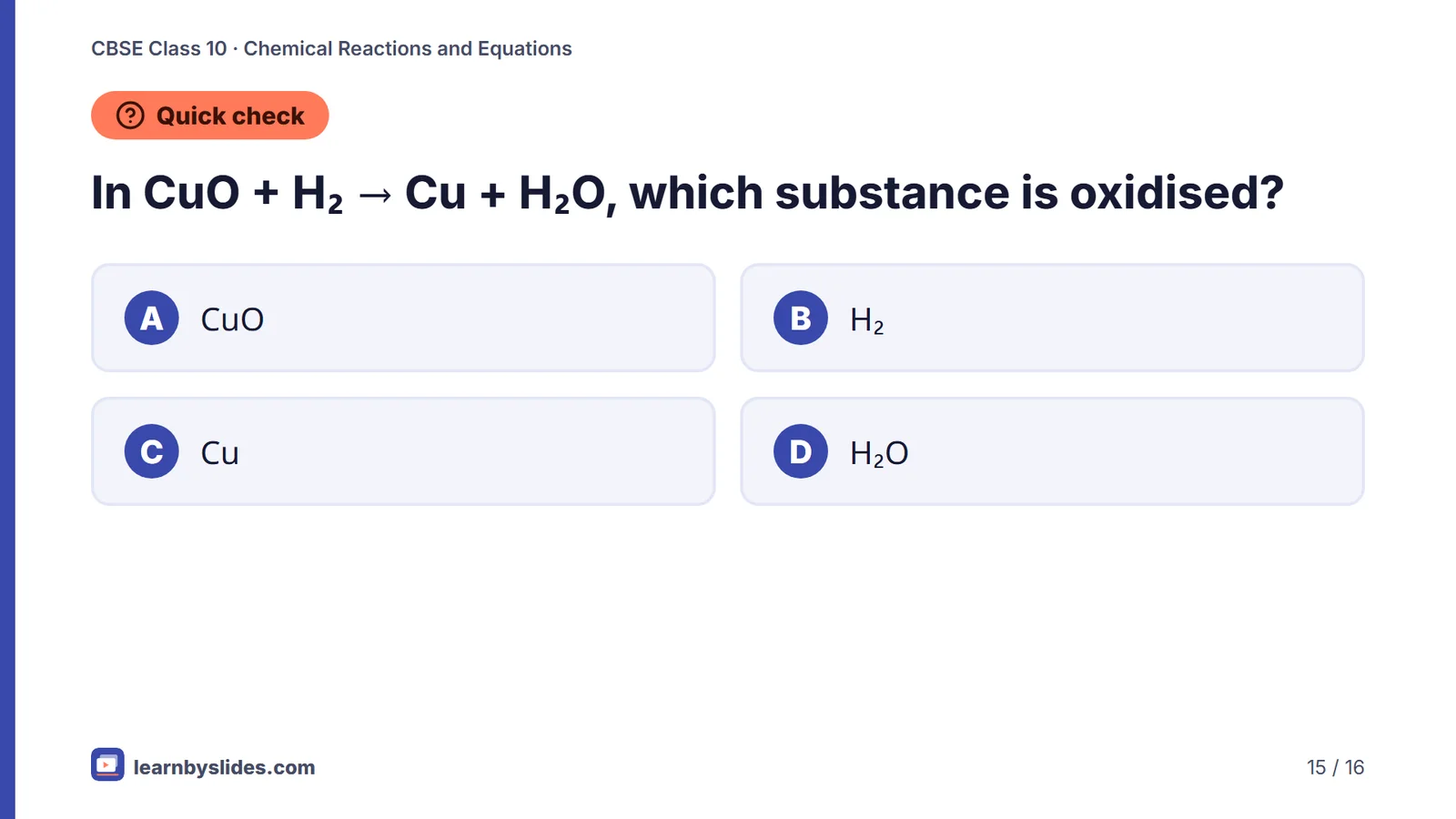
In CuO + H₂ → Cu + H₂O, which substance is oxidised?
- CuO
- H₂
- Cu
- H₂O
Speaker notes
Answer: B, hydrogen, because it gains oxygen to become water. Copper oxide loses oxygen, so it is reduced. Let students vote before revealing the answer, then ask them to explain their choice.
16. Key takeaways
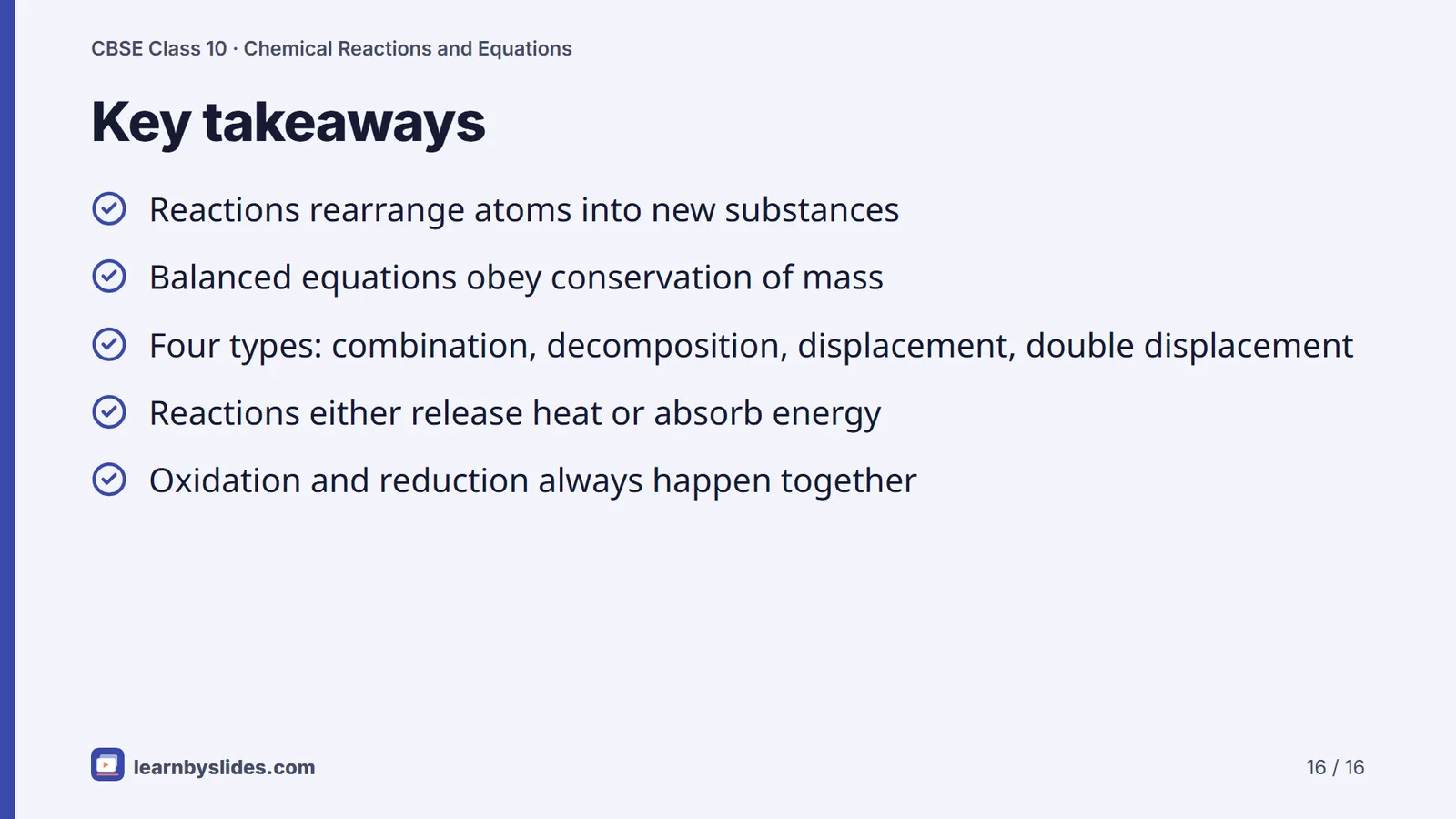
- Reactions rearrange atoms into new substances
- Balanced equations obey conservation of mass
- Four types: combination, decomposition, displacement, double displacement
- Reactions either release heat or absorb energy
- Oxidation and reduction always happen together
Speaker notes
Ask each student to write one balanced equation and label its reaction type as an exit ticket. Then move to the five-question quiz. Homework: find two examples of corrosion or rancidity at home and suggest how to prevent each.
Key terms
- Chemical equation
- A short way of showing a reaction using formulas, with reactants on the left and products on the right of an arrow.
- Balanced equation
- An equation with the same number of atoms of each element on both sides, as required by the law of conservation of mass.
- Combination reaction
- A reaction in which two or more reactants form a single product.
- Decomposition reaction
- A reaction in which one reactant breaks down into two or more simpler products, using heat, light or electricity.
- Precipitate
- An insoluble solid that forms when two solutions react, as in many double displacement reactions.
- Exothermic reaction
- A reaction that releases heat to the surroundings, such as respiration or burning fuel.
- Oxidation
- Gain of oxygen or loss of hydrogen by a substance; reduction is the opposite.
- Rancidity
- The unpleasant change in smell and taste of fats and oils in food caused by oxidation.
Quick quiz
Teacher notes
Suggested 45-minute plan: 5 min opener (curd and rust), 12 min on writing and balancing (slides 3 to 8), 15 min on reaction types and energy (slides 9 to 12), 5 min on redox and everyday oxidation, 8 min for the quick check and quiz. Common misconceptions: changing subscripts to balance an equation; thinking every colour change proves a reaction; thinking oxidation needs oxygen gas. Do the magnesium and electrolysis demonstrations yourself with safety precautions. For extension, give the unbalanced equation Fe + H₂O → Fe₃O₄ + H₂ and ask students to balance it, or ask why food packets sometimes contain antioxidants.
Syllabus reference: CBSE Curriculum 2026-27, Class X Science (Unit I: Chemical Substances)
Frequently asked questions
Which chapter is Chemical Reactions and Equations in CBSE Class 10 Science?
It is Chapter 1 of the NCERT Class 10 Science textbook (reprint 2026-27) and is part of Unit I, Chemical Substances: Nature and Behaviour, in the CBSE 2026-27 Class X syllabus. Always confirm against the syllabus your school follows.
Why can't we change subscripts when balancing an equation?
A subscript is part of a substance's formula. Changing H₂O to H₂O₂, for example, turns water into hydrogen peroxide, a different substance. Only the coefficients in front of formulas may change.
Is respiration exothermic or endothermic?
Respiration is exothermic. Glucose reacts with oxygen in our cells to form carbon dioxide and water, and the energy released keeps the body working.
What is the difference between displacement and double displacement?
In displacement, one element replaces another in a compound, as when iron displaces copper from copper sulphate. In double displacement, two compounds exchange ions with each other, often forming a precipitate.
Sources & methodology
Every fact is checked against the sources below. We write original explanations and draw original graphics; no figures are copied from textbooks. Spotted an error? See our corrections policy.
- Class X Science textbook, Chapter 1: Chemical Reactions and Equations (NCERT, accessed 30 Sept 2026)
- Science (Code 086) Curriculum, Class X, 2026-27 (CBSE, accessed 30 Sept 2026)
- Chemistry 2e, 4.2 Classifying Chemical Reactions (OpenStax (Rice University), accessed 30 Sept 2026)
Reviewed by Claude (pending owner check) · Updated
Related lessons
 Class 10 · Science
Life Processes: Class 10 Science Lesson Slides
A ready-to-teach deck on the four life processes in CBSE Class 10 Science: nutrition, respiration, transportation and excretion, with original diagrams, a 5-question quiz and speaker notes for every slide.
 Class 9 · Science
Motion: Class 9 Science Lesson Slides
A ready-to-teach CBSE Class 9 Science deck on motion in a straight line: position, distance and displacement, speed, velocity, acceleration, position-time and velocity-time graphs, kinematic equations and uniform circular motion.
 Topic
TopicHow to Study Effectively: Spaced Repetition and Active Recall
Research-based slides on studying smarter: why rereading and highlighting fade, how self-testing and spaced reviews work, the 10–20% spacing rule, and a 30-day exam plan, with notes and a quiz.
 Class 8 · Science
Crop Production and Management: Class 8 Science Slides
A ready-to-teach Class 8 Science deck on Crop Production and Management: kharif and rabi crops, soil preparation, sowing, manure and fertilisers, irrigation, weed control, harvesting and safe storage of grain.
 Class 10 · Social Science
Power Sharing: Class 10 Political Science Slides
A ready-to-teach CBSE Class 10 Democratic Politics deck on Power Sharing: the Belgium and Sri Lanka case studies, prudential and moral reasons for sharing power, and the four forms of power sharing with examples from India.
 Class 7 · Maths
Integers: Class 7 Maths Lesson Slides
Ready-to-teach Class 7 slides on integers: the number line, adding and subtracting, sign rules for multiplying and dividing, and key properties, with lifts, temperatures, money, speaker notes and a quiz.
Get new LearnBySlides resources by email
One short email when new free resources go live. No spam, unsubscribe anytime.