Power Sharing: Class 10 Political Science Slides
A ready-to-teach CBSE Class 10 Democratic Politics deck on Power Sharing: the Belgium and Sri Lanka case studies, prudential and moral reasons for sharing power, and the four forms of power sharing with examples from India.
17 slides · 45 min lesson · 5-question quiz · speaker notes · Chapter 1: Power Sharing
Learning objectives
- Describe the social composition of Belgium and Sri Lanka.
- Compare how Belgium and Sri Lanka responded to their diversity.
- Distinguish prudential reasons for power sharing from moral reasons.
- Identify the four forms of power sharing, with an example of each from India.
What this lesson covers
This deck teaches Power Sharing, the first chapter of the Class 10 Democratic Politics textbook in CBSE Social Science, in one 45-minute period. It uses two contrasting case studies, Belgium and Sri Lanka, to show why democracies share power, then sets out the four forms that power sharing takes, with examples from India. Every slide has neutral, textbook-based speaker notes. The chapter sets up the next one, Federalism, which looks at the vertical division of power in more depth.
Belgium: accommodation
Belgium is a small European country with a complex mix of languages. About 59% of its people live in the Flemish region and speak Dutch, about 40% live in Wallonia and speak French, and about 1% speak German. In the capital, Brussels, the pattern flips: about 80% speak French and 20% Dutch.
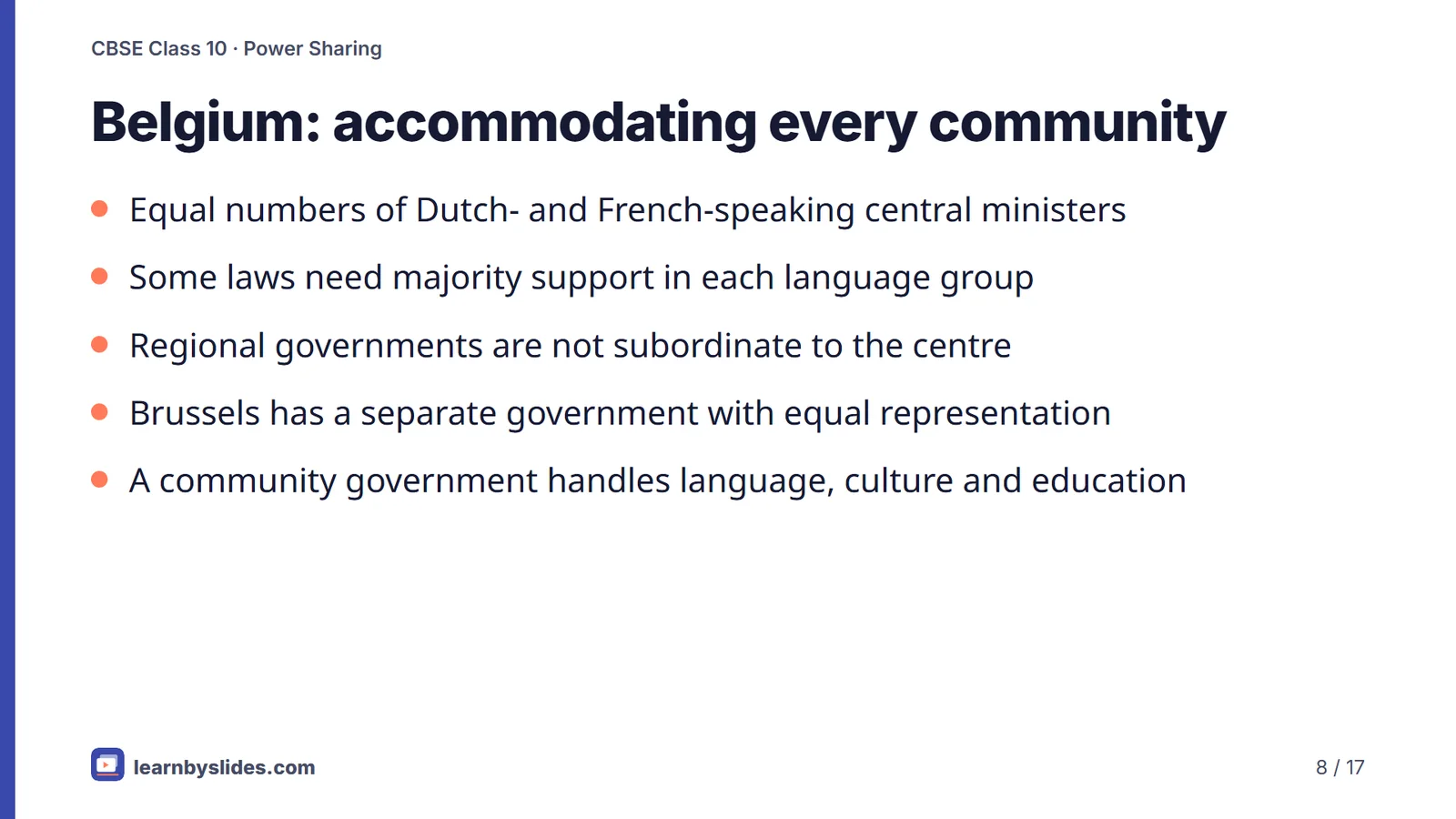
To avoid conflict, Belgium amended its constitution four times between 1970 and 1993. Its arrangement gives equal numbers of Dutch- and French-speaking ministers in the central government, requires some laws to have majority support in each language group, gives real powers to regional governments that are not subordinate to the centre, gives Brussels a government with equal representation, and adds a community government for each language community. Belgium stayed united, and Brussels became the headquarters of the European Union.
Sri Lanka: majoritarianism
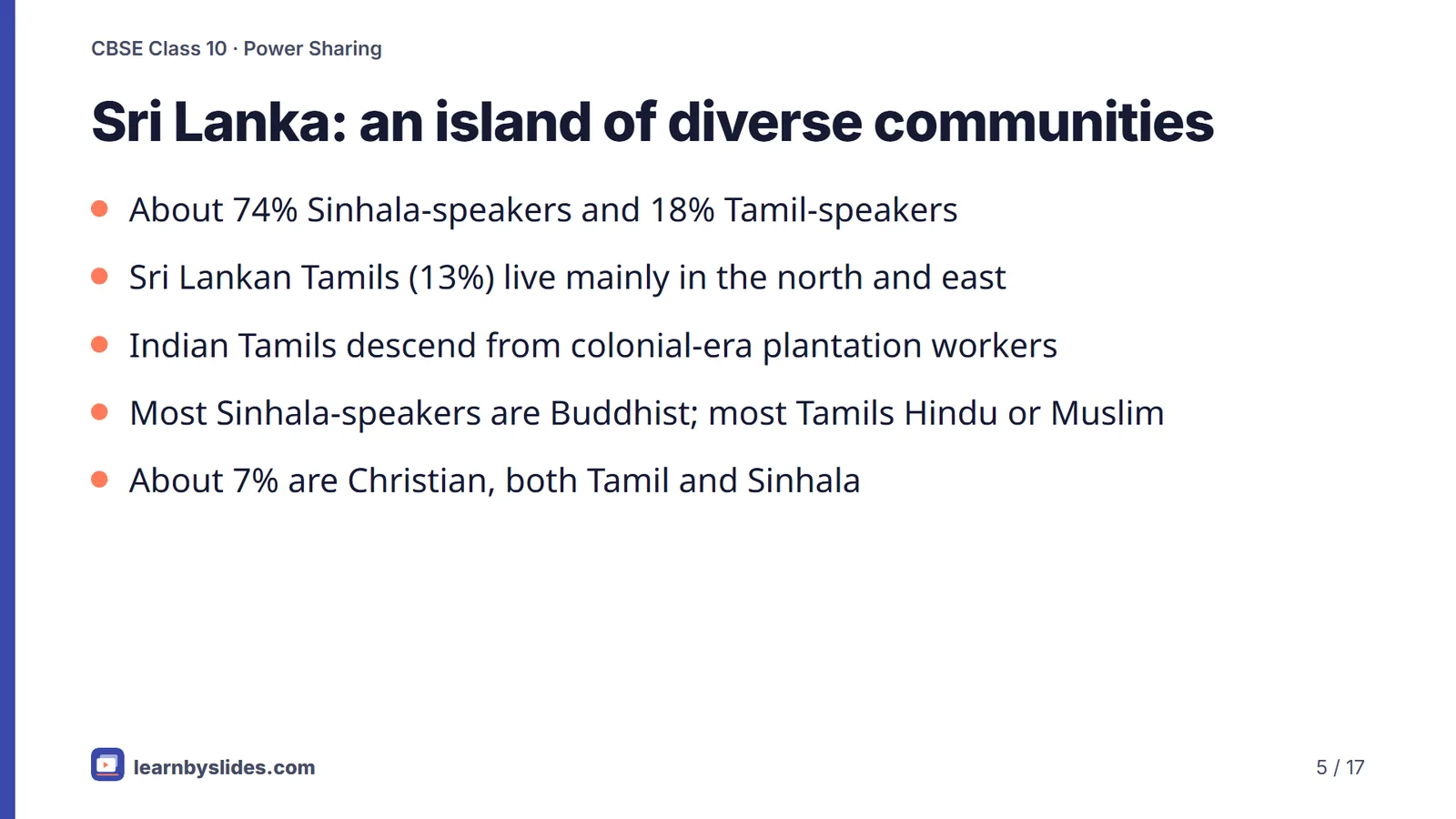
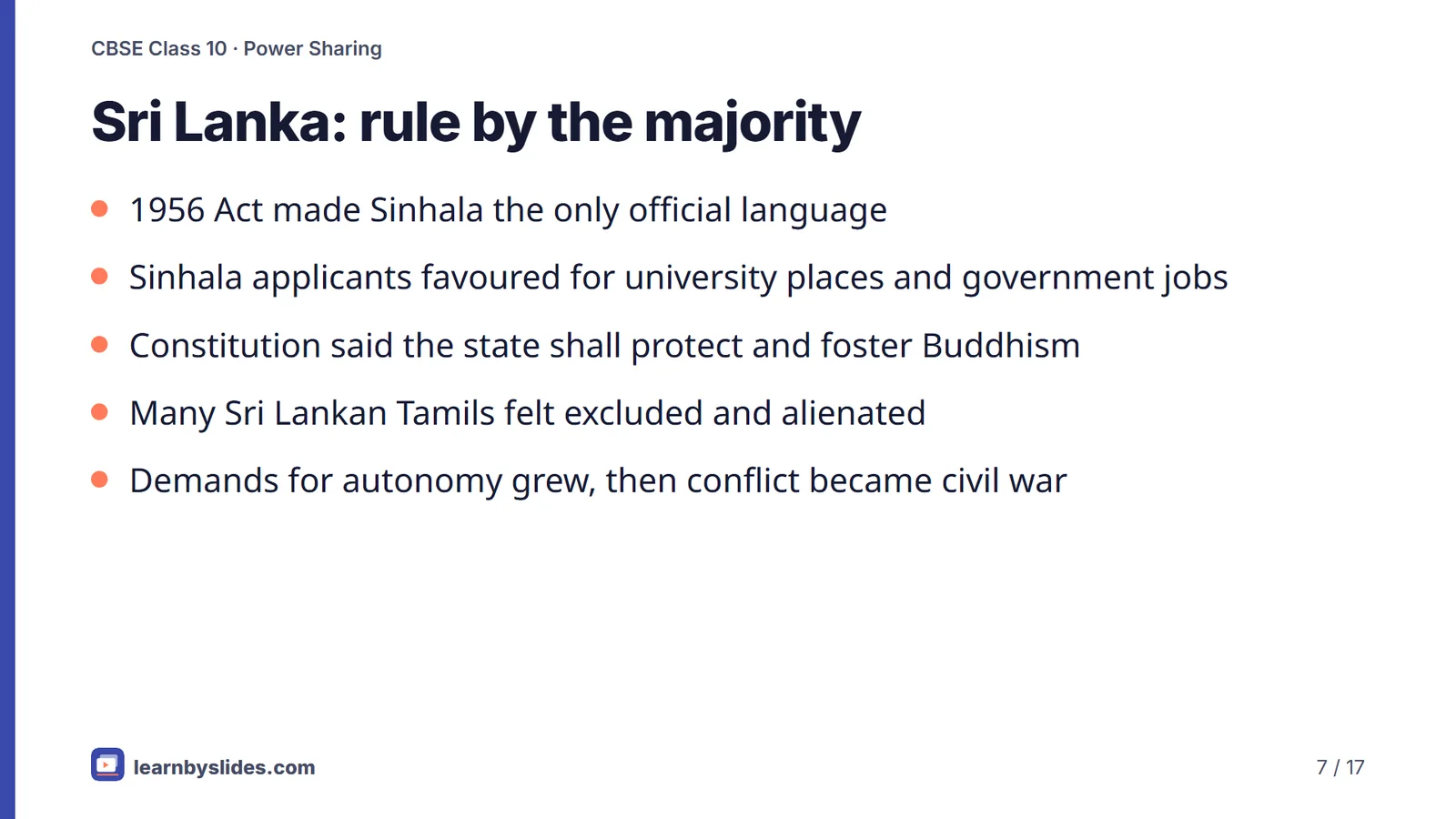
Sri Lanka, an island just off Tamil Nadu, has about 74% Sinhala-speakers and 18% Tamil-speakers. After independence in 1948, successive governments adopted majoritarian measures: a 1956 Act recognised Sinhala as the only official language, preferential policies favoured Sinhala applicants for university places and government jobs, and the constitution said the state would protect and foster Buddhism. Many Sri Lankan Tamils felt alienated, demands for autonomy grew, and distrust turned into a civil war that caused great loss of life before it ended in 2009.
Why power sharing is desirable
The textbook gives two kinds of reasons. Prudential reasons focus on outcomes: sharing power reduces conflict between social groups and helps keep the political order stable, while majority domination can harm the majority too. Moral reasons value power sharing for its own sake: it is the very spirit of democracy, because people have a right to be consulted on how they are governed, and a legitimate government is one in which citizens have a stake.
Four forms of power sharing
- Among organs of government (horizontal): the legislature, executive and judiciary check each other, creating a system of checks and balances.
- Among levels of government (vertical or federal): the Union, State and local governments in India each have powers set out in the Constitution.
- Among social groups: Belgium's community government, and reserved seats for Scheduled Castes and Scheduled Tribes in India.
- Among parties, pressure groups and movements: competition, alliances and coalition governments, plus interest groups that influence decisions.
The India example slide asks students to match real features of Indian democracy to each form.
Slide-by-slide content
1. Power Sharing
CBSE Class 10 Social Science · Democratic Politics, Chapter 1
Speaker notes
Open with a classroom situation: if the class monitor alone decided everything, from seating to sports teams, how would others feel? Let students answer, then explain that countries face the same question on a much larger scale. Today we look at two countries that answered it very differently.
2. By the end of this lesson you can
- Describe the people of Belgium and Sri Lanka
- Compare the two countries' approaches
- Give prudential and moral reasons for sharing power
- Name four forms of power sharing, with Indian examples
Speaker notes
Tell students that the two case studies are the core of the chapter and are often asked about in exams. Ask them to note one key difference between the countries as they go.
3. What is power sharing?
- Power is divided among institutions, levels and groups
- No single person, organ or group holds all power
- Different groups get a voice in decisions that affect them
- It is a key feature of democratic government
Speaker notes
Link to what students learnt in Class 9: in a democracy, power is shared among the legislature, executive and judiciary. Ask: why might it be risky if one group held all the power, even if it was the majority?
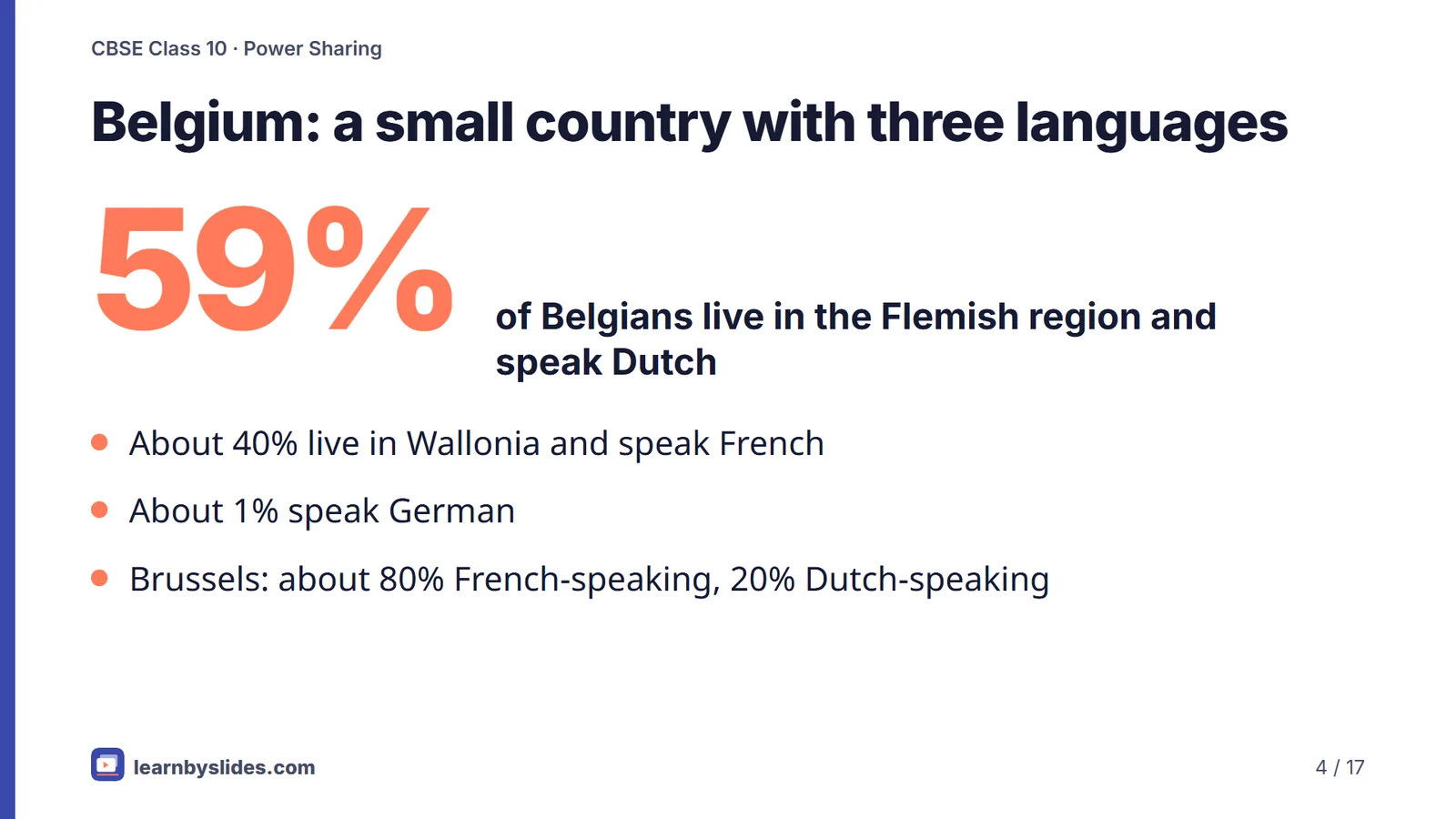
4. Belgium: a small country with three languages
59% of Belgians live in the Flemish region and speak Dutch
- About 40% live in Wallonia and speak French
- About 1% speak German
- Brussels: about 80% French-speaking, 20% Dutch-speaking
Speaker notes
These are the figures used in the NCERT textbook. The key point is that the Dutch-speakers were a majority in the country but a minority in the capital, Brussels. Ask students why this made the situation tricky for both communities.
5. Sri Lanka: an island of diverse communities
- About 74% Sinhala-speakers and 18% Tamil-speakers
- Sri Lankan Tamils (13%) live mainly in the north and east
- Indian Tamils descend from colonial-era plantation workers
- Most Sinhala-speakers are Buddhist; most Tamils Hindu or Muslim
- About 7% are Christian, both Tamil and Sinhala
Speaker notes
Point out Sri Lanka on a map, just off the coast of Tamil Nadu. Compare the size of the majority here, about three quarters, with Belgium's 59%. Ask: in which country could a majority more easily ignore a minority?
6. Key dates in the two case studies
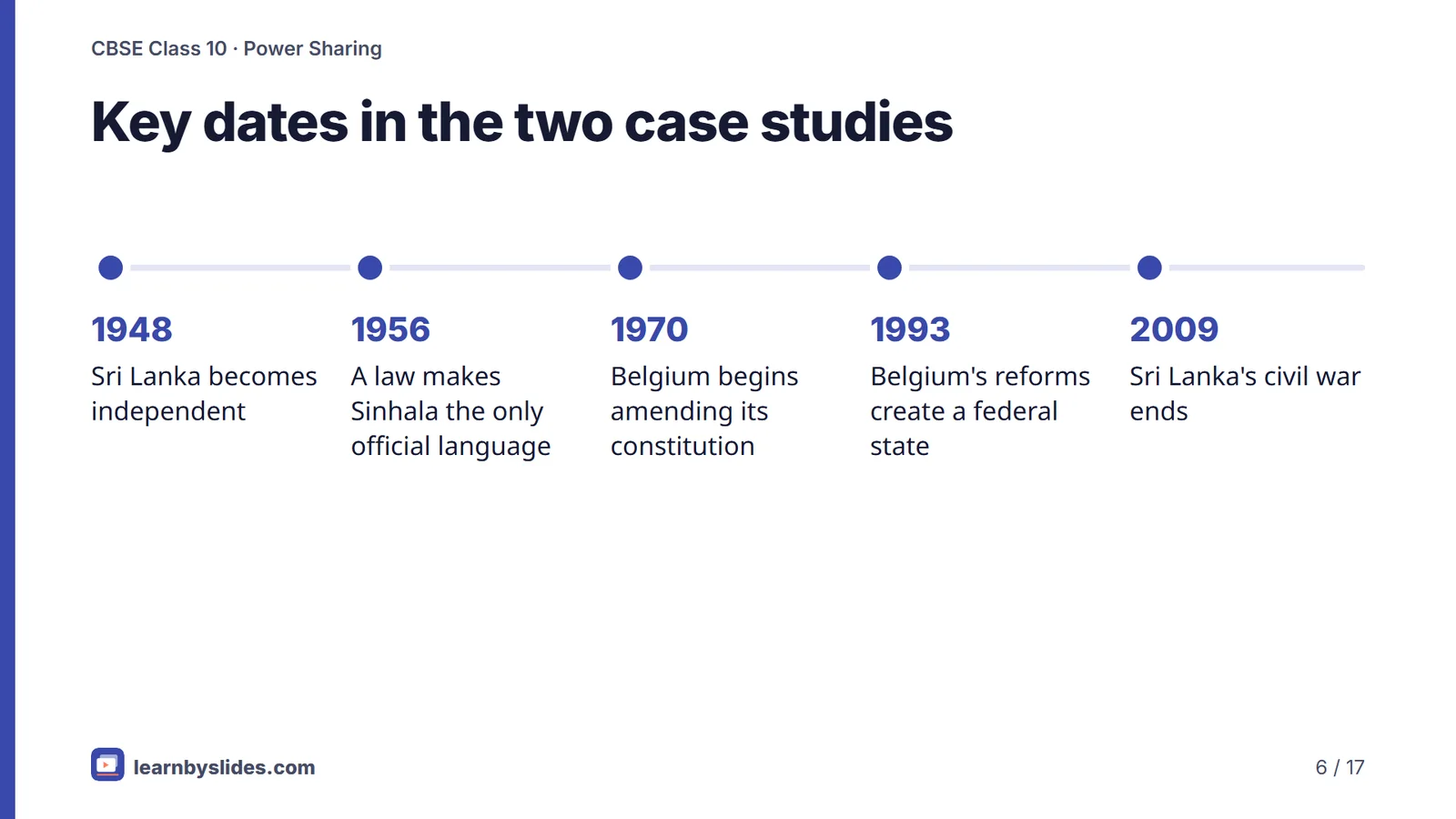
- 1948: Sri Lanka becomes independent
- 1956: A law makes Sinhala the only official language
- 1970: Belgium begins amending its constitution
- 1993: Belgium's reforms create a federal state
- 2009: Sri Lanka's civil war ends
Speaker notes
Belgium amended its constitution four times between 1970 and 1993. Keep the dates simple and let students see the two stories side by side. Ask what happened in Sri Lanka during the years Belgium was working out its arrangement.
7. Sri Lanka: rule by the majority
- 1956 Act made Sinhala the only official language
- Sinhala applicants favoured for university places and government jobs
- Constitution said the state shall protect and foster Buddhism
- Many Sri Lankan Tamils felt excluded and alienated
- Demands for autonomy grew, then conflict became civil war
Speaker notes
The textbook calls these measures majoritarianism: the belief that the majority community should rule in whatever way it wants, disregarding minority wishes. Stay with the facts in the textbook and avoid blaming any community as a whole. Ask: how might a Tamil-speaking student have felt about the language law?
8. Belgium: accommodating every community
- Equal numbers of Dutch- and French-speaking central ministers
- Some laws need majority support in each language group
- Regional governments are not subordinate to the centre
- Brussels has a separate government with equal representation
- A community government handles language, culture and education
Speaker notes
The community government is elected by people of one language community, Dutch, French or German-speaking, wherever they live. Explain that each side accepted give-and-take: the French-speakers accepted equal representation in Brussels because the Dutch-speakers accepted it at the centre. Ask students whether they think this arrangement is fair.
9. Two paths, two outcomes
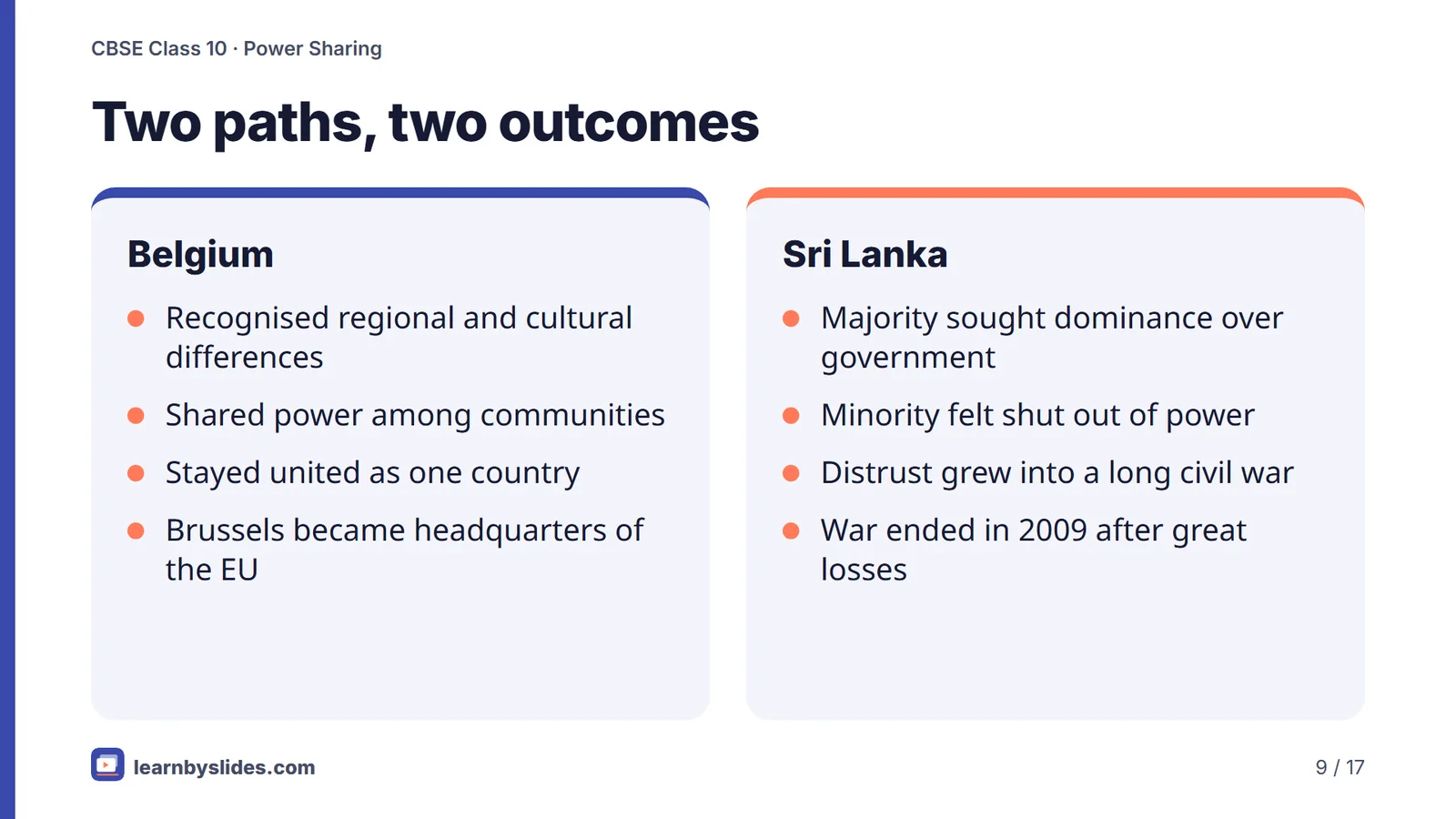
Belgium
- Recognised regional and cultural differences
- Shared power among communities
- Stayed united as one country
- Brussels became headquarters of the EU
Sri Lanka
- Majority sought dominance over government
- Minority felt shut out of power
- Distrust grew into a long civil war
- War ended in 2009 after great losses
Speaker notes
The lesson the textbook draws is that majoritarian policies can undermine a country's unity, while accommodation can strengthen it. Ask students to sum up the difference in one sentence. A common misconception is that power sharing weakens a country; Belgium shows it can hold a country together.
10. Why share power?
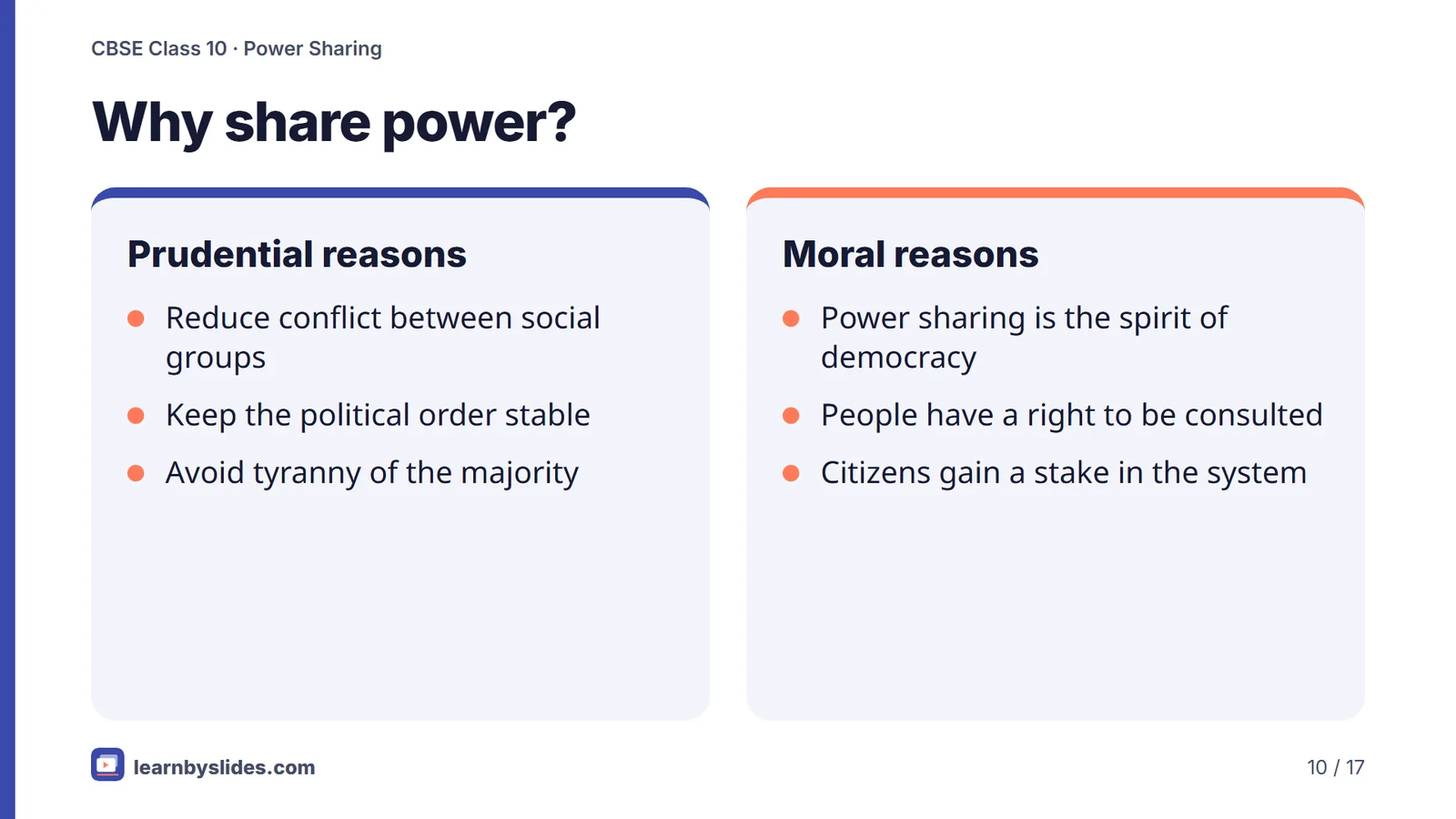
Prudential reasons
- Reduce conflict between social groups
- Keep the political order stable
- Avoid tyranny of the majority
Moral reasons
- Power sharing is the spirit of democracy
- People have a right to be consulted
- Citizens gain a stake in the system
Speaker notes
Prudential means based on careful calculation of gains and losses, so these reasons focus on better outcomes. Moral reasons value power sharing for its own sake. Ask students to classify this statement: 'sharing power keeps the country peaceful' (prudential).
11. Form 1: Among organs of government
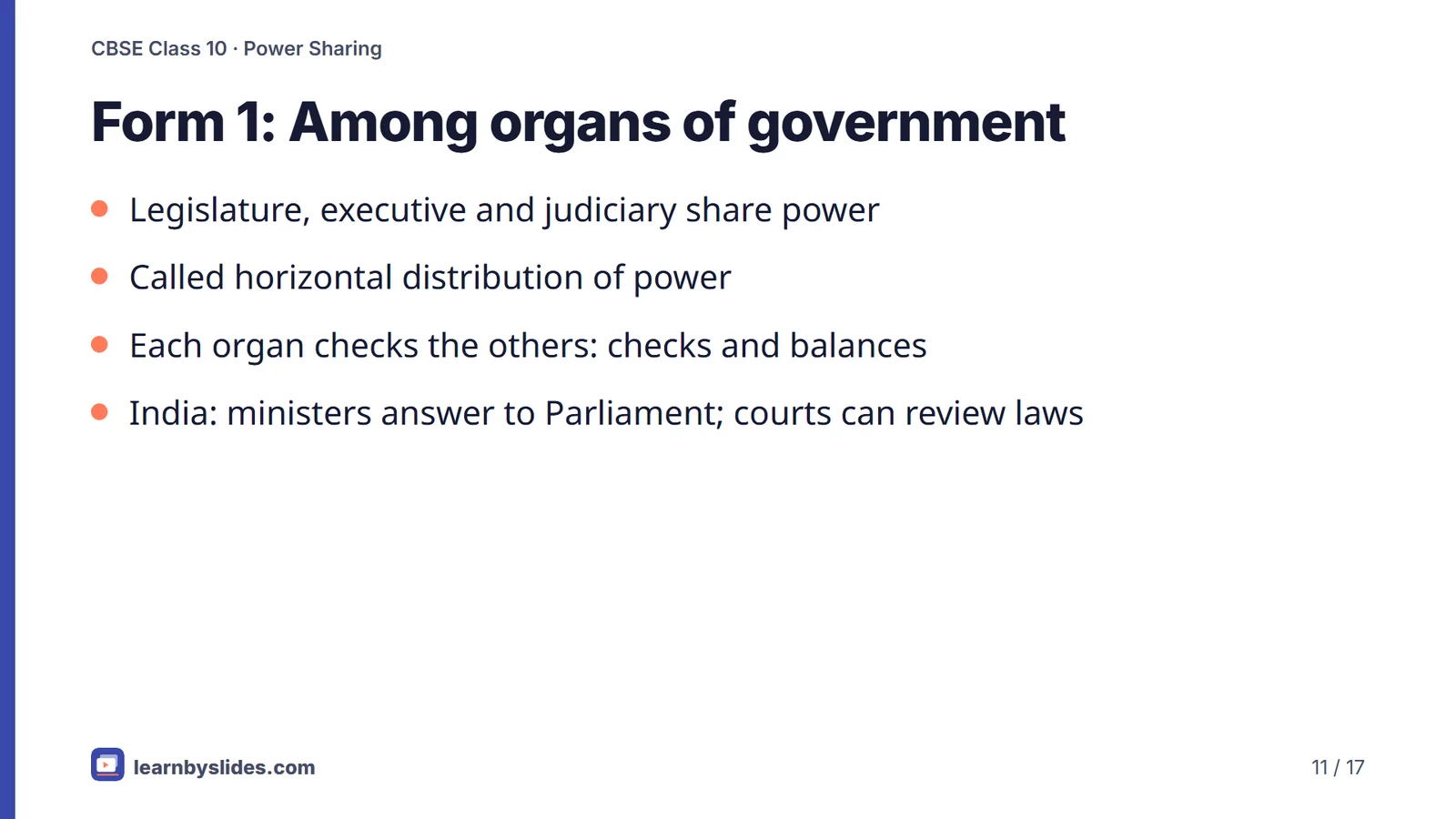
- Legislature, executive and judiciary share power
- Called horizontal distribution of power
- Each organ checks the others: checks and balances
- India: ministers answer to Parliament; courts can review laws
Speaker notes
The organs sit at the same level of government, which is why this is called horizontal. Ask students to name the three organs in India: Parliament, the Union executive led by the Prime Minister, and the judiciary led by the Supreme Court.
12. Form 2: Among levels of government
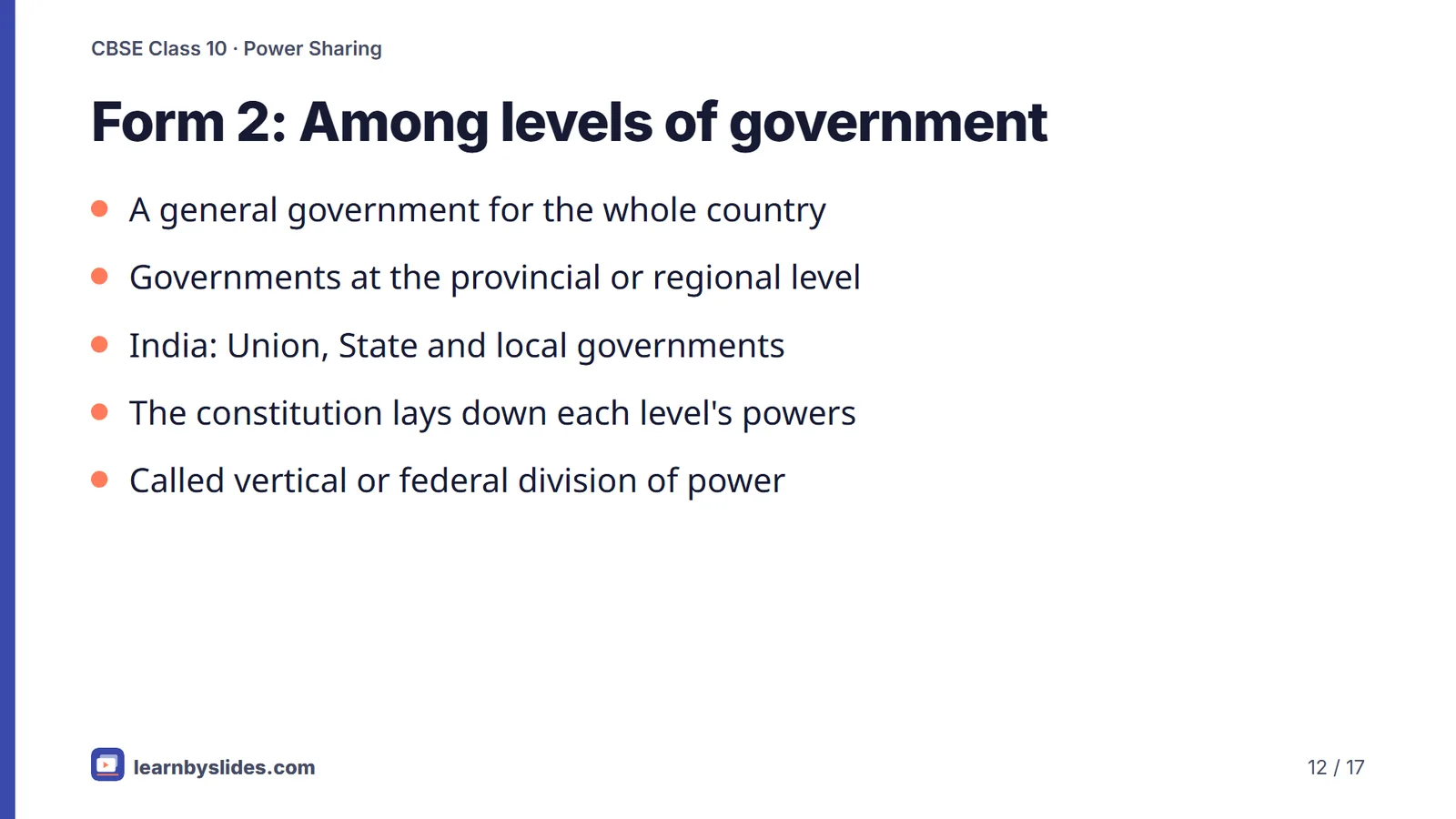
- A general government for the whole country
- Governments at the provincial or regional level
- India: Union, State and local governments
- The constitution lays down each level's powers
- Called vertical or federal division of power
Speaker notes
Belgium chose to share power this way; Sri Lanka refused to do so, according to the textbook. The next chapter, Federalism, covers this form in detail. Ask students to name their local government body: a panchayat or a municipality.
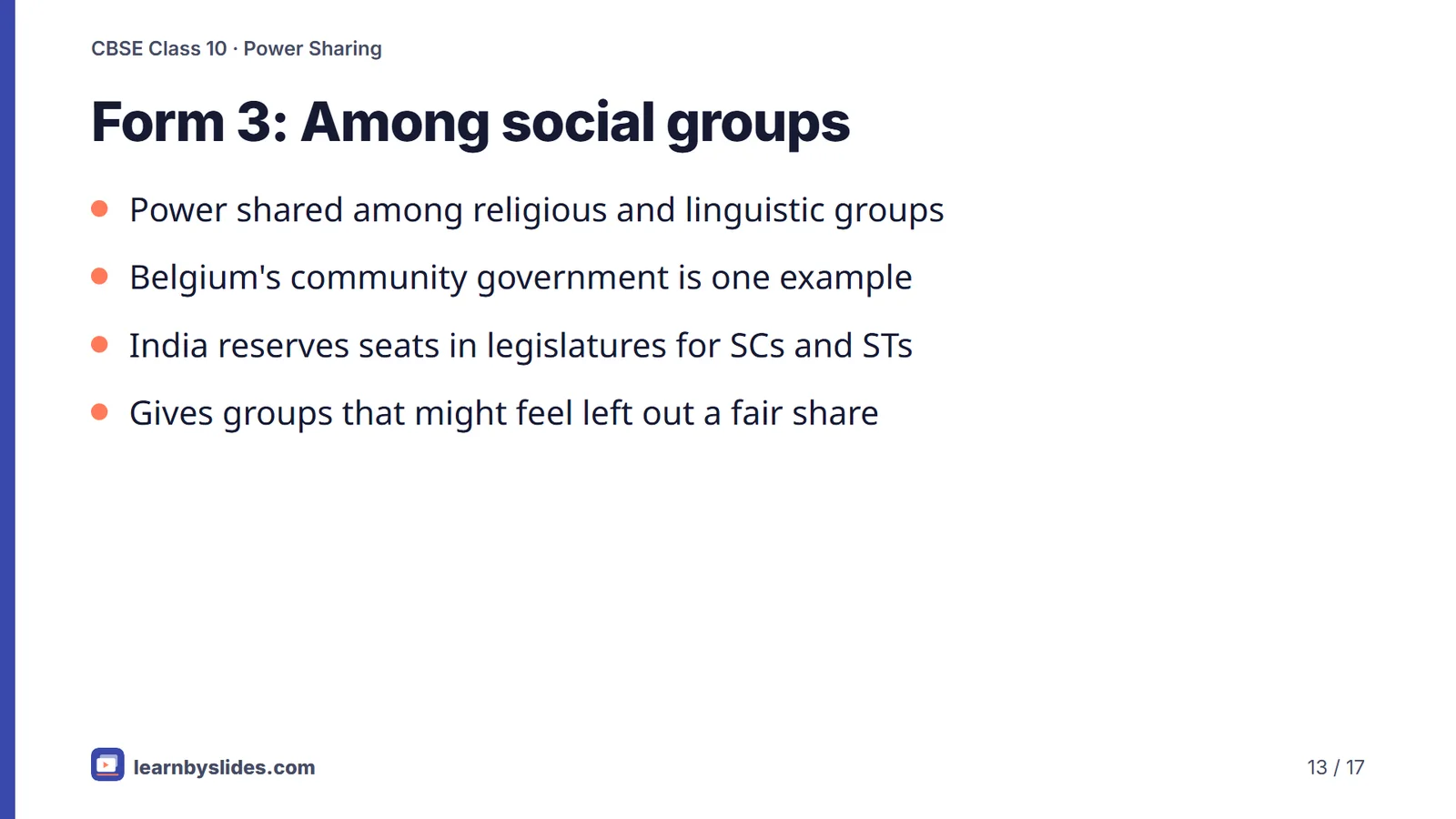
13. Form 3: Among social groups
- Power shared among religious and linguistic groups
- Belgium's community government is one example
- India reserves seats in legislatures for SCs and STs
- Gives groups that might feel left out a fair share
Speaker notes
Students met reserved constituencies in Class 9. Explain that such arrangements aim to give minority and weaker groups a voice in government. Ask why a group that is always outvoted might lose trust in the system.
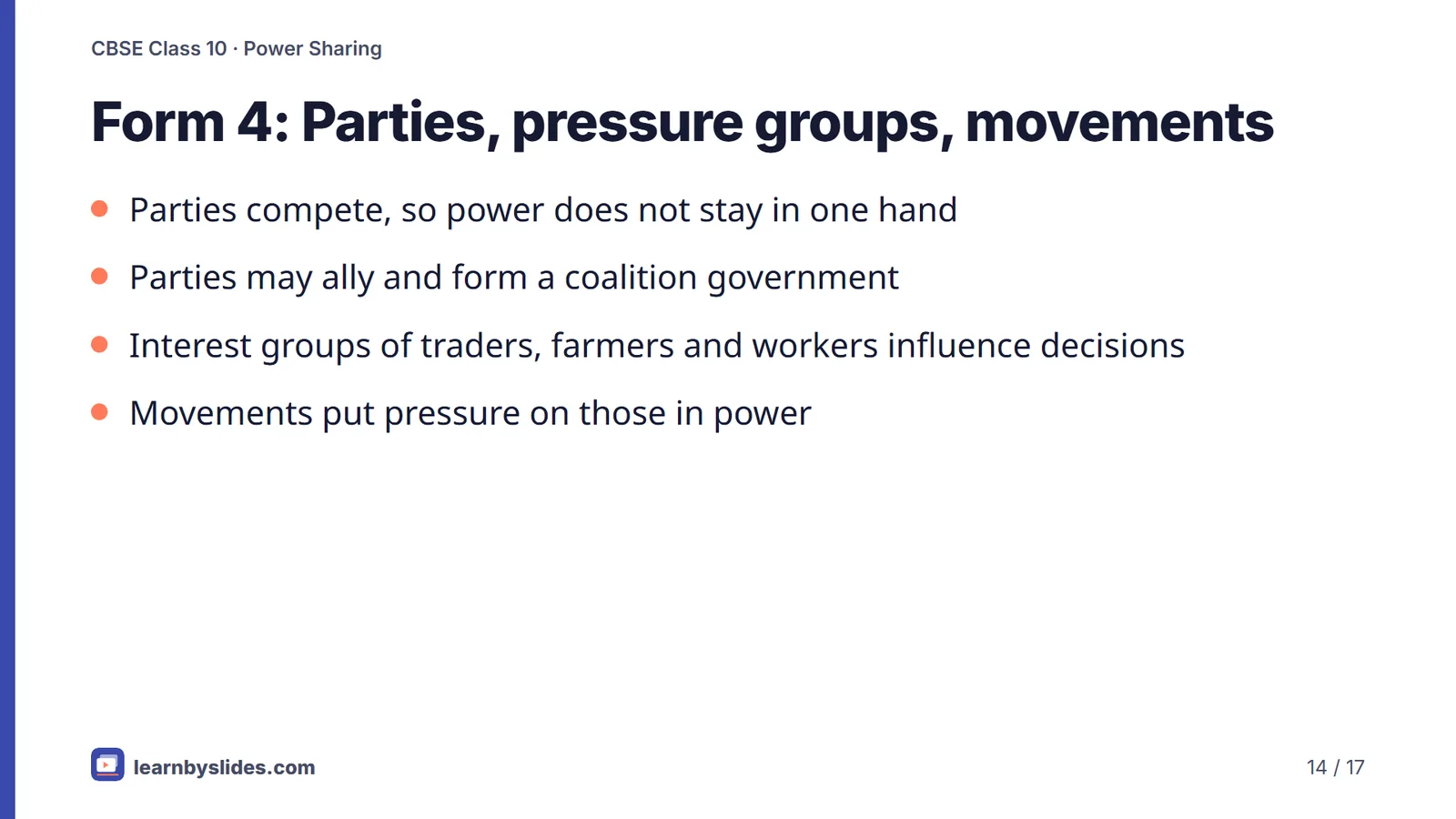
14. Form 4: Parties, pressure groups, movements
- Parties compete, so power does not stay in one hand
- Parties may ally and form a coalition government
- Interest groups of traders, farmers and workers influence decisions
- Movements put pressure on those in power
Speaker notes
Keep this neutral: the point is how competition and alliances share power, not which party is better. A coalition government is formed when two or more parties come together. Ask students for an example of a group, such as a farmers' association, that tries to influence government decisions.
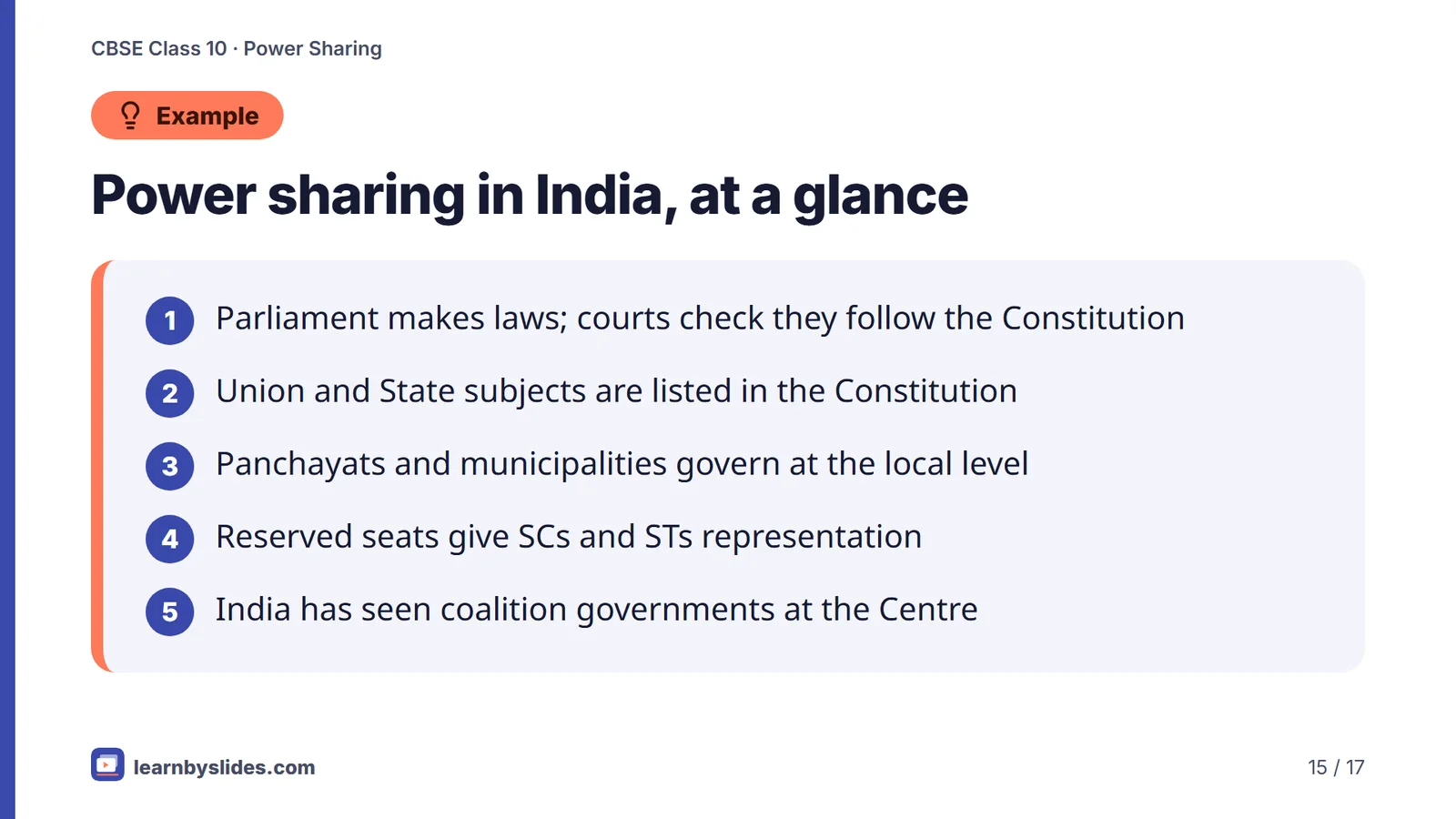
15. Power sharing in India, at a glance
- Parliament makes laws; courts check they follow the Constitution
- Union and State subjects are listed in the Constitution
- Panchayats and municipalities govern at the local level
- Reserved seats give SCs and STs representation
- India has seen coalition governments at the Centre
Speaker notes
Ask students to match each bullet to one of the four forms of power sharing. Answers: horizontal, vertical, vertical, social groups, and parties. This makes a good pair activity before the quick check.
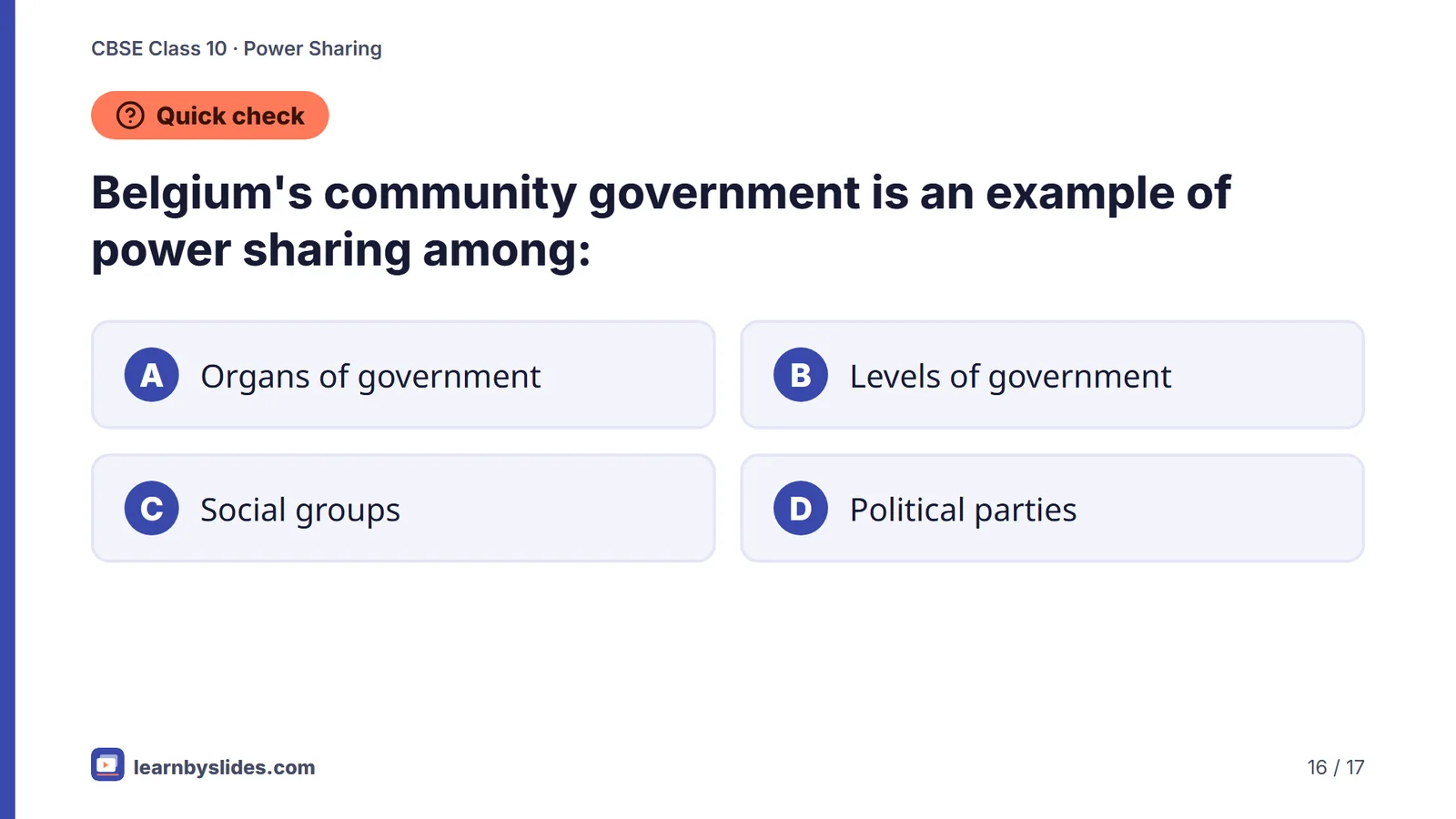
16. Quick check
Belgium's community government is an example of power sharing among:
- Organs of government
- Levels of government
- Social groups
- Political parties
Speaker notes
Answer: C, social groups, because the community government is elected by people of one language community. Some students pick levels of government; remind them that the community government is defined by language, not territory.
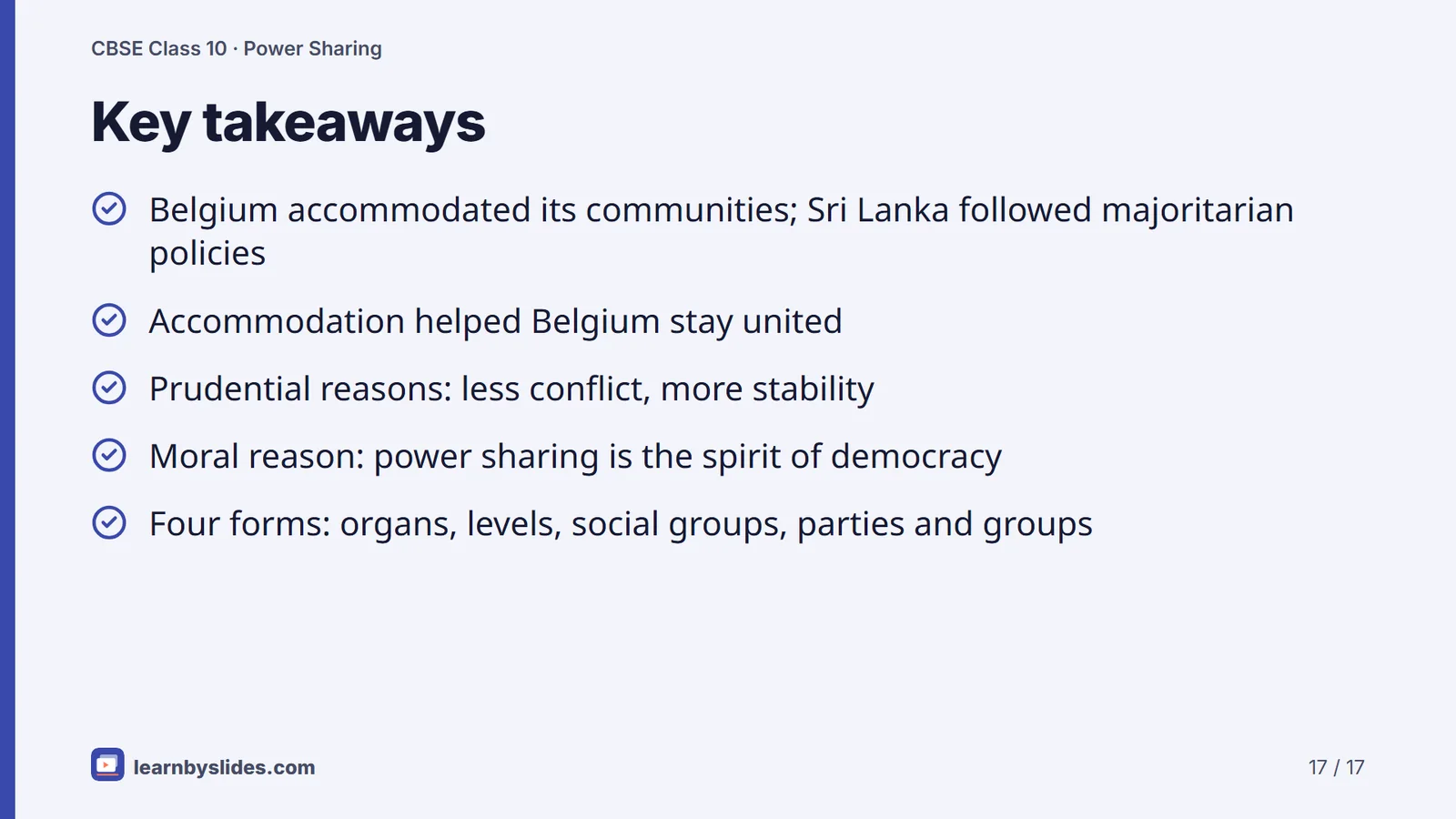
17. Key takeaways
- Belgium accommodated its communities; Sri Lanka followed majoritarian policies
- Accommodation helped Belgium stay united
- Prudential reasons: less conflict, more stability
- Moral reason: power sharing is the spirit of democracy
- Four forms: organs, levels, social groups, parties and groups
Speaker notes
Ask each student to write one sentence comparing Belgium and Sri Lanka as an exit ticket. Then move to the five-question quiz. Homework: find one example of each form of power sharing in a newspaper or news website.
Key terms
- Power sharing
- Dividing power among organs of government, levels of government, social groups and political parties or groups.
- Majoritarianism
- The belief that the majority community should rule a country in whatever way it wants, disregarding the wishes of minorities.
- Community government
- In Belgium, a government elected by people of one language community, wherever they live, dealing with cultural, educational and language matters.
- Prudential reason
- A reason based on careful calculation of gains and losses, such as reducing conflict.
- Horizontal distribution of power
- Sharing of power among organs of government at the same level: legislature, executive and judiciary.
- Checks and balances
- An arrangement in which each organ of government can limit the others, so none has unlimited power.
- Coalition government
- A government formed by two or more political parties coming together.
Quick quiz
Teacher notes
Suggested 45-minute plan: 5 min opener (the class monitor question), 15 min on the Belgium and Sri Lanka case studies (slides 4 to 9), 5 min on reasons for power sharing, 12 min on the four forms and the India example, 8 min for the quick check and quiz. Keep the discussion neutral and grounded in the textbook; avoid blaming any community or party. Common misconceptions: power sharing weakens a country; democracy simply means majority rule; vertical and horizontal forms are the same. For extension, ask students to debate whether Belgium's rule of equal ministers from each language group could work in a country as diverse as India.
Syllabus reference: CBSE Curriculum 2026-27, Class X Social Science (Democratic Politics II)
Frequently asked questions
Which chapter is Power Sharing in CBSE Class 10 Social Science?
Power Sharing is Chapter 1 of Democratic Politics II, the Class 10 political science textbook, and it is listed as Chapter 1 in the CBSE 2026-27 Class X Social Science syllabus. Always confirm against the syllabus your school follows.
What is the main difference between Belgium and Sri Lanka in this chapter?
Belgium accommodated its language communities by sharing power among them, and stayed united. Sri Lanka followed majoritarian policies that favoured the Sinhala-speaking majority, which led to alienation among Sri Lankan Tamils and eventually a civil war that ended in 2009.
What is the difference between prudential and moral reasons for power sharing?
Prudential reasons are based on better outcomes, such as reducing conflict and keeping the country stable. Moral reasons treat power sharing as valuable in itself, because it is the spirit of democracy and people have a right to be consulted.
What are the four forms of power sharing?
Power can be shared among organs of government (horizontal), among levels of government (vertical or federal), among social groups such as religious and linguistic groups, and among political parties, pressure groups and movements.
Sources & methodology
Every fact is checked against the sources below. We write original explanations and draw original graphics; no figures are copied from textbooks. Spotted an error? See our corrections policy.
- Democratic Politics II, Chapter 1: Power-sharing (NCERT, accessed 30 Sept 2026)
- Social Science Curriculum, Class X, 2026-27 (CBSE, accessed 30 Sept 2026)
- Belgium is a federal state (Flemish Government, accessed 30 Sept 2026)
- Belgium (Kingdom of Belgium), by André Lecours (Forum of Federations, accessed 30 Sept 2026)
Reviewed by Claude (pending owner check) · Updated
Related lessons
 UPSC · Polity
Fundamental Rights: UPSC Polity Revision Slides
Exam-ready revision slides on Part III of the Constitution (Articles 12–35): six categories of rights, citizen-only rights, Article 32 and the five writs, key amendments and emergency rules, with a quiz.
 UPSC · Geography
Monsoon in India: UPSC Geography Revision Slides
UPSC revision slides on the Indian monsoon: ITCZ and jet streams, IMD's normal onset and withdrawal dates, the two branches, breaks, October heat, El Niño and the Indian Ocean Dipole, with a quiz.
 Topic
TopicHow to Study Effectively: Spaced Repetition and Active Recall
Research-based slides on studying smarter: why rereading and highlighting fade, how self-testing and spaced reviews work, the 10–20% spacing rule, and a 30-day exam plan, with notes and a quiz.
 Class 10 · Science
Chemical Reactions and Equations: Class 10 Science Slides
A ready-to-teach CBSE Class 10 Science deck on Chemical Reactions and Equations: writing and balancing equations, the main reaction types, exothermic and endothermic changes, oxidation, reduction, corrosion and rancidity.
 Class 10 · Science
Life Processes: Class 10 Science Lesson Slides
A ready-to-teach deck on the four life processes in CBSE Class 10 Science: nutrition, respiration, transportation and excretion, with original diagrams, a 5-question quiz and speaker notes for every slide.
 Class 8 · Science
Crop Production and Management: Class 8 Science Slides
A ready-to-teach Class 8 Science deck on Crop Production and Management: kharif and rabi crops, soil preparation, sowing, manure and fertilisers, irrigation, weed control, harvesting and safe storage of grain.
Get new LearnBySlides resources by email
One short email when new free resources go live. No spam, unsubscribe anytime.