Monsoon in India: UPSC Geography Revision Slides
UPSC revision slides on the Indian monsoon: ITCZ and jet streams, IMD's normal onset and withdrawal dates, the two branches, breaks, October heat, El Niño and the Indian Ocean Dipole, with a quiz.
17 slides · 45 min lesson · 5-question quiz · speaker notes
Learning objectives
- Explain how the ITCZ shift and the jet streams drive the southwest monsoon.
- Recall IMD's normal onset and withdrawal dates for key places.
- Describe the Arabian Sea and Bay of Bengal branches and their rainfall.
- Explain breaks, withdrawal, October heat and the northeast monsoon.
- Relate El Niño and the Indian Ocean Dipole to Indian rainfall.

What this revision deck covers
The southwest monsoon brings 70–90% of the annual rainfall to most parts of India in just four months, June to September, according to the India Meteorological Department (IMD). This deck revises how the monsoon works, when it normally arrives and leaves, how its two branches spread rain, and how ocean conditions in the Pacific and Indian Oceans affect it. All dates and figures come from IMD and NCERT material, so aspirants can quote them with confidence in Prelims and Mains.
Mechanism: the ITCZ and the jet streams
The older explanation was differential heating: in April and May the land north of the Indian Ocean heats up faster than the sea, creating low pressure over northwest India. That idea is useful but incomplete.
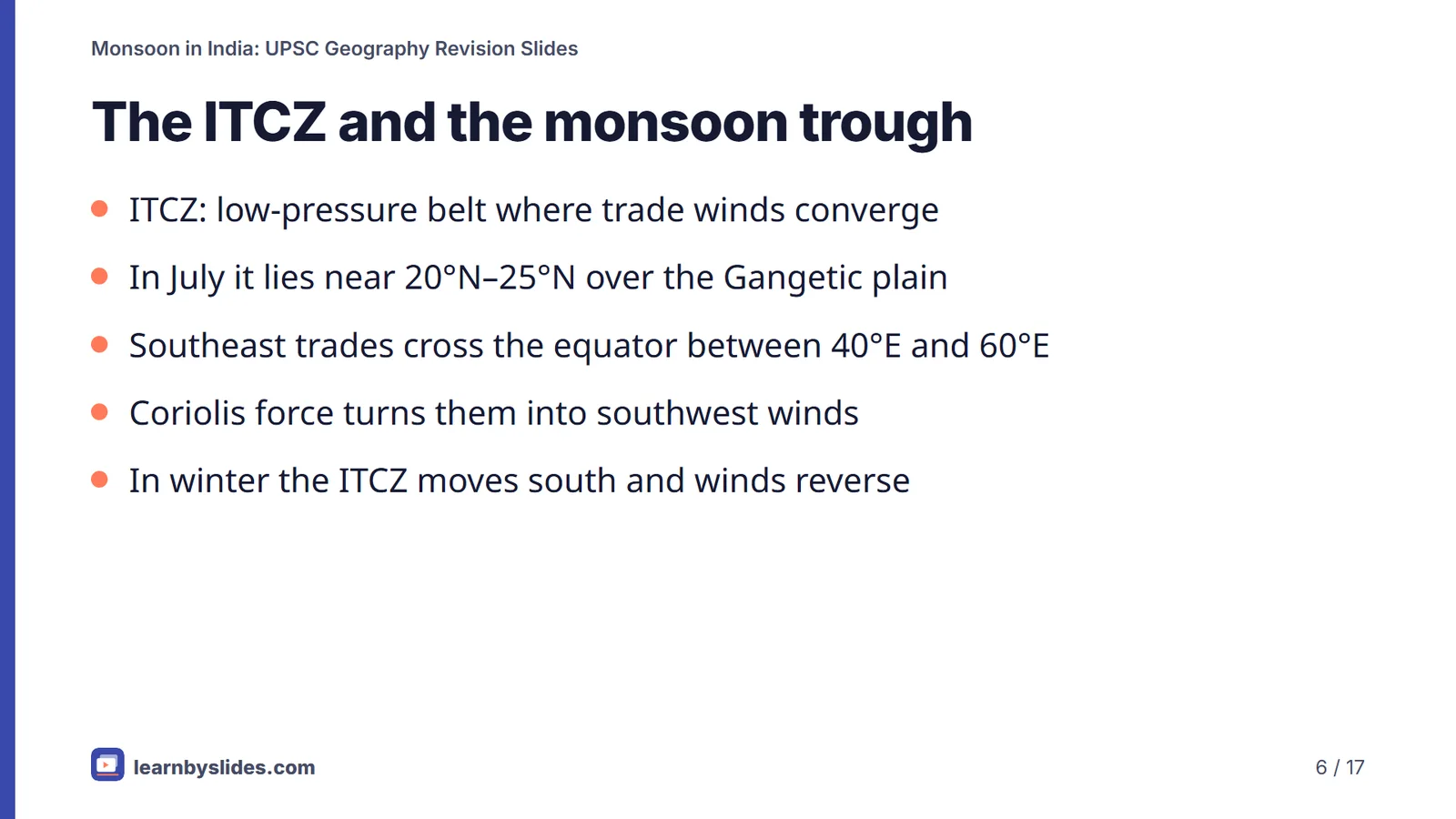
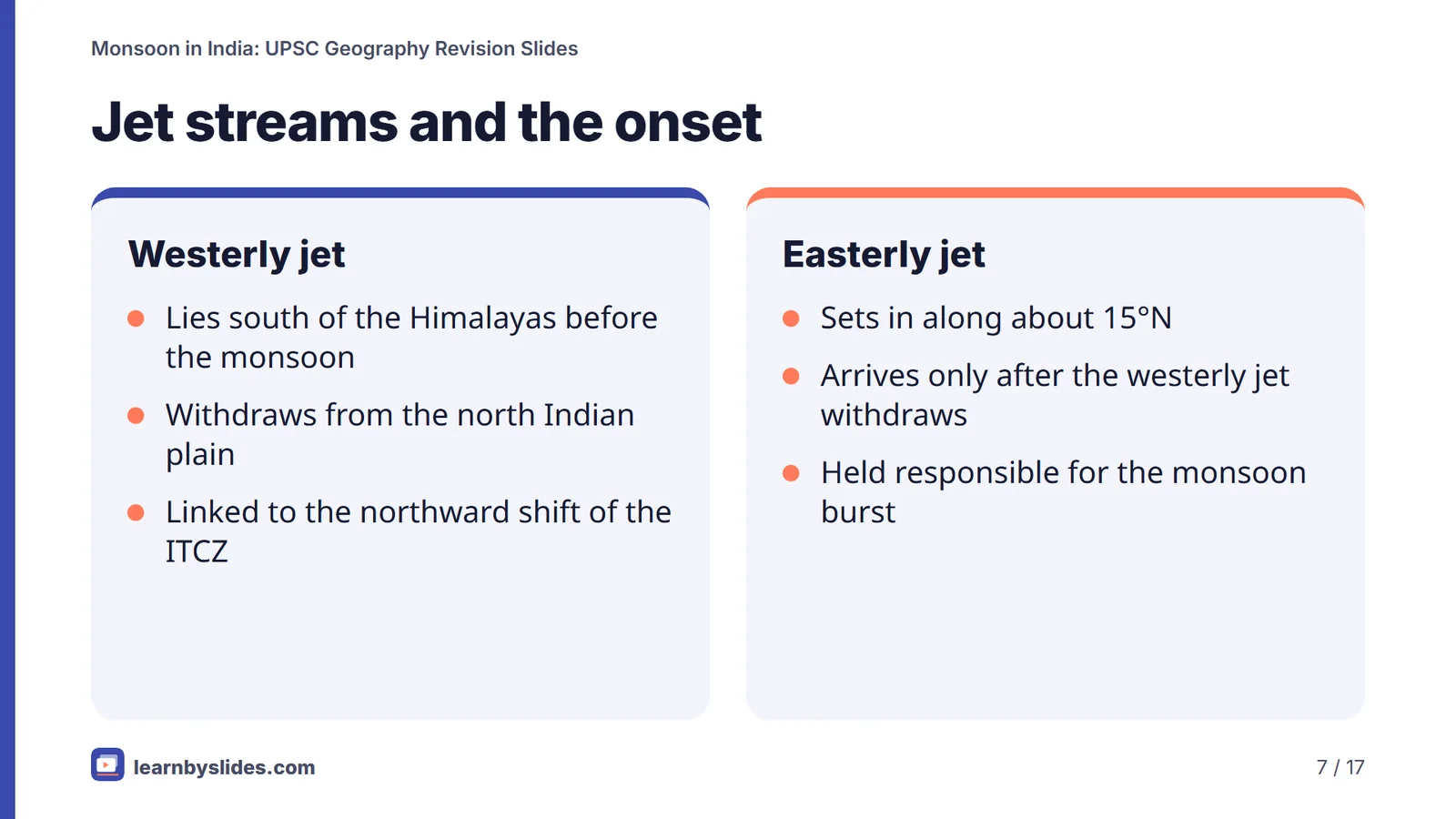
NCERT explains the monsoon through the Inter Tropical Convergence Zone (ITCZ), the low-pressure belt where trade winds converge. In July it lies around 20°N–25°N over the Gangetic plain, where it is called the monsoon trough. Southeast trade winds from the southern hemisphere cross the equator between 40°E and 60°E and are turned into southwest winds by the Coriolis force. The ITCZ shift is linked to the withdrawal of the westerly jet stream from south of the Himalayas; the easterly jet stream then sets in along about 15°N and is held responsible for the burst of the monsoon.
Onset, advance and the two branches
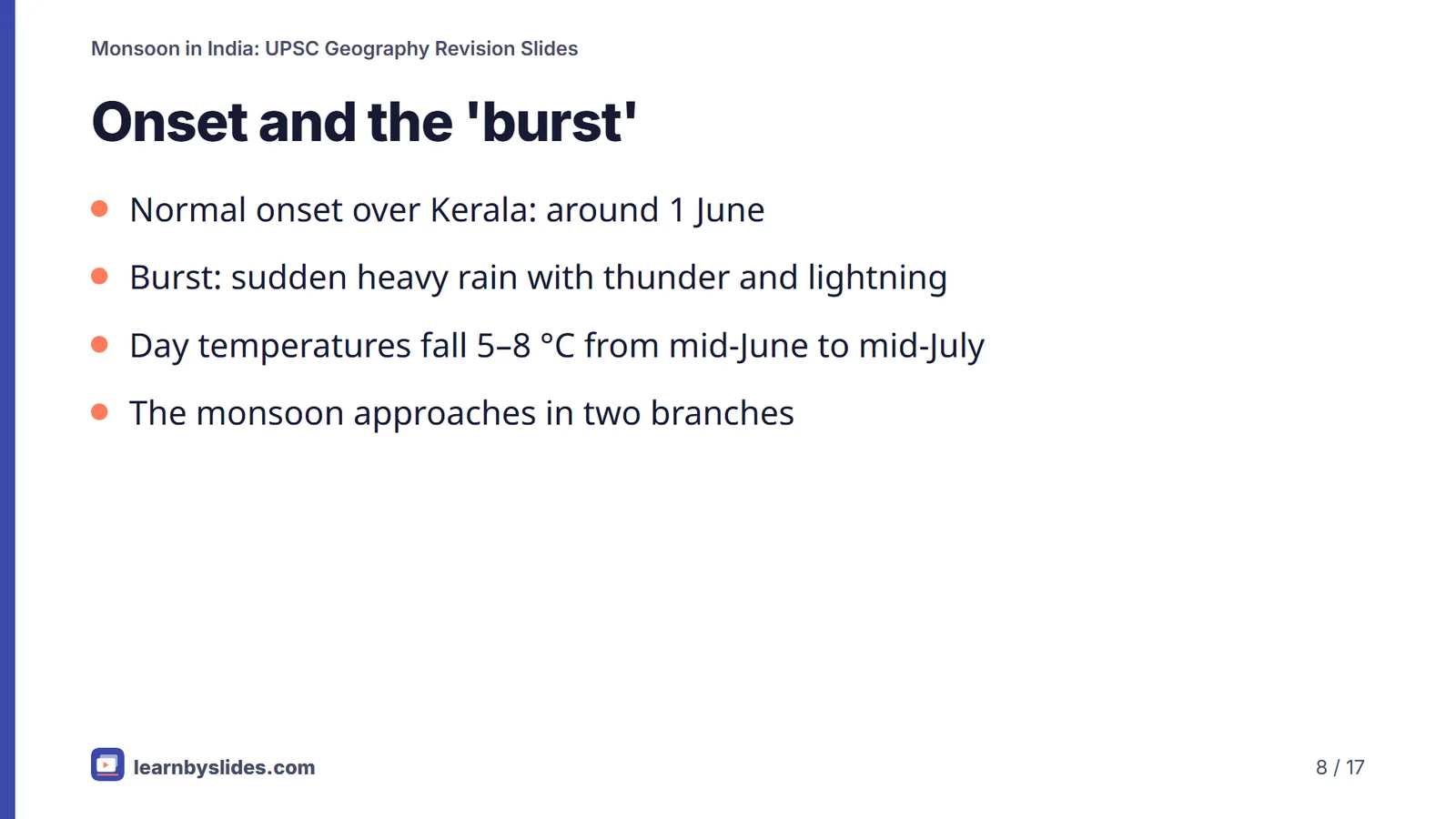
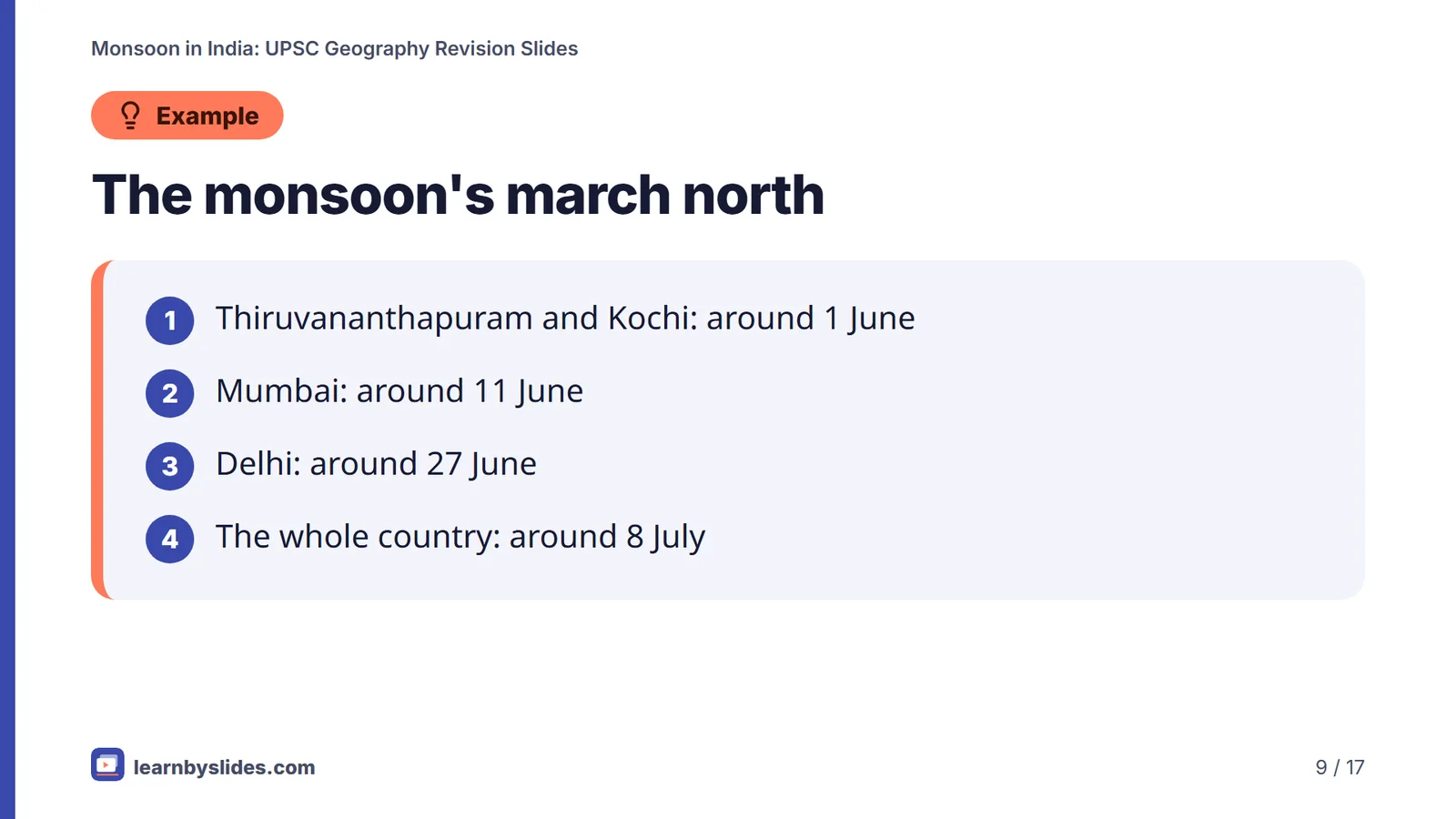
IMD's normal date of onset over Kerala is 1 June. Under the new normal dates published in 2020 (based on 1961–2019 data), the monsoon reaches Mumbai around 11 June, Delhi around 27 June and covers the entire country by 8 July, a week earlier than the old normal of 15 July.
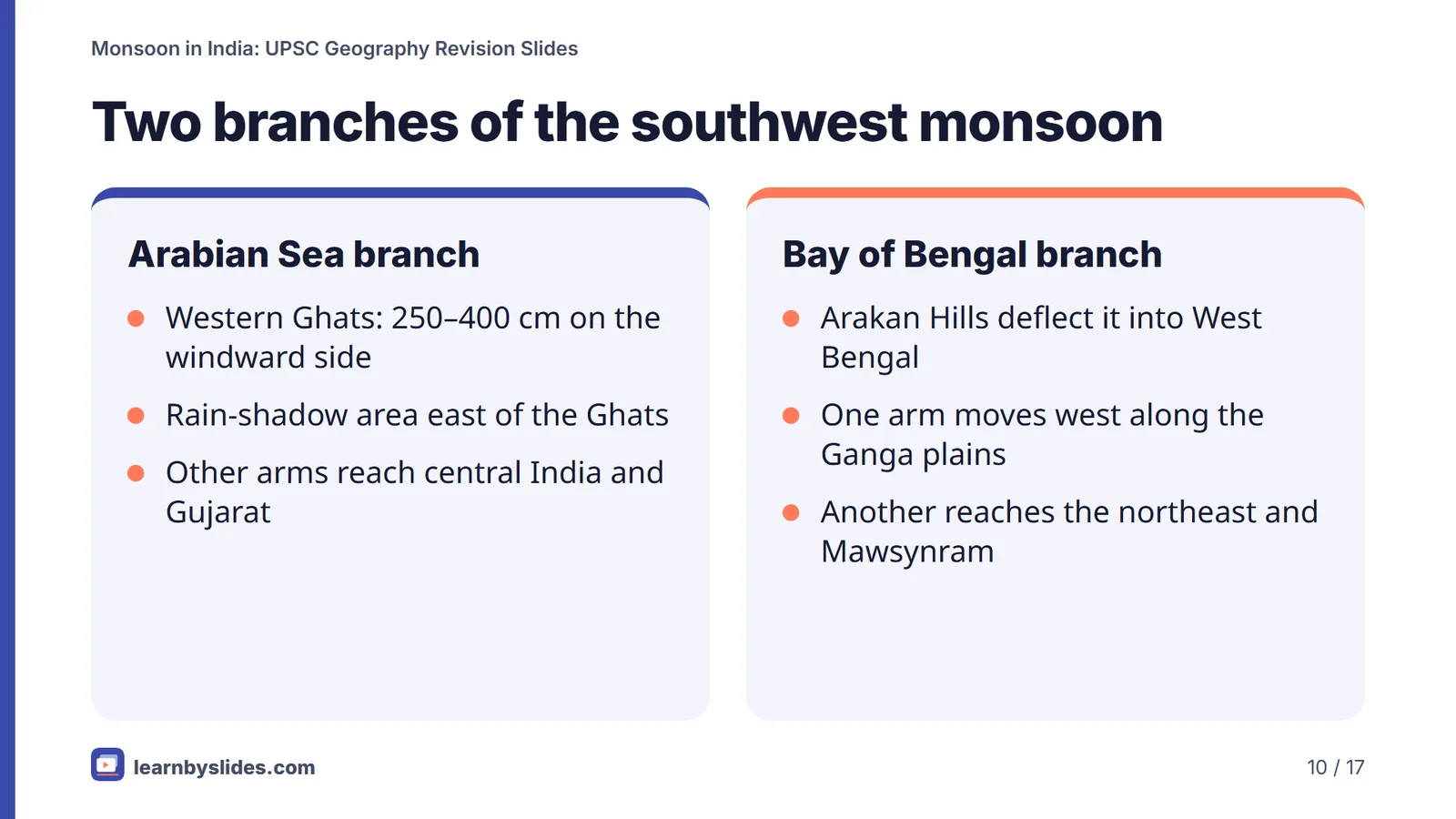
The Arabian Sea branch strikes the Western Ghats, giving 250–400 cm of rain on the windward side and leaving a rain-shadow area to the east. The Bay of Bengal branch is deflected by the Arakan Hills into West Bengal, then splits: one arm moves west along the Ganga plains, another up the Brahmaputra valley to the northeast, where Mawsynram receives the highest average annual rainfall in the world.
Breaks, withdrawal and the northeast monsoon
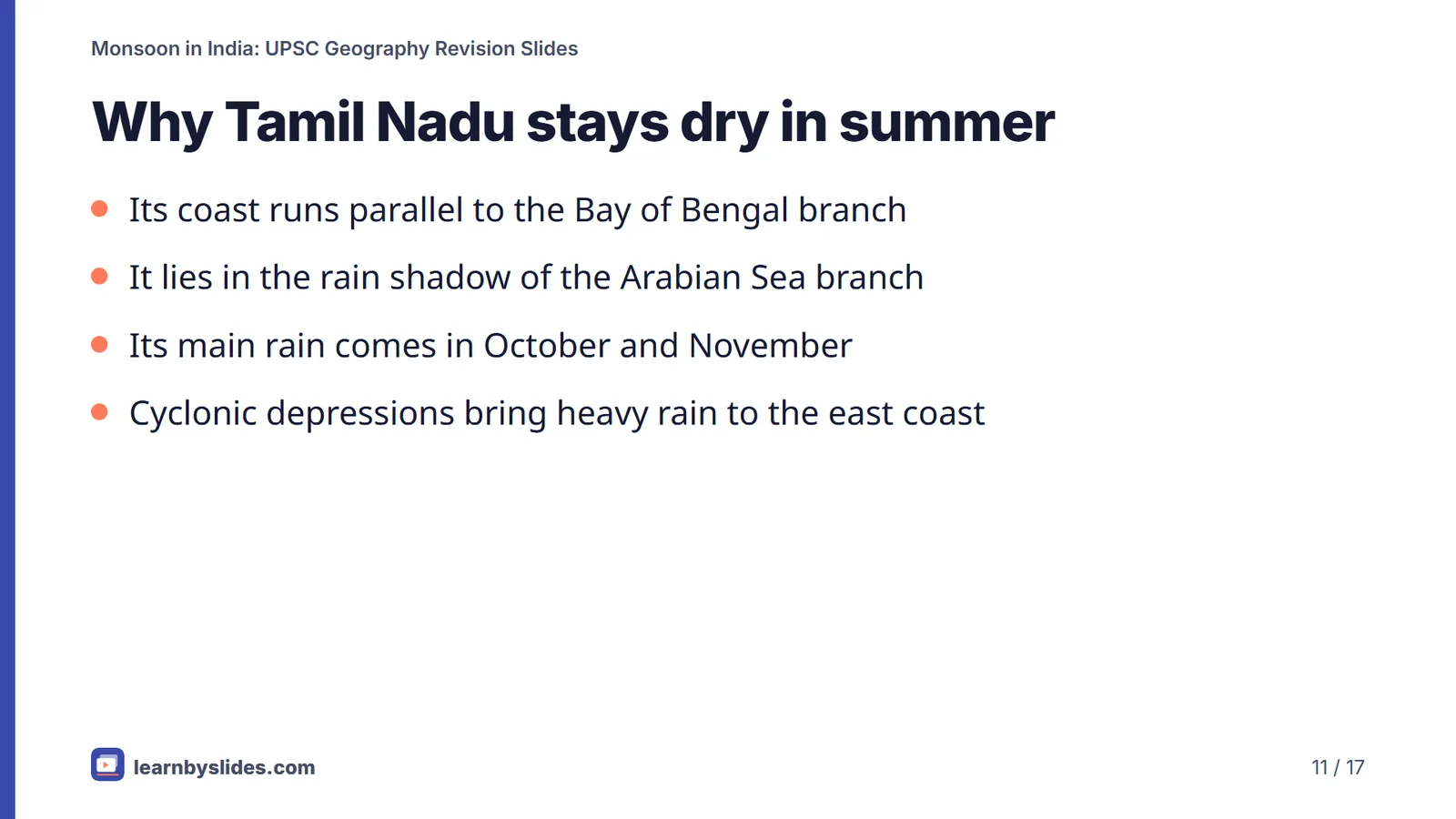
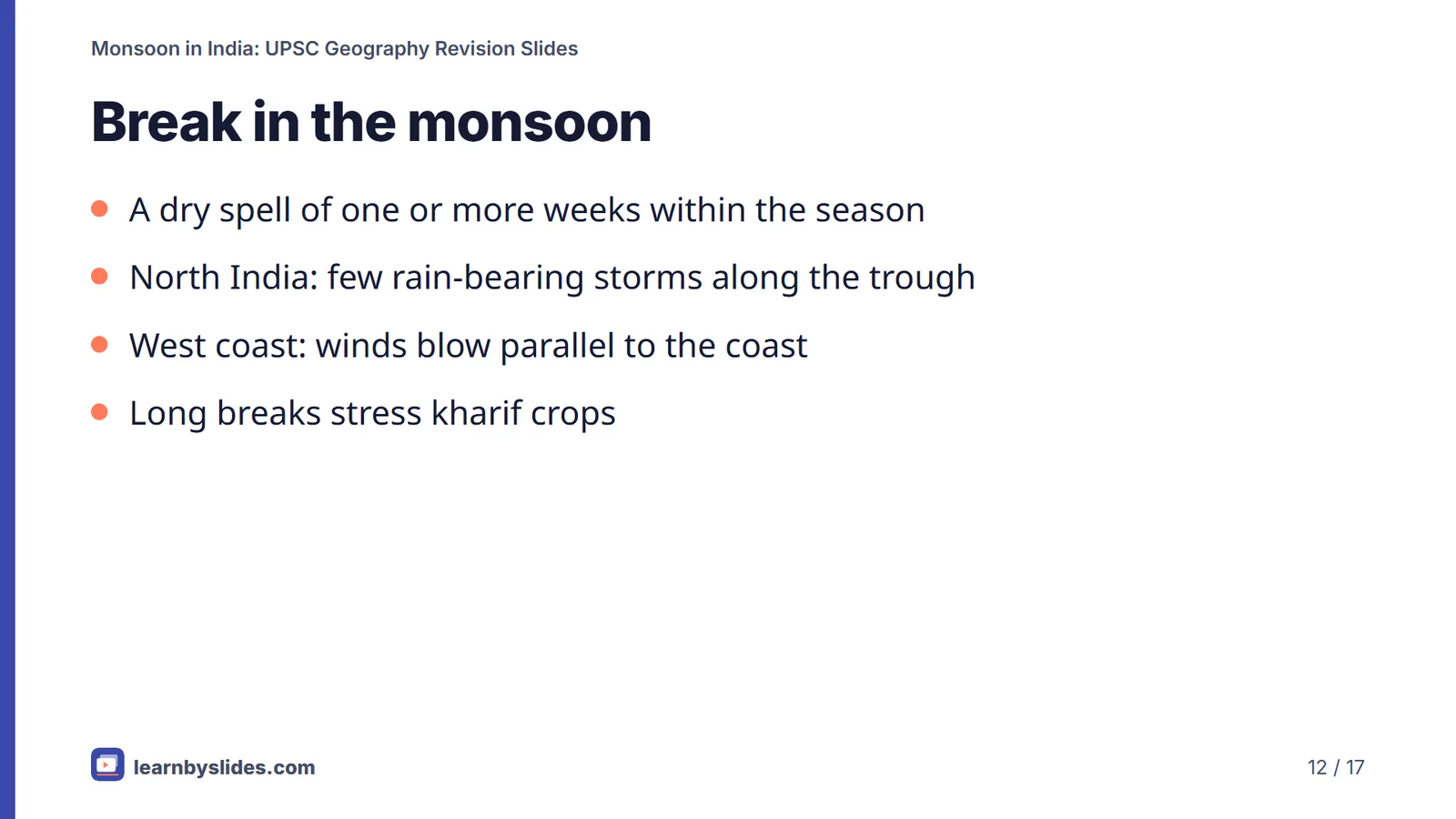
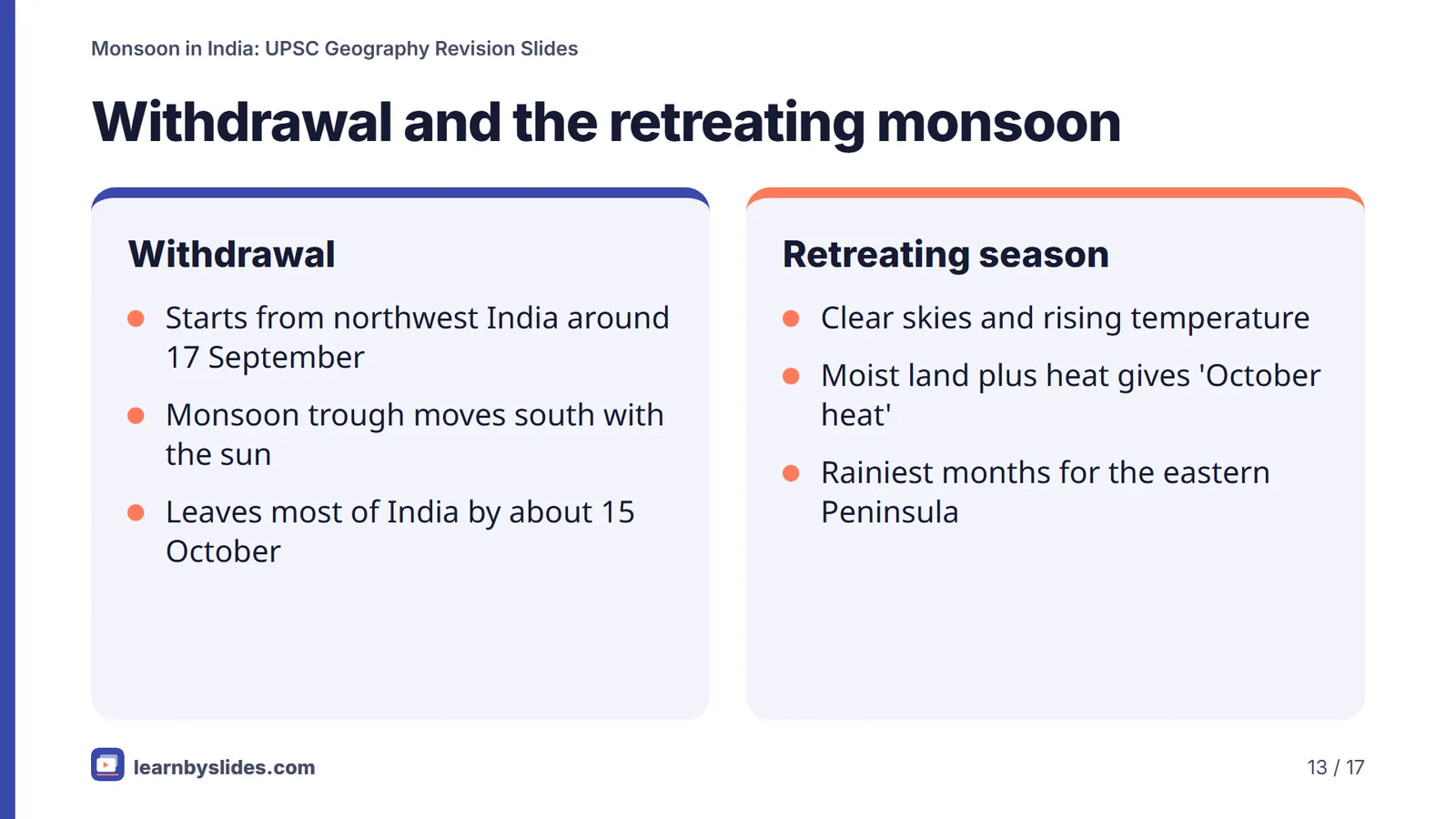
A break in the monsoon is a dry spell of one or more weeks within the rainy season. Withdrawal normally begins from northwest India around 17 September and the monsoon leaves most of the country by about 15 October. The retreating season brings clear skies, high temperature and humid ground, the oppressive October heat. Tamil Nadu stays fairly dry in summer because its coast runs parallel to the Bay of Bengal branch and lies in the rain shadow of the Arabian Sea branch; October and November are its rainiest months.
El Niño, the IOD and forecasting
An El Niño brings warm water off the coast of Peru and distorts equatorial circulation; Indian monsoon rainfall is often suppressed in El Niño years. A positive Indian Ocean Dipole (a warmer western than eastern tropical Indian Ocean) tends to favour good monsoon rain and can partly offset El Niño. IMD states its seasonal forecasts as a percentage of the Long Period Average (LPA), which is 87 cm for 1971–2020.
Slide-by-slide content
1. Monsoon in India
UPSC Geography revision · Mechanism, onset, withdrawal, El Niño and the IOD
Speaker notes
Ask aspirants: on what date does the monsoon normally reach Kerala? Most will say 1 June; tell them we will also learn the dates for Mumbai, Delhi and the whole country. Remind them that UPSC tests both mechanisms and exact facts.
2. By the end of this session you can
- Explain the roles of the ITCZ and jet streams
- Trace the onset from Kerala to the whole country
- Describe the Arabian Sea and Bay of Bengal branches
- Explain breaks, withdrawal and October heat
- Link El Niño and the IOD to Indian rainfall
Speaker notes
Read the objectives aloud. Suggest that aspirants keep a blank outline map of India to mark the branches and onset dates as we go.
3. Why the monsoon matters
- Most of India gets 70–90% of annual rain in June–September
- Winds reverse: southwest in summer, northeast in winter
- India's average annual rainfall is about 125 cm
- Onset timing shapes sowing and water planning
Speaker notes
The 70–90% figure comes from IMD's 2020 report on normal onset dates. Ask: which crops depend most on monsoon timing? Kharif crops such as rice. A common misconception is that the monsoon is just heavy rain; it is a seasonal reversal of winds.
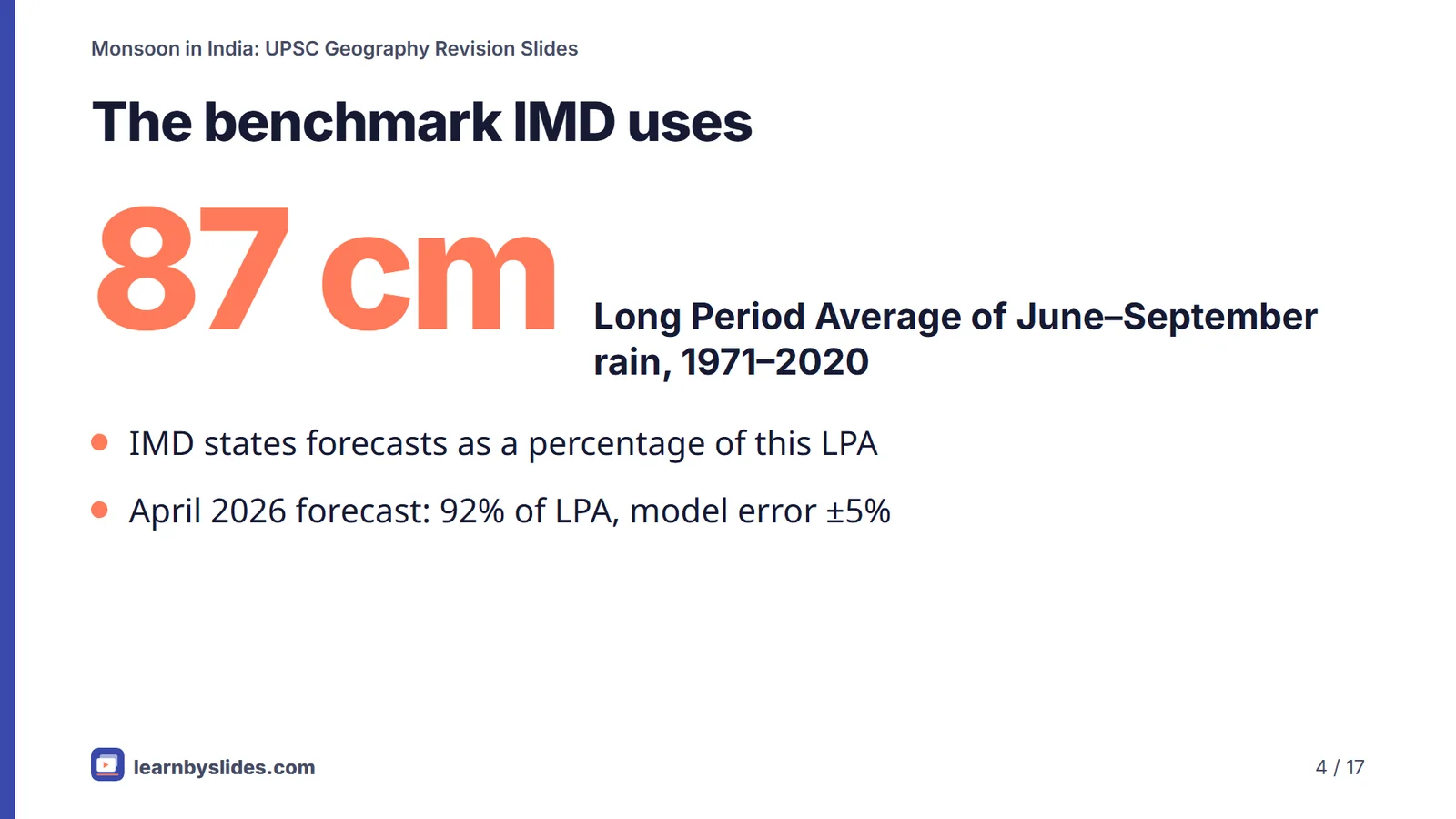
4. The benchmark IMD uses
87 cm Long Period Average of June–September rain, 1971–2020
- IMD states forecasts as a percentage of this LPA
- April 2026 forecast: 92% of LPA, model error ±5%
Speaker notes
Explain that the LPA is the all-India seasonal average. Ask: if a season gets 92% of LPA, roughly how many centimetres is that? About 80 cm. Stress that an all-India figure can hide big regional differences.
5. The older idea: differential heating
- April–May: the sun is overhead near the Tropic of Cancer
- Land heats fast; low pressure forms over northwest India
- The Indian Ocean heats slowly, so pressure stays higher
- Winds are drawn from sea to land, but this is incomplete
Speaker notes
NCERT says this was the accepted view towards the end of the nineteenth century. Ask: what does this simple model leave out? Upper-air winds and the global circulation, which the next slides add.
6. The ITCZ and the monsoon trough
- ITCZ: low-pressure belt where trade winds converge
- In July it lies near 20°N–25°N over the Gangetic plain
- Southeast trades cross the equator between 40°E and 60°E
- Coriolis force turns them into southwest winds
- In winter the ITCZ moves south and winds reverse
Speaker notes
Sketch the equator, the ITCZ in July and the curving trade winds. Ask: why do the winds bend to the right after crossing the equator? The Coriolis force deflects moving air to the right in the northern hemisphere.
7. Jet streams and the onset
Westerly jet
- Lies south of the Himalayas before the monsoon
- Withdraws from the north Indian plain
- Linked to the northward shift of the ITCZ
Easterly jet
- Sets in along about 15°N
- Arrives only after the westerly jet withdraws
- Held responsible for the monsoon burst
Speaker notes
This follows the NCERT Class 11 explanation. Ask: what has to happen first, the westerly jet leaving or the easterly jet arriving? The westerly jet must withdraw first. Many aspirants mix up which jet causes the burst.
8. Onset and the 'burst'
- Normal onset over Kerala: around 1 June
- Burst: sudden heavy rain with thunder and lightning
- Day temperatures fall 5–8 °C from mid-June to mid-July
- The monsoon approaches in two branches
Speaker notes
Onset over Kerala is the first official milestone every year, and IMD declares it using rainfall, wind and cloud criteria. Ask: why does the first rain bring such a big drop in temperature? Cloud cover and evaporation cool the land.
9. The monsoon's march north
- Thiruvananthapuram and Kochi: around 1 June
- Mumbai: around 11 June
- Delhi: around 27 June
- The whole country: around 8 July
Speaker notes
These are IMD's new normal dates, published in 2020 from 1961–2019 data; in any single year actual dates vary. Ask: how many days does the monsoon take from Kerala to Delhi? About four weeks. The old normal for full coverage was 15 July.
10. Two branches of the southwest monsoon
Arabian Sea branch
- Western Ghats: 250–400 cm on the windward side
- Rain-shadow area east of the Ghats
- Other arms reach central India and Gujarat
Bay of Bengal branch
- Arakan Hills deflect it into West Bengal
- One arm moves west along the Ganga plains
- Another reaches the northeast and Mawsynram
Speaker notes
Ask aspirants to compare Mangaluru with Bengaluru to see the rain-shadow effect. Mawsynram, on the crest of the Khasi hills, receives the highest average annual rainfall in the world according to NCERT.
11. Why Tamil Nadu stays dry in summer
- Its coast runs parallel to the Bay of Bengal branch
- It lies in the rain shadow of the Arabian Sea branch
- Its main rain comes in October and November
- Cyclonic depressions bring heavy rain to the east coast
Speaker notes
This is a favourite Prelims statement question. Ask: which two reasons does NCERT give? Parallel coastline and rain shadow. A common error is to blame the Eastern Ghats alone.
12. Break in the monsoon
- A dry spell of one or more weeks within the season
- North India: few rain-bearing storms along the trough
- West coast: winds blow parallel to the coast
- Long breaks stress kharif crops
Speaker notes
Stress that breaks are normal, not a failure of the monsoon. Ask: why would a two-week break in July worry a rice farmer? Transplanted seedlings need standing water.
13. Withdrawal and the retreating monsoon
Withdrawal
- Starts from northwest India around 17 September
- Monsoon trough moves south with the sun
- Leaves most of India by about 15 October
Retreating season
- Clear skies and rising temperature
- Moist land plus heat gives 'October heat'
- Rainiest months for the eastern Peninsula
Speaker notes
IMD moved the normal start of withdrawal from 1 September to about 17 September in 2020. Ask: why is October heat so uncomfortable? High temperature and high humidity together. Withdrawal is gradual, unlike the sudden onset.
14. El Niño and the Southern Oscillation
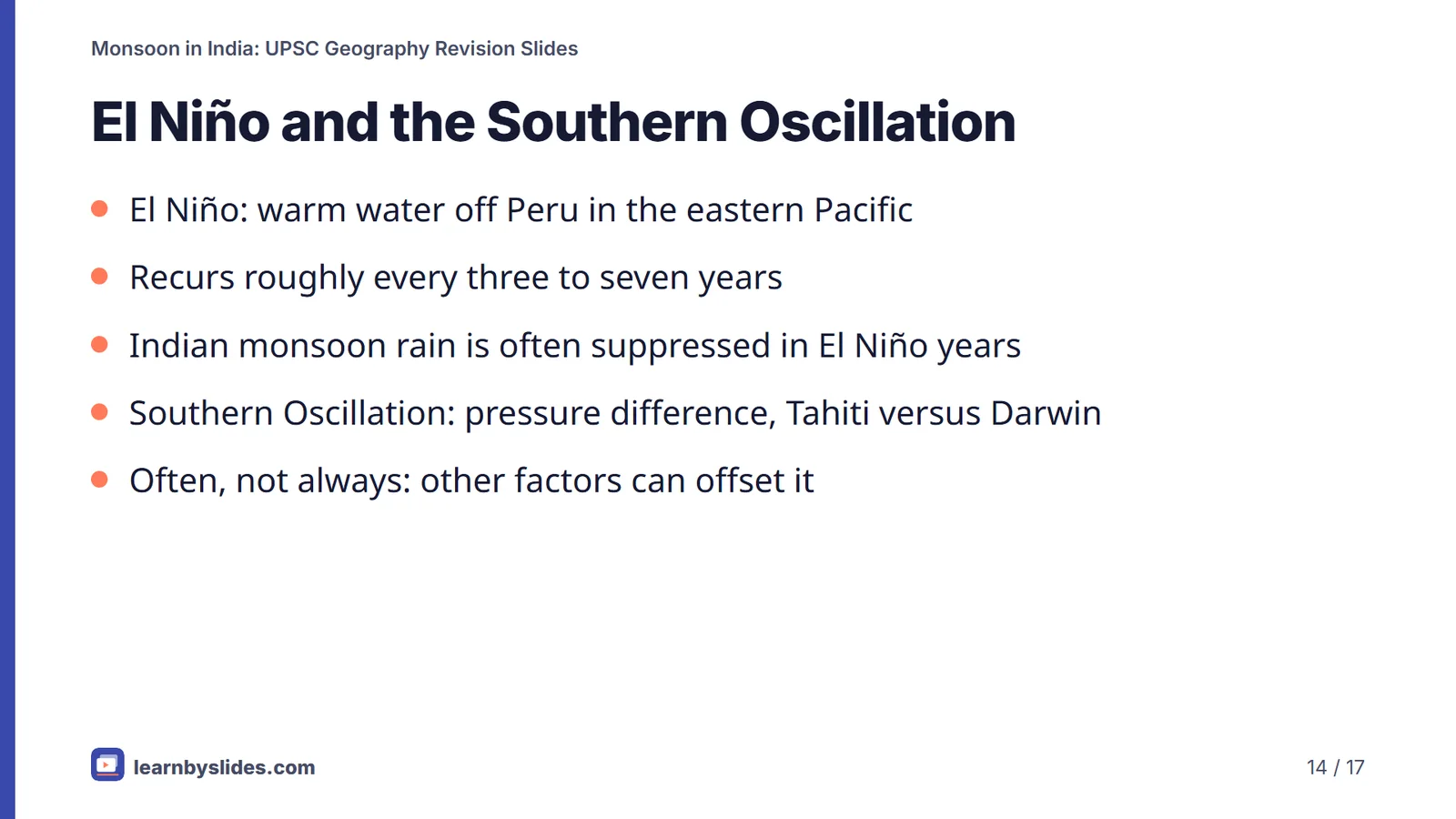
- El Niño: warm water off Peru in the eastern Pacific
- Recurs roughly every three to seven years
- Indian monsoon rain is often suppressed in El Niño years
- Southern Oscillation: pressure difference, Tahiti versus Darwin
- Often, not always: other factors can offset it
Speaker notes
NCERT notes that El Niño is used in India for long-range monsoon forecasting. Ask: does every El Niño year bring drought in India? No, which is why the Indian Ocean Dipole matters too.
15. Indian Ocean Dipole (IOD)
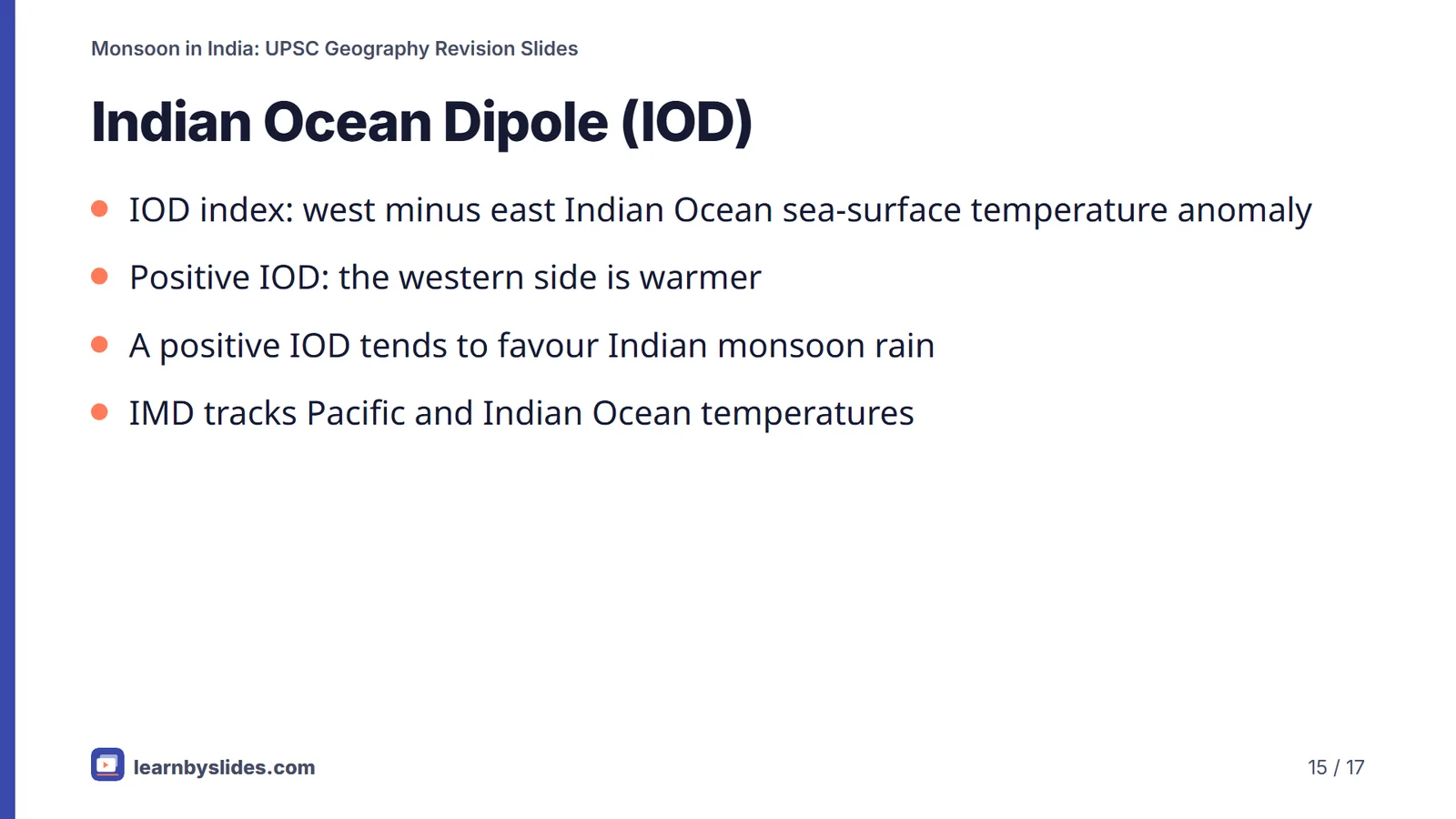
- IOD index: west minus east Indian Ocean sea-surface temperature anomaly
- Positive IOD: the western side is warmer
- A positive IOD tends to favour Indian monsoon rain
- IMD tracks Pacific and Indian Ocean temperatures
Speaker notes
Researchers define the IOD index as the sea surface temperature difference between a western and an eastern box of the tropical Indian Ocean. Ask: how could a positive IOD help in an El Niño year? It can partly offset the drying effect.
16. Prelims practice
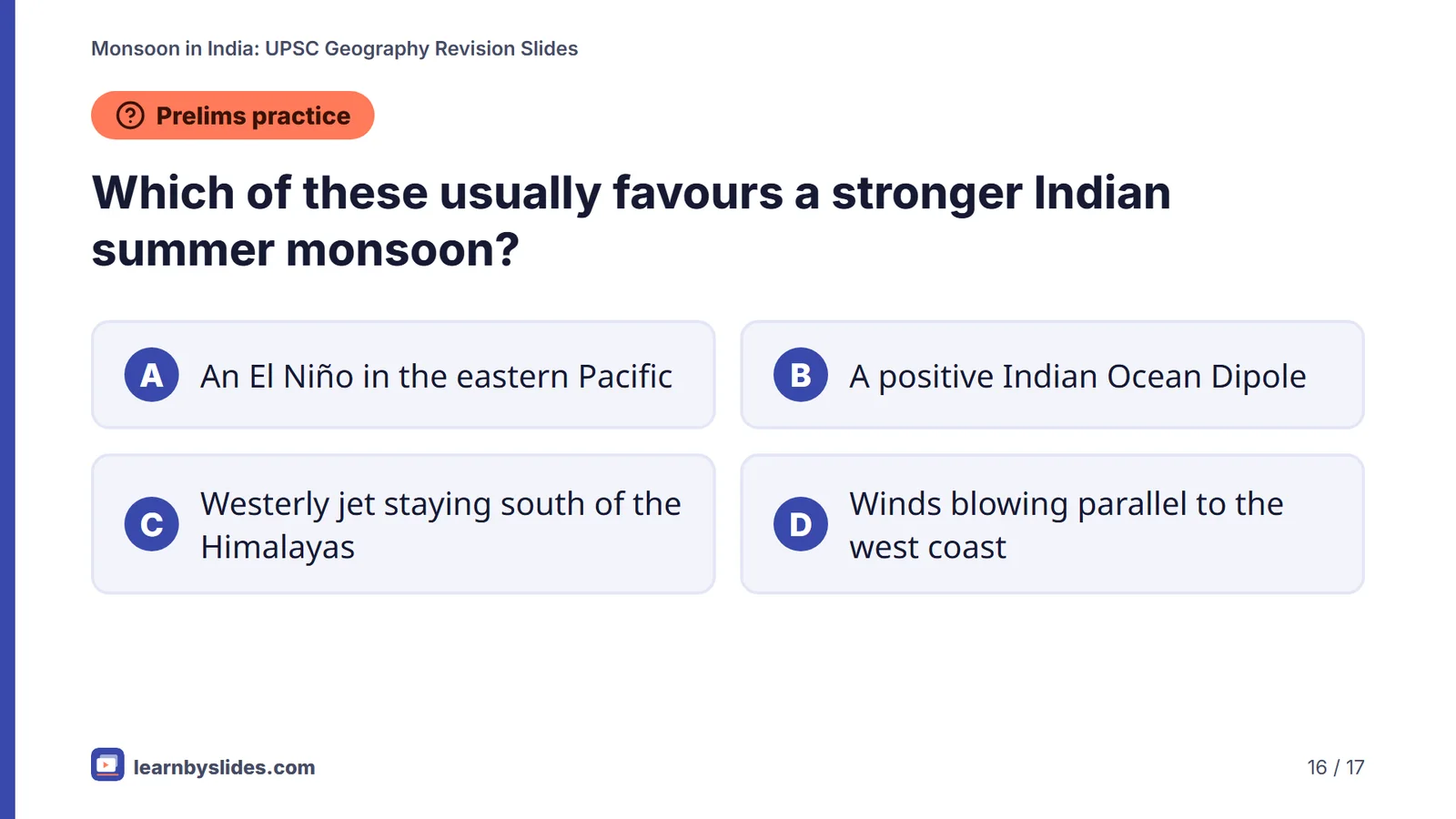
Which of these usually favours a stronger Indian summer monsoon?
- An El Niño in the eastern Pacific
- A positive Indian Ocean Dipole
- Westerly jet staying south of the Himalayas
- Winds blowing parallel to the west coast
Speaker notes
Answer: B, a positive Indian Ocean Dipole. El Niño often suppresses rainfall, the westerly jet must withdraw before the burst, and parallel winds cause breaks on the west coast.
17. Revision takeaways
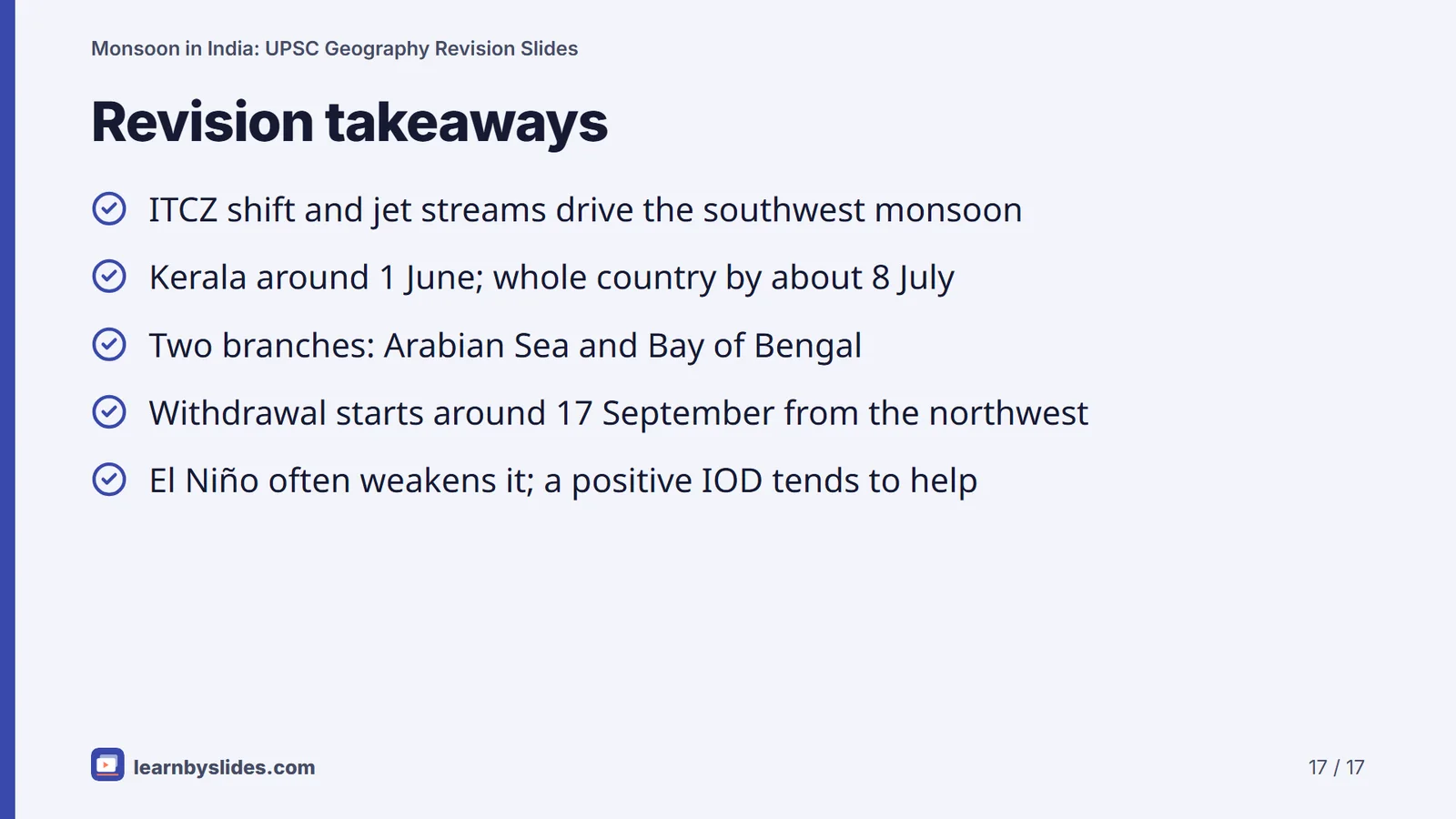
- ITCZ shift and jet streams drive the southwest monsoon
- Kerala around 1 June; whole country by about 8 July
- Two branches: Arabian Sea and Bay of Bengal
- Withdrawal starts around 17 September from the northwest
- El Niño often weakens it; a positive IOD tends to help
Speaker notes
Ask aspirants to mark the onset dates and both branches on their outline map. Then take the five-question quiz on the page and revise the NCERT Class 11 chapter on climate alongside these slides.
Key terms
- ITCZ
- Inter Tropical Convergence Zone: a low-pressure belt where trade winds converge; it shifts north in summer.
- Monsoon trough
- The ITCZ's position over the Gangetic plain (about 20°N–25°N) in July.
- Burst of the monsoon
- The sudden onset of heavy, thundery monsoon rain after the dry hot season.
- Break in the monsoon
- A dry spell of one or more weeks during the rainy season.
- October heat
- Oppressive hot and humid weather under clear skies as the monsoon retreats.
- El Niño
- Warm water appearing off Peru in the eastern Pacific, recurring about every three to seven years.
- Indian Ocean Dipole
- The difference in sea surface temperature between the western and eastern tropical Indian Ocean.
- Long Period Average
- IMD's all-India average June–September rainfall: 87 cm for 1971–2020.
Quick quiz
Teacher notes
Suggested 45-minute revision plan: 5 minutes on why the monsoon matters and the LPA, 10 minutes on differential heating, the ITCZ and jet streams, 10 minutes on onset dates and the two branches, 10 minutes on breaks, withdrawal and the northeast monsoon, 10 minutes on El Niño, the IOD and the quiz. Common misconceptions: the monsoon is just heavy rain; every El Niño year is a drought year; Tamil Nadu is dry only because of the Eastern Ghats. Keep an outline map on the board throughout. Extension: ask aspirants to compare this year's IMD onset and withdrawal dates with the normal dates and explain any difference.
Frequently asked questions
What is the normal date of monsoon onset over Kerala?
1 June. IMD's revised normal dates (2020) kept Kerala onset at 1 June, moved full coverage of the country to 8 July (from 15 July) and moved the start of withdrawal from northwest India to around 17 September (from 1 September).
What is the difference between El Niño and a positive Indian Ocean Dipole?
El Niño is warming of the eastern equatorial Pacific near Peru and often weakens the Indian monsoon. A positive IOD is a warmer western and cooler eastern tropical Indian Ocean, and it tends to favour Indian monsoon rainfall.
What is the Long Period Average (LPA) of monsoon rainfall?
It is the average June–September rainfall over India as a whole. IMD uses 87 cm, based on 1971–2020, and describes each season's forecast and outcome as a percentage of this figure.
Why does Chennai get most of its rain in October and November?
During the southwest monsoon the Tamil Nadu coast lies parallel to the Bay of Bengal branch and in the rain shadow of the Arabian Sea branch. In the retreating season, cyclonic depressions and the northeast monsoon bring heavy rain to the eastern coast of the Peninsula.
Sources & methodology
Every fact is checked against the sources below. We write original explanations and draw original graphics; no figures are copied from textbooks. Spotted an error? See our corrections policy.
- New Normal Dates of Onset/Progress and Withdrawal of Southwest Monsoon over India (CRS Research Report 3/2020) (India Meteorological Department, accessed 30 Sept 2026)
- Long Range Forecast for the 2026 Southwest Monsoon Season Rainfall (press release, 13 April 2026) (India Meteorological Department, accessed 30 Sept 2026)
- India: Physical Environment, Class XI, Chapter 4: Climate (NCERT, accessed 30 Sept 2026)
- Restored relationship between ENSO and Indian summer monsoon rainfall around 1999/2000 (Yang and Huang, The Innovation, 2021) (PubMed Central (US National Library of Medicine), accessed 30 Sept 2026)
Reviewed by Claude (pending owner check) · Updated
Related lessons
 Class 8 · Science
Crop Production and Management: Class 8 Science Slides
A ready-to-teach Class 8 Science deck on Crop Production and Management: kharif and rabi crops, soil preparation, sowing, manure and fertilisers, irrigation, weed control, harvesting and safe storage of grain.
 UPSC · Polity
Fundamental Rights: UPSC Polity Revision Slides
Exam-ready revision slides on Part III of the Constitution (Articles 12–35): six categories of rights, citizen-only rights, Article 32 and the five writs, key amendments and emergency rules, with a quiz.
 Topic
TopicHow to Study Effectively: Spaced Repetition and Active Recall
Research-based slides on studying smarter: why rereading and highlighting fade, how self-testing and spaced reviews work, the 10–20% spacing rule, and a 30-day exam plan, with notes and a quiz.
 Class 10 · Science
Chemical Reactions and Equations: Class 10 Science Slides
A ready-to-teach CBSE Class 10 Science deck on Chemical Reactions and Equations: writing and balancing equations, the main reaction types, exothermic and endothermic changes, oxidation, reduction, corrosion and rancidity.
 Class 7 · Maths
Integers: Class 7 Maths Lesson Slides
Ready-to-teach Class 7 slides on integers: the number line, adding and subtracting, sign rules for multiplying and dividing, and key properties, with lifts, temperatures, money, speaker notes and a quiz.
 Class 10 · Science
Life Processes: Class 10 Science Lesson Slides
A ready-to-teach deck on the four life processes in CBSE Class 10 Science: nutrition, respiration, transportation and excretion, with original diagrams, a 5-question quiz and speaker notes for every slide.
Get new LearnBySlides resources by email
One short email when new free resources go live. No spam, unsubscribe anytime.