Crop Production and Management: Class 8 Science Slides
A ready-to-teach Class 8 Science deck on Crop Production and Management: kharif and rabi crops, soil preparation, sowing, manure and fertilisers, irrigation, weed control, harvesting and safe storage of grain.
16 slides · 40 min lesson · 5-question quiz · speaker notes · Chapter : Crop Production and Management
Learning objectives
- Classify common Indian crops as kharif or rabi crops.
- Describe the main agricultural practices in order, from soil preparation to storage.
- Compare manure with fertilisers and explain how crop rotation keeps soil fertile.
- Compare traditional and modern methods of irrigation.
- Explain how weeds are controlled and how harvested grain is stored safely.
What this lesson covers
This deck teaches Crop Production and Management, a Class 8 Science topic on how farmers grow and look after crops, in one 40-minute period. It follows a crop through the seven agricultural practices, from preparing the soil to storing the grain, and ends with a year on a paddy-wheat farm in Punjab. Every slide has speaker notes with a question to ask and a common mistake to watch for.
Crops and crop seasons
A crop is a large number of plants of the same kind grown in one place. India has two main crop seasons. Kharif crops, such as paddy, maize, soyabean, groundnut and cotton, are sown with the rainy season, roughly June to September, and need plenty of water. Rabi crops, such as wheat, gram, pea and mustard, are grown in the cooler winter months, roughly October to March, and are harvested in spring. A short summer season between the two, called zaid, is used for crops such as watermelon and cucumber.
Preparing the soil, sowing and feeding the crop
Farmers first plough (till) the soil to loosen it, so that roots can breathe and grow deep and earthworms and microbes can thrive; the field is then levelled. Good seeds are chosen, since damaged seeds are hollow and float in water, and sown at the right depth and spacing, today often with a tractor-drawn seed drill. Paddy is first raised in a nursery and then transplanted.
To replace nutrients, farmers add manure, which is natural, adds humus and improves soil texture, or fertilisers such as urea and NPK, which act fast but harm soil and water when overused. Crop rotation with legumes, whose root nodules hold nitrogen-fixing Rhizobium bacteria, keeps soil fertile naturally.
Irrigation and weed control
Crops need water at regular intervals, supplied from wells, tubewells, ponds, rivers, dams and canals. Traditional methods such as the moat, chain pump, dhekli and rahat use human or animal power. Modern sprinkler and drip systems save water and suit uneven land and dry regions; the government's Per Drop More Crop programme promotes them. Weeds compete with crops for water, nutrients, space and light. They are removed by hand, with a khurpi or by tilling, ideally before they seed, or with weedicides such as 2,4-D, which farmers must spray with care.
Harvesting and storage
Mature crops are cut with a sickle or a harvester. Threshing separates grain from chaff, and a combine does harvesting and threshing together; small farmers winnow to let the wind carry the chaff away. Fresh grain holds moisture, so it is sun-dried before storage to keep off insects, rats and microbes. Families use jute bags or metal bins, often with dried neem leaves, while large stocks go into silos and granaries. Harvest festivals such as Pongal, Baisakhi and Bihu celebrate the end of this long cycle.
Slide-by-slide content
1. Crop Production and Management
CBSE Class 8 Science · From preparing the soil to storing the harvest
Speaker notes
Hold up a roti or a handful of rice and ask: how many steps did this take before it reached your plate? Collect guesses, then tell the class that today they will follow a crop from the empty field to the storehouse.
2. By the end of this lesson you can
- Sort crops into kharif and rabi
- List the agricultural practices in order
- Compare manure and fertilisers
- Compare old and new ways of irrigation
- Explain weed control, harvesting and storage
Speaker notes
Read the objectives aloud and ask if anyone has helped on a farm or seen one up close. Invite them to share one farm tool they know; it will come up later in the lesson.
3. What is a crop?
- Plants of the same kind grown on a large scale in one place
- Cereals: wheat, rice, maize; pulses: gram, pea, moong
- Also vegetables, fruits, oilseeds and fibre crops like cotton
- Growing crops needs planned work across a whole season
Speaker notes
Explain that settled farming began when people learnt to grow food instead of only gathering it. Ask students to name one crop grown near their home. Mention that animals reared on farms for food, called animal husbandry, are another source of food.
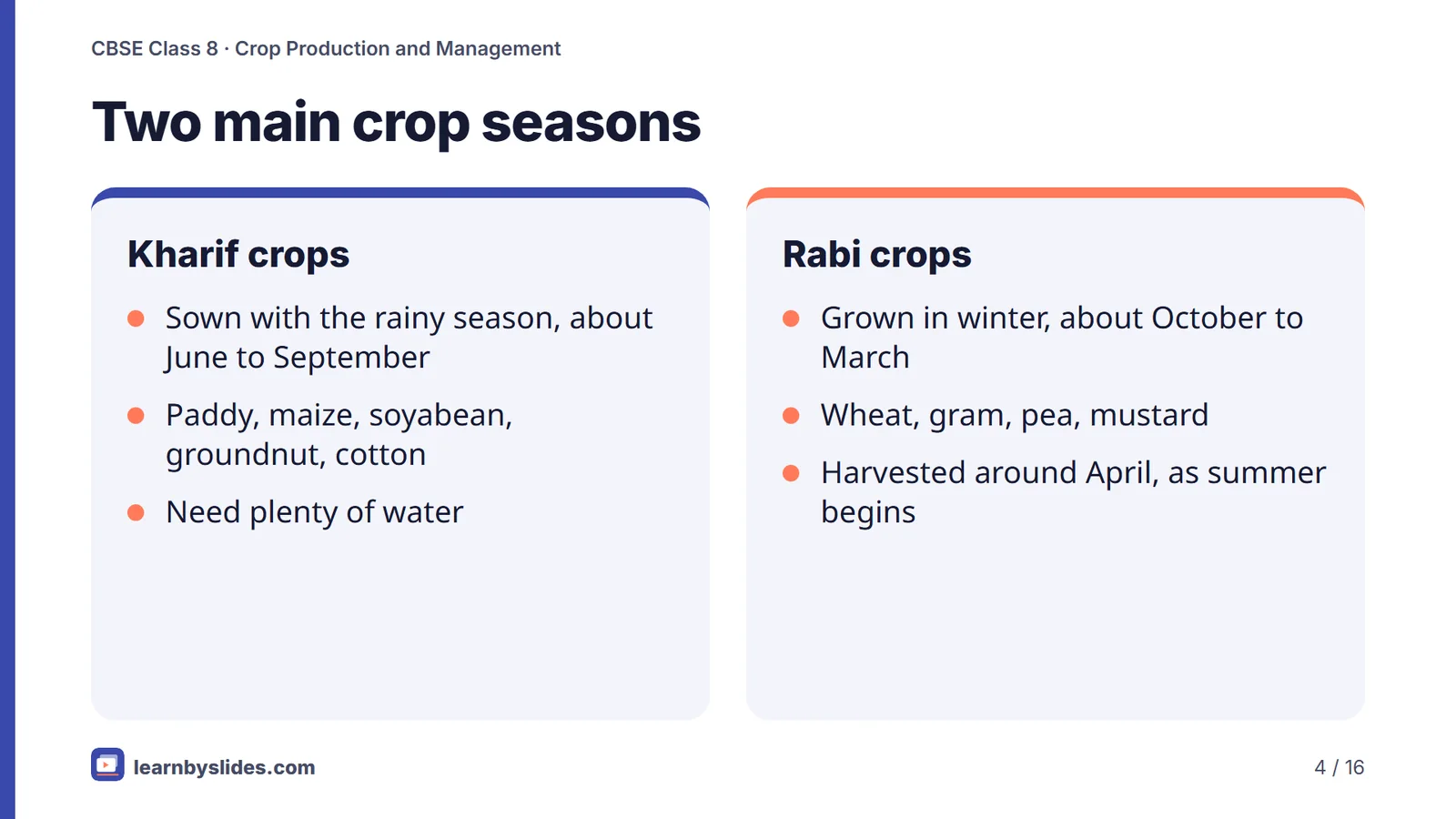
4. Two main crop seasons
Kharif crops
- Sown with the rainy season, about June to September
- Paddy, maize, soyabean, groundnut, cotton
- Need plenty of water
Rabi crops
- Grown in winter, about October to March
- Wheat, gram, pea, mustard
- Harvested around April, as summer begins
Speaker notes
The months are approximate and shift a little from region to region. Paddy needs standing water, which is why it is grown when the monsoon brings rain. Ask: what would happen if wheat were sown in the rainy season? It would not grow well, because it needs a cool, drier season.
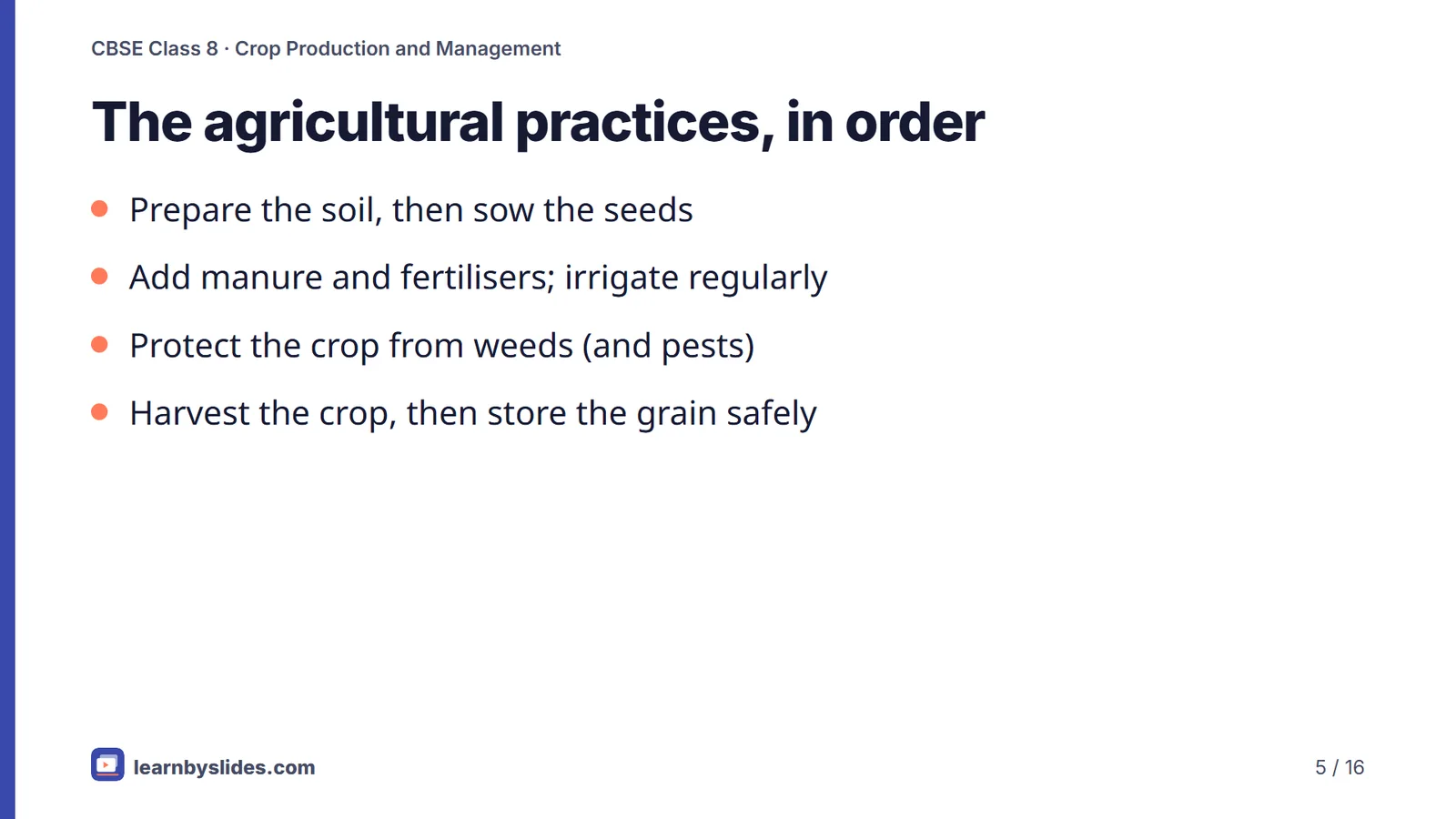
5. The agricultural practices, in order
- Prepare the soil, then sow the seeds
- Add manure and fertilisers; irrigate regularly
- Protect the crop from weeds (and pests)
- Harvest the crop, then store the grain safely
Speaker notes
Write the seven steps down one side of the board and keep them there for the whole lesson. Tick each one as you teach it. Ask students which step they think takes the longest; irrigation and weed control continue for most of the season.
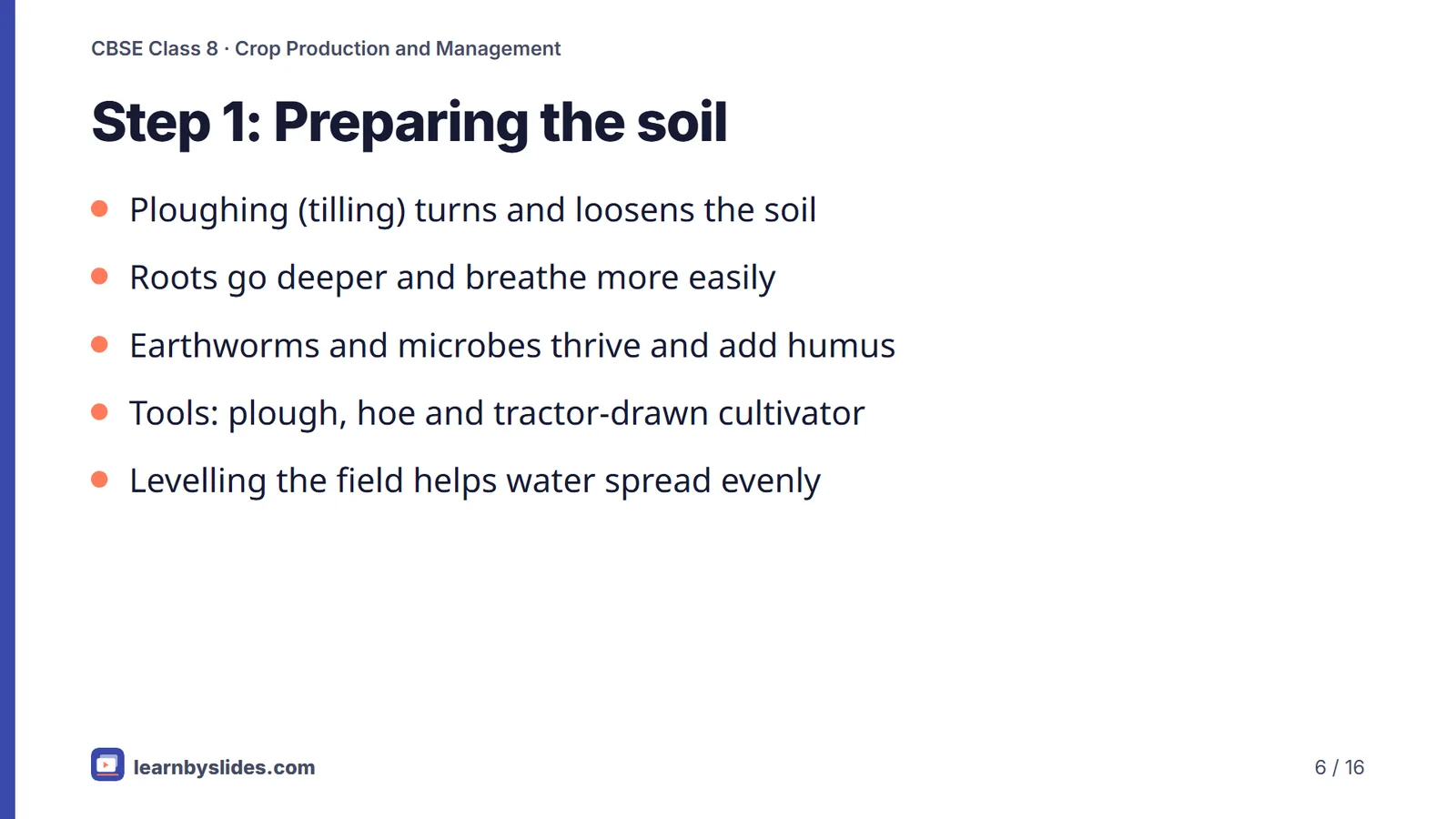
6. Step 1: Preparing the soil
- Ploughing (tilling) turns and loosens the soil
- Roots go deeper and breathe more easily
- Earthworms and microbes thrive and add humus
- Tools: plough, hoe and tractor-drawn cultivator
- Levelling the field helps water spread evenly
Speaker notes
Nutrient-rich soil from below is brought up to the surface when the soil is turned. If the soil is very dry, farmers may water it before ploughing. Ask why earthworms are called the farmer's friends.
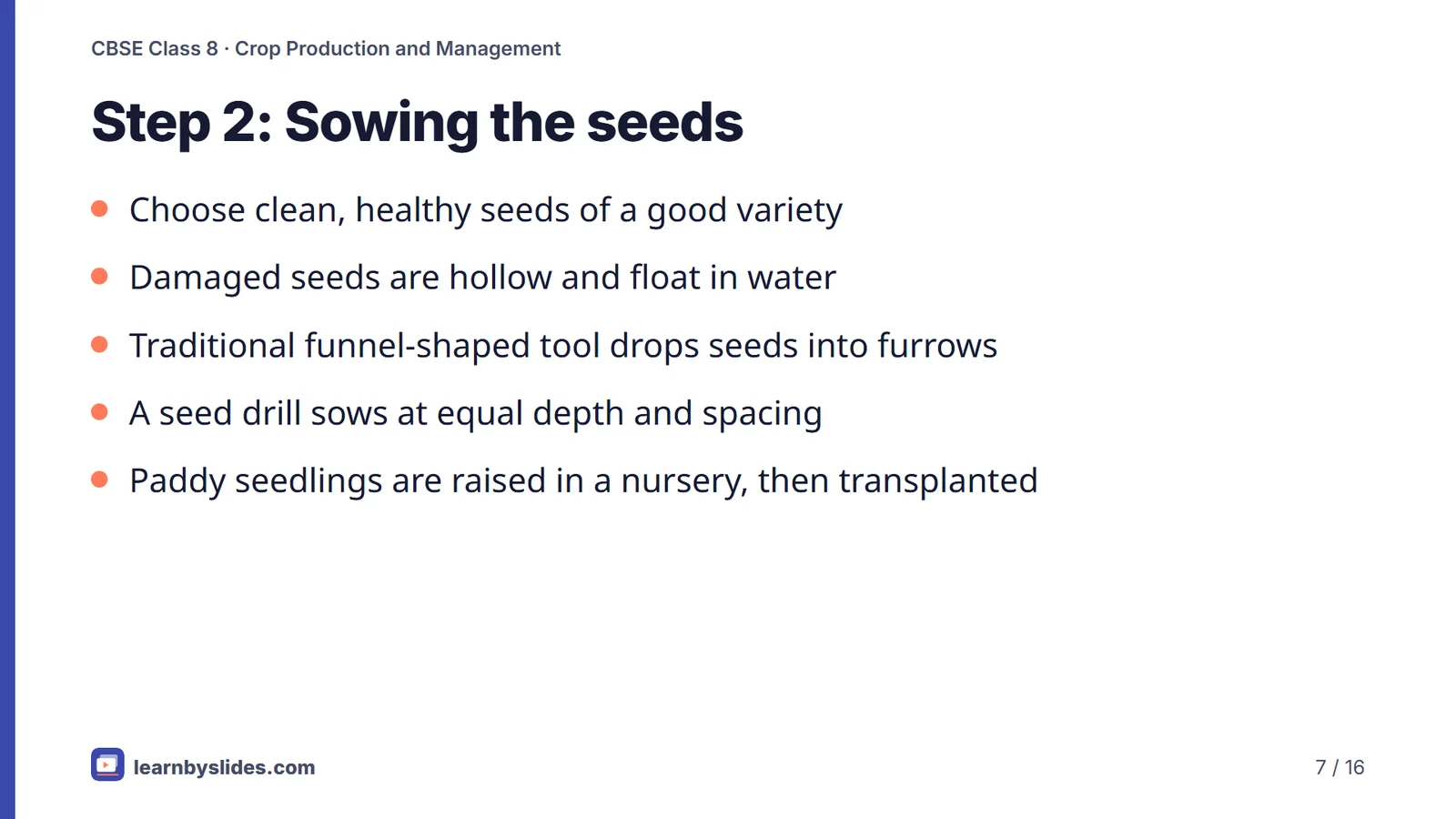
7. Step 2: Sowing the seeds
- Choose clean, healthy seeds of a good variety
- Damaged seeds are hollow and float in water
- Traditional funnel-shaped tool drops seeds into furrows
- A seed drill sows at equal depth and spacing
- Paddy seedlings are raised in a nursery, then transplanted
Speaker notes
Try the float test in class with a bowl of water and a handful of gram or wheat seeds. Explain that the seed drill covers seeds with soil, which protects them from birds. Correct spacing stops overcrowding, so every plant gets enough sunlight, water and nutrients.
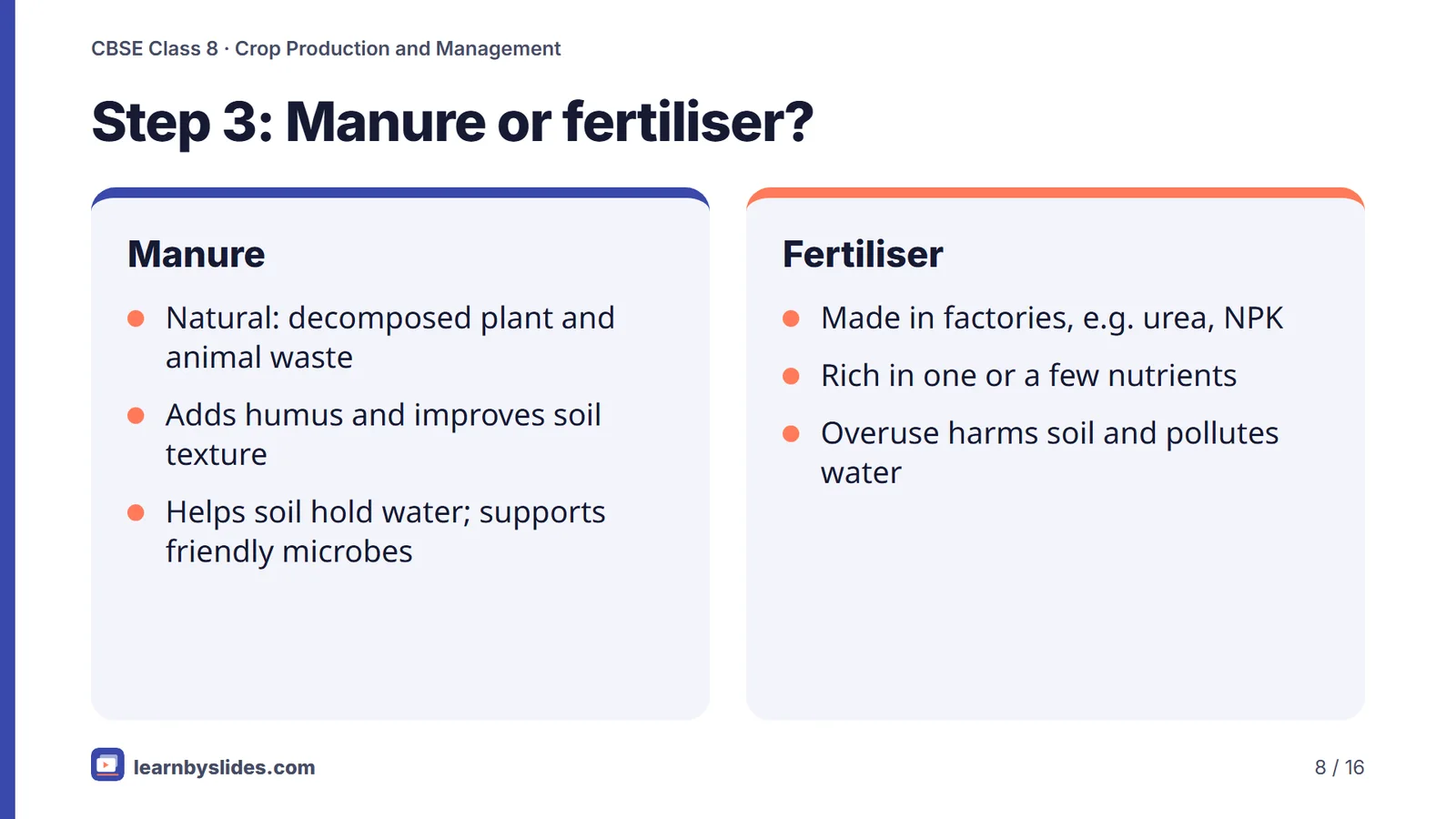
8. Step 3: Manure or fertiliser?
Manure
- Natural: decomposed plant and animal waste
- Adds humus and improves soil texture
- Helps soil hold water; supports friendly microbes
Fertiliser
- Made in factories, e.g. urea, NPK
- Rich in one or a few nutrients
- Overuse harms soil and pollutes water
Speaker notes
NPK stands for nitrogen, phosphorus and potassium. Fertilisers helped increase yields of wheat, paddy and maize, but using too much reduces soil fertility over time. Ask students which they would choose for a kitchen garden and why.
9. Keeping the soil fertile
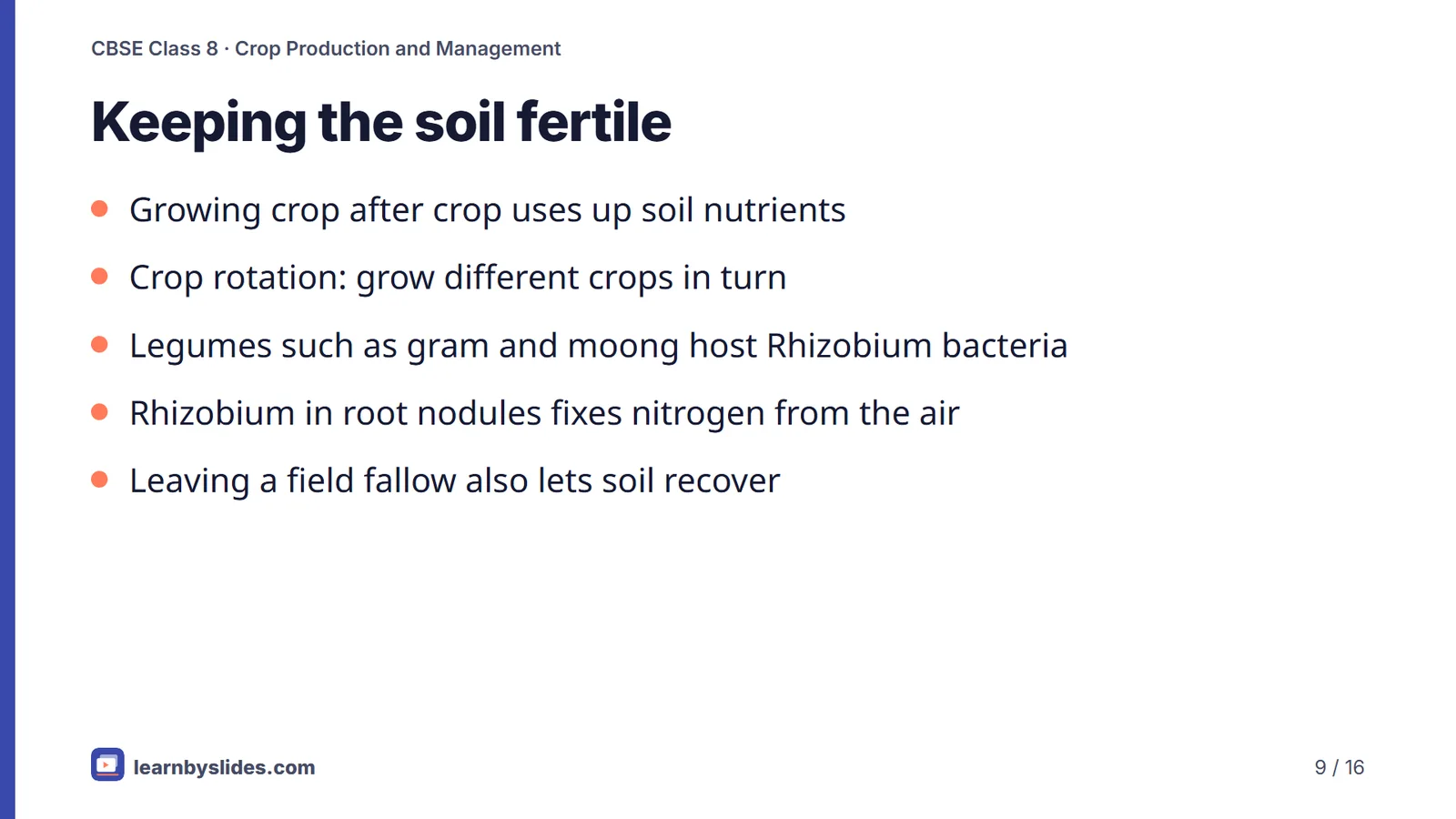
- Growing crop after crop uses up soil nutrients
- Crop rotation: grow different crops in turn
- Legumes such as gram and moong host Rhizobium bacteria
- Rhizobium in root nodules fixes nitrogen from the air
- Leaving a field fallow also lets soil recover
Speaker notes
A field left fallow is left uncultivated for a season. Rotating a cereal with a legume adds nitrogen back naturally, reducing the need for fertiliser. Ask students to explain in one sentence why a pulse crop is good for the next wheat crop.
10. Step 4: Irrigation, old and new
Traditional
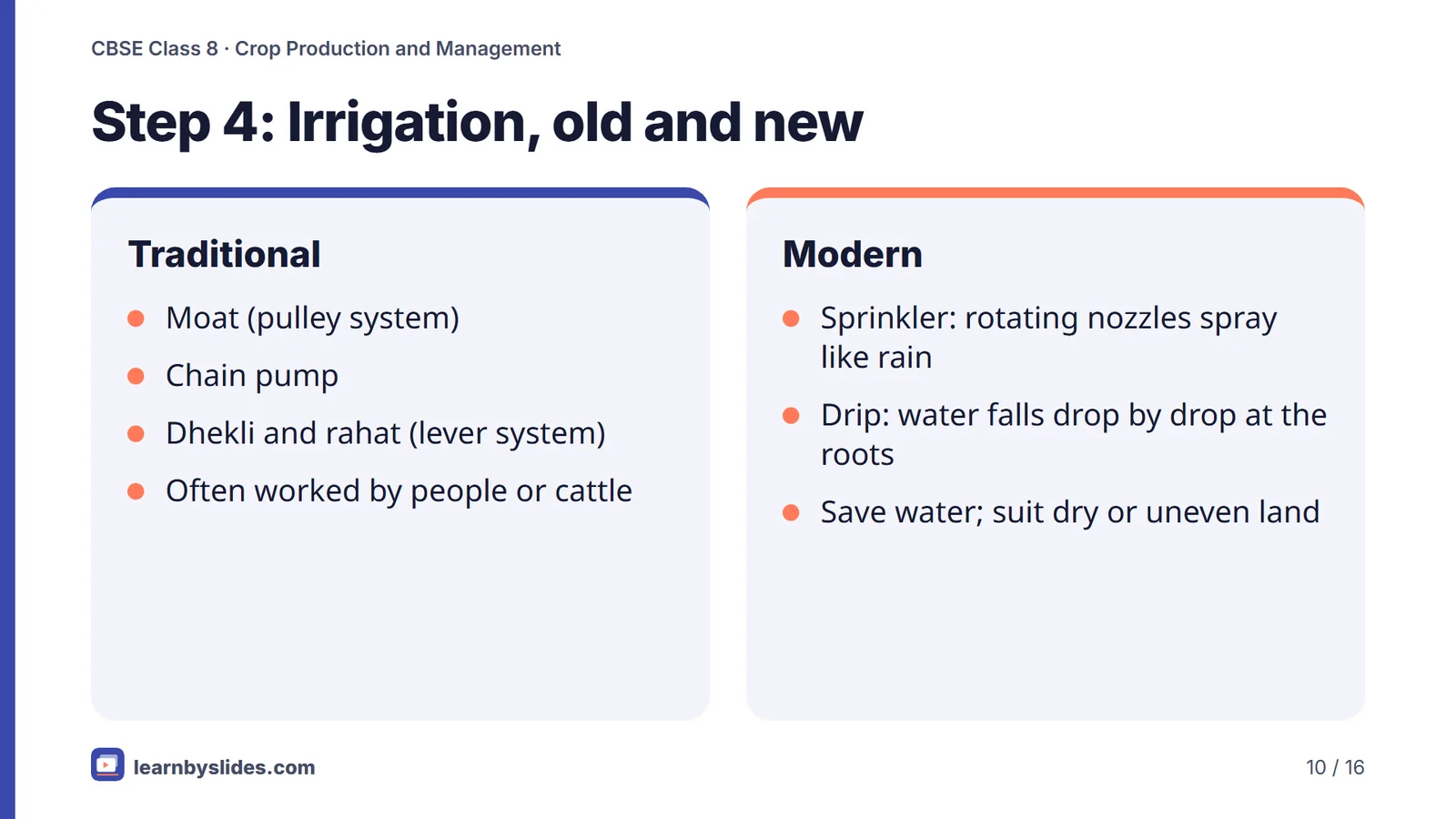
- Moat (pulley system)
- Chain pump
- Dhekli and rahat (lever system)
- Often worked by people or cattle
Modern
- Sprinkler: rotating nozzles spray like rain
- Drip: water falls drop by drop at the roots
- Save water; suit dry or uneven land
Speaker notes
Sources of irrigation water include wells, tubewells, ponds, lakes, rivers, dams and canals. The government's 'Per Drop More Crop' programme promotes drip and sprinkler irrigation to use water efficiently. Ask why fields need watering more often in summer: more water evaporates in the heat.
11. Step 5: Protecting the crop from weeds
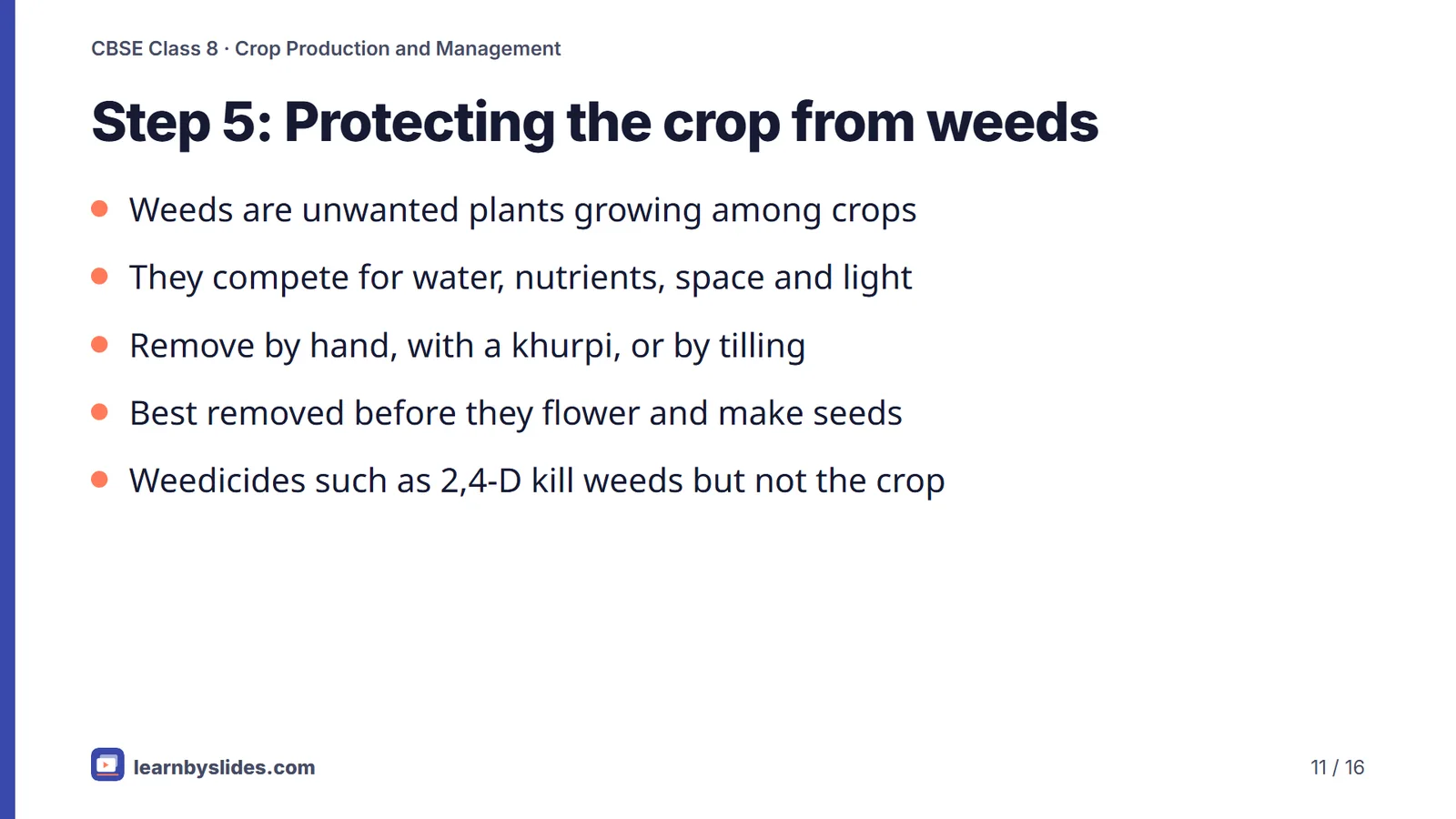
- Weeds are unwanted plants growing among crops
- They compete for water, nutrients, space and light
- Remove by hand, with a khurpi, or by tilling
- Best removed before they flower and make seeds
- Weedicides such as 2,4-D kill weeds but not the crop
Speaker notes
Farmers spraying weedicides should cover their nose and mouth, because the chemicals can harm their health. Crops also need protection from pests and diseases, which farmers control with pesticides. Ask: why remove weeds before they make seeds?
12. Step 6: Harvesting, threshing and winnowing
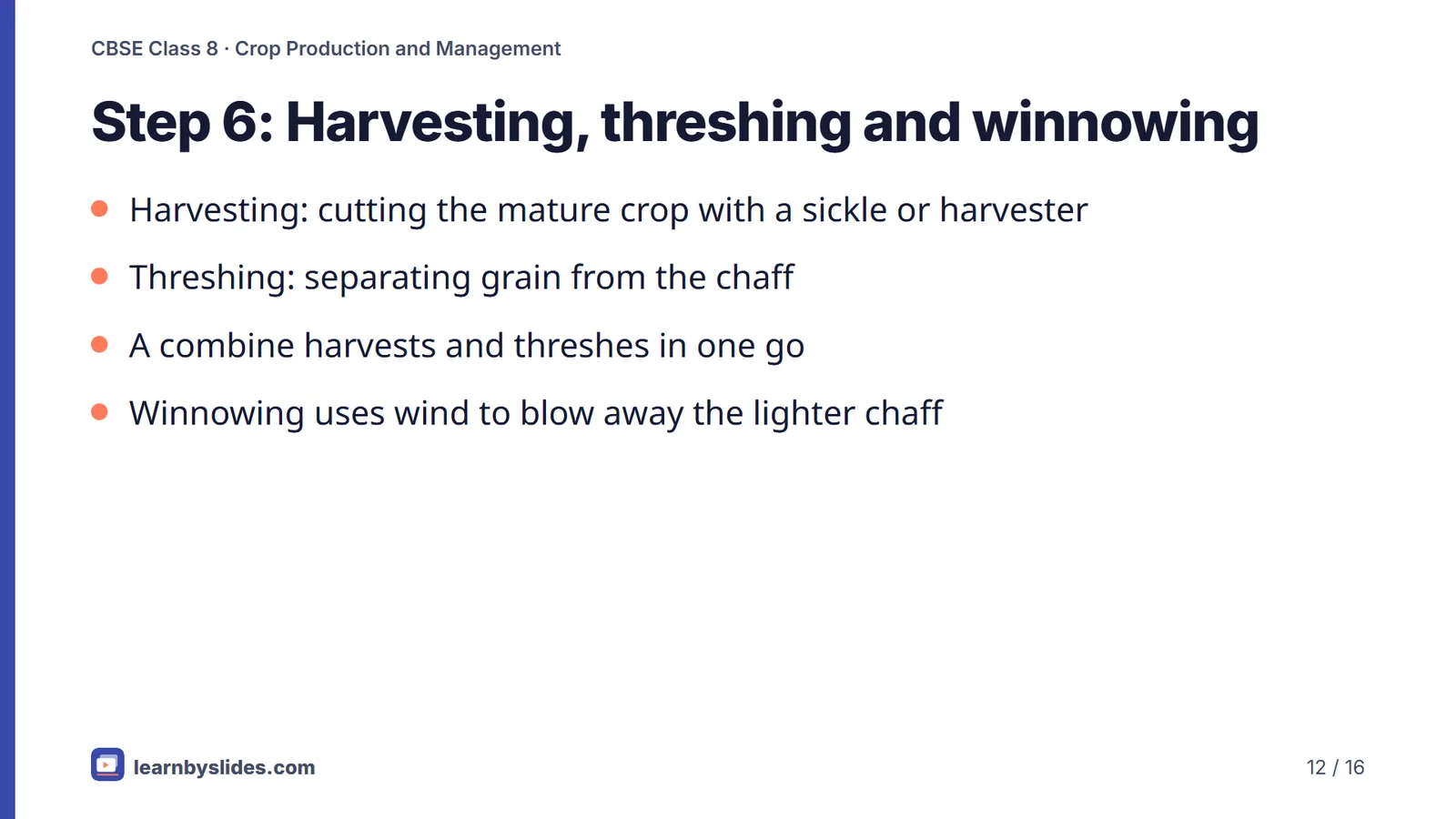
- Harvesting: cutting the mature crop with a sickle or harvester
- Threshing: separating grain from the chaff
- A combine harvests and threshes in one go
- Winnowing uses wind to blow away the lighter chaff
Speaker notes
Small farmers often winnow by hand, pouring grain from a height so the wind carries the husk away. Connect this to harvest festivals celebrated across India, such as Pongal, Baisakhi and Bihu. Ask students which harvest festival their family celebrates.
13. Step 7: Storing the grain safely
- Freshly harvested grain holds extra moisture
- Dry it in the sun before storing
- Moist grain attracts insects, rats and microbes
- At home: jute bags or metal bins, often with dried neem leaves
- Large stores: silos and granaries with pest control
Speaker notes
Explain that stored grain must stay safe for months, so both drying and pest control matter. Ask students how their family stores rice, wheat or dal at home. Big godowns use specific chemical treatments, which must be handled by trained workers.
14. A year on a paddy-wheat farm in Punjab
- June-July: paddy seedlings are transplanted from a nursery
- Canals and tubewells top up the monsoon rain
- Autumn: paddy is harvested, often with a combine
- The field is ploughed and wheat is sown for winter
- April: the wheat harvest, celebrated with Baisakhi
Speaker notes
Punjab grows paddy in kharif with the help of canals and tubewells, and wheat is its main rabi crop. Ask students to map each bullet to one of the seven agricultural practices. Point out that growing only paddy and wheat year after year uses up soil nutrients and a lot of water, which is why crop rotation and water-saving irrigation matter.
15. Quick check
Which of these is a rabi crop?
- Paddy
- Maize
- Soyabean
- Wheat
Speaker notes
Answer: D, wheat, which is grown in the cool winter season. Paddy, maize and soyabean are kharif crops sown with the monsoon. Ask a student to name one more rabi crop, such as gram, pea or mustard.
16. Key takeaways
- Kharif crops grow in the rains; rabi crops in winter
- Seven practices take a crop from soil to store
- Manure, fertilisers and crop rotation feed the soil
- Drip and sprinkler irrigation save water
- Weed control, drying and safe storage protect the harvest
Speaker notes
Ask students to recall the seven practices in order without looking at the board. Then move to the five-question quiz. Homework: interview a family member or neighbour about how grain is stored at home.
Key terms
- Crop
- Plants of the same kind grown on a large scale in one place.
- Kharif crop
- A crop sown with the rainy season, such as paddy, maize or cotton.
- Rabi crop
- A crop grown in the winter season, such as wheat, gram or mustard.
- Tilling (ploughing)
- Loosening and turning the soil before sowing.
- Manure
- Natural organic matter from decomposed plant and animal waste that adds humus to soil.
- Crop rotation
- Growing different crops in turn on the same field to keep the soil fertile.
- Irrigation
- Supplying water to crops at regular intervals.
- Weedicide
- A chemical, such as 2,4-D, used to kill weeds without harming the crop.
Quick quiz
Teacher notes
Suggested 40-minute plan: 5 min opener (from field to plate), 5 min on crops and seasons, 20 min on the seven agricultural practices (slides 5 to 13), 5 min on the Punjab example and quick check, 5 min quiz. Common misconceptions: fertilisers and manure are the same thing; more fertiliser always means a better crop; weeds are harmless. Bring a few seeds and a bowl of water for the float test. Note that this chapter comes from the earlier NCERT Class 8 Science book, so confirm it is in your school's current syllabus. For extension, ask students to design a water-saving plan for a farm in a dry district.
Syllabus reference: NCERT Class 8 Science (earlier edition): Crop Production and Management
Frequently asked questions
Is Crop Production and Management in the current CBSE Class 8 syllabus?
It was Chapter 1 of the earlier NCERT Class 8 Science textbook. NCERT's new Class 8 science book, Curiosity (first published in 2025), has no chapter with this title. Check your school's current syllabus before using this deck for exam preparation; the content still suits lessons on agriculture and food.
What is the difference between kharif and rabi crops?
Kharif crops, such as paddy and maize, are sown with the rainy season and need a lot of water. Rabi crops, such as wheat and gram, are grown in the cool winter season and harvested in spring.
Why is manure considered better for soil than fertiliser?
Manure adds humus, improves soil texture, helps soil hold water and supports friendly microbes. Fertilisers supply specific nutrients quickly, but overuse reduces soil fertility and can pollute water.
Why is drip irrigation said to save water?
It delivers water drop by drop right at the roots of plants, so very little is lost to evaporation or run-off. This makes it useful in dry regions and for fruit trees and gardens.
Sources & methodology
Every fact is checked against the sources below. We write original explanations and draw original graphics; no figures are copied from textbooks. Spotted an error? See our corrections policy.
- Class VIII Science (earlier edition), Chapter 1: Crop Production and Management (NCERT, accessed 30 Sept 2026)
- Contemporary India II, Chapter 4: Agriculture (cropping seasons) (NCERT, accessed 30 Sept 2026)
- Pradhan Mantri Krishi Sinchayee Yojana (Per Drop More Crop) (Government of India, accessed 30 Sept 2026)
Reviewed by Claude (pending owner check) · Updated
Related lessons
 Class 10 · Science
Life Processes: Class 10 Science Lesson Slides
A ready-to-teach deck on the four life processes in CBSE Class 10 Science: nutrition, respiration, transportation and excretion, with original diagrams, a 5-question quiz and speaker notes for every slide.
 UPSC · Geography
Monsoon in India: UPSC Geography Revision Slides
UPSC revision slides on the Indian monsoon: ITCZ and jet streams, IMD's normal onset and withdrawal dates, the two branches, breaks, October heat, El Niño and the Indian Ocean Dipole, with a quiz.
 Topic
TopicHow to Study Effectively: Spaced Repetition and Active Recall
Research-based slides on studying smarter: why rereading and highlighting fade, how self-testing and spaced reviews work, the 10–20% spacing rule, and a 30-day exam plan, with notes and a quiz.
 Class 10 · Science
Chemical Reactions and Equations: Class 10 Science Slides
A ready-to-teach CBSE Class 10 Science deck on Chemical Reactions and Equations: writing and balancing equations, the main reaction types, exothermic and endothermic changes, oxidation, reduction, corrosion and rancidity.
 Class 9 · Science
Motion: Class 9 Science Lesson Slides
A ready-to-teach CBSE Class 9 Science deck on motion in a straight line: position, distance and displacement, speed, velocity, acceleration, position-time and velocity-time graphs, kinematic equations and uniform circular motion.
 Class 7 · Maths
Integers: Class 7 Maths Lesson Slides
Ready-to-teach Class 7 slides on integers: the number line, adding and subtracting, sign rules for multiplying and dividing, and key properties, with lifts, temperatures, money, speaker notes and a quiz.
Get new LearnBySlides resources by email
One short email when new free resources go live. No spam, unsubscribe anytime.