Motion: Class 9 Science Lesson Slides
A ready-to-teach CBSE Class 9 Science deck on motion in a straight line: position, distance and displacement, speed, velocity, acceleration, position-time and velocity-time graphs, kinematic equations and uniform circular motion.
16 slides · 45 min lesson · 5-question quiz · speaker notes · Chapter 4: Motion
Learning objectives
- Describe position using a reference point and distinguish distance from displacement.
- Calculate average speed, average velocity and average acceleration in SI units.
- Interpret position-time and velocity-time graphs for straight-line motion.
- Apply the kinematic equations to problems with constant acceleration.
- Explain why uniform circular motion is accelerated motion.
What this lesson covers
This deck teaches how to describe motion, the physics topic at the start of CBSE Class 9 Science, in one 45-minute period. It moves from the basic idea of position to graphs and the kinematic equations, then ends with uniform circular motion. Worked examples use familiar situations, such as a walk to a shop, a metro train leaving a station and a cyclist on a circular track, and every slide has speaker notes.
Position, distance and displacement
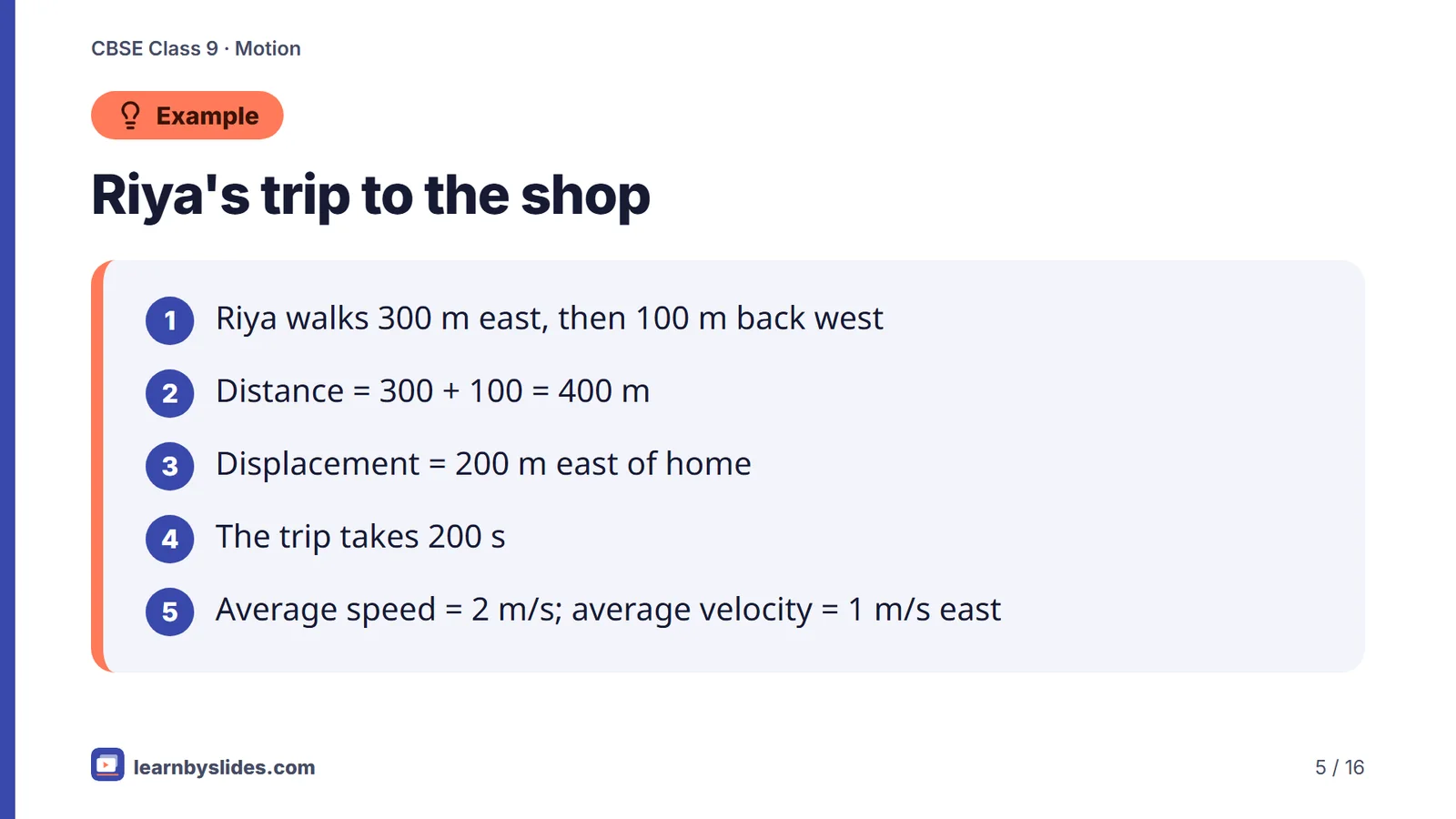
Motion is always described from a reference point, or origin. An object is in motion when its position, meaning its distance and direction from the origin, changes with time. Distance is the total length of the path covered and has no direction. Displacement is the change in position and does have a direction. If Riya walks 300 m east and then 100 m west, she covers a distance of 400 m but her displacement is only 200 m east. After a full lap of a track, displacement is zero.
Speed, velocity and acceleration
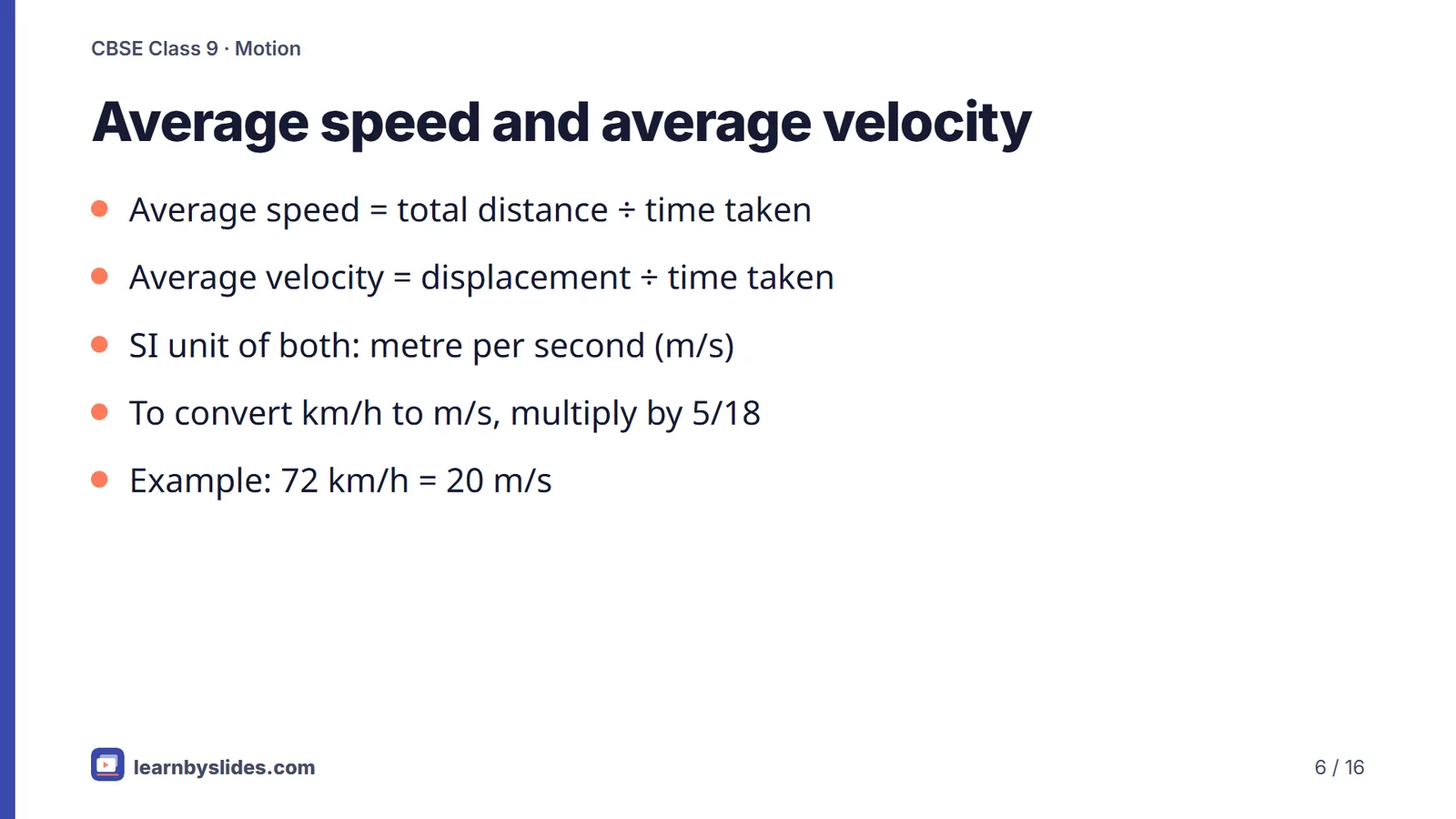
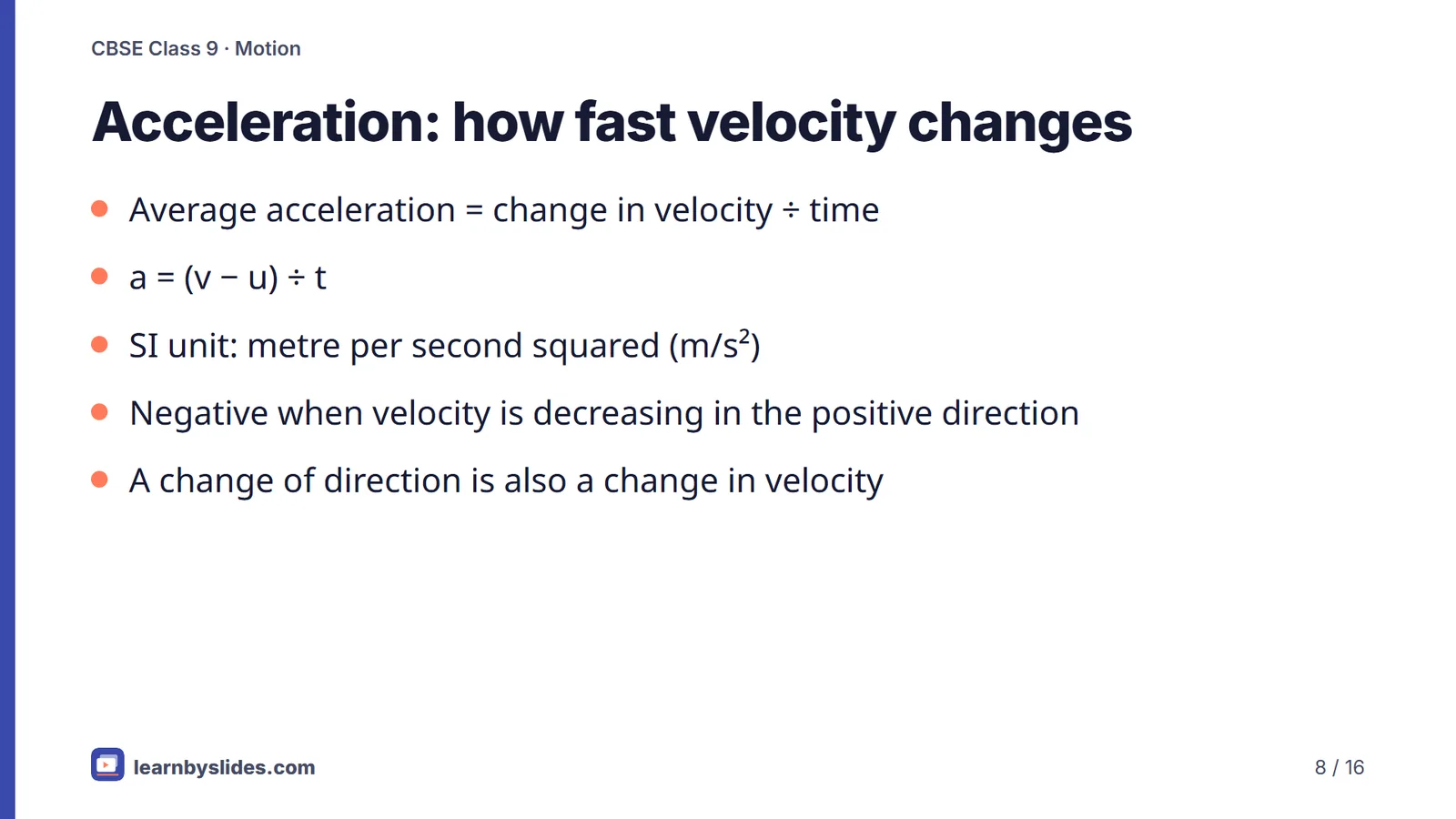
Average speed is total distance divided by time, and average velocity is displacement divided by time. Both are measured in metres per second; to convert km/h to m/s, multiply by 5/18, so 72 km/h is 20 m/s. Acceleration is the rate of change of velocity, a = (v − u) ÷ t, measured in m/s². It is negative when an object moving in the positive direction slows down, and it is also present whenever the direction of motion changes.
Reading motion graphs
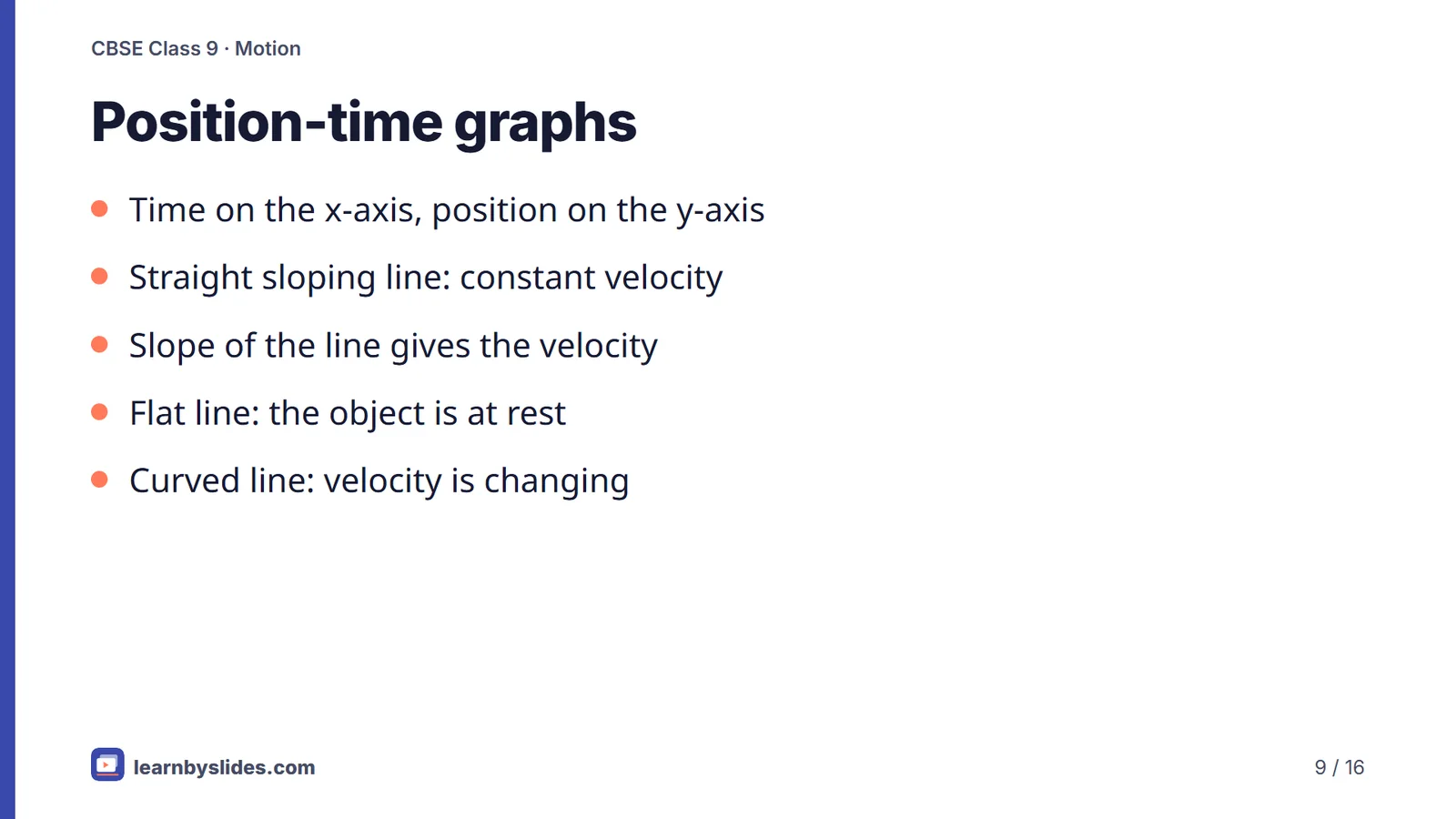
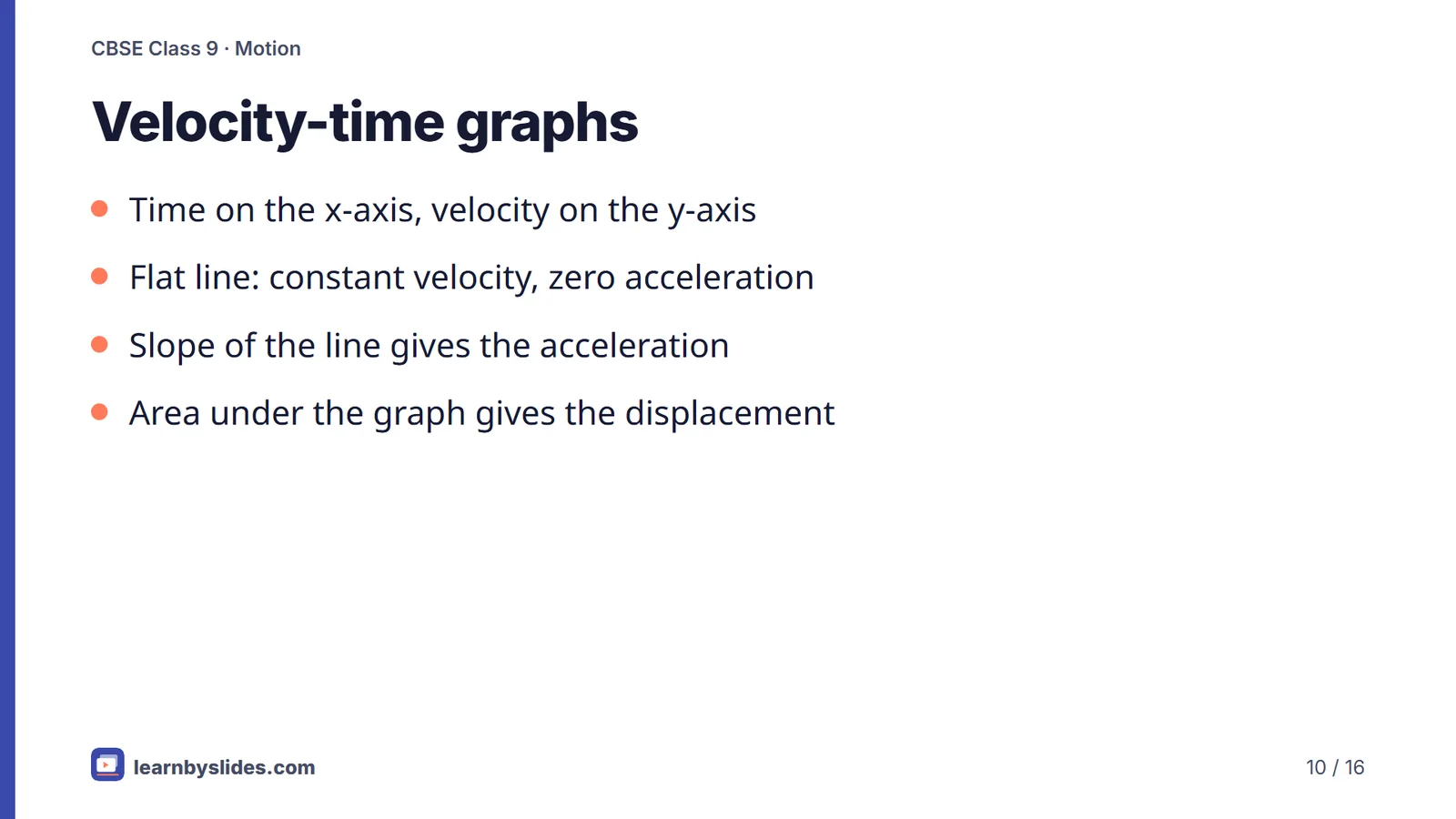
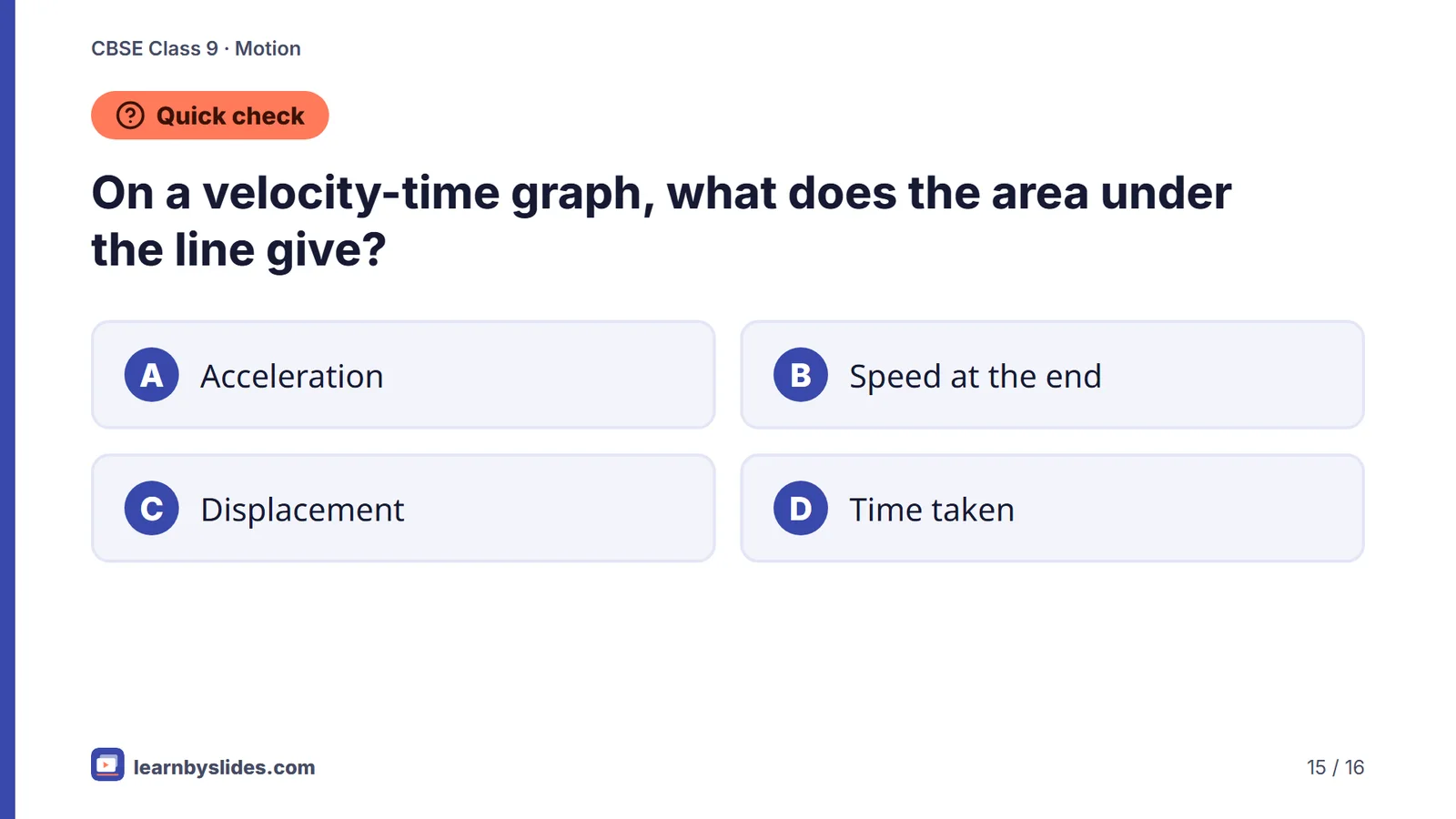
On a position-time graph, a flat line means the object is at rest, a straight sloping line means constant velocity, and the slope gives the velocity. On a velocity-time graph, a flat line means constant velocity, the slope gives the acceleration and the area under the line gives the displacement. Students often mix up slope and area, so the deck returns to this point in the quick check.
Kinematic equations and uniform circular motion
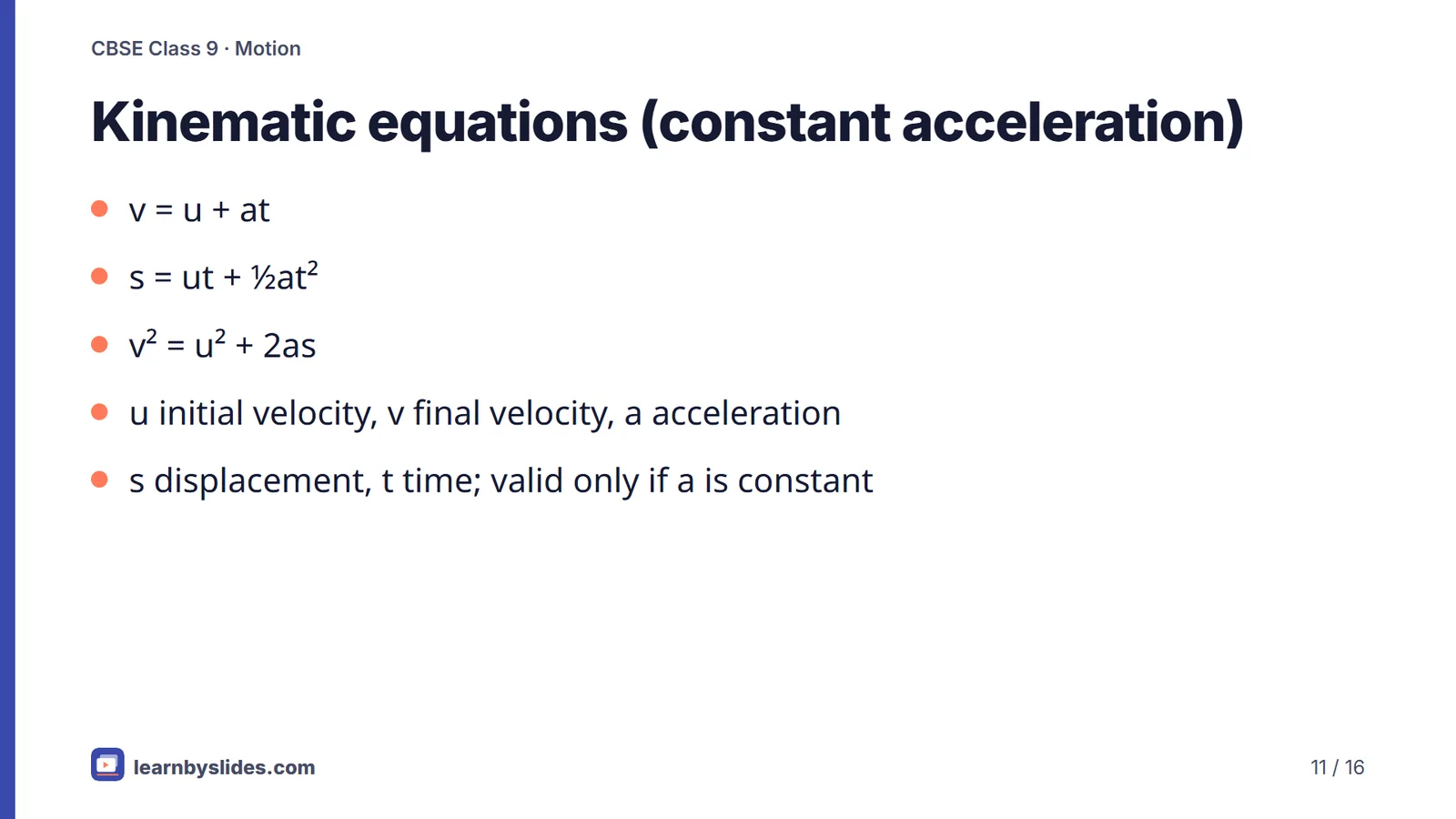
For motion in a straight line with constant acceleration, three equations link initial velocity u, final velocity v, acceleration a, displacement s and time t:
- v = u + at
- s = ut + ½at²
- v² = u² + 2as
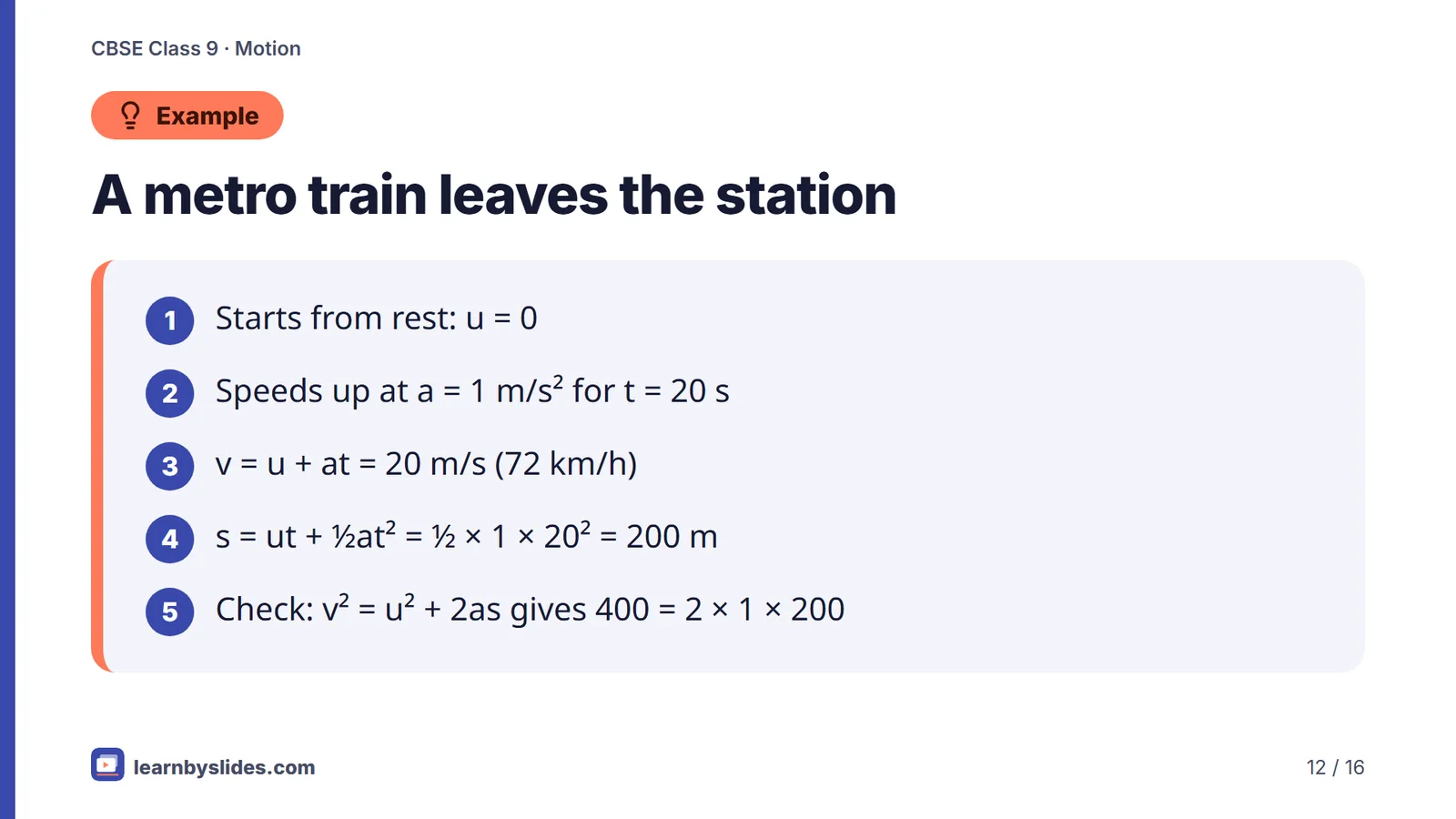
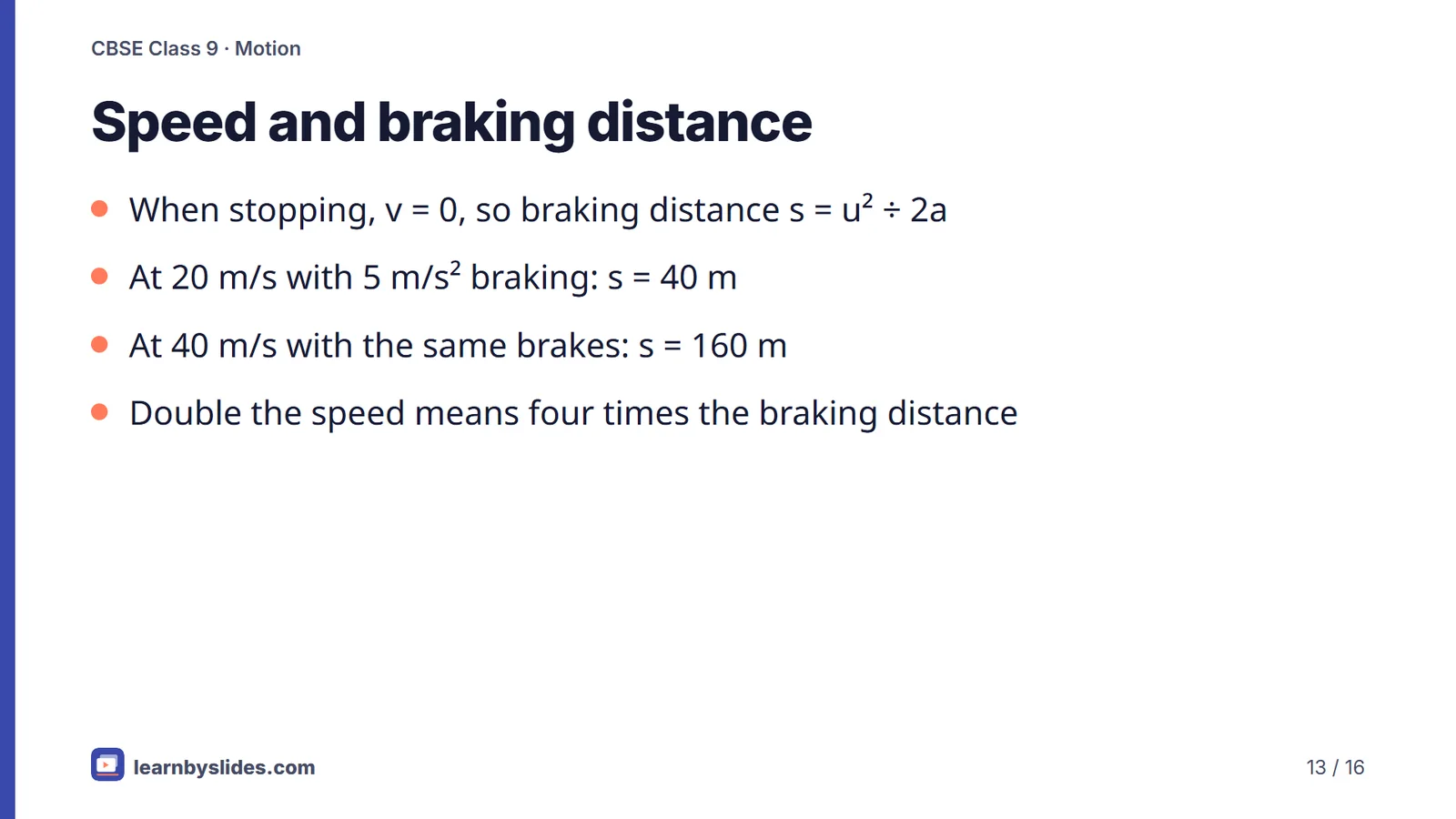
A metro train starting from rest with an acceleration of 1 m/s² reaches 20 m/s (72 km/h) in 20 s and covers 200 m. The third equation also shows why speeding is dangerous: braking distance grows with the square of speed, so doubling the speed makes it four times longer.
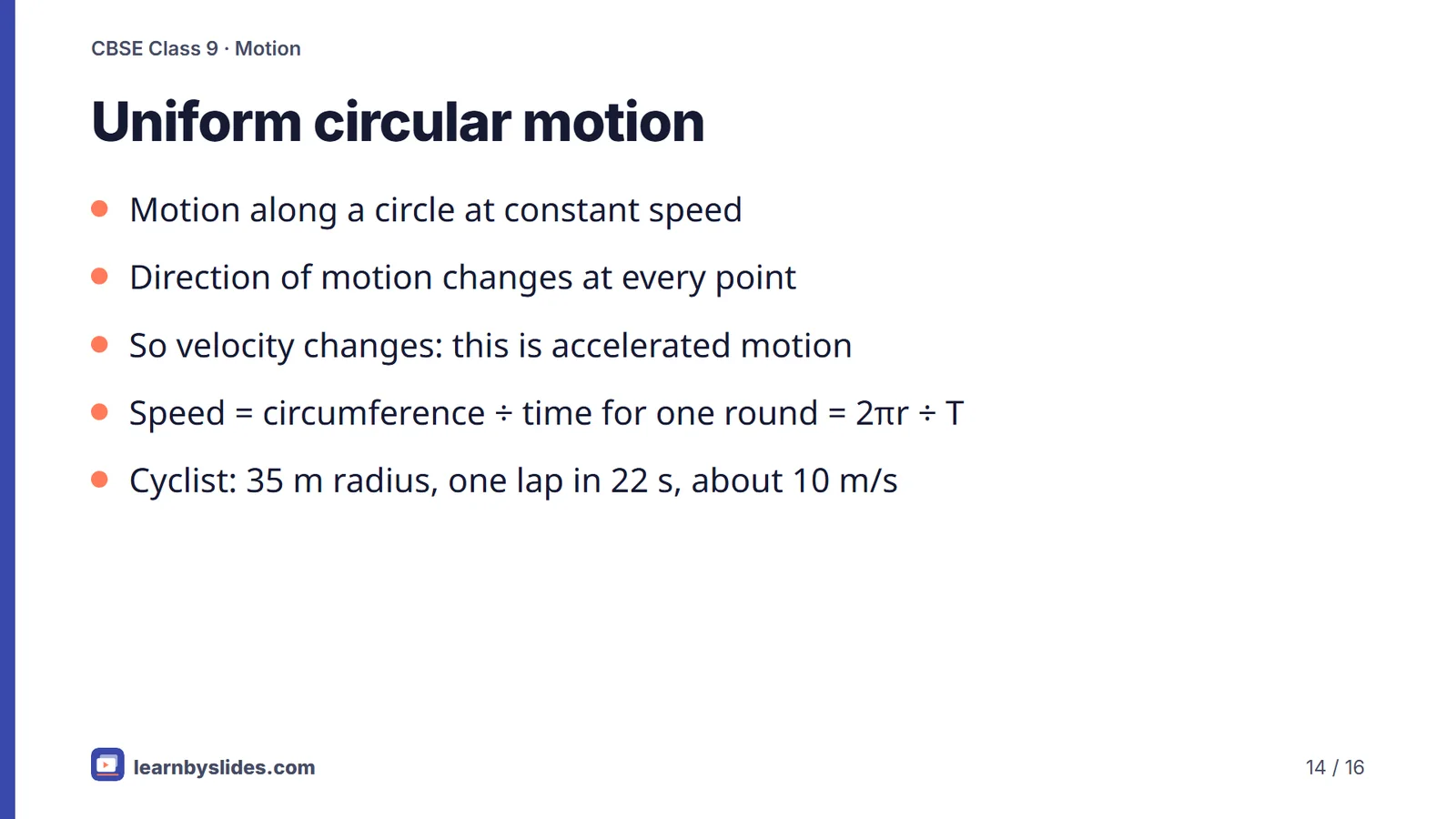
In uniform circular motion, speed is constant but direction changes continuously, so the motion is accelerated. Speed equals the circumference divided by the time for one round, 2πr ÷ T.
How to use these slides
Present the deck in class or download the free PDF for handouts. Use the worked examples on the board and pause at the quick check before the five-question quiz on this page. The editable PPTX lets you replace the numbers with examples from your own town.
Slide-by-slide content
1. Motion
CBSE Class 9 Science · Describing motion in a straight line and in a circle
Speaker notes
Ask the class: are you moving right now? Most will say no, until someone points out that the Earth is spinning and orbiting the Sun. Use this to show that whether something moves depends on what we compare it with.
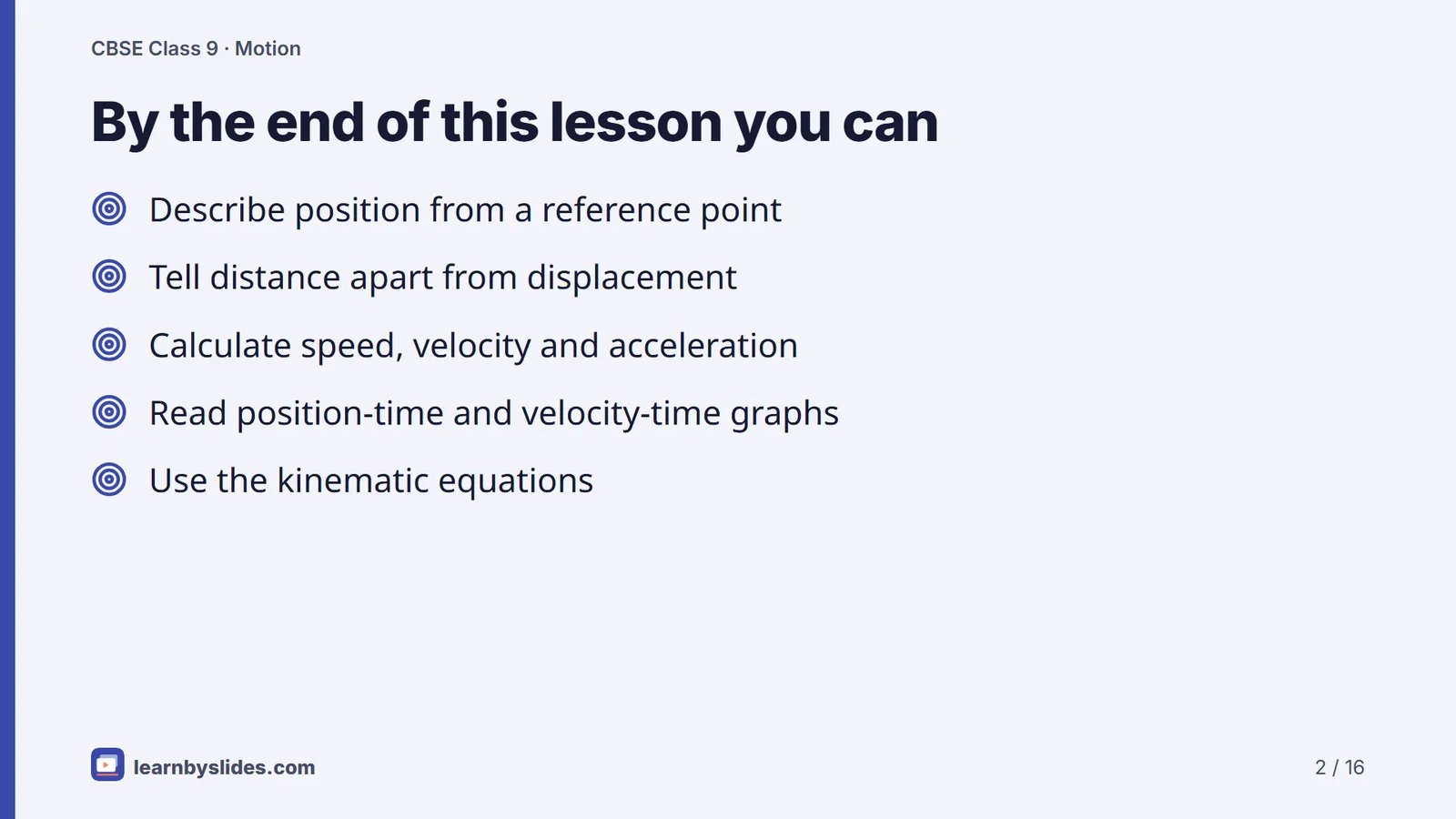
2. By the end of this lesson you can
- Describe position from a reference point
- Tell distance apart from displacement
- Calculate speed, velocity and acceleration
- Read position-time and velocity-time graphs
- Use the kinematic equations
Speaker notes
Tell students the lesson ends with numericals, so they should keep a notebook ready for the worked examples. Ask which objective they already feel confident about.
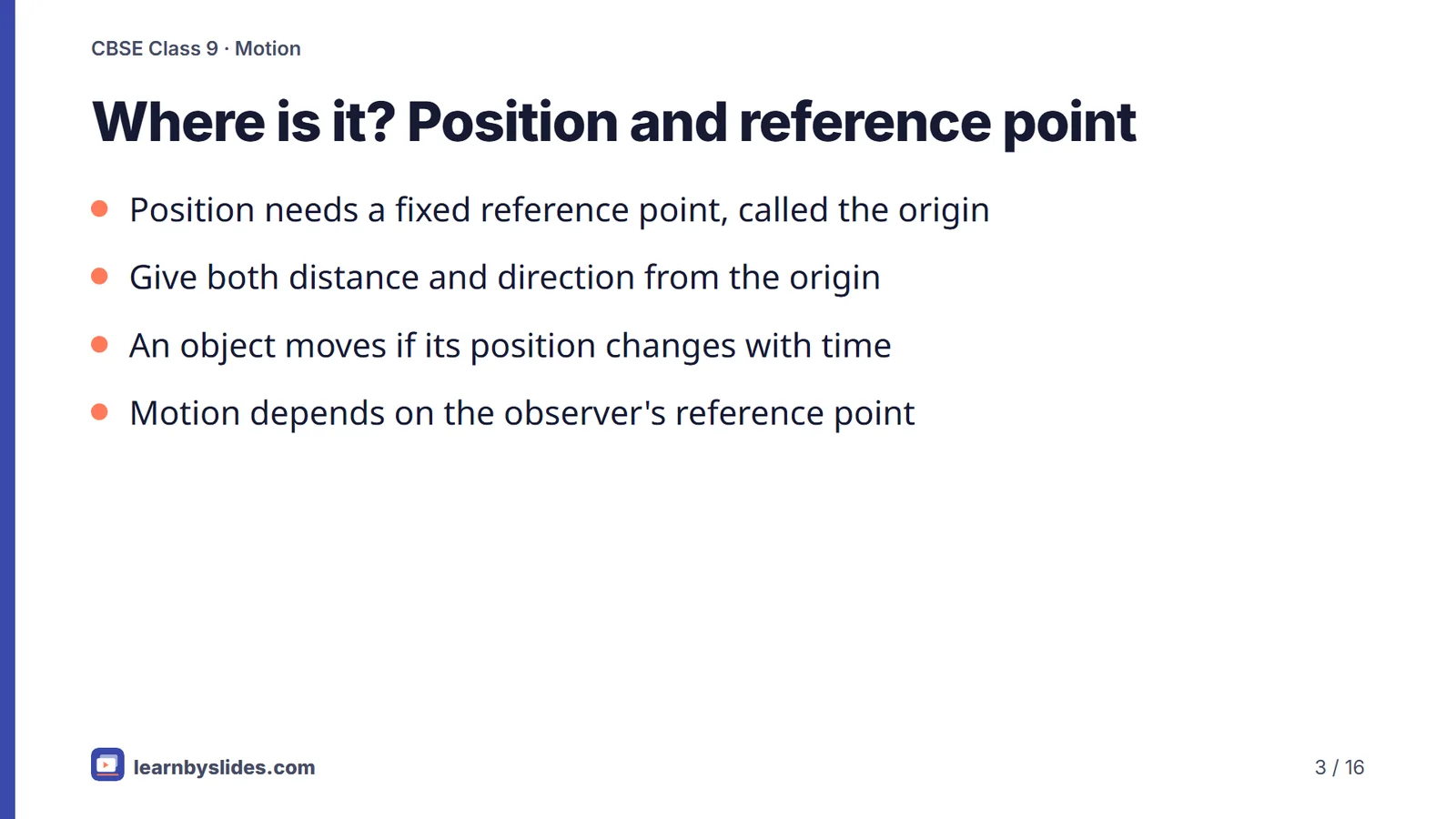
3. Where is it? Position and reference point
- Position needs a fixed reference point, called the origin
- Give both distance and direction from the origin
- An object moves if its position changes with time
- Motion depends on the observer's reference point
Speaker notes
A passenger sitting in a moving train is at rest compared with the seat but moving compared with the platform. Ask students to describe the position of the classroom door from their own desk, with a distance and a direction. A common misconception is that rest and motion are absolute.
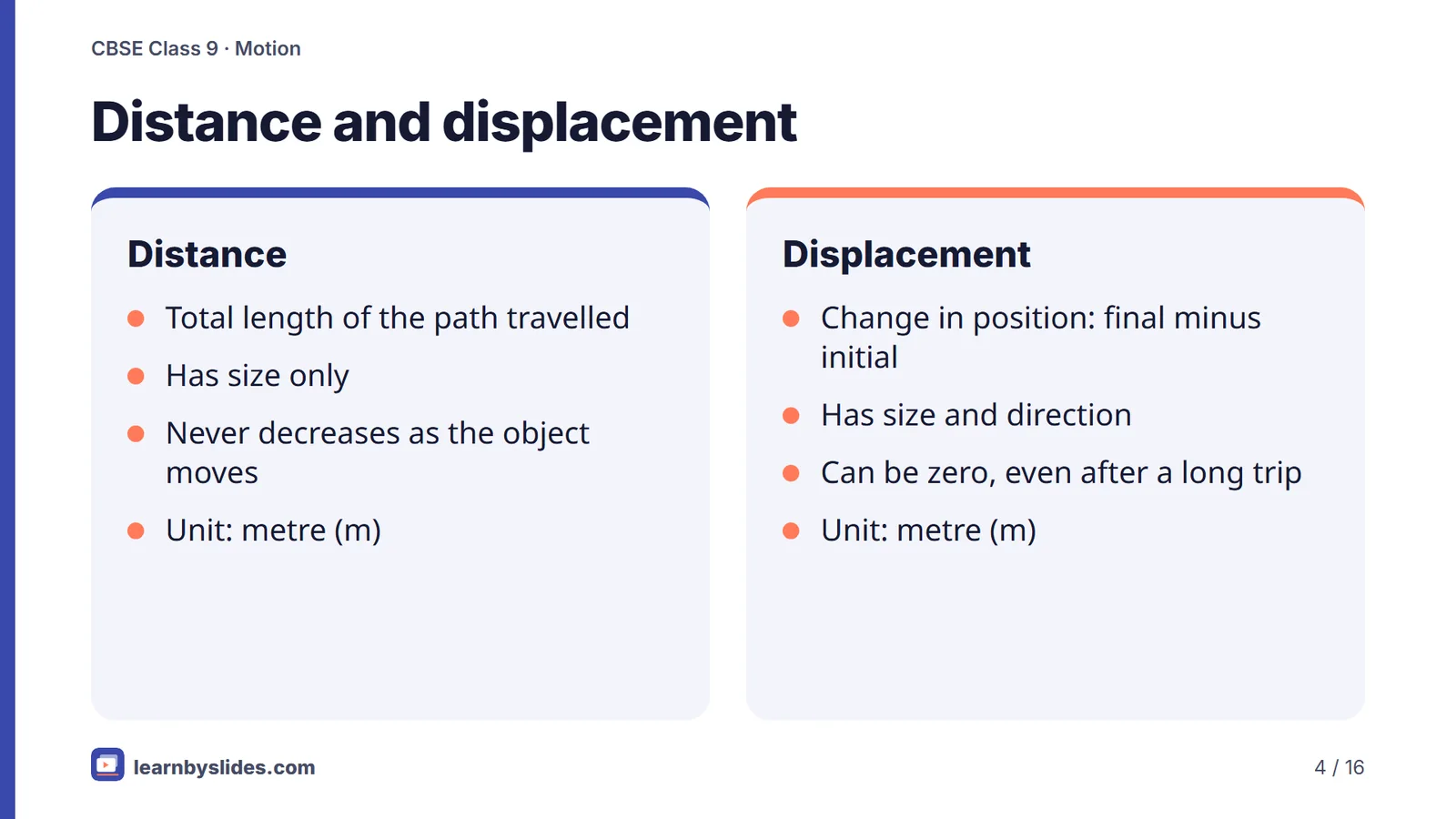
4. Distance and displacement
Distance
- Total length of the path travelled
- Has size only
- Never decreases as the object moves
- Unit: metre (m)
Displacement
- Change in position: final minus initial
- Has size and direction
- Can be zero, even after a long trip
- Unit: metre (m)
Speaker notes
A student who runs one full lap of a school track and stops at the start has covered a distance but has zero displacement. The size of the displacement is never more than the distance. Ask: when are they equal? Only for motion in one direction along a straight line.
5. Riya's trip to the shop
- Riya walks 300 m east, then 100 m back west
- Distance = 300 + 100 = 400 m
- Displacement = 200 m east of home
- The trip takes 200 s
- Average speed = 2 m/s; average velocity = 1 m/s east
Speaker notes
Work out each line on the board: average speed is 400 m ÷ 200 s and average velocity is 200 m ÷ 200 s. Ask why the two answers differ. The walking back cancels part of the displacement but still adds to the distance.
6. Average speed and average velocity
- Average speed = total distance ÷ time taken
- Average velocity = displacement ÷ time taken
- SI unit of both: metre per second (m/s)
- To convert km/h to m/s, multiply by 5/18
- Example: 72 km/h = 20 m/s
Speaker notes
Show where 5/18 comes from: 1 km/h is 1000 m in 3600 s. Ask students to convert 36 km/h and 54 km/h; the answers are 10 m/s and 15 m/s. Remind them that velocity has a direction, so it can be negative.
7. Uniform and non-uniform motion
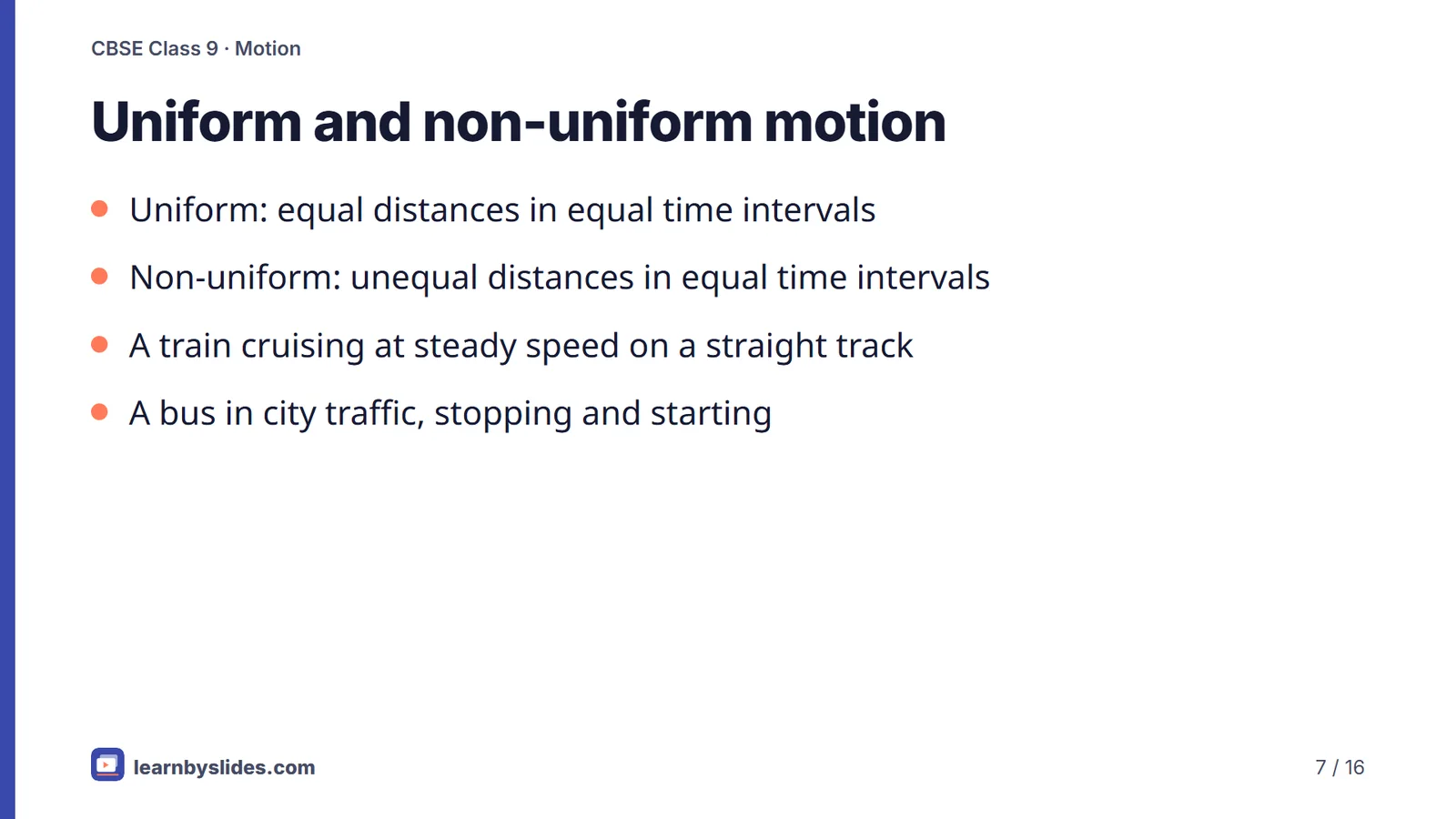
- Uniform: equal distances in equal time intervals
- Non-uniform: unequal distances in equal time intervals
- A train cruising at steady speed on a straight track
- A bus in city traffic, stopping and starting
Speaker notes
Ask students to give one example of each from their journey to school. Point out that truly uniform motion is rare in daily life; most real motion is non-uniform, which is why we talk about average speed.
8. Acceleration: how fast velocity changes
- Average acceleration = change in velocity ÷ time
- a = (v − u) ÷ t
- SI unit: metre per second squared (m/s²)
- Negative when velocity is decreasing in the positive direction
- A change of direction is also a change in velocity
Speaker notes
Here u is the initial velocity and v the final velocity. Braking gives negative acceleration, which is sometimes called retardation. A common misconception is that a fast object must have a large acceleration; a car cruising at a steady 100 km/h in a straight line has zero acceleration.
9. Position-time graphs
- Time on the x-axis, position on the y-axis
- Straight sloping line: constant velocity
- Slope of the line gives the velocity
- Flat line: the object is at rest
- Curved line: velocity is changing
Speaker notes
Sketch three quick graphs and ask students to act out each one by walking. Stress that a graph is not a map of the route; it shows how position changes with time. A steeper slope means a greater velocity.
10. Velocity-time graphs
- Time on the x-axis, velocity on the y-axis
- Flat line: constant velocity, zero acceleration
- Slope of the line gives the acceleration
- Area under the graph gives the displacement
Speaker notes
Draw a line rising from 0 to 20 m/s over 20 s and ask for the acceleration (1 m/s²) and the displacement (the triangle's area, 200 m). This graph is used on the next slides to build the kinematic equations.
11. Kinematic equations (constant acceleration)
- v = u + at
- s = ut + ½at²
- v² = u² + 2as
- u initial velocity, v final velocity, a acceleration
- s displacement, t time; valid only if a is constant
Speaker notes
Show how each equation comes from the velocity-time graph: the slope gives the first and the area gives the second. The third is obtained by combining them to remove t. Remind students to pick the equation that contains the three quantities they know and the one they need.
12. A metro train leaves the station
- Starts from rest: u = 0
- Speeds up at a = 1 m/s² for t = 20 s
- v = u + at = 20 m/s (72 km/h)
- s = ut + ½at² = ½ × 1 × 20² = 200 m
- Check: v² = u² + 2as gives 400 = 2 × 1 × 200
Speaker notes
The numbers are chosen for easy arithmetic, not taken from any particular metro line. Ask students to find how far the train travels in the first 10 s; the answer is 50 m, a quarter of the distance in 20 s. Checking with a second equation is a good habit.
13. Speed and braking distance
- When stopping, v = 0, so braking distance s = u² ÷ 2a
- At 20 m/s with 5 m/s² braking: s = 40 m
- At 40 m/s with the same brakes: s = 160 m
- Double the speed means four times the braking distance
Speaker notes
Here a is the size of the deceleration, so the minus sign has been handled. This ignores the driver's reaction time, which adds even more distance, so real stopping distances are longer. Ask students why highways have speed limits and why drivers should keep a safe gap.
14. Uniform circular motion
- Motion along a circle at constant speed
- Direction of motion changes at every point
- So velocity changes: this is accelerated motion
- Speed = circumference ÷ time for one round = 2πr ÷ T
- Cyclist: 35 m radius, one lap in 22 s, about 10 m/s
Speaker notes
For the cyclist, 2 × (22/7) × 35 m = 220 m per lap, and 220 m ÷ 22 s = 10 m/s. After one full lap the displacement is zero, so the average velocity for the lap is zero. Ask: can an object have constant speed but still be accelerating? Yes, in circular motion.
15. Quick check
On a velocity-time graph, what does the area under the line give?
- Acceleration
- Speed at the end
- Displacement
- Time taken
Speaker notes
Answer: C, displacement. The slope of a velocity-time graph gives acceleration, which is the most common wrong choice. Ask a student to explain the difference between slope and area in their own words.
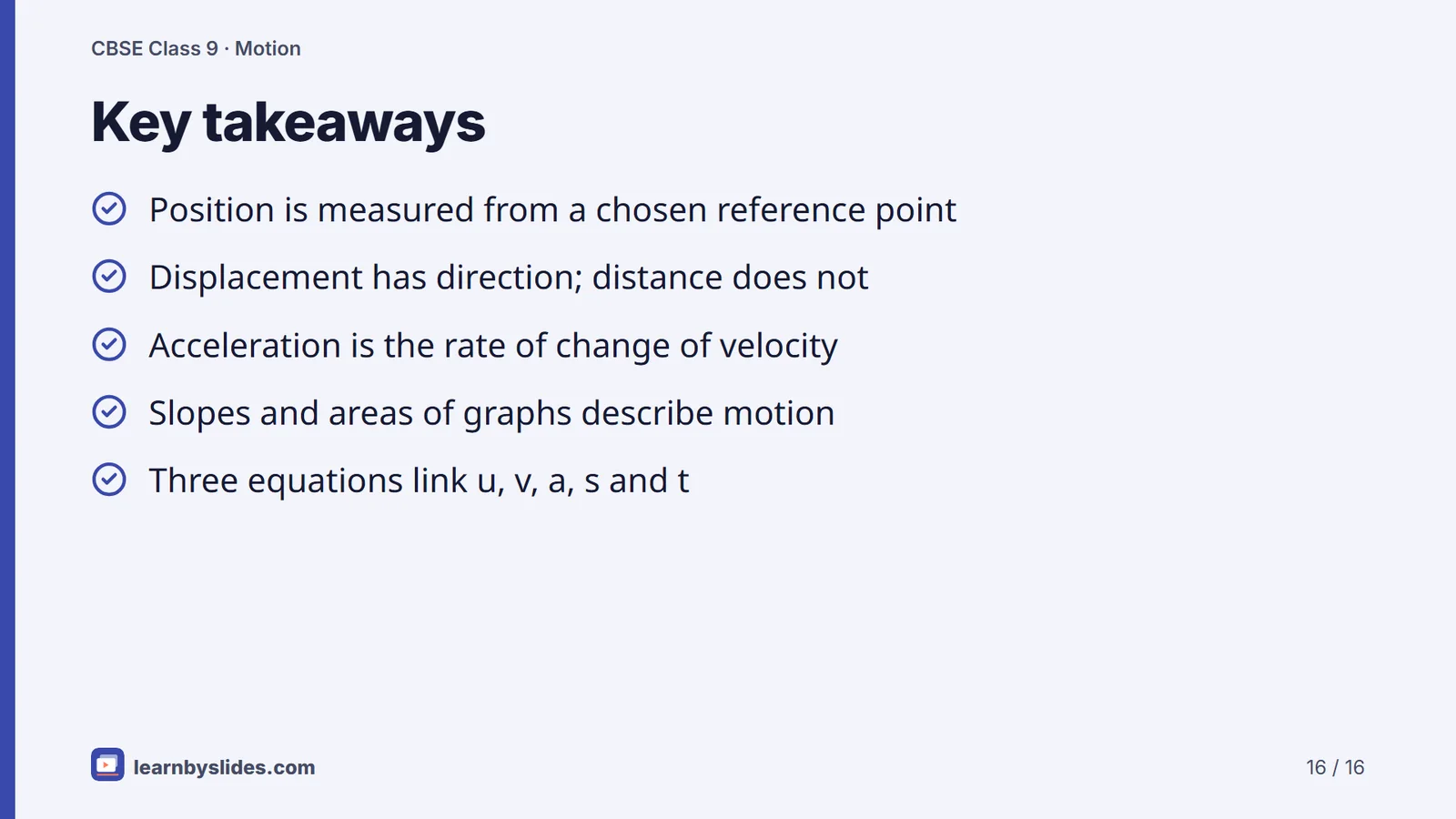
16. Key takeaways
- Position is measured from a chosen reference point
- Displacement has direction; distance does not
- Acceleration is the rate of change of velocity
- Slopes and areas of graphs describe motion
- Three equations link u, v, a, s and t
Speaker notes
Ask students to write the three kinematic equations from memory and say when they apply. Then move to the five-question quiz. Homework: time a vehicle or a friend over a measured distance and calculate the average speed.
Key terms
- Reference point (origin)
- A fixed point from which the position of an object is measured.
- Distance
- The total length of the path travelled by an object; it has size but no direction.
- Displacement
- The change in position of an object, with both size and direction.
- Average velocity
- Displacement divided by the time interval in which it happens.
- Acceleration
- The rate of change of velocity, measured in m/s².
- Kinematic equations
- Equations linking u, v, a, s and t for motion in a straight line with constant acceleration.
- Uniform circular motion
- Motion along a circular path at constant speed, in which the direction of velocity keeps changing.
Quick quiz
Teacher notes
Suggested 45-minute plan: 5 min opener (are you moving right now?), 12 min on position, distance, displacement, speed and velocity (slides 3 to 7), 8 min on acceleration and graphs, 10 min on the kinematic equations and worked examples, 5 min on circular motion, 5 min for the quick check and quiz. Common misconceptions: displacement and distance are always equal; a fast object must be accelerating; constant speed means no acceleration, even in a circle. Keep a slow pace on the metro example and let students check it with a second equation. For extension, ask students to sketch the velocity-time graph of a car braking from 20 m/s to rest and find the braking distance from the area.
Syllabus reference: CBSE Curriculum 2026-27, Class IX Science (Motion)
Frequently asked questions
Which chapter covers Motion in CBSE Class 9 Science?
NCERT released a new Class 9 Science textbook, Exploration, in April 2026. In it, motion is taught in Chapter 4, 'Describing Motion Around Us', which matches the Motion topic in the CBSE 2026-27 Class IX syllabus. Older editions had a chapter simply called 'Motion' with a different number, so check which book your school uses.
What is the difference between distance and displacement?
Distance is the total length of the path travelled and has no direction. Displacement is the change in position from start to finish and has a direction. After running one full lap of a track, your distance is the lap length but your displacement is zero.
When can I use the kinematic equations?
Only for motion in a straight line with constant acceleration. If the acceleration changes during the motion, the equations do not apply to the whole journey.
Can an object moving at constant speed be accelerating?
Yes. In uniform circular motion the speed stays the same but the direction keeps changing. Since velocity includes direction, the velocity changes, so the object is accelerating.
Sources & methodology
Every fact is checked against the sources below. We write original explanations and draw original graphics; no figures are copied from textbooks. Spotted an error? See our corrections policy.
- Exploration, Textbook of Science for Grade 9, Chapter 4: Describing Motion Around Us (NCERT, accessed 30 Sept 2026)
- Science (Code 086) Curriculum, Class IX, 2026-27 (CBSE, accessed 30 Sept 2026)
- College Physics 2e, 2.5 Motion Equations for Constant Acceleration in One Dimension (OpenStax (Rice University), accessed 30 Sept 2026)
Reviewed by Claude (pending owner check) · Updated
Related lessons
 Class 10 · Science
Chemical Reactions and Equations: Class 10 Science Slides
A ready-to-teach CBSE Class 10 Science deck on Chemical Reactions and Equations: writing and balancing equations, the main reaction types, exothermic and endothermic changes, oxidation, reduction, corrosion and rancidity.
 Class 7 · Maths
Integers: Class 7 Maths Lesson Slides
Ready-to-teach Class 7 slides on integers: the number line, adding and subtracting, sign rules for multiplying and dividing, and key properties, with lifts, temperatures, money, speaker notes and a quiz.
 Topic
TopicHow to Study Effectively: Spaced Repetition and Active Recall
Research-based slides on studying smarter: why rereading and highlighting fade, how self-testing and spaced reviews work, the 10–20% spacing rule, and a 30-day exam plan, with notes and a quiz.
 Class 8 · Science
Crop Production and Management: Class 8 Science Slides
A ready-to-teach Class 8 Science deck on Crop Production and Management: kharif and rabi crops, soil preparation, sowing, manure and fertilisers, irrigation, weed control, harvesting and safe storage of grain.
 Class 10 · Science
Life Processes: Class 10 Science Lesson Slides
A ready-to-teach deck on the four life processes in CBSE Class 10 Science: nutrition, respiration, transportation and excretion, with original diagrams, a 5-question quiz and speaker notes for every slide.
 Class 10 · Social Science
Power Sharing: Class 10 Political Science Slides
A ready-to-teach CBSE Class 10 Democratic Politics deck on Power Sharing: the Belgium and Sri Lanka case studies, prudential and moral reasons for sharing power, and the four forms of power sharing with examples from India.
Get new LearnBySlides resources by email
One short email when new free resources go live. No spam, unsubscribe anytime.