Life Processes: Class 10 Science Lesson Slides
A ready-to-teach deck on the four life processes in CBSE Class 10 Science: nutrition, respiration, transportation and excretion, with original diagrams, a 5-question quiz and speaker notes for every slide.
15 slides · 45 min lesson · 5-question quiz · speaker notes · Chapter 5: Life Processes
Learning objectives
- Define life processes and explain why living things need them.
- Compare autotrophic and heterotrophic nutrition, including photosynthesis.
- Describe aerobic and anaerobic respiration and where each happens.
- Explain transport in humans (heart, blood vessels) and in plants (xylem, phloem).
- Describe how the kidneys and nephrons remove waste from the blood.
What this lesson covers
This deck teaches the Life Processes chapter of CBSE Class 10 Science in a single 45-minute period. It moves through the four processes every organism depends on (nutrition, respiration, transportation and excretion) using short slides, original diagrams and a real-life example students already know: playing a cricket match on a hot afternoon.
Every slide includes speaker notes, so a teacher or a student revising alone can follow the reasoning, not just the bullet points.
Nutrition: getting the raw materials
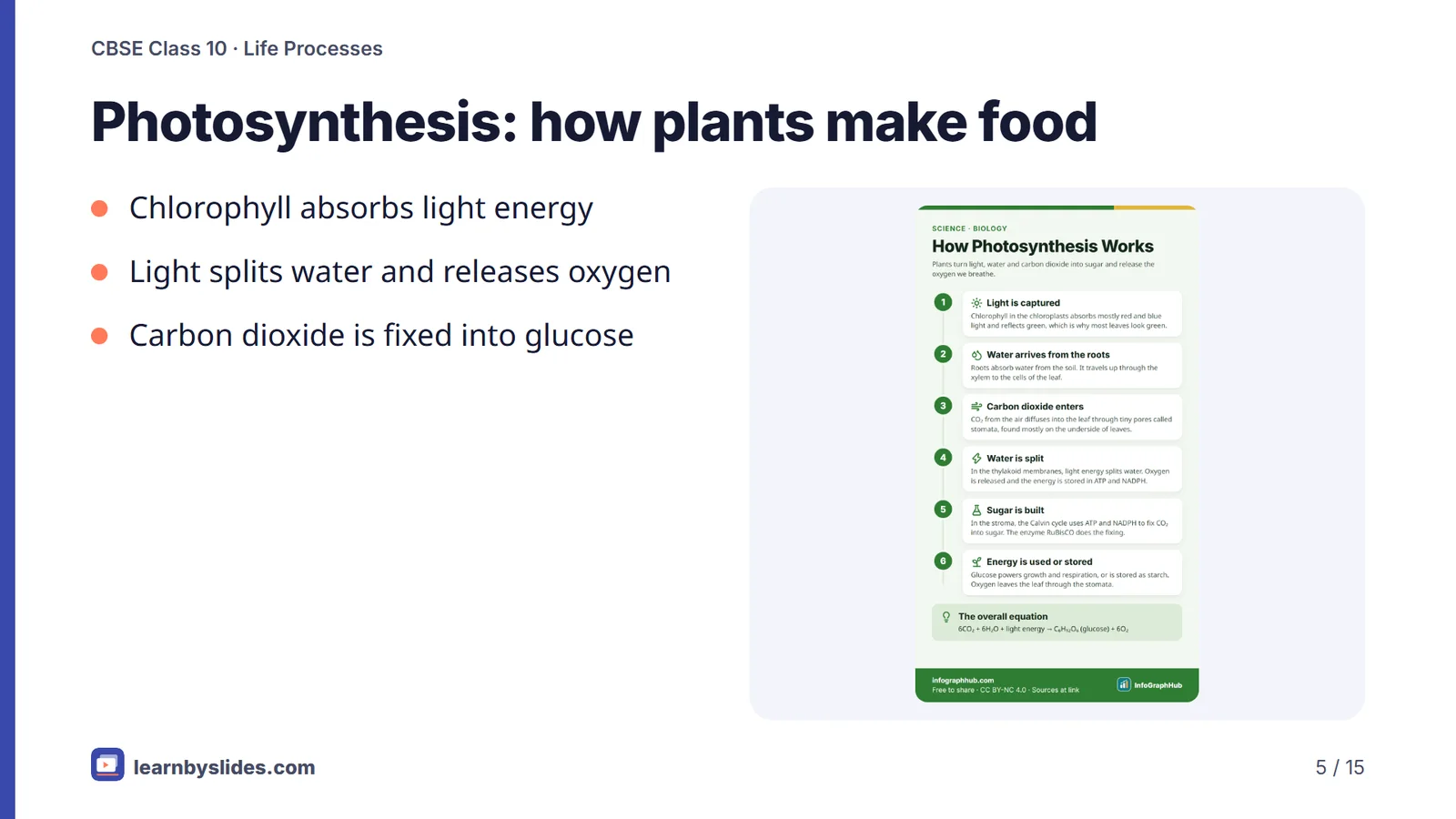
Organisms get food in one of two ways. Autotrophs, such as green plants, make their own food by photosynthesis: they use sunlight to combine carbon dioxide and water into glucose, and release oxygen. Heterotrophs, including humans, take in food made by other organisms and break it down.
In humans, digestion begins in the mouth, where saliva starts breaking down starch. It continues in the stomach, where acid and pepsin act on proteins, and is completed in the small intestine. Finger-like villi then absorb the digested food into the blood. The liver (bile) and the pancreas (pancreatic juice) pour their secretions into the small intestine to help finish the job, and the large intestine absorbs extra water before waste leaves the body.
Respiration: releasing the energy
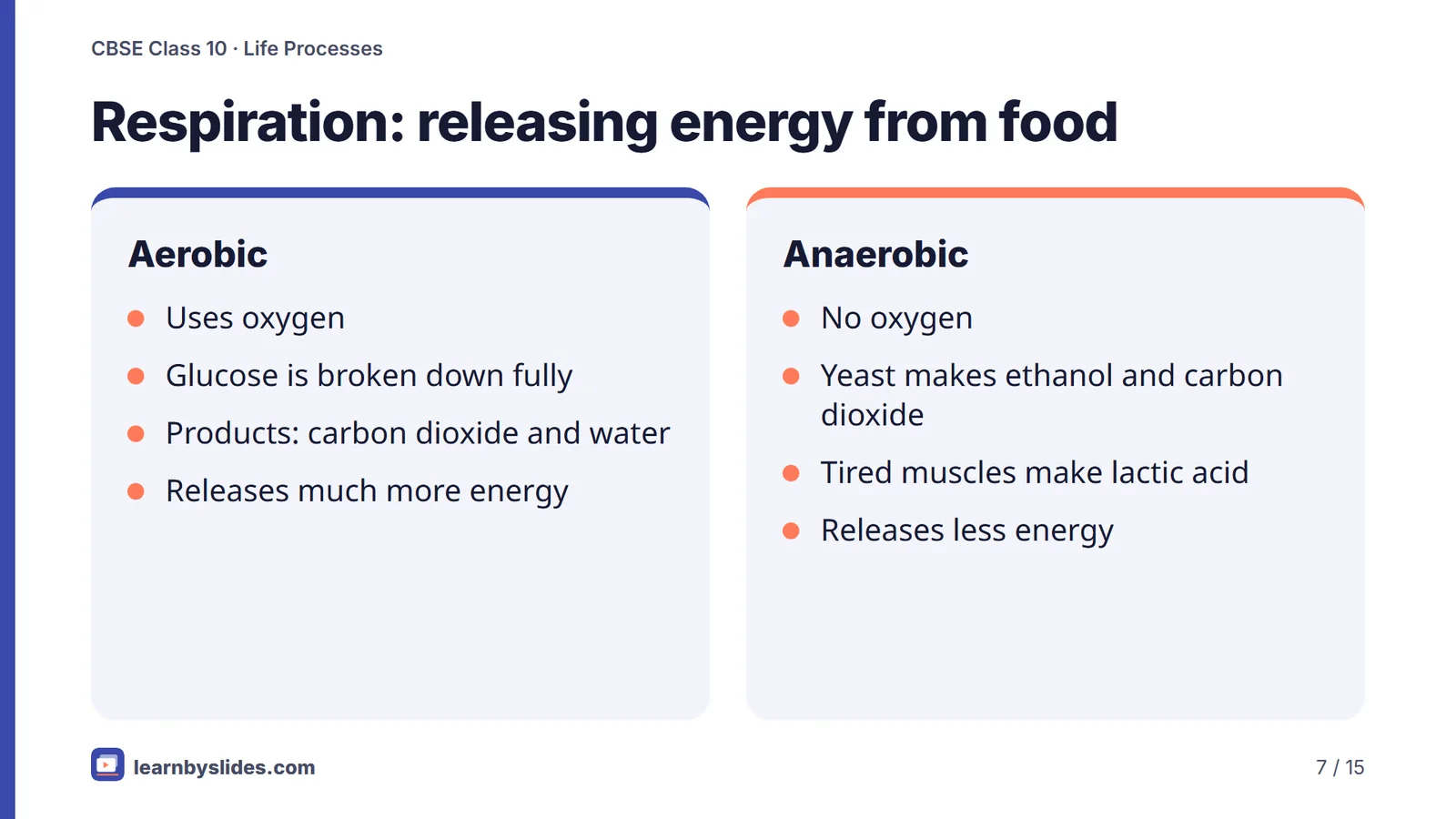
Food is only useful once its energy is released. In aerobic respiration, glucose is broken down using oxygen, mostly inside the mitochondria, producing carbon dioxide, water and a large amount of energy. Without oxygen, cells fall back on anaerobic respiration: yeast makes ethanol and carbon dioxide, while tired human muscles make lactic acid, which can cause cramps.
Breathing is different from respiration. Breathing is the movement of air in and out of the lungs; respiration is the chemical process in cells.
Transportation: moving materials around
In humans, the four-chambered heart pumps blood through arteries, capillaries and veins. Because blood passes through the heart twice in each circuit (double circulation), oxygen-rich and oxygen-poor blood never mix, which supports our high energy needs.
Plants have two transport tissues. Xylem carries water and minerals upward, pulled by transpiration from the leaves. Phloem carries food such as sucrose to wherever it is needed; this movement is called translocation.
Excretion: removing waste
Metabolism produces harmful wastes such as urea. The two kidneys filter the blood through tiny filtering units called nephrons; each kidney has about a million of them. Useful substances such as glucose and some water are reabsorbed, and the remaining liquid, urine, passes down the ureters to the bladder. When kidneys fail, dialysis can filter the blood artificially.
How to use these slides
Present the deck in class using the Present button, or download the free PDF to print handouts. Use the quick-check slide as a pause point, and finish with the five-question quiz on this page. Premium downloads include an editable PPTX with speaker notes, so you can adapt the examples to your own class.
Slide-by-slide content
1. Life Processes
CBSE Class 10 Science · Nutrition, respiration, transportation and excretion
Speaker notes
Open by asking: how can we tell that something is alive? Collect answers such as movement, growth and breathing, then say that today we look at the processes that keep every living thing alive, even when it seems to be doing nothing.
2. By the end of this lesson you can
- Define life processes and why organisms need them
- Compare autotrophic and heterotrophic nutrition
- Explain aerobic and anaerobic respiration
- Describe transport in humans and plants
- Explain how kidneys filter blood
Speaker notes
Read the objectives aloud. Tell students there will be a five-question quiz at the end, so they should note one key idea from each section.
3. What are life processes?
- Processes that maintain a living body, even during sleep
- Repairing and maintaining cells needs a steady supply of energy
- Energy comes from food broken down inside the body
- Four core processes: nutrition, respiration, transportation, excretion
Speaker notes
Stress that maintenance never stops: cells are repaired and replaced even while we sleep. Ask a student to name the four processes back to you before moving on.
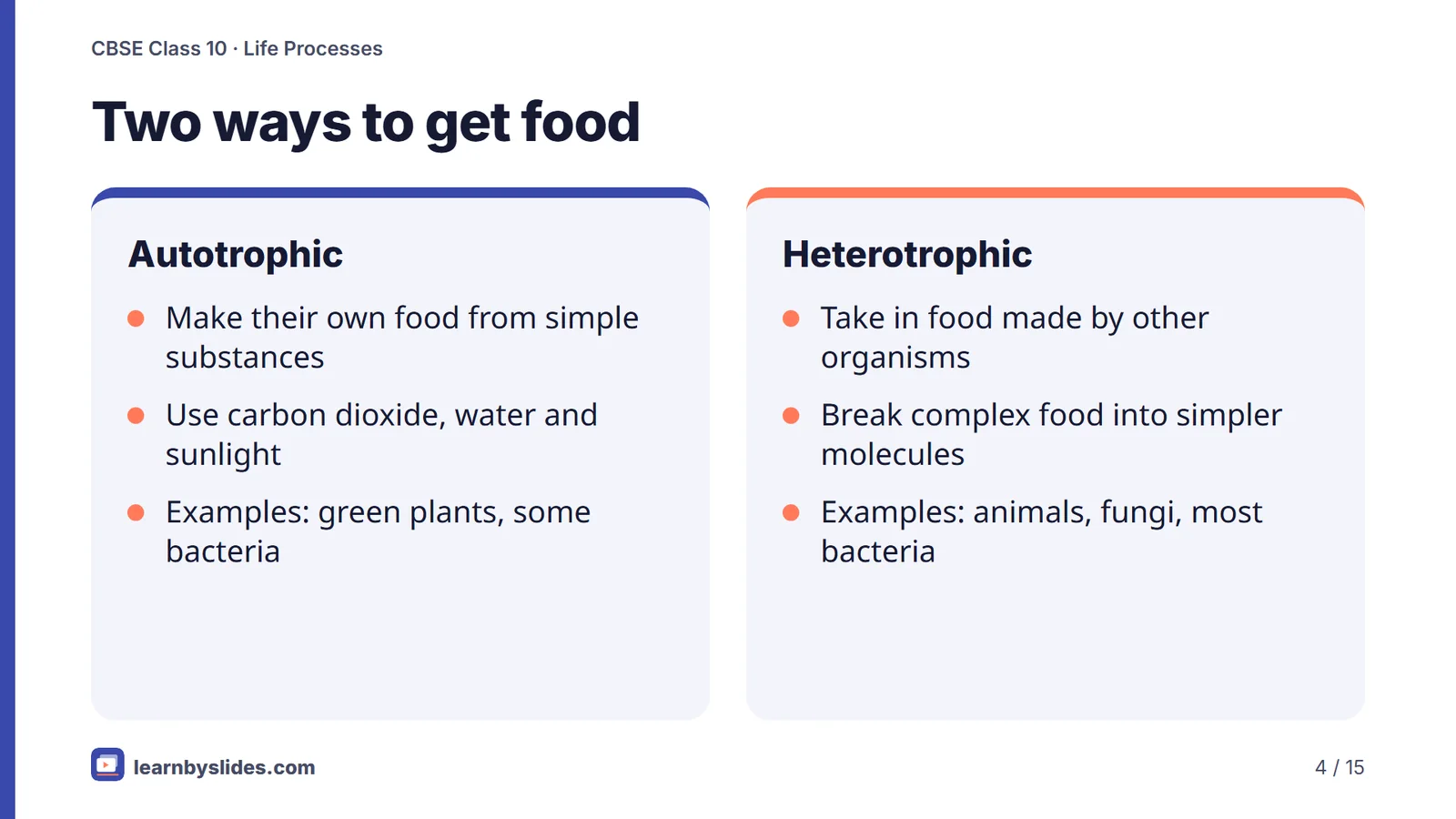
4. Two ways to get food
Autotrophic
- Make their own food from simple substances
- Use carbon dioxide, water and sunlight
- Examples: green plants, some bacteria
Heterotrophic
- Take in food made by other organisms
- Break complex food into simpler molecules
- Examples: animals, fungi, most bacteria
Speaker notes
Autotroph means self-feeder. Ask for examples of heterotrophic nutrition in daily life: a cow grazing, bread mould growing, a tapeworm living inside a host.
5. Photosynthesis: how plants make food
- Chlorophyll absorbs light energy
- Light splits water and releases oxygen
- Carbon dioxide is fixed into glucose
Speaker notes
Use the infographic to walk through the steps. Write the balanced equation on the board: 6CO2 + 6H2O + light → C6H12O6 + 6O2. Point out that CO2 enters through the stomata.
6. Nutrition in humans
- Mouth: teeth chew food; saliva starts breaking down starch
- Stomach: acid and pepsin begin digesting proteins
- Small intestine: digestion is completed; villi absorb nutrients
- Large intestine: absorbs water; waste is removed
Speaker notes
Trace a bite of chapati through the alimentary canal. Mention the liver (bile) and pancreas (pancreatic juice) as helpers that pour secretions into the small intestine.
7. Respiration: releasing energy from food
Aerobic
- Uses oxygen
- Glucose is broken down fully
- Products: carbon dioxide and water
- Releases much more energy
Anaerobic
- No oxygen
- Yeast makes ethanol and carbon dioxide
- Tired muscles make lactic acid
- Releases less energy
Speaker notes
Both start by breaking glucose into pyruvate in the cytoplasm. Aerobic respiration continues in the mitochondria. Link muscle cramps after a sprint to lactic acid build-up.
8. Breathing in humans
- Air enters through the nostrils and passes down the trachea
- Bronchi branch into bronchioles ending in alveoli
- Alveoli have thin walls and a rich blood supply
- Oxygen diffuses into blood; carbon dioxide diffuses out
Speaker notes
Clarify that breathing is the physical movement of air, while respiration is the chemical release of energy in cells. Many students confuse the two.
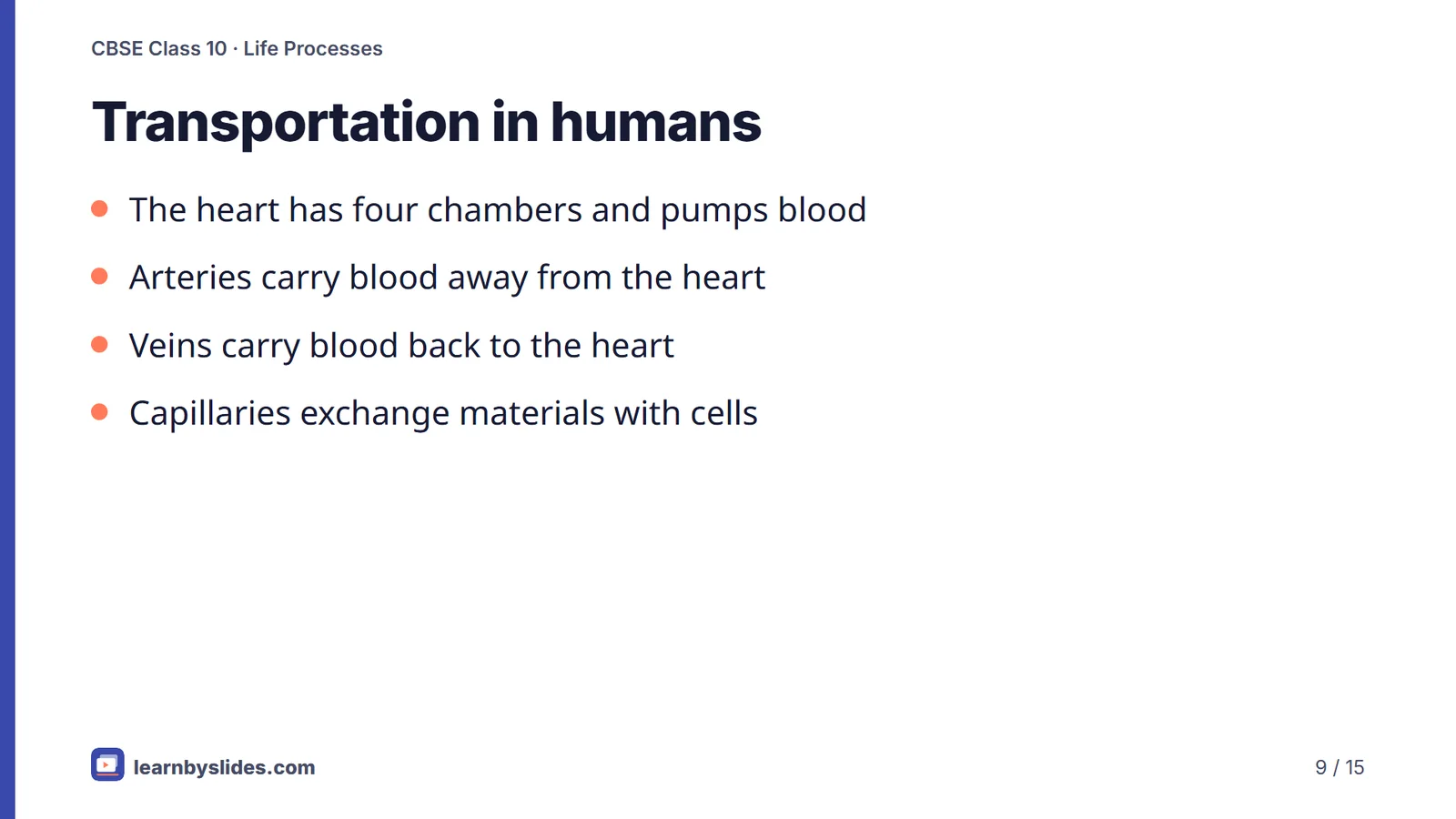
9. Transportation in humans
- The heart has four chambers and pumps blood
- Arteries carry blood away from the heart
- Veins carry blood back to the heart
- Capillaries exchange materials with cells
Speaker notes
Explain double circulation: blood passes through the heart twice in one full circuit, once to the lungs and once to the body. This keeps oxygenated and deoxygenated blood separate.
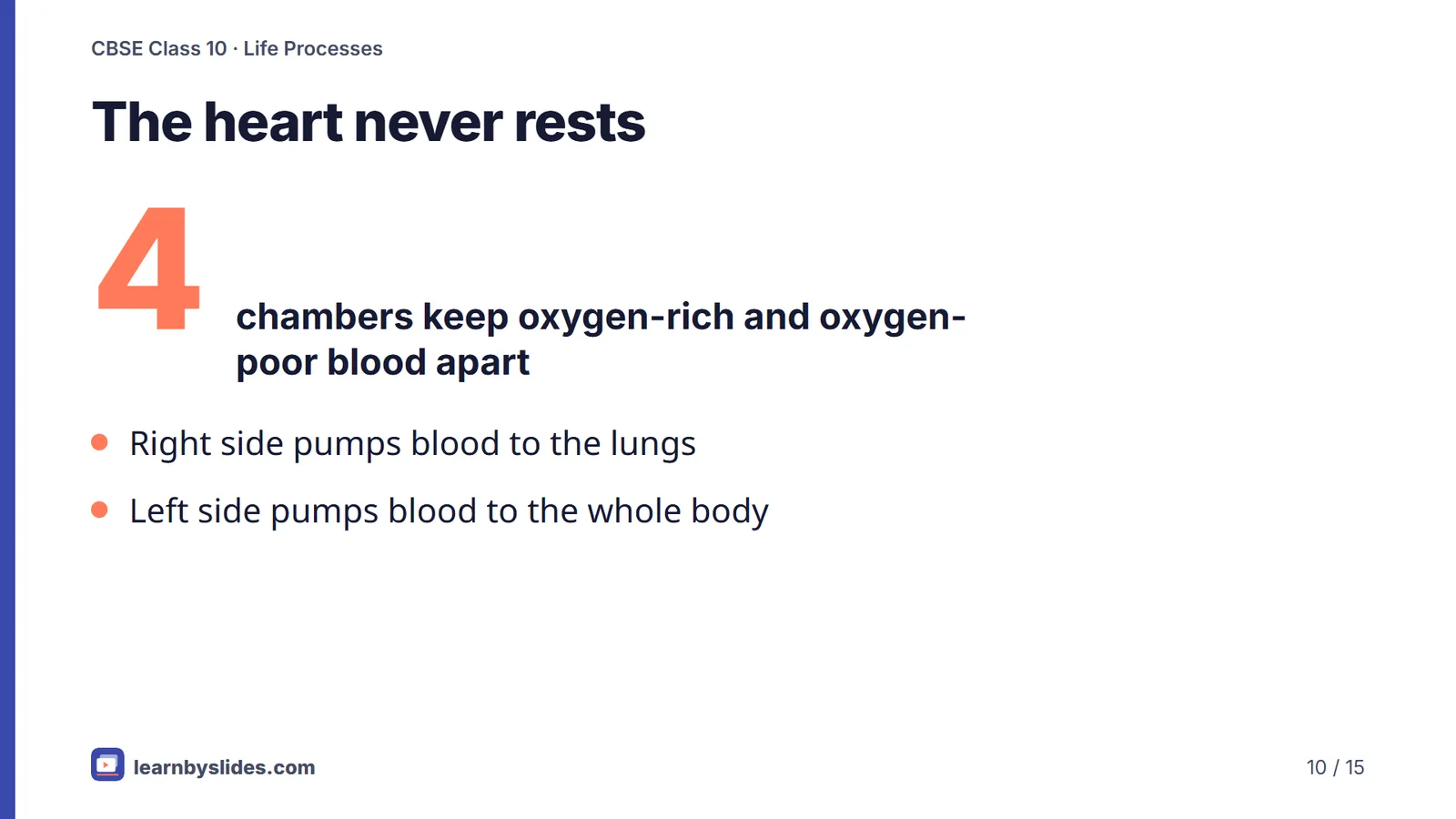
10. The heart never rests
4 chambers keep oxygen-rich and oxygen-poor blood apart
- Right side pumps blood to the lungs
- Left side pumps blood to the whole body
Speaker notes
Mammals and birds need a lot of energy to keep a constant body temperature, so separating oxygenated blood from deoxygenated blood matters. Compare with the three-chambered heart of frogs.
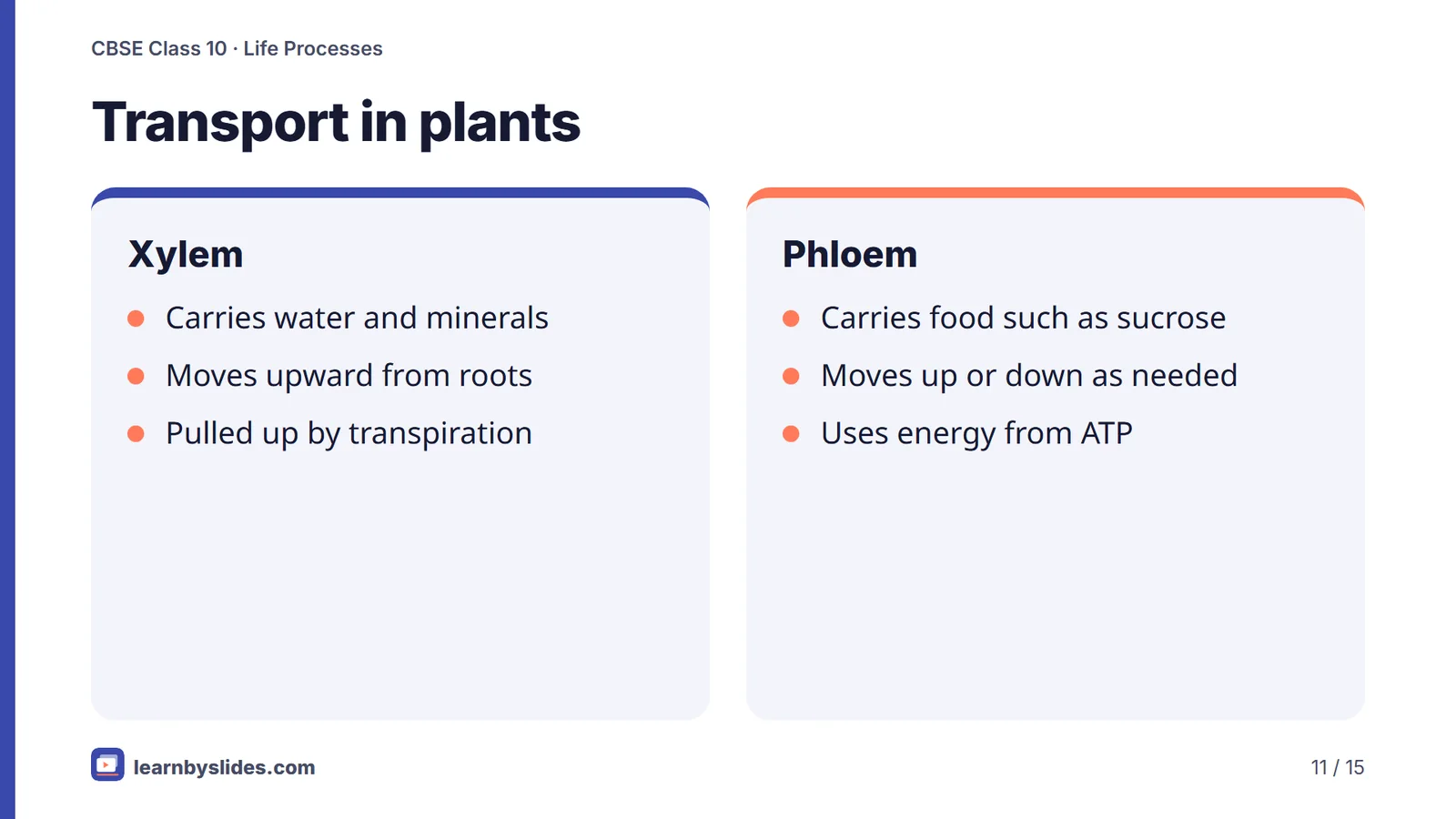
11. Transport in plants
Xylem
- Carries water and minerals
- Moves upward from roots
- Pulled up by transpiration
Phloem
- Carries food such as sucrose
- Moves up or down as needed
- Uses energy from ATP
Speaker notes
Transpiration, the loss of water vapour from leaves, creates a suction that pulls water up. Moving food in the phloem is called translocation.
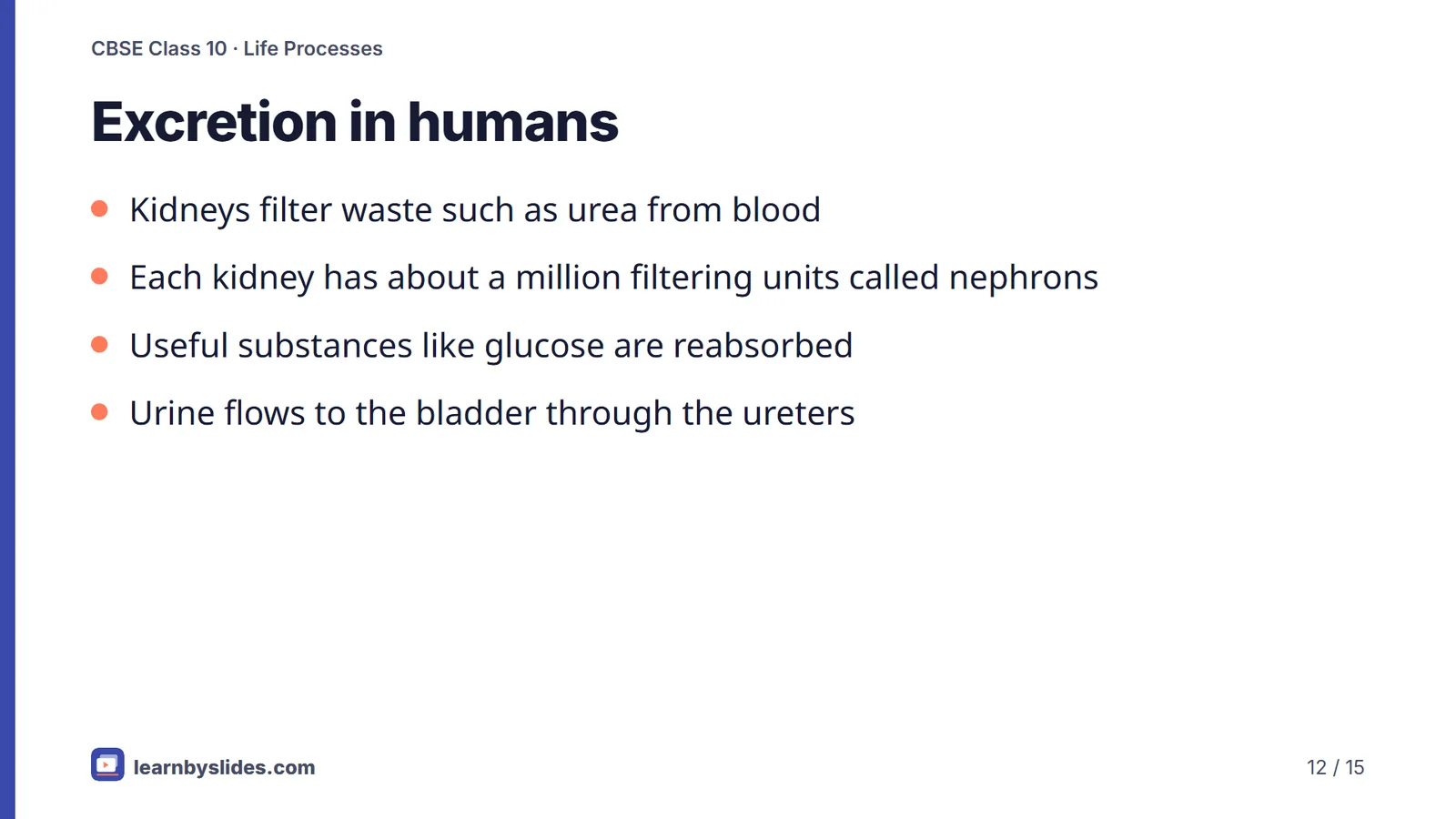
12. Excretion in humans
- Kidneys filter waste such as urea from blood
- Each kidney has about a million filtering units called nephrons
- Useful substances like glucose are reabsorbed
- Urine flows to the bladder through the ureters
Speaker notes
Draw a simple nephron: Bowman's capsule, the tubule and the collecting duct. Mention dialysis as an artificial kidney used when kidneys fail.
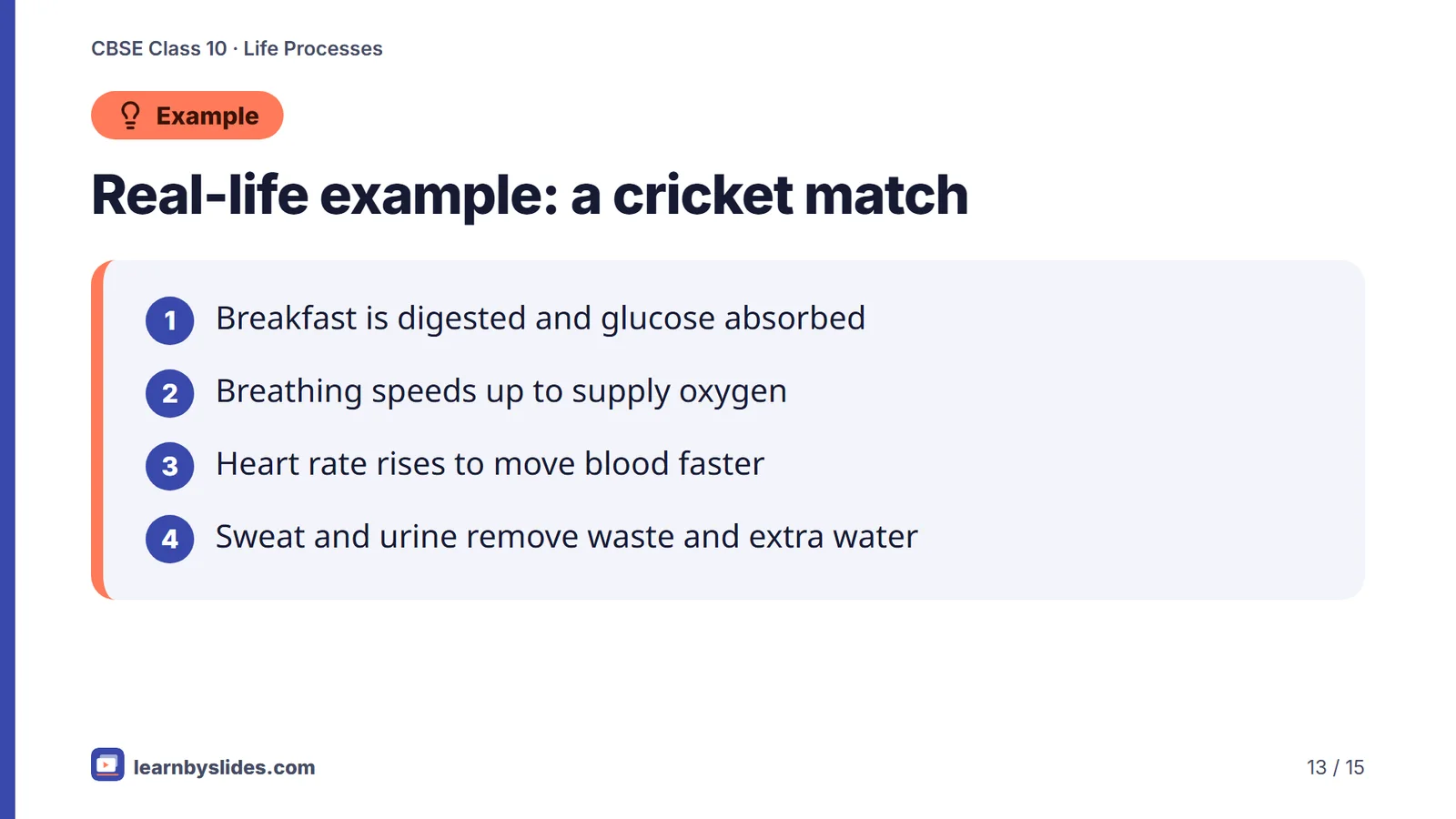
13. Real-life example: a cricket match
- Breakfast is digested and glucose absorbed
- Breathing speeds up to supply oxygen
- Heart rate rises to move blood faster
- Sweat and urine remove waste and extra water
Speaker notes
Use a familiar situation: a student playing cricket on a hot afternoon. Ask the class to name which life process is at work for each bullet.
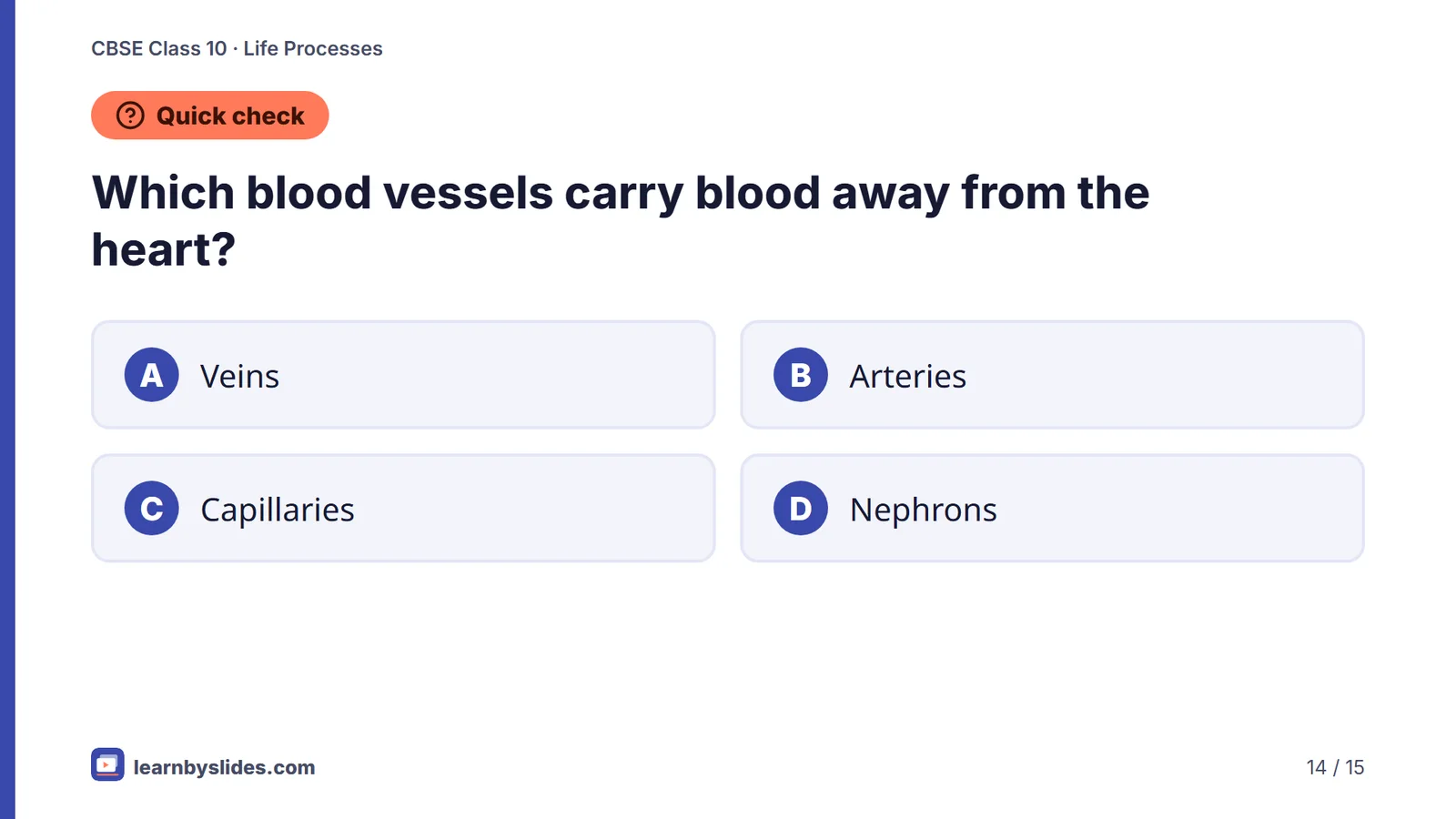
14. Quick check
Which blood vessels carry blood away from the heart?
- Veins
- Arteries
- Capillaries
- Nephrons
Speaker notes
Answer: arteries. Take a show of hands before revealing the answer. Remind students that nephrons are not blood vessels at all.
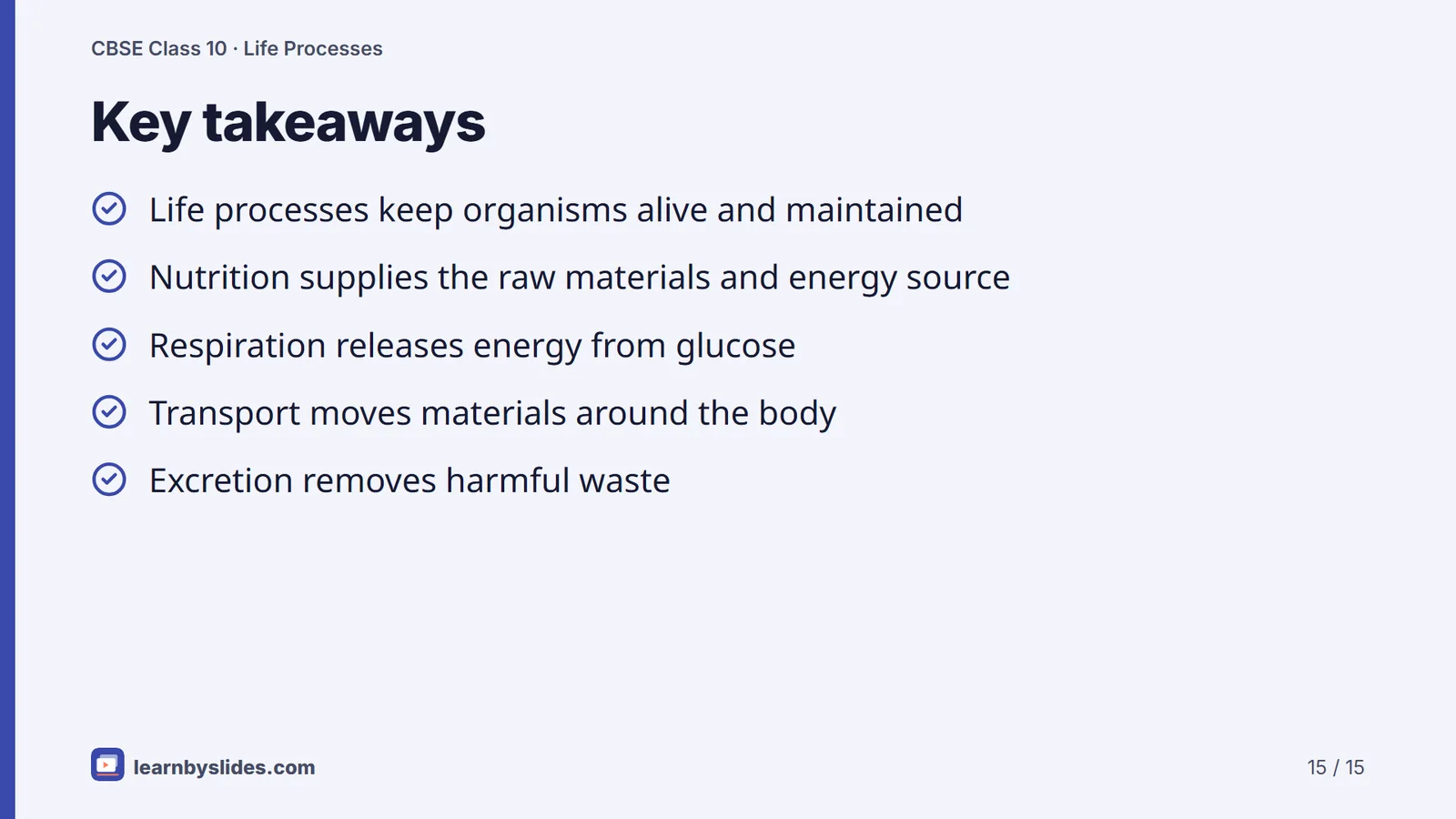
15. Key takeaways
- Life processes keep organisms alive and maintained
- Nutrition supplies the raw materials and energy source
- Respiration releases energy from glucose
- Transport moves materials around the body
- Excretion removes harmful waste
Speaker notes
Recap with a one-line summary per process, then move to the five-question quiz on the page. Set homework: draw and label the human heart.
Key terms
- Autotroph
- An organism that makes its own food from simple inorganic substances, e.g. green plants.
- Heterotroph
- An organism that depends on food made by other organisms.
- Aerobic respiration
- Breakdown of glucose using oxygen, producing carbon dioxide, water and a large amount of energy.
- Anaerobic respiration
- Breakdown of glucose without oxygen, producing less energy, plus lactic acid or ethanol.
- Double circulation
- Blood passes through the heart twice in each complete circuit of the body.
- Transpiration
- Loss of water vapour from the aerial parts of a plant, mainly through stomata.
- Nephron
- The basic filtering unit of the kidney.
Quick quiz
Teacher notes
Suggested 45-minute plan: 5 min opener (what makes something alive?), 25 min through slides 3 to 13, 5 min quick check, 10 min quiz and homework. Common misconceptions: breathing and respiration are the same thing (they are not); veins always carry deoxygenated blood (the pulmonary vein carries oxygenated blood); plants do not respire (they respire all the time, day and night). For extension, ask students why a fish has a two-chambered heart while birds and mammals have four, or ask them to sketch a nephron and label where filtration and reabsorption happen.
Syllabus reference: CBSE Curriculum 2026-27, Class X Science (Unit II: World of Living)
Frequently asked questions
Which chapter is Life Processes in CBSE Class 10 Science?
In the NCERT Class 10 Science textbook (reprint 2026-27), Life Processes is Chapter 5, and it sits in Unit II (World of Living) of the CBSE 2026-27 Class X Science syllabus. Always confirm against the syllabus your school follows.
What is the difference between breathing and respiration?
Breathing is the physical movement of air into and out of the lungs. Respiration is the chemical breakdown of glucose inside cells to release energy.
How long does this lesson take to teach?
The deck is planned for one 45-minute period: a 5-minute opener, about 25 minutes on the four processes, a quick check, and 10 minutes for the quiz and homework. Split it into two periods if your class needs more time on the heart or the nephron.
Can I edit these slides?
Yes. The premium download is an editable PowerPoint (PPTX) file with real text boxes and speaker notes. The free download is a PDF of all slides.
Sources & methodology
Every fact is checked against the sources below. We write original explanations and draw original graphics; no figures are copied from textbooks. Spotted an error? See our corrections policy.
- Class X Science textbook, Chapter 5: Life Processes (NCERT, accessed 30 Sept 2026)
- Your Kidneys & How They Work (National Institute of Diabetes and Digestive and Kidney Diseases (NIH), accessed 30 Sept 2026)
- Concepts of Biology, 4.4 Fermentation (OpenStax (Rice University), accessed 30 Sept 2026)
Reviewed by Claude (pending owner check) · Updated
Related lessons
 Class 10 · Science
Chemical Reactions and Equations: Class 10 Science Slides
A ready-to-teach CBSE Class 10 Science deck on Chemical Reactions and Equations: writing and balancing equations, the main reaction types, exothermic and endothermic changes, oxidation, reduction, corrosion and rancidity.
 Class 8 · Science
Crop Production and Management: Class 8 Science Slides
A ready-to-teach Class 8 Science deck on Crop Production and Management: kharif and rabi crops, soil preparation, sowing, manure and fertilisers, irrigation, weed control, harvesting and safe storage of grain.
 Topic
TopicHow to Study Effectively: Spaced Repetition and Active Recall
Research-based slides on studying smarter: why rereading and highlighting fade, how self-testing and spaced reviews work, the 10–20% spacing rule, and a 30-day exam plan, with notes and a quiz.
 Class 9 · Science
Motion: Class 9 Science Lesson Slides
A ready-to-teach CBSE Class 9 Science deck on motion in a straight line: position, distance and displacement, speed, velocity, acceleration, position-time and velocity-time graphs, kinematic equations and uniform circular motion.
 Class 10 · Social Science
Power Sharing: Class 10 Political Science Slides
A ready-to-teach CBSE Class 10 Democratic Politics deck on Power Sharing: the Belgium and Sri Lanka case studies, prudential and moral reasons for sharing power, and the four forms of power sharing with examples from India.
 Class 7 · Maths
Integers: Class 7 Maths Lesson Slides
Ready-to-teach Class 7 slides on integers: the number line, adding and subtracting, sign rules for multiplying and dividing, and key properties, with lifts, temperatures, money, speaker notes and a quiz.
Get new LearnBySlides resources by email
One short email when new free resources go live. No spam, unsubscribe anytime.