Fundamental Rights: UPSC Polity Revision Slides
Exam-ready revision slides on Part III of the Constitution (Articles 12–35): six categories of rights, citizen-only rights, Article 32 and the five writs, key amendments and emergency rules, with a quiz.
17 slides · 45 min lesson · 5-question quiz · speaker notes
Learning objectives
- Identify the six categories of Fundamental Rights and their article ranges.
- Distinguish rights available only to citizens from rights of all persons.
- Explain Article 32, Article 226 and the purpose of each of the five writs.
- Recall the amendments that reshaped Part III, including the 44th Amendment.
- Apply the Article 359 rule that Articles 20 and 21 cannot be suspended.
What this revision deck covers
Fundamental Rights are set out in Part III of the Constitution of India, Articles 12 to 35. They are justiciable: a person whose right is violated can go to the High Court, or straight to the Supreme Court under Article 32. This deck revises the text of each article, the citizen-only distinction, the writs, and the amendments and emergency provisions that UPSC Prelims and GS Paper 2 questions keep returning to. Every article number on the slides has been checked against the official text of the Constitution.
Six categories and who can claim them
Since the 44th Amendment (1978) omitted Article 31 and removed the Right to Property from Part III, there are six categories: Right to Equality (Articles 14–18), Right to Freedom (19–22), Right against Exploitation (23–24), Right to Freedom of Religion (25–28), Cultural and Educational Rights (29–30) and the Right to Constitutional Remedies (32). Property is now a legal right under Article 300A.
Articles 15, 16, 19, 29 and 30 are available only to citizens. Others, such as Article 14 (equality before law), Articles 20 and 21 and Article 25, use the words "any person" or "all persons", so foreigners in India can claim them too.
Articles UPSC asks about most
Article 12 defines "the State" to include the Government and Parliament of India, the Government and Legislature of each State, and all local or other authorities. Article 13 makes laws inconsistent with Part III void to the extent of the inconsistency; clause (4), added by the 24th Amendment (1971), keeps constitutional amendments under Article 368 outside it.
Article 14 guarantees equality before the law and equal protection of the laws. Article 17 abolishes untouchability and makes its enforcement an offence. Article 19 gives citizens six freedoms, each subject to reasonable restrictions listed in the article. Article 21 protects life and personal liberty, and the Supreme Court has read many rights into it, including the right to privacy (2017). Article 21A, inserted by the 86th Amendment (2002), promises free and compulsory education to children aged six to fourteen.
Remedies: Article 32, Article 226 and the writs
Article 32 guarantees the right to move the Supreme Court for enforcing Part III, and empowers it to issue writs of habeas corpus, mandamus, prohibition, quo warranto and certiorari. Dr B. R. Ambedkar called this right the "heart and soul" of the Constitution. Under Article 226, High Courts can issue the same writs for Part III rights and for any other purpose, so their writ jurisdiction is wider.
Amendments and emergency limits
Under Article 359, during a Proclamation of Emergency the President may suspend the right to move a court for enforcing Part III rights, except Articles 20 and 21. That exception was written in by the 44th Amendment (1978). Articles 33 and 34 let Parliament restrict rights for the armed forces and police and protect acts done under martial law, and Article 35 reserves certain Part III laws to Parliament alone. Parliament can amend Fundamental Rights, but the Supreme Court held in Kesavananda Bharati (1973) that amendments cannot destroy the basic structure.
Slide-by-slide content
1. Fundamental Rights
UPSC Polity revision · Part III of the Constitution (Articles 12–35)
Speaker notes
Open with a Prelims-style question: which article did Dr Ambedkar call the heart and soul of the Constitution? Hold the answer until the Article 32 slide. Tell aspirants that today's focus is exact article numbers, because UPSC options often differ by only one article.
2. By the end of this session you can
- Name the six categories and their article ranges
- Separate citizen-only rights from rights of all persons
- Explain Article 32, Article 226 and the five writs
- Recall the amendments that reshaped Part III
- Apply the emergency rule for Articles 20 and 21
Speaker notes
Read the objectives aloud. Ask aspirants to keep a blank sheet ready and write the six categories from memory at the end of the session.
3. Part III at a glance
- Articles 12 to 35 form Part III of the Constitution
- Justiciable: enforceable in the Supreme Court and High Courts
- Mostly limits on the State; a few bind private persons too
- Not absolute: many rights carry stated restrictions
- Right to Property left Part III in 1978
Speaker notes
Stress that justiciable means a court can enforce the right, unlike the Directive Principles in Part IV. Ask: which rights bind private individuals? Articles 17, 23 and 24 are the usual examples. A common error is to think all rights are absolute.
4. Articles 12 and 13: the State and judicial review
- Art 12: 'State' covers Union and State governments and legislatures
- It also covers all local or other authorities
- Art 13: laws inconsistent with Part III are void
- 'Law' includes ordinances, orders, bye-laws, custom and usage
- Art 13(4), added in 1971, excludes Article 368 amendments
Speaker notes
Article 13(4) was inserted by the 24th Amendment in 1971. Ask: if amendments are outside Article 13, what limits them? Answer: the basic structure doctrine from Kesavananda Bharati in 1973.
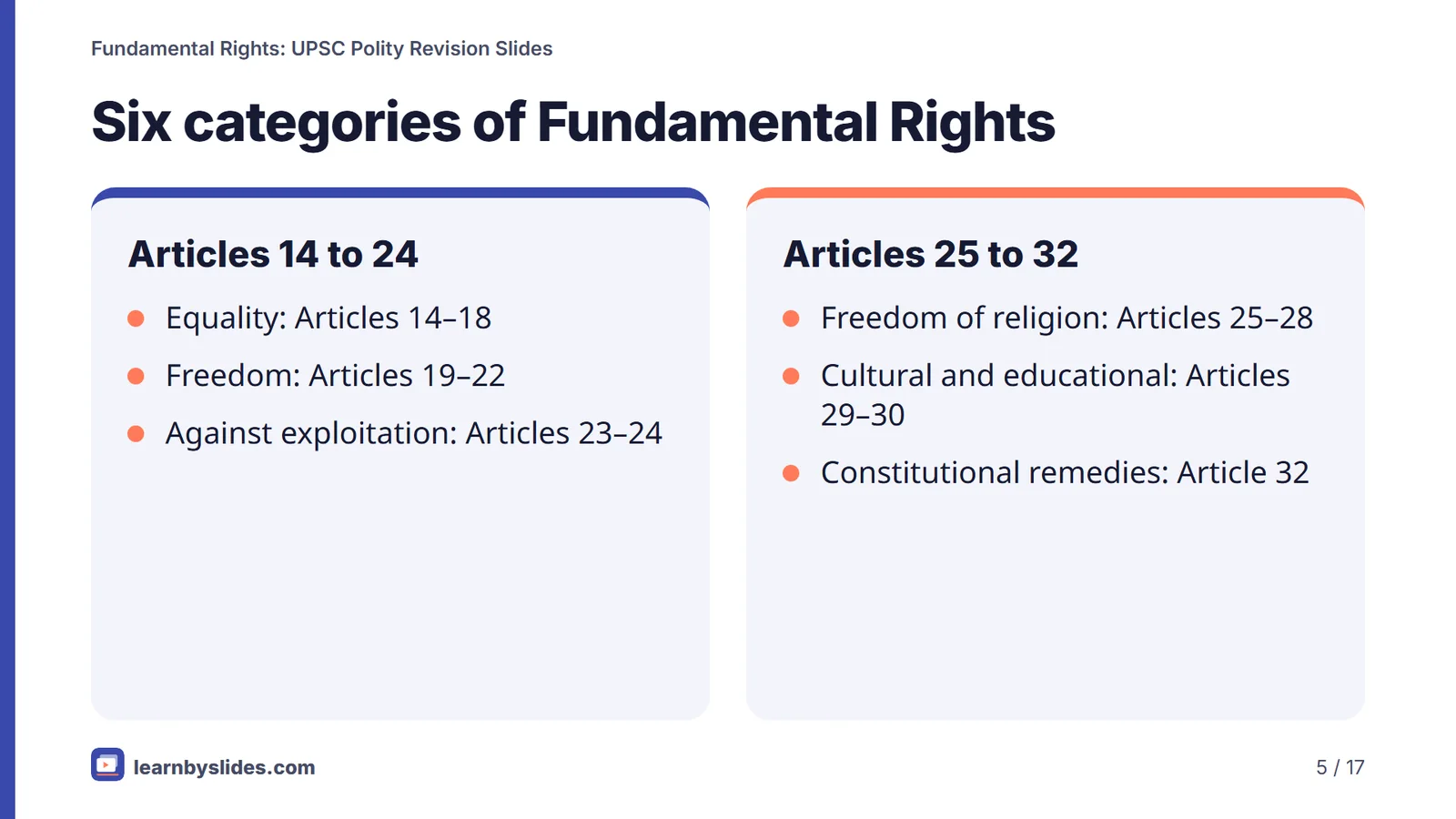
5. Six categories of Fundamental Rights
Articles 14 to 24
- Equality: Articles 14–18
- Freedom: Articles 19–22
- Against exploitation: Articles 23–24
Articles 25 to 32
- Freedom of religion: Articles 25–28
- Cultural and educational: Articles 29–30
- Constitutional remedies: Article 32
Speaker notes
There were seven categories until the 44th Amendment in 1978 omitted Article 31, the right to property. Ask aspirants to write the six headings in order. A common trap: Articles 31A to 31C are savings clauses, not a category of rights.
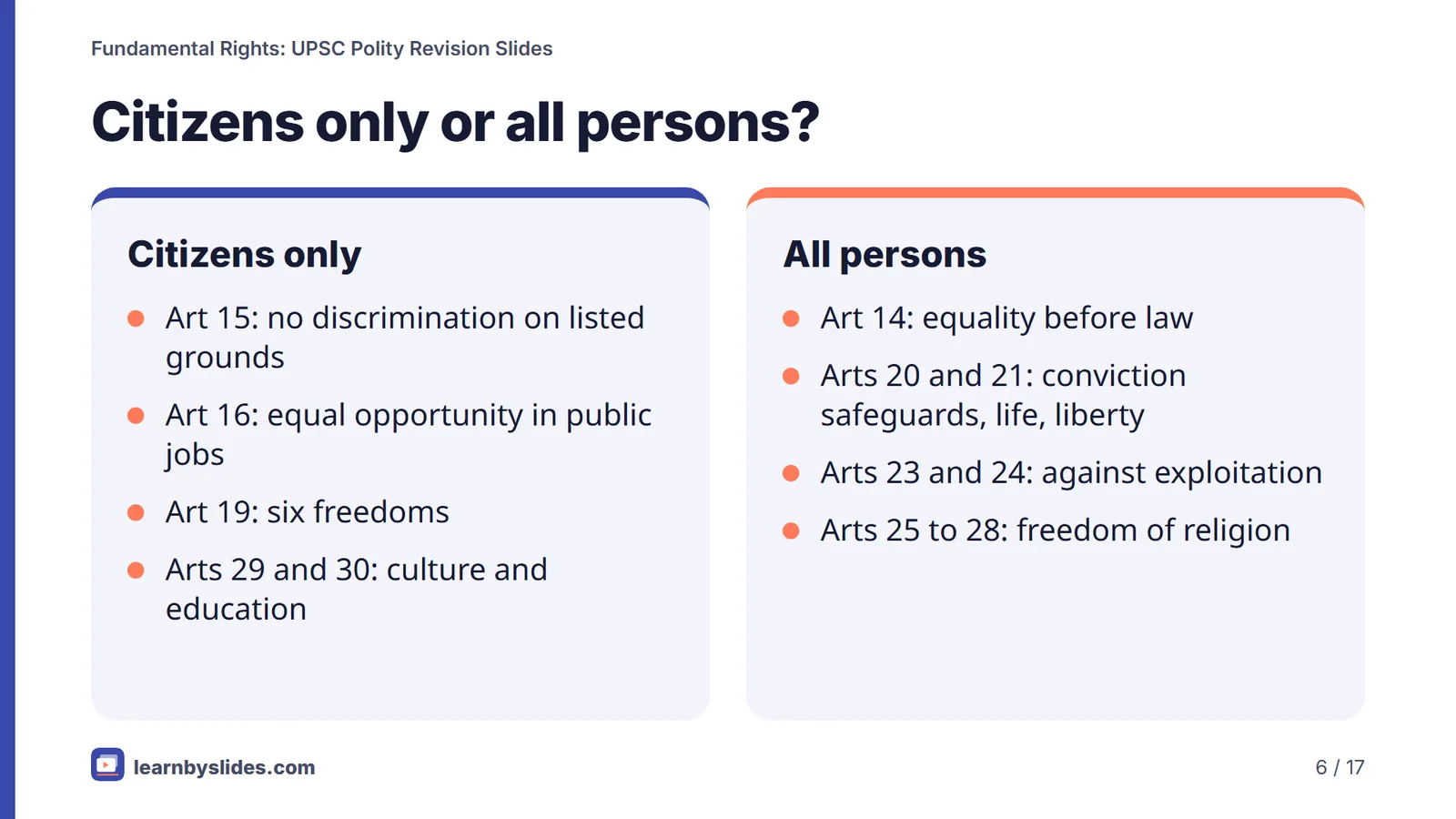
6. Citizens only or all persons?
Citizens only
- Art 15: no discrimination on listed grounds
- Art 16: equal opportunity in public jobs
- Art 19: six freedoms
- Arts 29 and 30: culture and education
All persons
- Art 14: equality before law
- Arts 20 and 21: conviction safeguards, life, liberty
- Arts 23 and 24: against exploitation
- Arts 25 to 28: freedom of religion
Speaker notes
Memorise the citizen-only list as 15, 16, 19, 29 and 30. The text gives the clue: Article 14 says 'any person' and Article 25 says 'all persons', while Article 19 says 'all citizens'. Ask: can a foreign tourist claim Article 21? Yes.
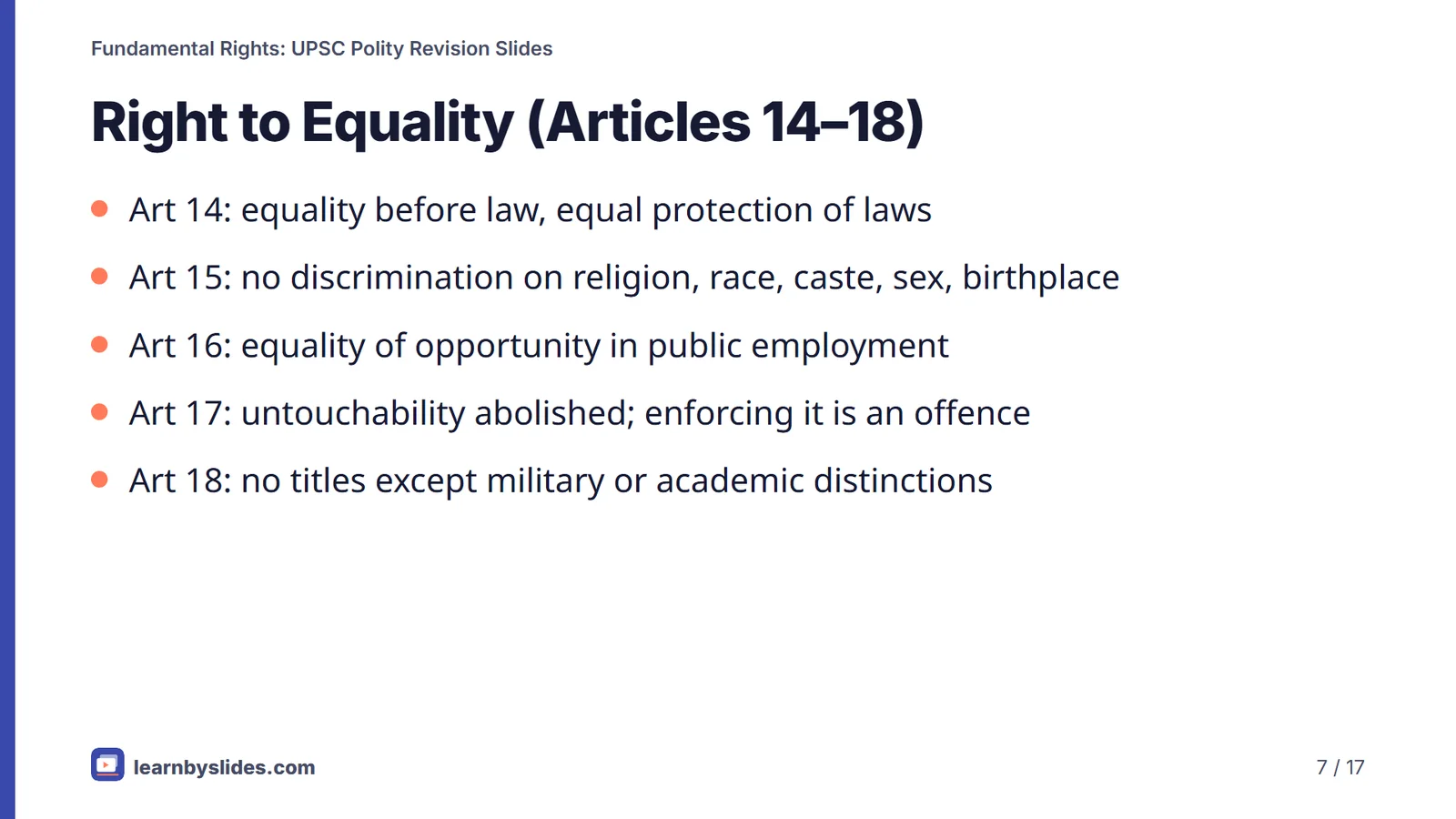
7. Right to Equality (Articles 14–18)
- Art 14: equality before law, equal protection of laws
- Art 15: no discrimination on religion, race, caste, sex, birthplace
- Art 16: equality of opportunity in public employment
- Art 17: untouchability abolished; enforcing it is an offence
- Art 18: no titles except military or academic distinctions
Speaker notes
Article 15(4) and 16(4) allow special provisions and reservations, so equality does not mean identical treatment. Ask: does Article 18 stop the State from awarding a military honour? No, military and academic distinctions are allowed.
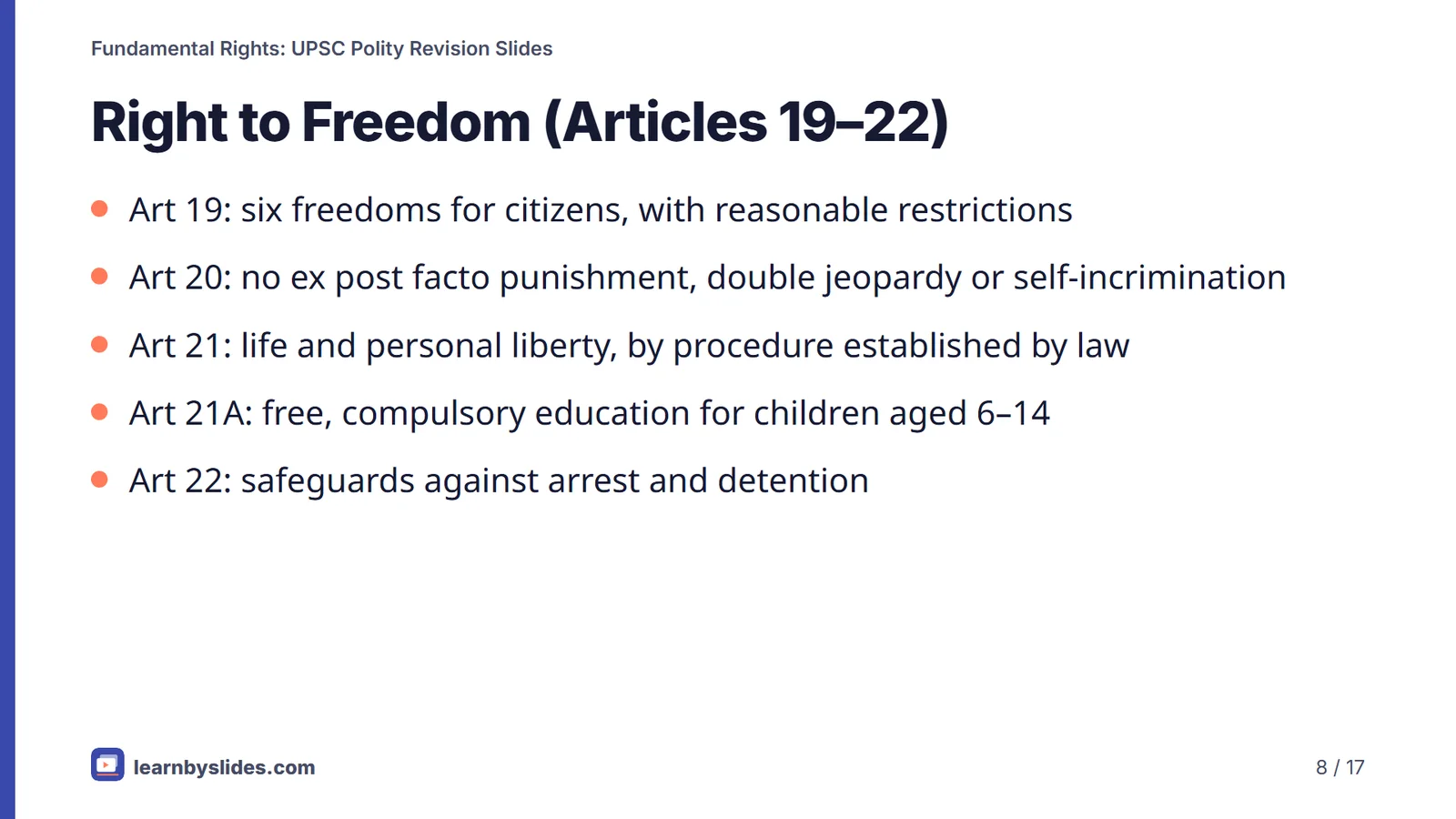
8. Right to Freedom (Articles 19–22)
- Art 19: six freedoms for citizens, with reasonable restrictions
- Art 20: no ex post facto punishment, double jeopardy or self-incrimination
- Art 21: life and personal liberty, by procedure established by law
- Art 21A: free, compulsory education for children aged 6–14
- Art 22: safeguards against arrest and detention
Speaker notes
Name the six freedoms of Article 19: speech and expression, peaceful assembly, associations or unions or co-operatives, movement, residence, and profession or trade. Ask why there are six, not seven: the property clause 19(1)(f) was omitted in 1978.
9. Amendments that reshaped Part III
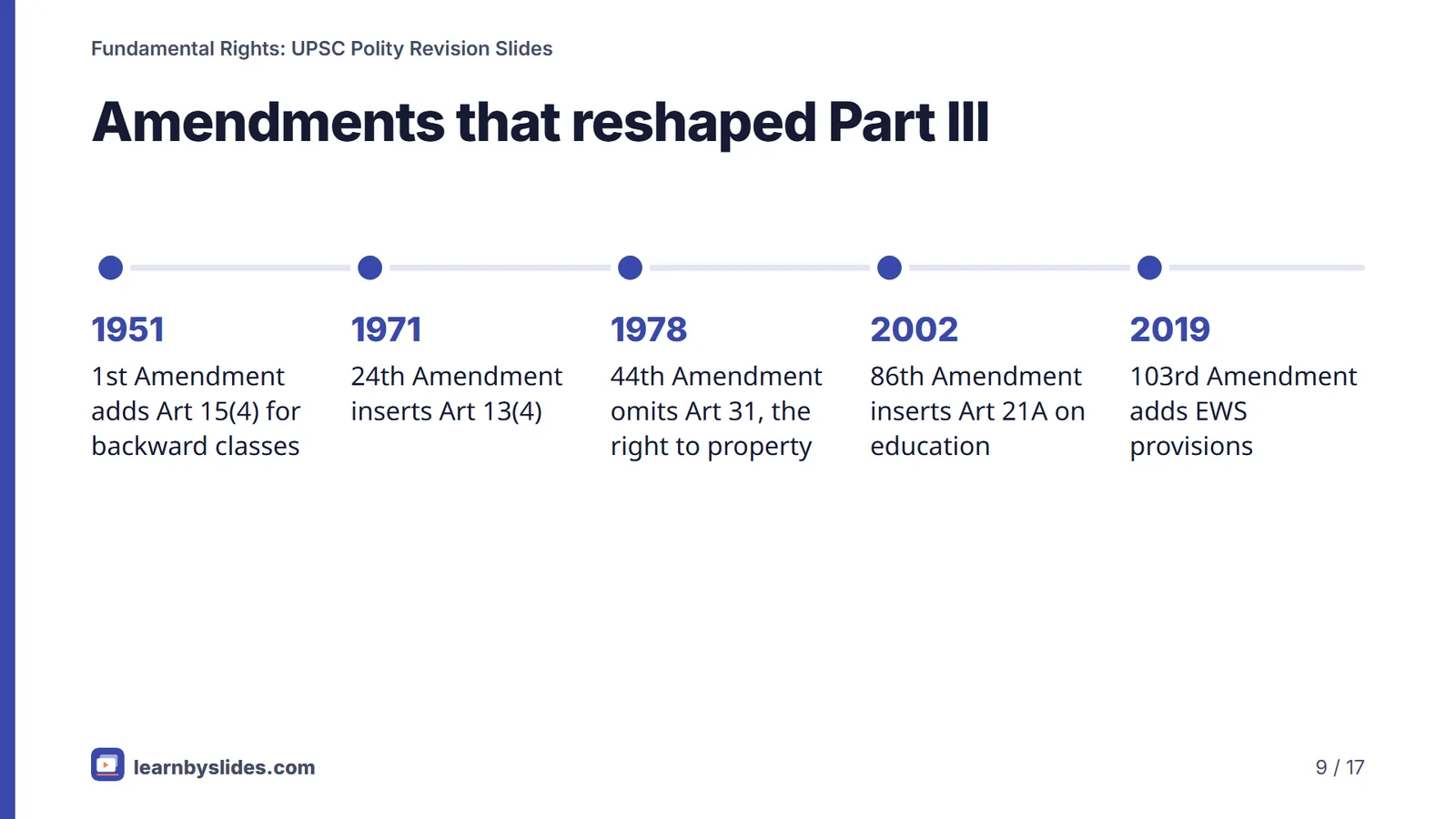
- 1951: 1st Amendment adds Art 15(4) for backward classes
- 1971: 24th Amendment inserts Art 13(4)
- 1978: 44th Amendment omits Art 31, the right to property
- 2002: 86th Amendment inserts Art 21A on education
- 2019: 103rd Amendment adds EWS provisions
Speaker notes
All dates come from the footnotes of the official Constitution text. Ask: which amendment also protected Articles 20 and 21 during emergencies? The same 44th Amendment. Note that Article 21A took effect on 1 April 2010.
10. Exploitation and religion (Articles 23–28)
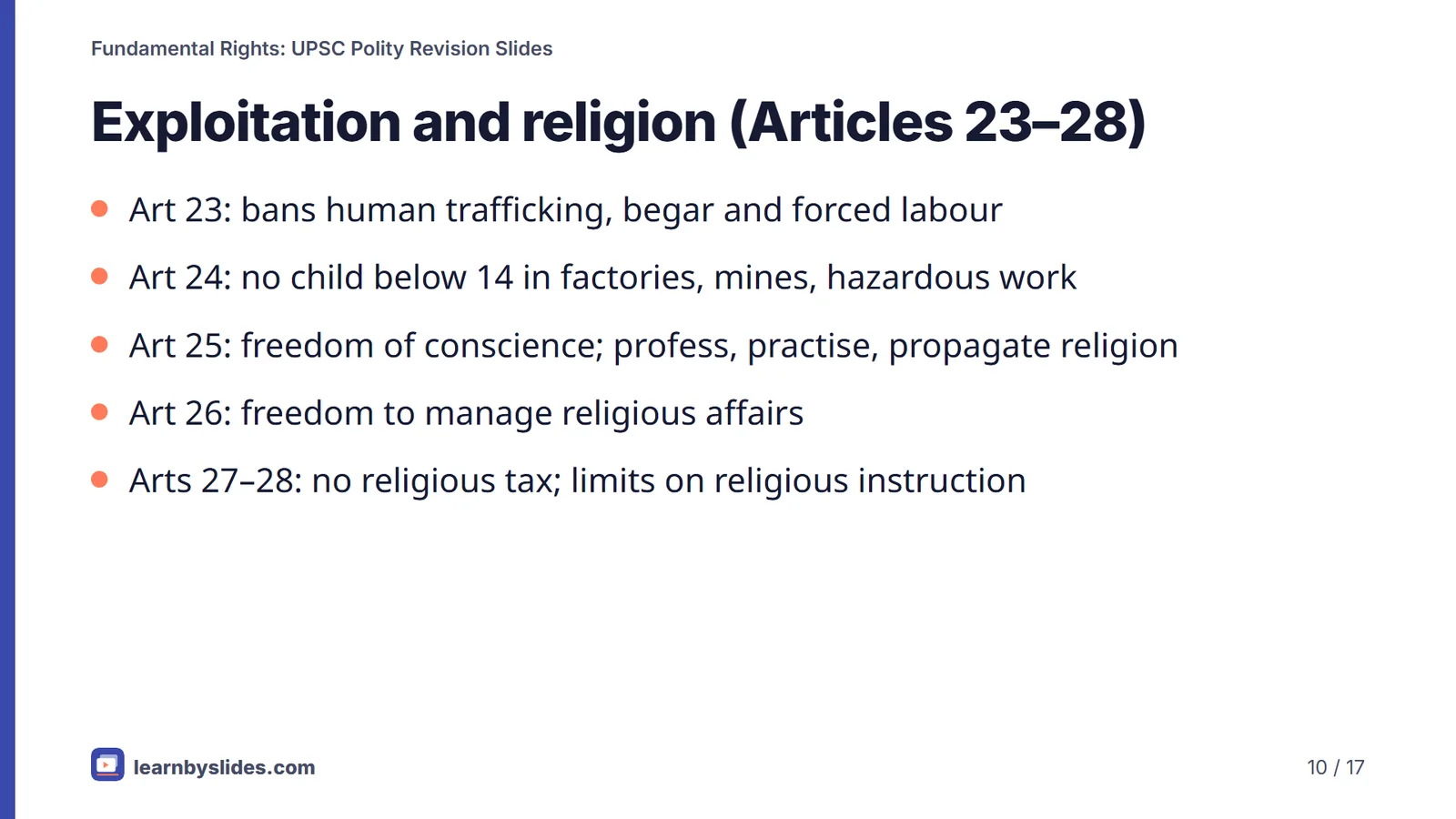
- Art 23: bans human trafficking, begar and forced labour
- Art 24: no child below 14 in factories, mines, hazardous work
- Art 25: freedom of conscience; profess, practise, propagate religion
- Art 26: freedom to manage religious affairs
- Arts 27–28: no religious tax; limits on religious instruction
Speaker notes
Article 23(2) still allows the State to impose compulsory service for public purposes. Ask: is Article 25 absolute? No, it is subject to public order, morality, health and other provisions of Part III.
11. Cultural and educational rights (Articles 29–30)
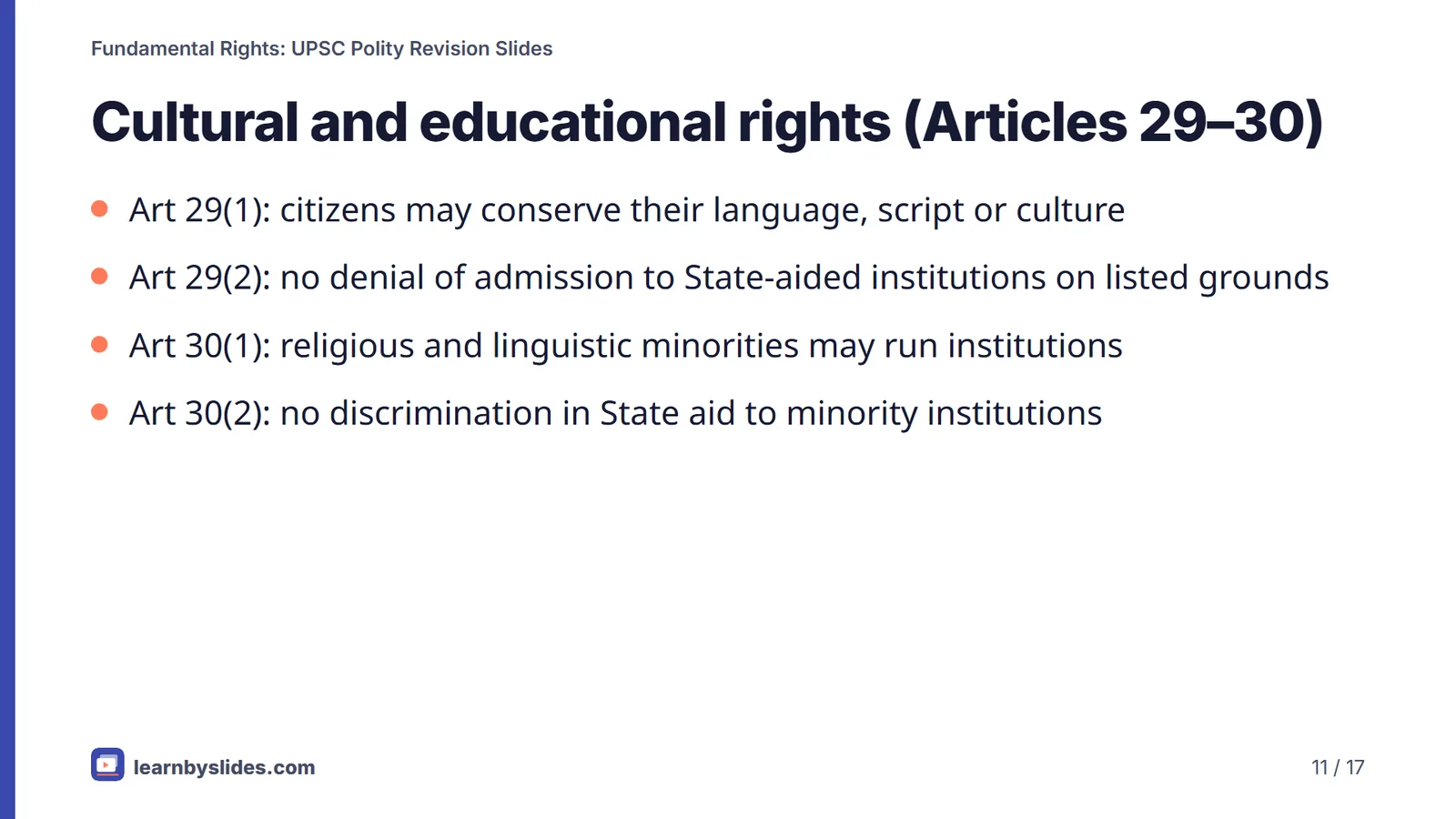
- Art 29(1): citizens may conserve their language, script or culture
- Art 29(2): no denial of admission to State-aided institutions on listed grounds
- Art 30(1): religious and linguistic minorities may run institutions
- Art 30(2): no discrimination in State aid to minority institutions
Speaker notes
Article 29 protects any section of citizens with a distinct language, script or culture, not only minorities. Ask: on what two bases does Article 30 recognise minorities? Religion and language.
12. Article 32: right to constitutional remedies
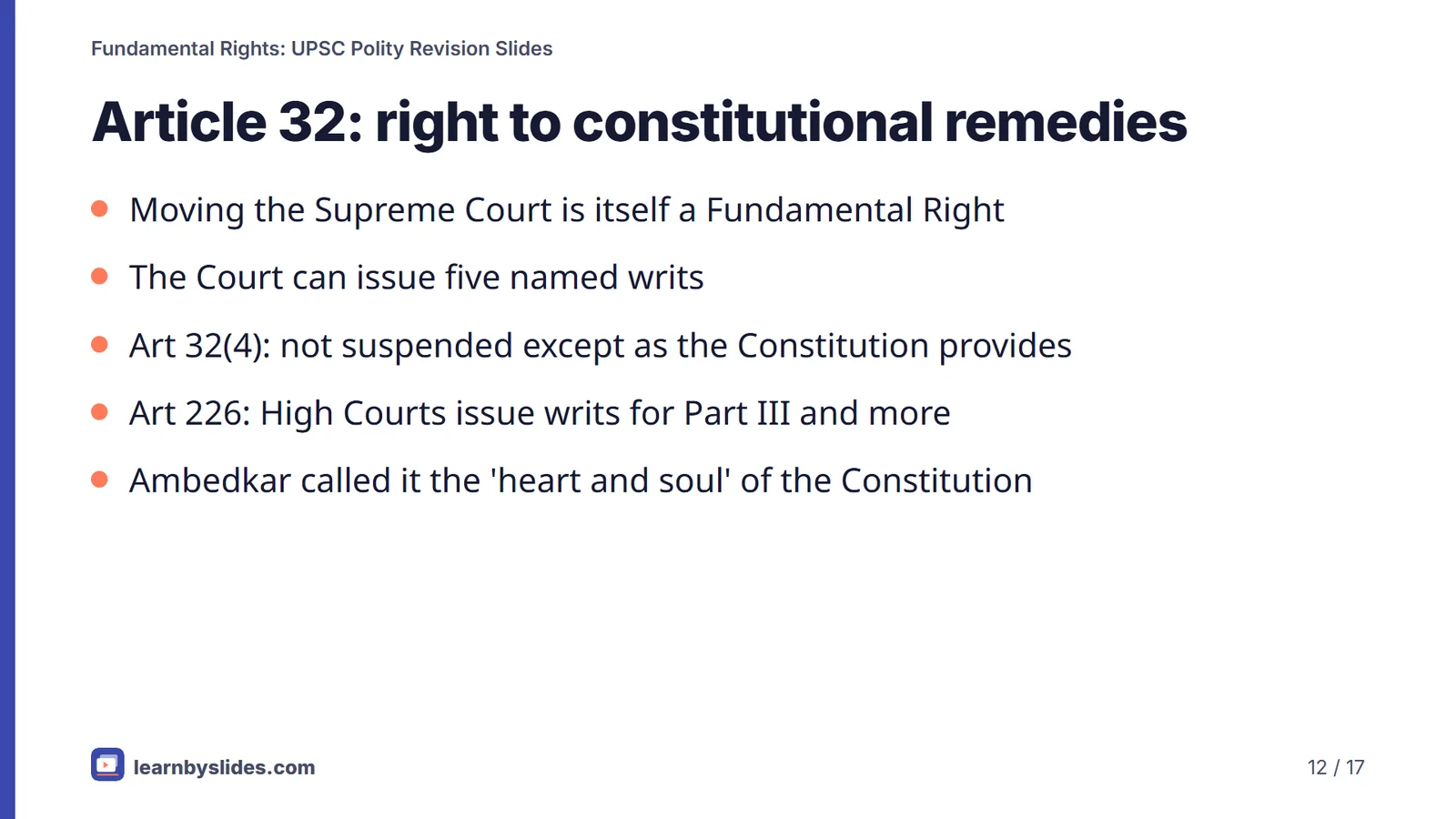
- Moving the Supreme Court is itself a Fundamental Right
- The Court can issue five named writs
- Art 32(4): not suspended except as the Constitution provides
- Art 226: High Courts issue writs for Part III and more
- Ambedkar called it the 'heart and soul' of the Constitution
Speaker notes
Answer the opening question now: Article 32. Ask why a High Court's writ power is wider: Article 226 adds 'for any other purpose'. A common error is to say Article 32 can never be suspended; Article 359 allows suspension during an emergency.
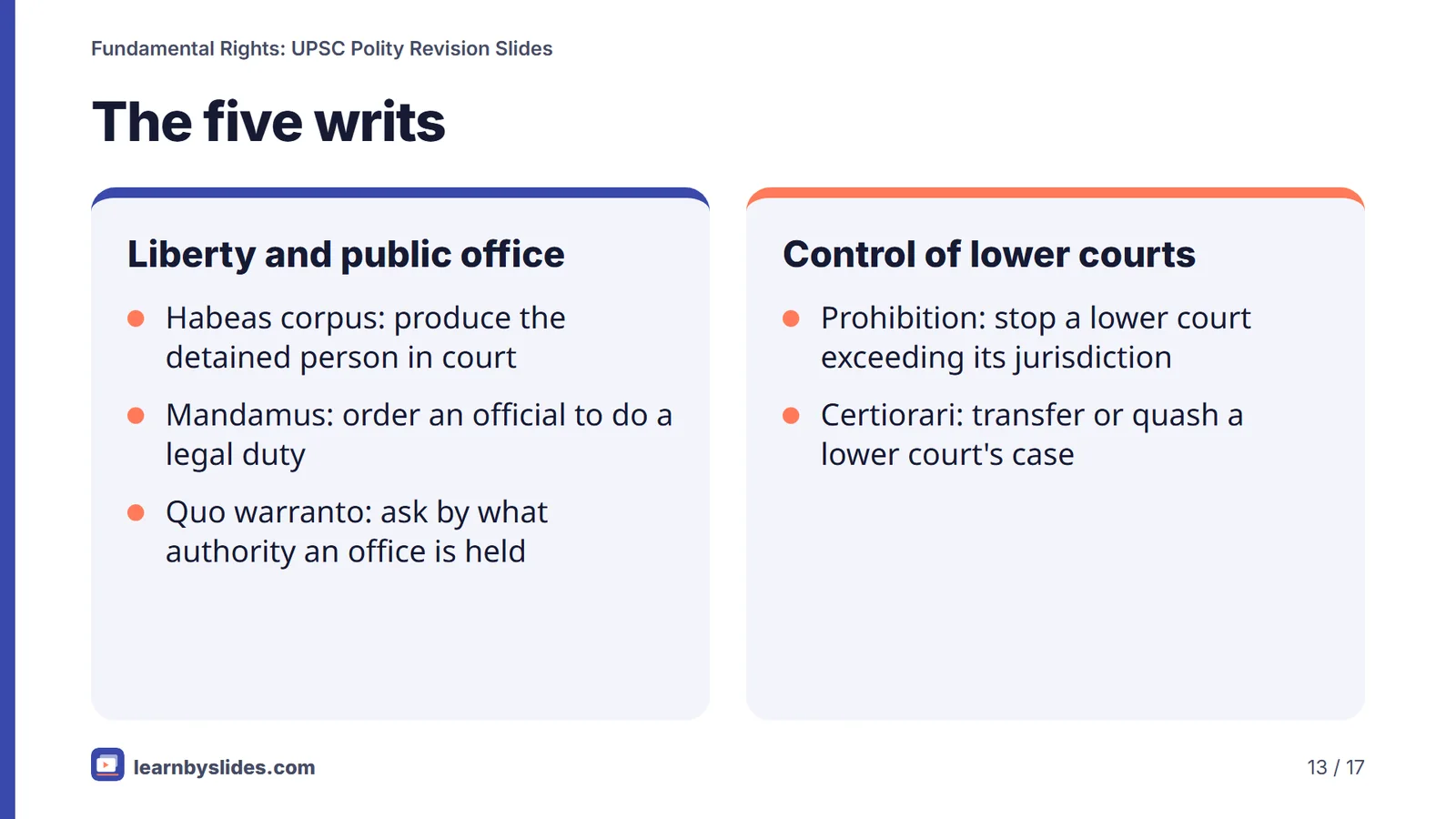
13. The five writs
Liberty and public office
- Habeas corpus: produce the detained person in court
- Mandamus: order an official to do a legal duty
- Quo warranto: ask by what authority an office is held
Control of lower courts
- Prohibition: stop a lower court exceeding its jurisdiction
- Certiorari: transfer or quash a lower court's case
Speaker notes
Prohibition is issued while a case is still pending, to stop it; certiorari moves or quashes it. Ask: which writ would you use against someone holding a public office without legal qualification? Quo warranto.
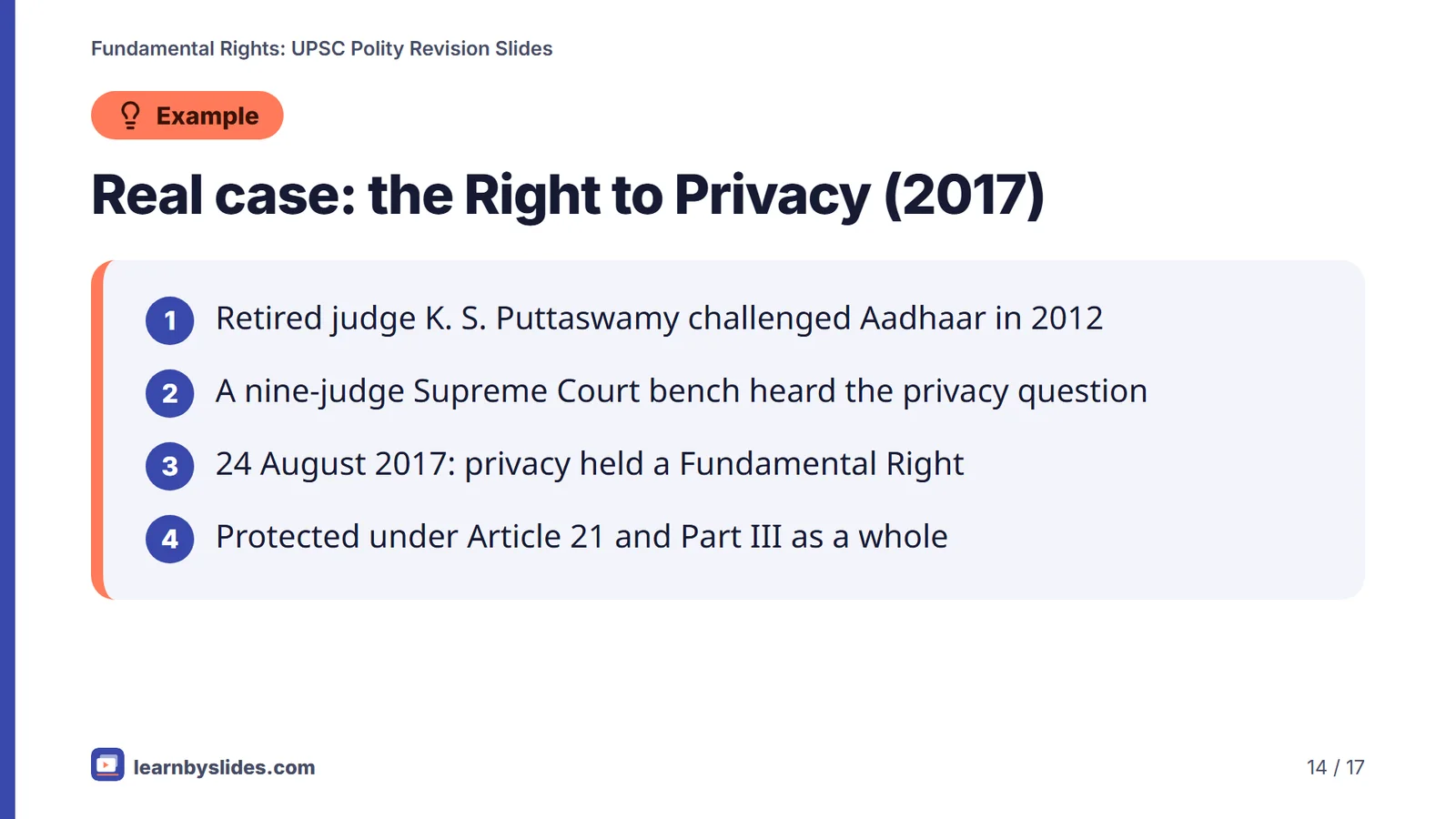
14. Real case: the Right to Privacy (2017)
- Retired judge K. S. Puttaswamy challenged Aadhaar in 2012
- A nine-judge Supreme Court bench heard the privacy question
- 24 August 2017: privacy held a Fundamental Right
- Protected under Article 21 and Part III as a whole
Speaker notes
Use the case to show how Article 21 grows through interpretation. Ask aspirants to list other rights read into Article 21 that they have met in current affairs. Keep the discussion to what the Court decided, not political opinion.
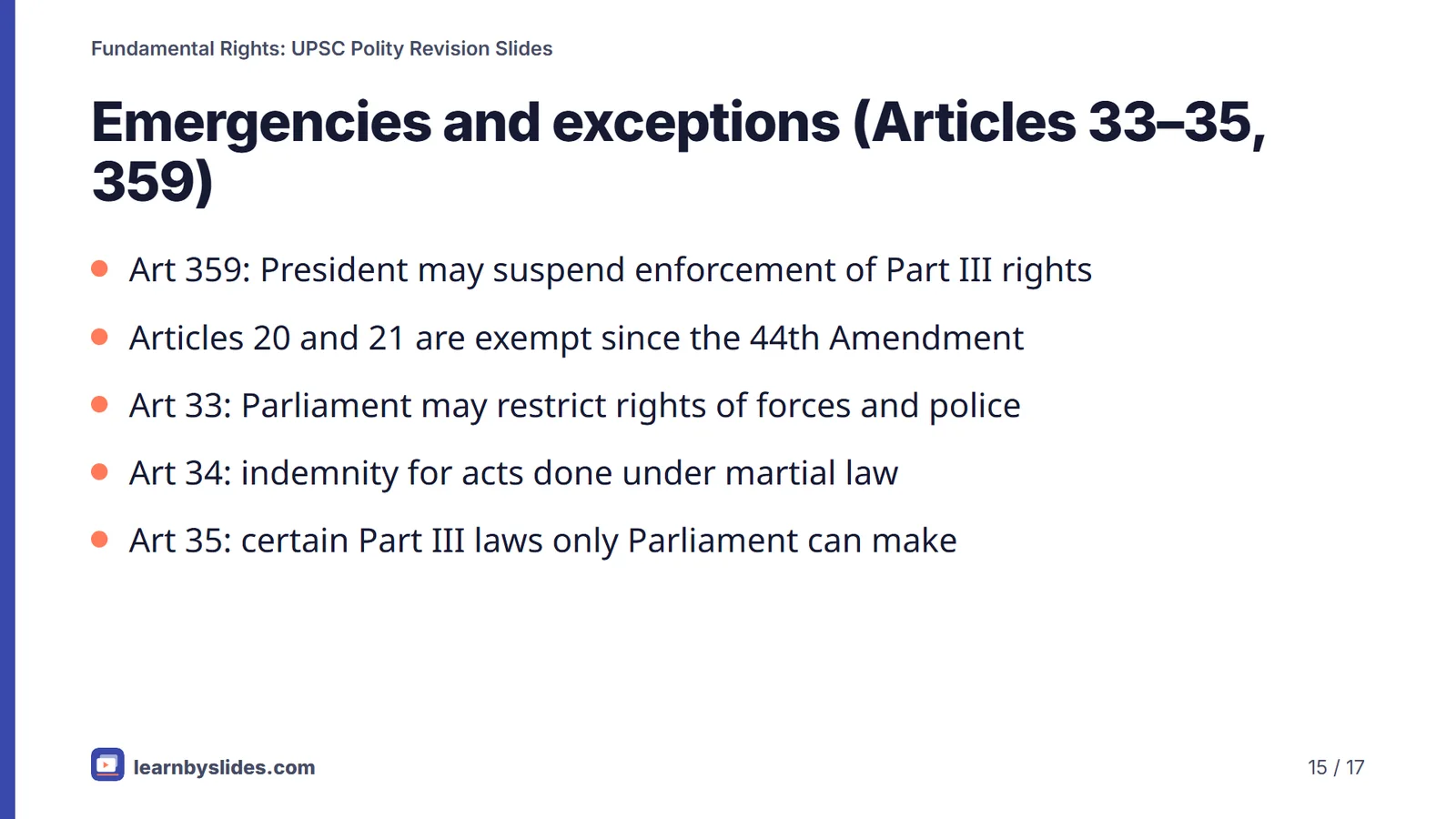
15. Emergencies and exceptions (Articles 33–35, 359)
- Art 359: President may suspend enforcement of Part III rights
- Articles 20 and 21 are exempt since the 44th Amendment
- Art 33: Parliament may restrict rights of forces and police
- Art 34: indemnity for acts done under martial law
- Art 35: certain Part III laws only Parliament can make
Speaker notes
Article 359 now reads 'the rights conferred by Part III (except articles 20 and 21)'. Ask: why protect exactly these two? They cover punishment under law and life and liberty, the rights most at risk in an emergency.
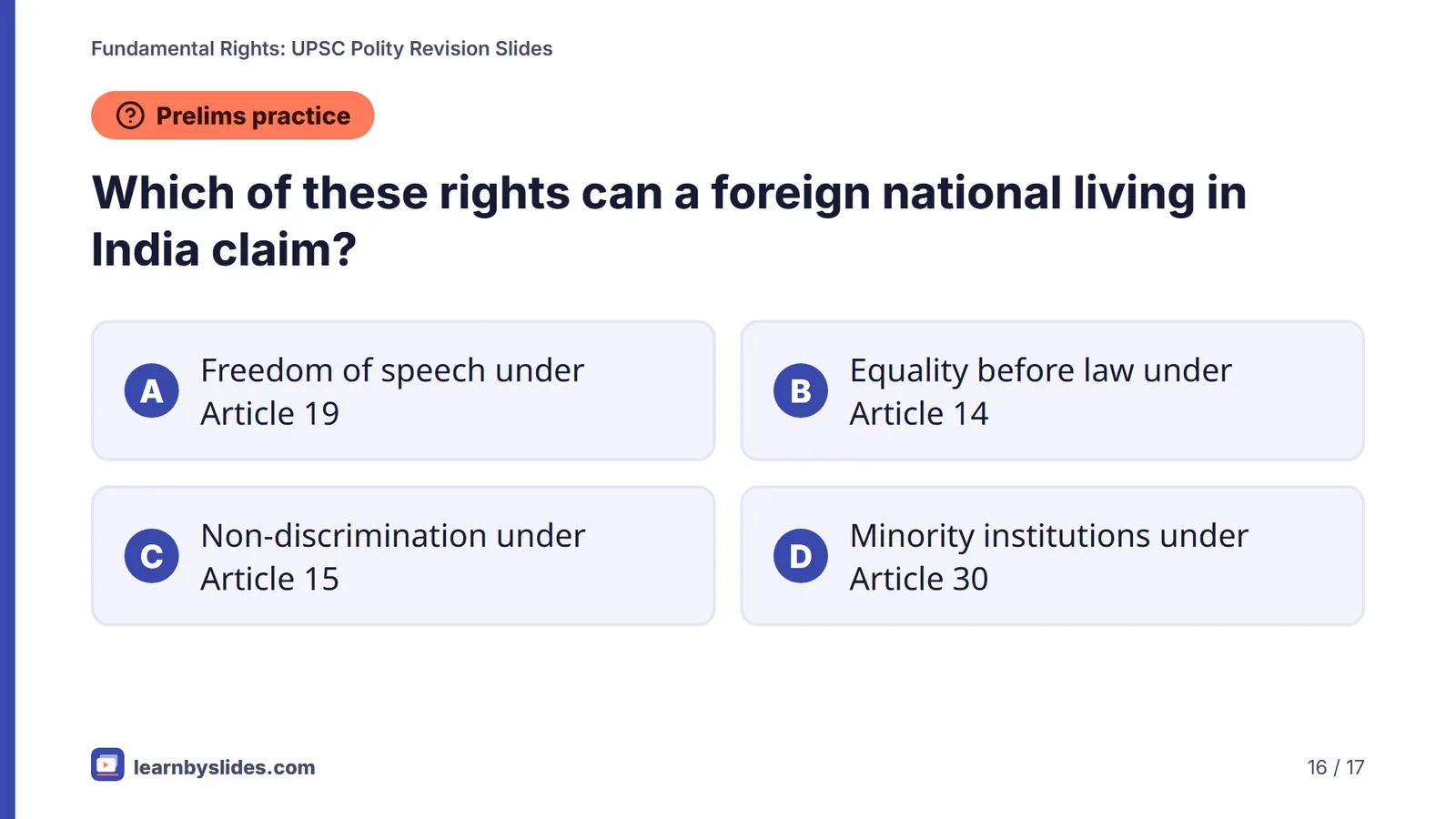
16. Prelims practice
Which of these rights can a foreign national living in India claim?
- Freedom of speech under Article 19
- Equality before law under Article 14
- Non-discrimination under Article 15
- Minority institutions under Article 30
Speaker notes
Answer: B, Article 14, which applies to any person. Articles 15, 19 and 30 are limited to citizens. Ask a student to name one more right that foreigners can claim, such as Article 21.
17. Revision takeaways
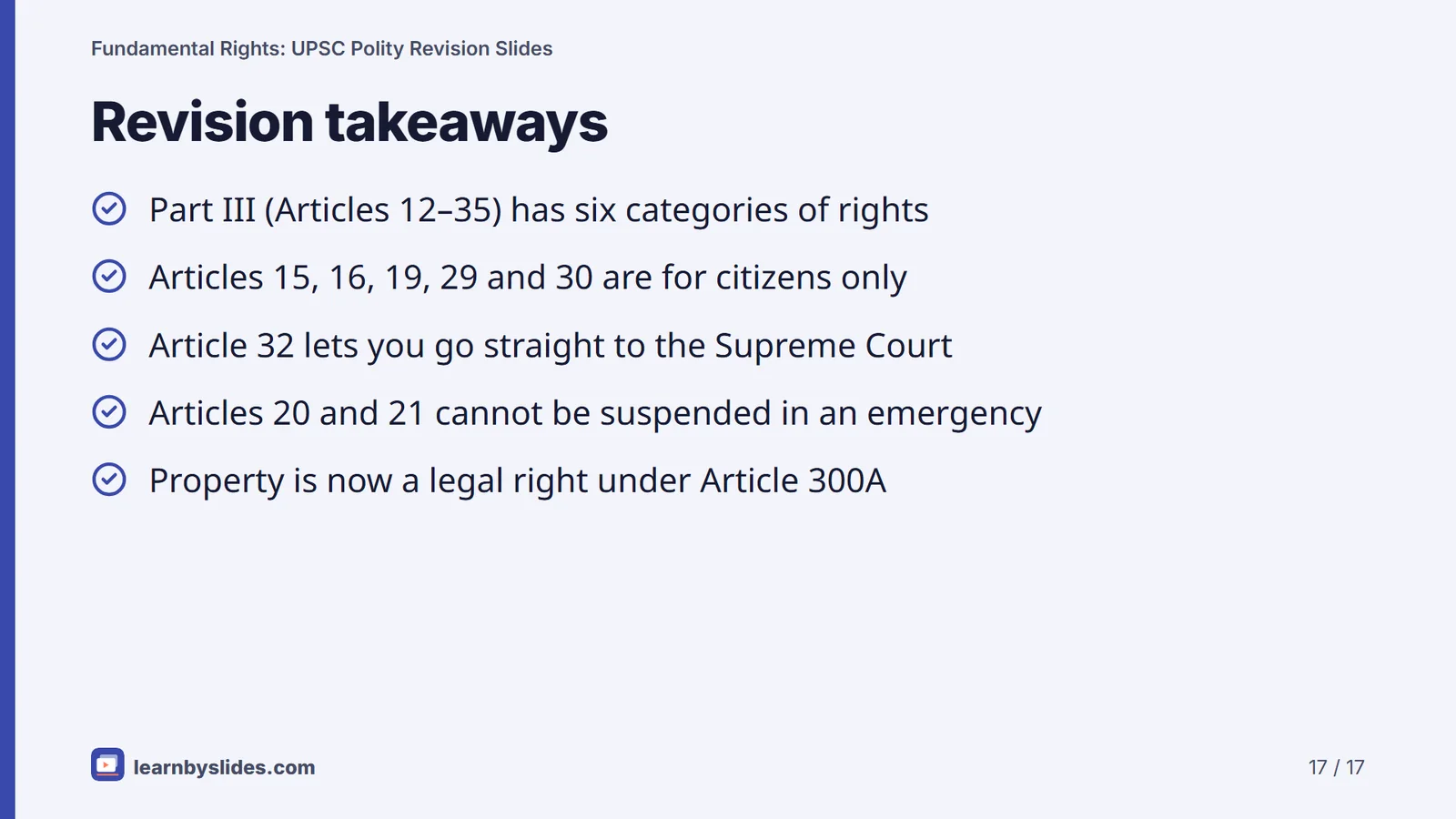
- Part III (Articles 12–35) has six categories of rights
- Articles 15, 16, 19, 29 and 30 are for citizens only
- Article 32 lets you go straight to the Supreme Court
- Articles 20 and 21 cannot be suspended in an emergency
- Property is now a legal right under Article 300A
Speaker notes
Ask aspirants to write the six categories and the citizen-only list from memory. Then take the five-question quiz on the page and set previous years' Prelims questions on Part III as homework.
Key terms
- Justiciable
- Enforceable by a court; Fundamental Rights are justiciable, Directive Principles are not.
- State (Article 12)
- The Union and State governments and legislatures, and all local or other authorities in India.
- Judicial review
- The power of courts to declare laws void if they violate the Constitution, including Part III (Article 13).
- Writ
- A formal court order such as habeas corpus or mandamus, issued under Article 32 or 226.
- Double jeopardy
- Being prosecuted and punished twice for the same offence, barred by Article 20(2).
- Basic structure
- Core features of the Constitution that amendments cannot destroy (Kesavananda Bharati, 1973).
- Article 300A
- Protects property as a legal right: no deprivation of property except by authority of law.
Quick quiz
Teacher notes
Suggested 45-minute revision plan: 5 minutes on Part III and Articles 12 and 13, 10 minutes on the six categories and the citizen-only list, 10 minutes on Articles 14 to 30, 10 minutes on Article 32, the writs and Article 226, 10 minutes on amendments, emergency rules and the quiz. Common misconceptions: all rights are available to foreigners; Article 32 can never be suspended; the right to property no longer exists at all. Keep the Constitution text open and read the exact words of Articles 14, 19 and 359 aloud. Extension: ask aspirants to map each article to one previous-year Prelims question.
Frequently asked questions
Can Parliament amend Fundamental Rights?
Yes, through a constitutional amendment under Article 368, and Article 13(4) says such amendments are not 'law' under Article 13. However, since Kesavananda Bharati (1973) the Supreme Court has held that an amendment cannot damage the basic structure of the Constitution.
What is the difference between Article 32 and Article 226?
Article 32 is itself a Fundamental Right: you can move the Supreme Court directly to enforce Part III rights. Article 226 lets High Courts issue writs to enforce Part III rights and 'for any other purpose', so it also covers ordinary legal rights.
Is the Right to Property still a Fundamental Right?
No. The 44th Amendment (1978) omitted Article 31 and the property clause of Article 19. Property is now protected as a constitutional legal right under Article 300A: no person can be deprived of property save by authority of law.
Which Fundamental Rights apply against private individuals too?
Most rights restrain the State. Some provisions also bind private persons, for example Article 17 (untouchability), Article 23 (trafficking and forced labour) and Article 24 (child labour in factories, mines and hazardous work).
Sources & methodology
Every fact is checked against the sources below. We write original explanations and draw original graphics; no figures are copied from textbooks. Spotted an error? See our corrections policy.
- The Constitution of India (as on 1 May 2024), Part III and Article 359 (Legislative Department, Ministry of Law and Justice, Government of India, accessed 30 Sept 2026)
- Indian Constitution at Work, Class XI, Chapter 2: Rights in the Indian Constitution (NCERT, accessed 30 Sept 2026)
- Fundamental Right to Privacy: Puttaswamy v Union of India, case background (Supreme Court Observer, accessed 30 Sept 2026)
Reviewed by Claude (pending owner check) · Updated
Related lessons
 Class 10 · Social Science
Power Sharing: Class 10 Political Science Slides
A ready-to-teach CBSE Class 10 Democratic Politics deck on Power Sharing: the Belgium and Sri Lanka case studies, prudential and moral reasons for sharing power, and the four forms of power sharing with examples from India.
 UPSC · Geography
Monsoon in India: UPSC Geography Revision Slides
UPSC revision slides on the Indian monsoon: ITCZ and jet streams, IMD's normal onset and withdrawal dates, the two branches, breaks, October heat, El Niño and the Indian Ocean Dipole, with a quiz.
 Topic
TopicHow to Study Effectively: Spaced Repetition and Active Recall
Research-based slides on studying smarter: why rereading and highlighting fade, how self-testing and spaced reviews work, the 10–20% spacing rule, and a 30-day exam plan, with notes and a quiz.
 Class 10 · Science
Chemical Reactions and Equations: Class 10 Science Slides
A ready-to-teach CBSE Class 10 Science deck on Chemical Reactions and Equations: writing and balancing equations, the main reaction types, exothermic and endothermic changes, oxidation, reduction, corrosion and rancidity.
 Class 8 · Science
Crop Production and Management: Class 8 Science Slides
A ready-to-teach Class 8 Science deck on Crop Production and Management: kharif and rabi crops, soil preparation, sowing, manure and fertilisers, irrigation, weed control, harvesting and safe storage of grain.
 Class 7 · Maths
Integers: Class 7 Maths Lesson Slides
Ready-to-teach Class 7 slides on integers: the number line, adding and subtracting, sign rules for multiplying and dividing, and key properties, with lifts, temperatures, money, speaker notes and a quiz.
Get new LearnBySlides resources by email
One short email when new free resources go live. No spam, unsubscribe anytime.