Ratio and Proportion: Lesson Slides & Worksheet
Ready-to-teach maths slides for ages 11–14 on ratio and proportion: writing and simplifying ratios, ratio vs fraction, sharing in a ratio, unit rates and best buys, direct proportion and scale drawings and maps, with speaker notes and a quiz.
Ages 11–14 · Grades 6–8 (US) · Years 7–9 (UK) · Classes 6–8 (India)
- Common Core Math 6.RP.A.1
- Common Core Math 6.RP.A.2
- Common Core Math 6.RP.A.3
- Common Core Math 7.RP.A.2
- Common Core Math 7.G.A.1
- England KS3 Years 7–9
- AQA GCSE R4
- AQA GCSE R5
- AQA GCSE R10
- AQA GCSE R11
- AQA GCSE R2
- Cambridge IGCSE 0580 C1.11 / E1.11
- Cambridge IGCSE 0580 C1.12 / E1.12
- Cambridge IGCSE 0580 C4.3 / E4.3
- Australian Curriculum v9 AC9M7N08
- Australian Curriculum v9 AC9M7M06
- Australian Curriculum v9 AC9M8M05
- Australian Curriculum v9 AC9M8M07
- CBSE Class 8
Cambridge and IGCSE are trademarks of Cambridge University Press & Assessment. Common Core State Standards © Copyright 2010 National Governors Association Center for Best Practices and Council of Chief State School Officers. All rights reserved. Names and codes are used only to describe curriculum fit; LearnBySlides is not endorsed by these organisations.
16 slides · 45 min lesson · 5-question quiz · speaker notes
Learning objectives
- Write a ratio in its simplest form, converting units where needed.
- Explain the difference between a ratio and a fraction.
- Share an amount in a given ratio, including three-part ratios.
- Use unit rates to compare prices and solve direct proportion problems.
- Use a scale to find real lengths from drawings and maps.
What this lesson covers
This deck teaches ratio and proportion to students aged 11–14 in one 45-minute lesson. It starts with ratio notation and simplifying, compares ratios with fractions, and then moves through the problem types students meet most often: sharing an amount in a given ratio, unit rates and best buys, direct proportion, and scale on drawings and maps.
Every idea comes with a worked example in steps that students can copy. Examples use prices in USD, GBP and EUR, metric masses, lengths and volumes, and everyday contexts such as paint, recipes and maps. Speaker notes on every slide give the teacher a question to ask and a common mistake to watch for.
Writing and simplifying ratios
A ratio compares the sizes of two or more quantities. If a bag holds 12 red beads and 8 blue beads, the ratio of red to blue is 12 : 8. Order matters: blue to red is 8 : 12.
To simplify a ratio, divide every part by the highest common factor. 12 : 8 divides by 4 to give 3 : 2, so for every 3 red beads there are 2 blue ones. Put the parts in the same units first: 40 cm : 2 m becomes 40 : 200, which simplifies to 1 : 5. Multiply out decimals, so 1.5 : 2 becomes 3 : 4.
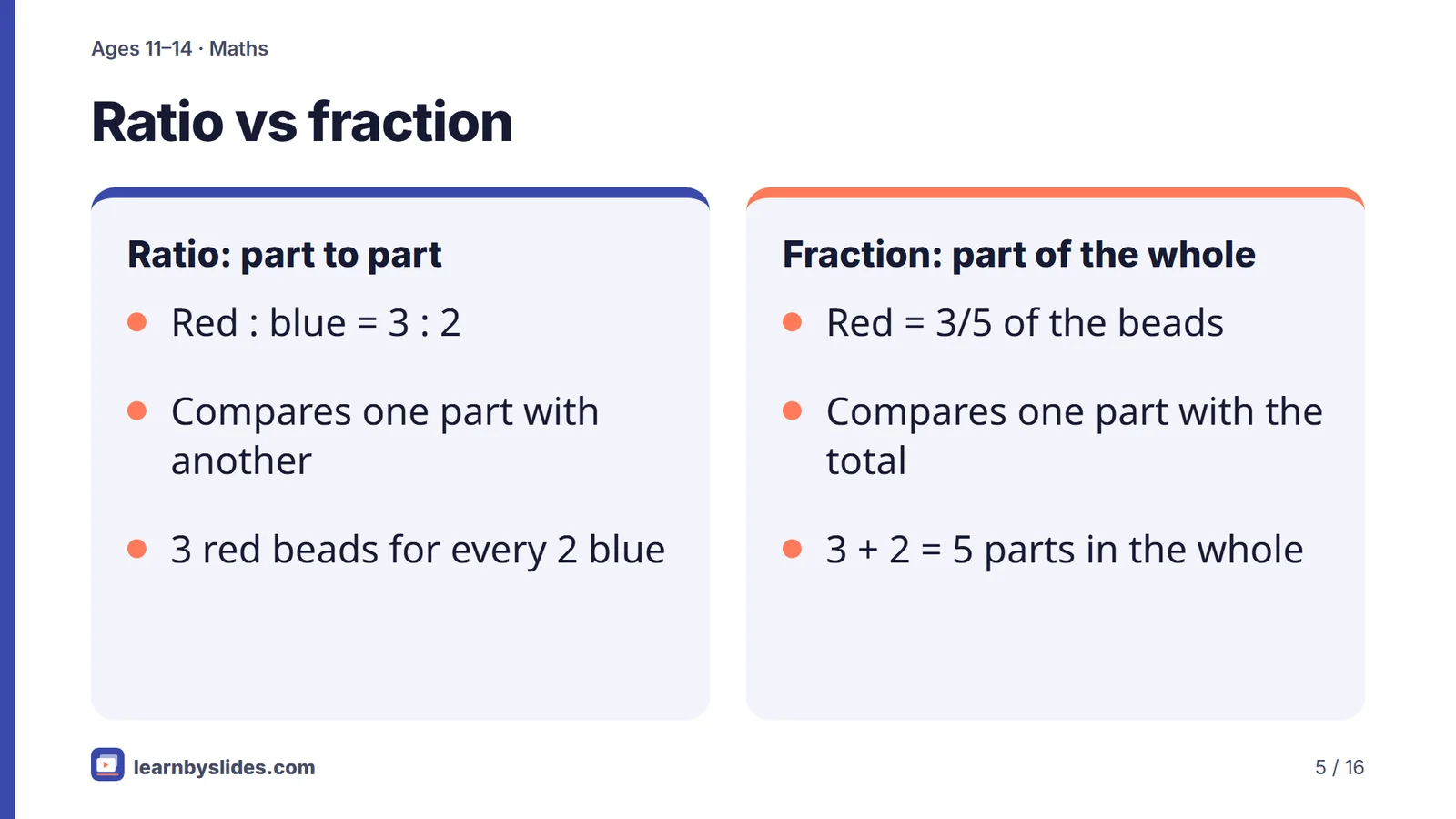
A ratio is not the same as a fraction. In the ratio 3 : 2 there are 5 parts altogether, so red beads make up 3/5 of the bag and blue beads 2/5.
Sharing in a ratio
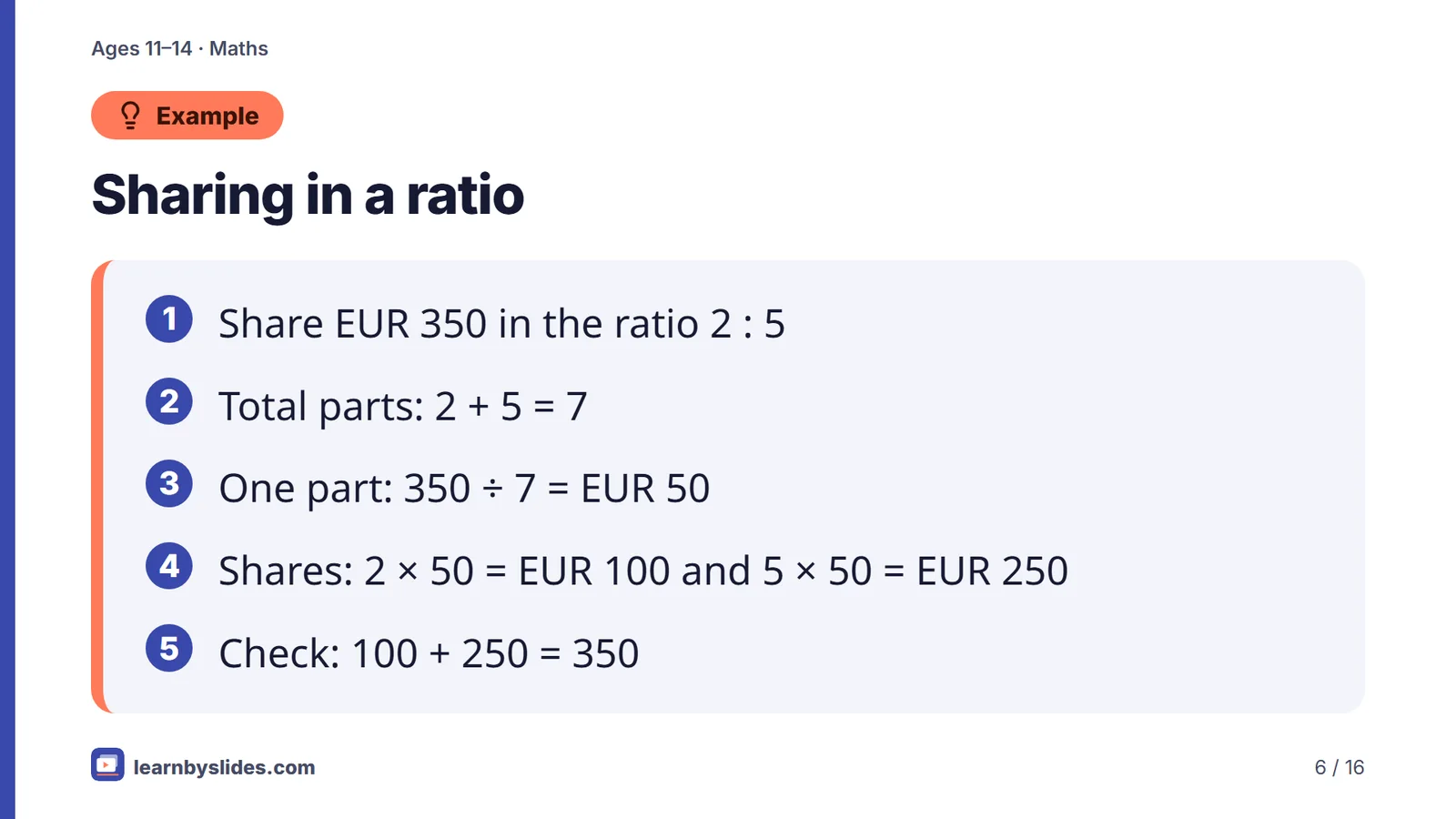
To share an amount in a ratio, add the parts, find the value of one part, then multiply. To share EUR 350 in the ratio 2 : 5: there are 2 + 5 = 7 parts, one part is 350 ÷ 7 = EUR 50, so the shares are EUR 100 and EUR 250. Check that they add back to EUR 350.
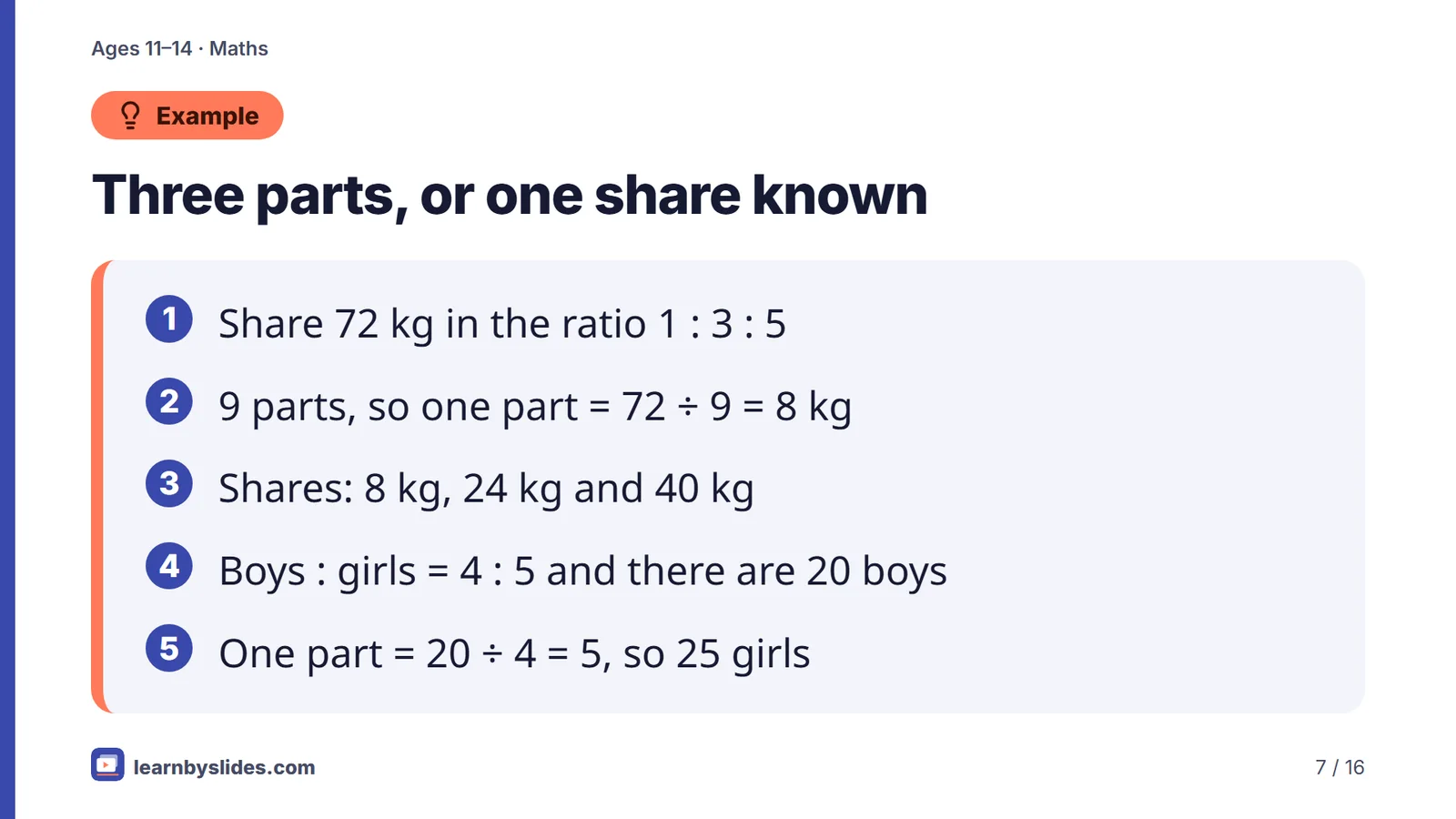
The same method works for three parts. Sharing 72 kg of compost in the ratio 1 : 3 : 5 gives 9 parts of 8 kg each, so 8 kg, 24 kg and 40 kg. Sometimes you know one share instead of the total: if boys and girls in a club are in the ratio 4 : 5 and there are 20 boys, one part is 5, so there are 25 girls.
Unit rates and best buys
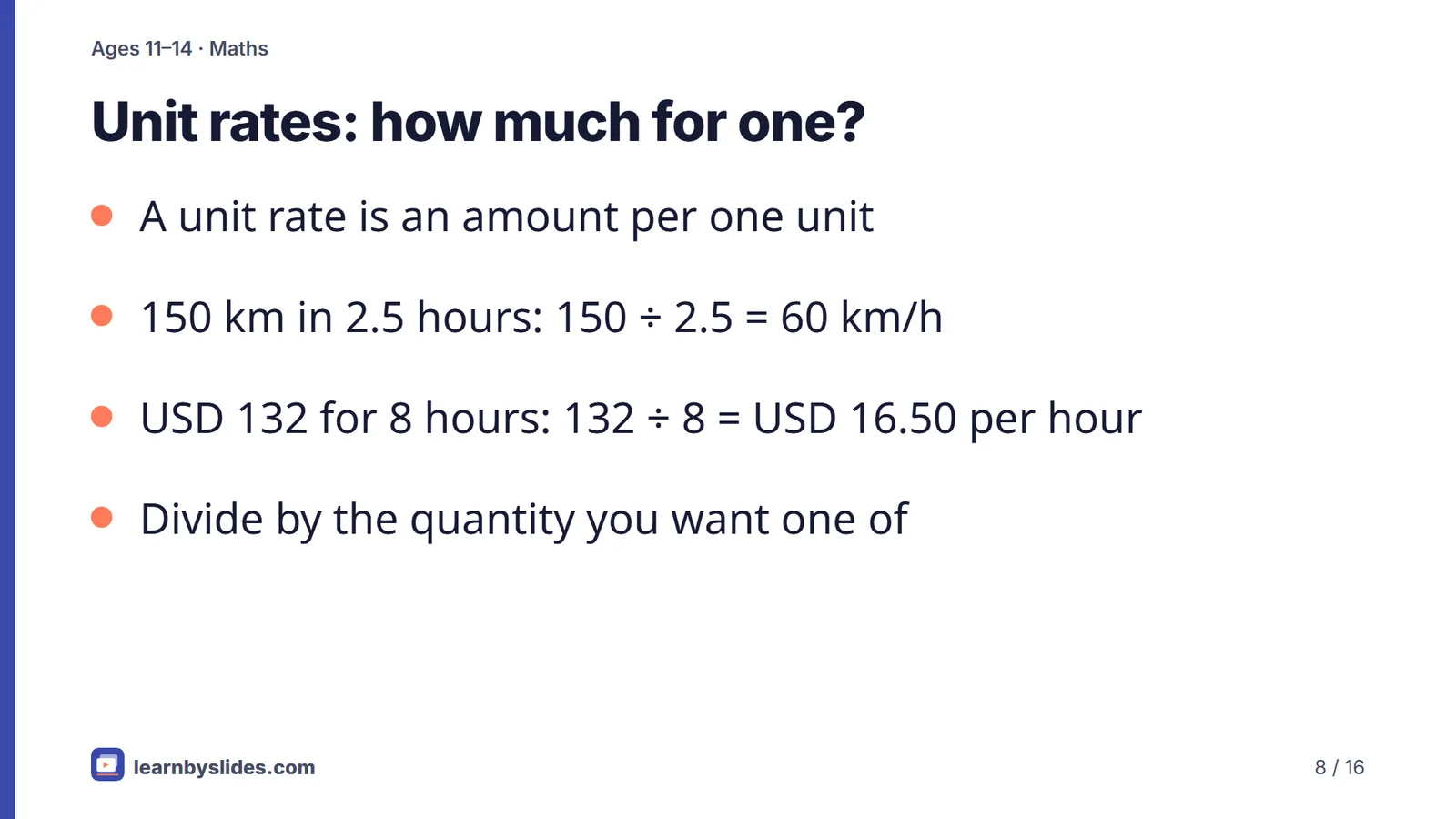
A unit rate tells you how much for one unit: kilometres per hour, cost per kilogram, pay per hour. A car that travels 150 km in 2.5 hours averages 150 ÷ 2.5 = 60 km/h. Someone paid USD 132 for 8 hours earns USD 16.50 per hour.
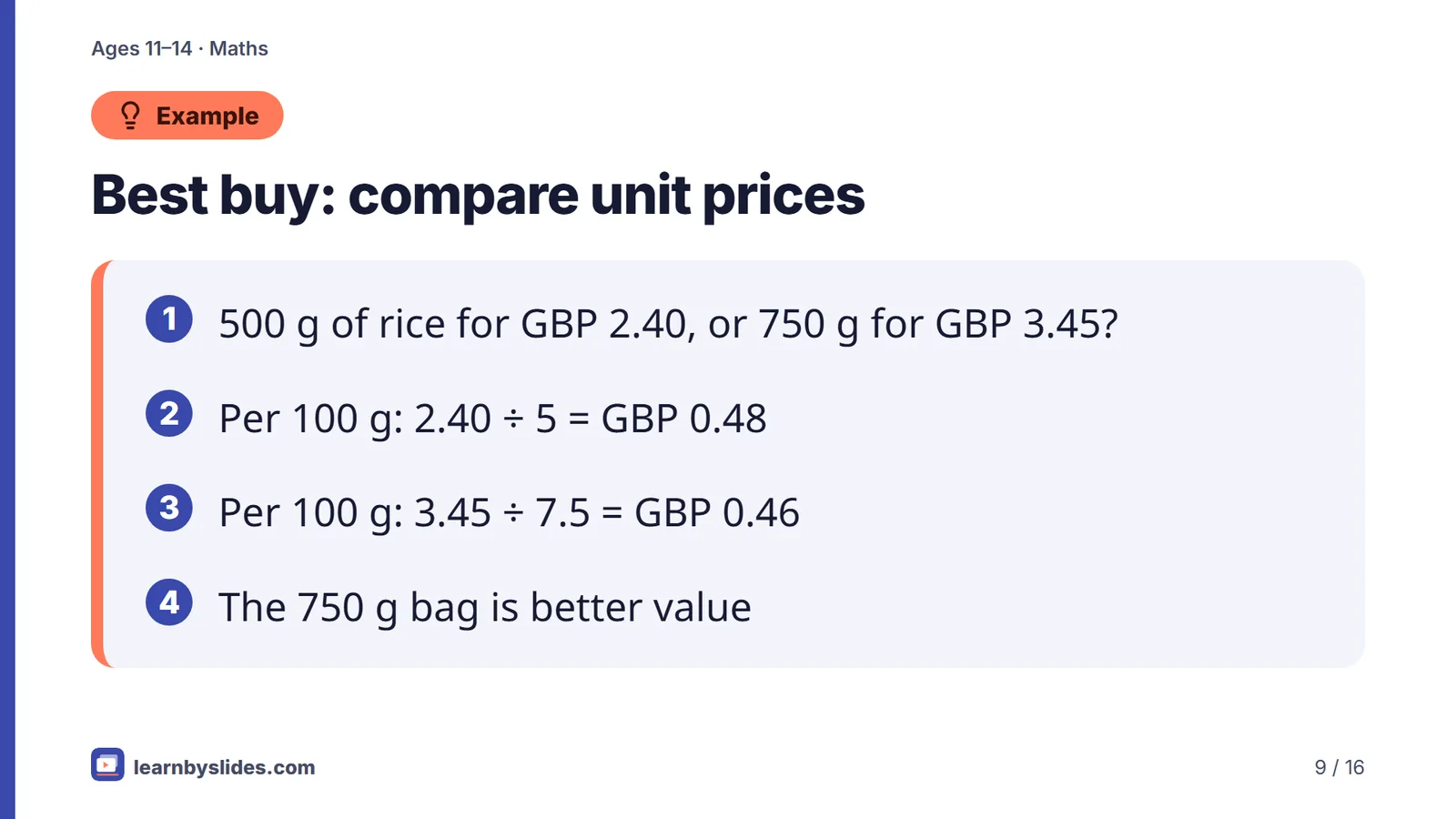
Unit rates make best buys easy to spot. A 500 g bag of rice costs GBP 2.40 and a 750 g bag costs GBP 3.45. Per 100 g, the small bag costs GBP 0.48 and the large bag GBP 0.46, so the large bag is better value.
Direct proportion and scale
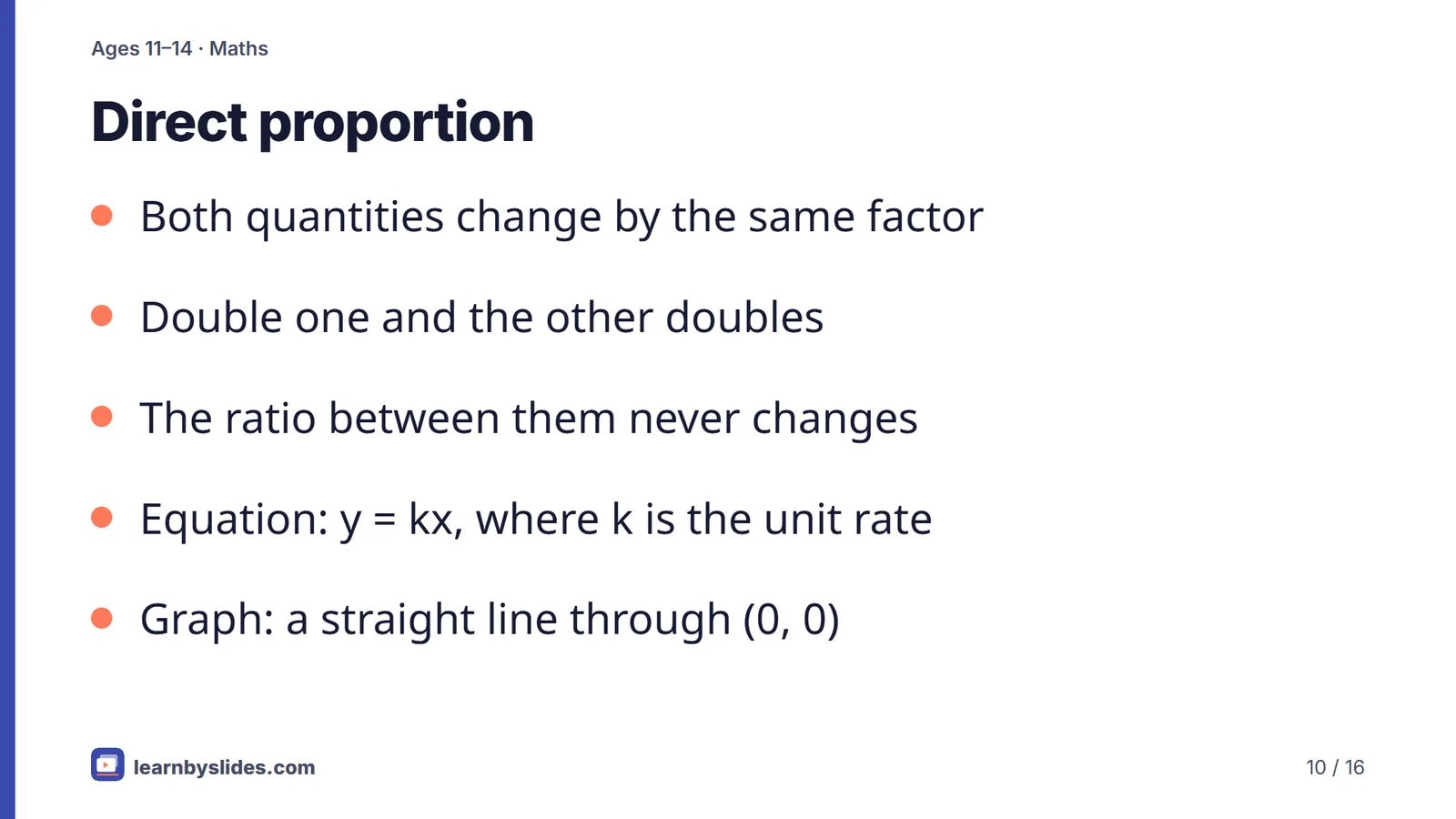
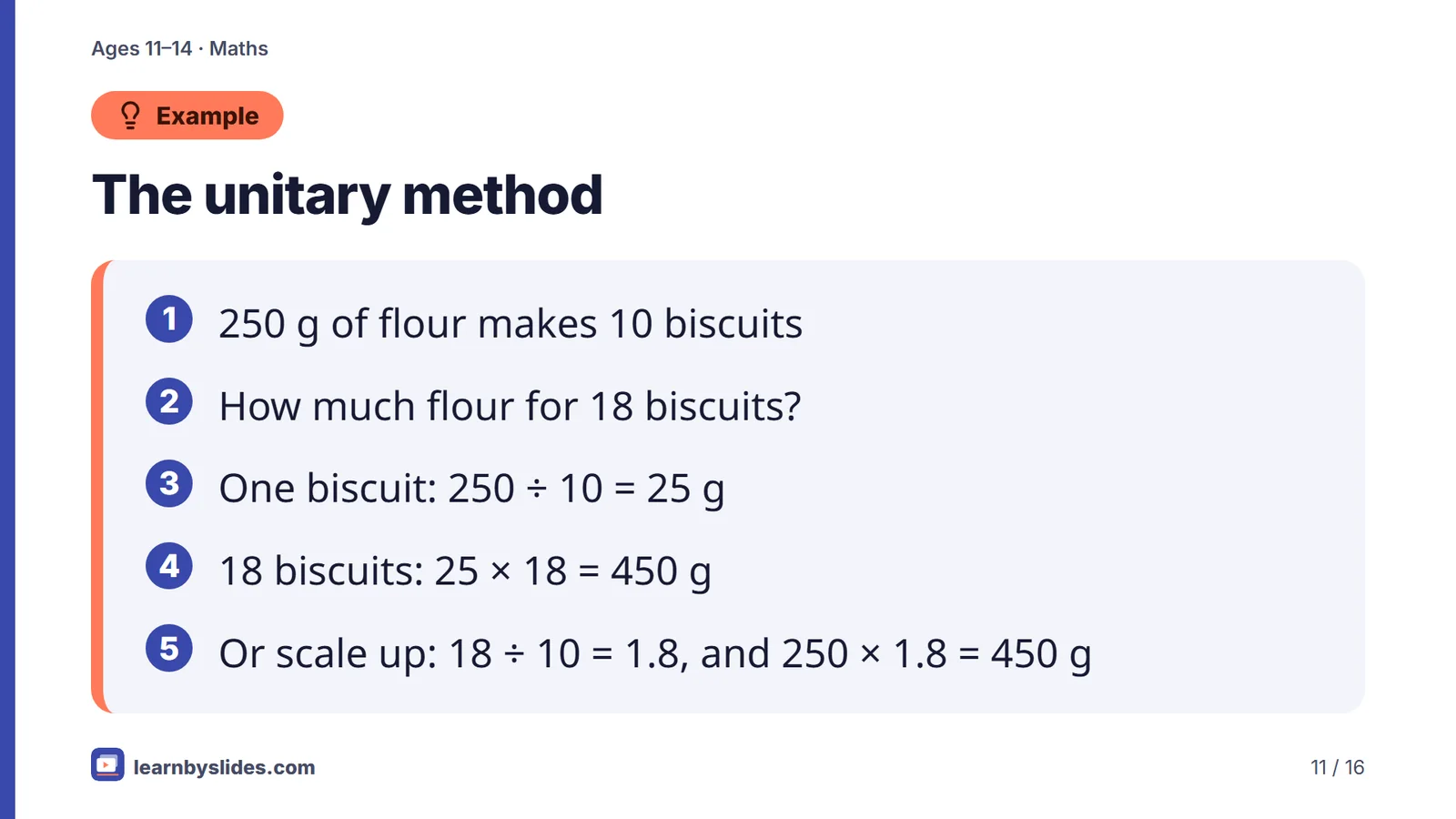
Two quantities are in direct proportion when they change by the same factor: double one and the other doubles. Their ratio stays the same, they fit an equation y = kx, and their graph is a straight line through the origin. If 250 g of flour makes 10 biscuits, 18 biscuits need 25 × 18 = 450 g. A taxi fare with a fixed starting charge is not proportional to distance, because doubling the distance does not double the fare.
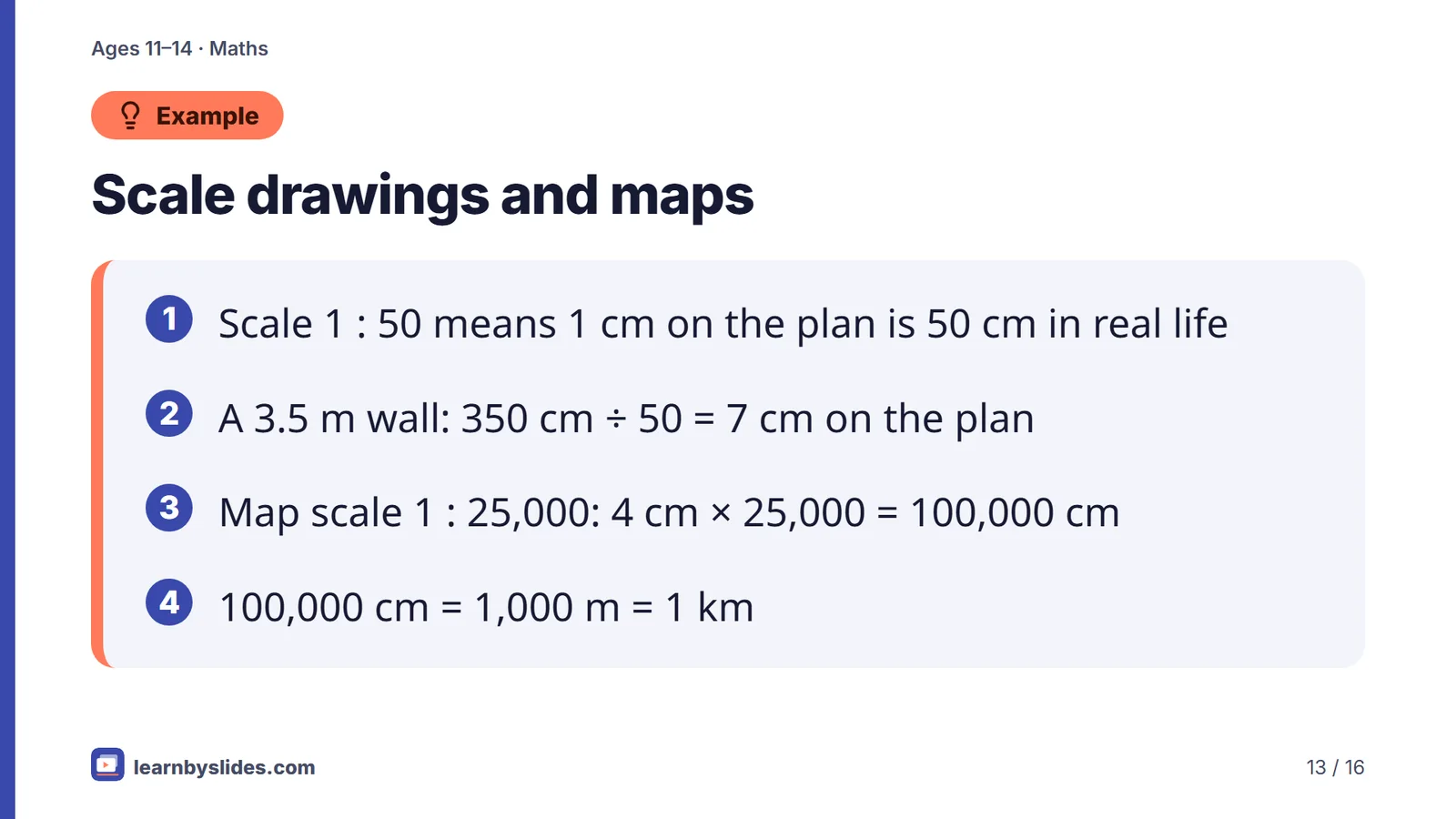
A scale is a ratio between a drawing and real life. On a plan with scale 1 : 50, a 3.5 m wall is drawn 350 ÷ 50 = 7 cm long. On a map with scale 1 : 25,000, 4 cm stands for 100,000 cm, which is 1 km.
How to use these slides
Present the deck in class, or download the PDF to print handouts and the one-page worksheet. Pause at the quick-check slide for a show of hands, then use the five-question quiz on this page. The editable PPTX and Google Slides copy let you swap in local prices and a map of your own area.
Slide-by-slide content
1. Ratio and Proportion
Maths · Simplifying, sharing, unit rates, direct proportion and scale
Speaker notes
Show two glasses of squash, one with 1 part juice to 4 parts water and one with 2 parts juice to 8 parts water. Ask: which one is stronger? Collect votes. Tell students that by the end of the lesson they will be able to prove that the two drinks taste the same.
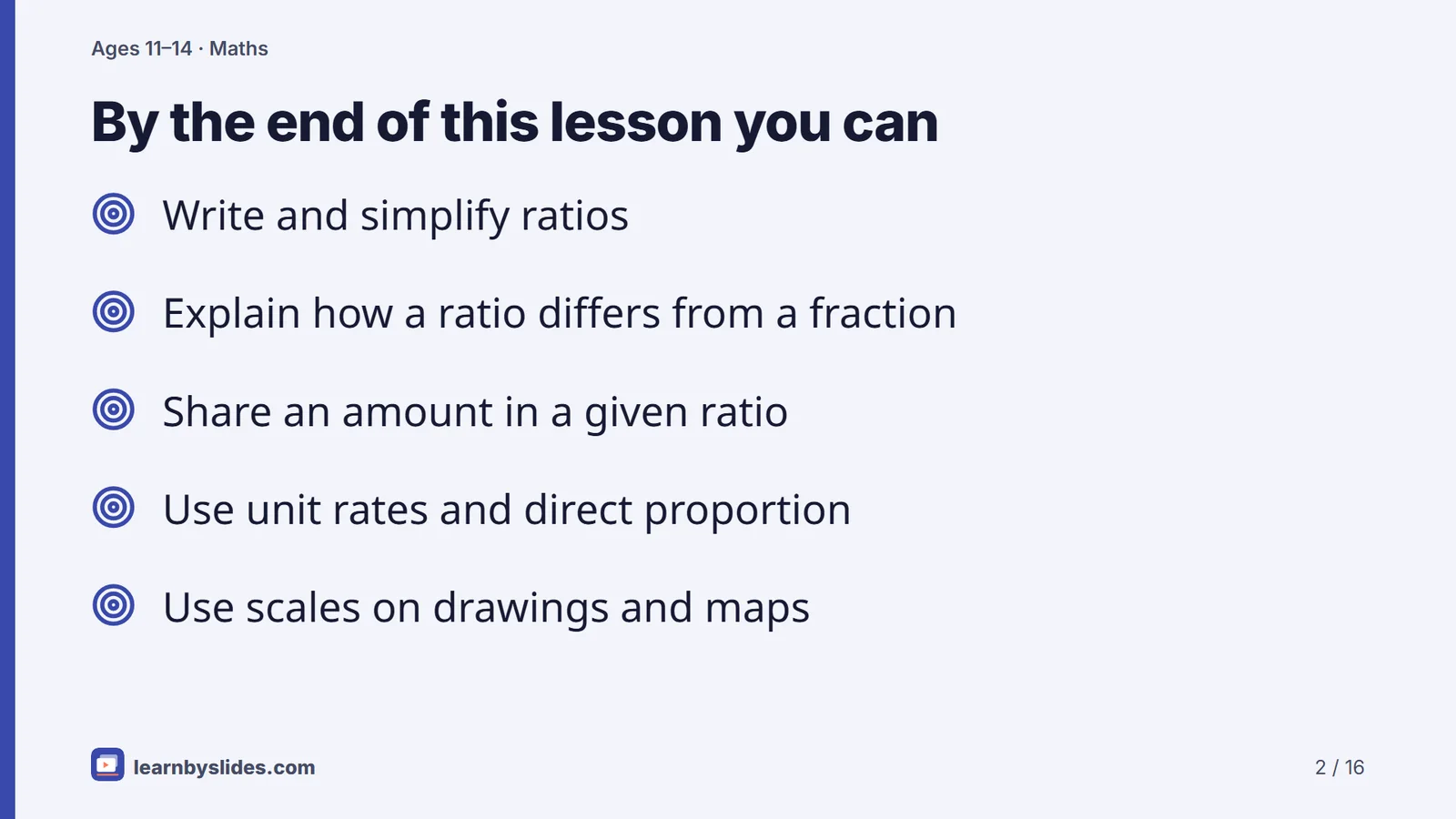
2. By the end of this lesson you can
- Write and simplify ratios
- Explain how a ratio differs from a fraction
- Share an amount in a given ratio
- Use unit rates and direct proportion
- Use scales on drawings and maps
Speaker notes
Read the objectives aloud. Tell students there is a five-question quiz at the end, and that one method, finding the value of one part, solves most problems in the lesson.
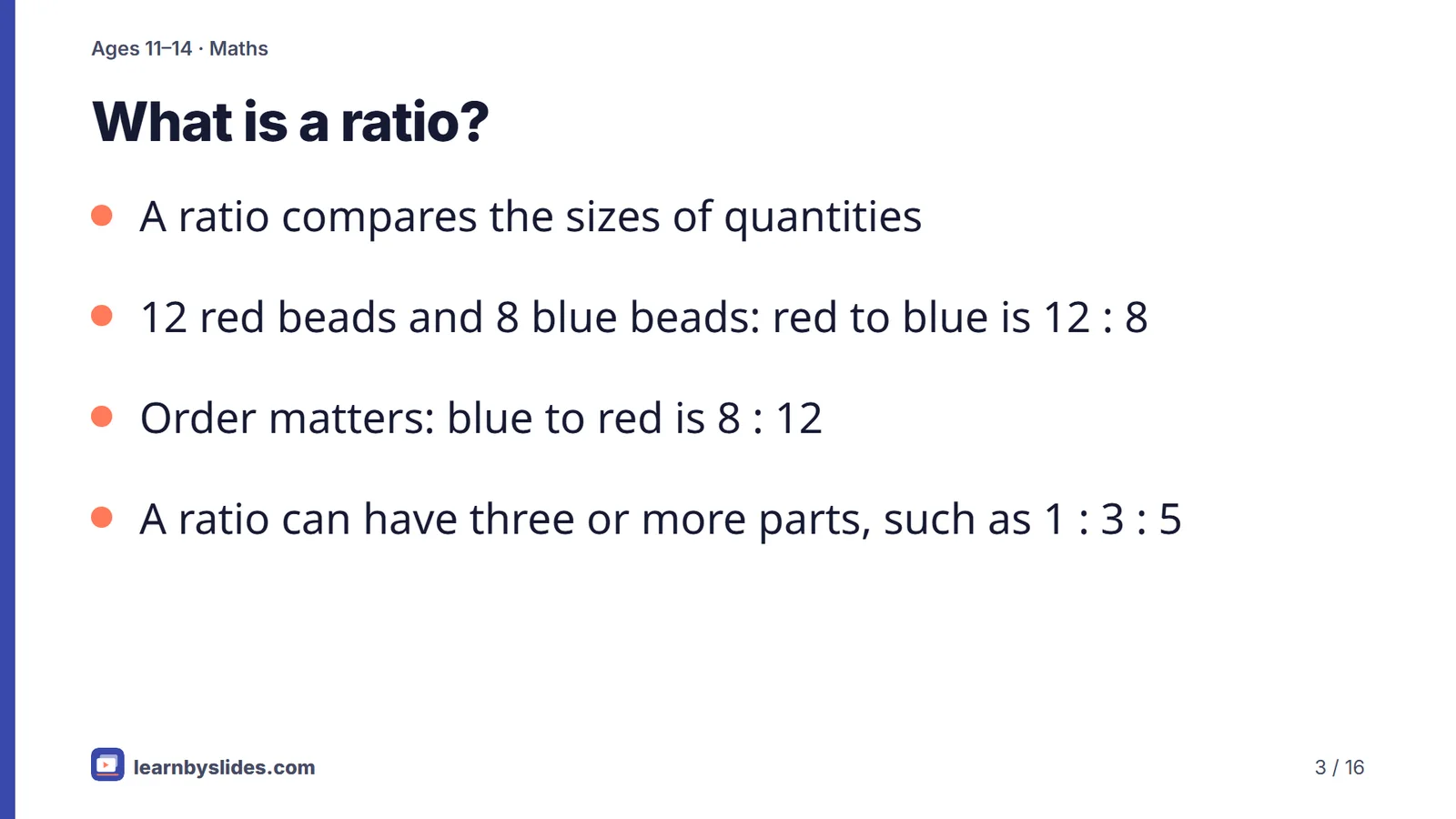
3. What is a ratio?
- A ratio compares the sizes of quantities
- 12 red beads and 8 blue beads: red to blue is 12 : 8
- Order matters: blue to red is 8 : 12
- A ratio can have three or more parts, such as 1 : 3 : 5
Speaker notes
Ask students to write the ratio of students wearing glasses to students not wearing glasses in the room. Stress that the order of the words gives the order of the numbers. A common mistake is writing the parts the wrong way round.
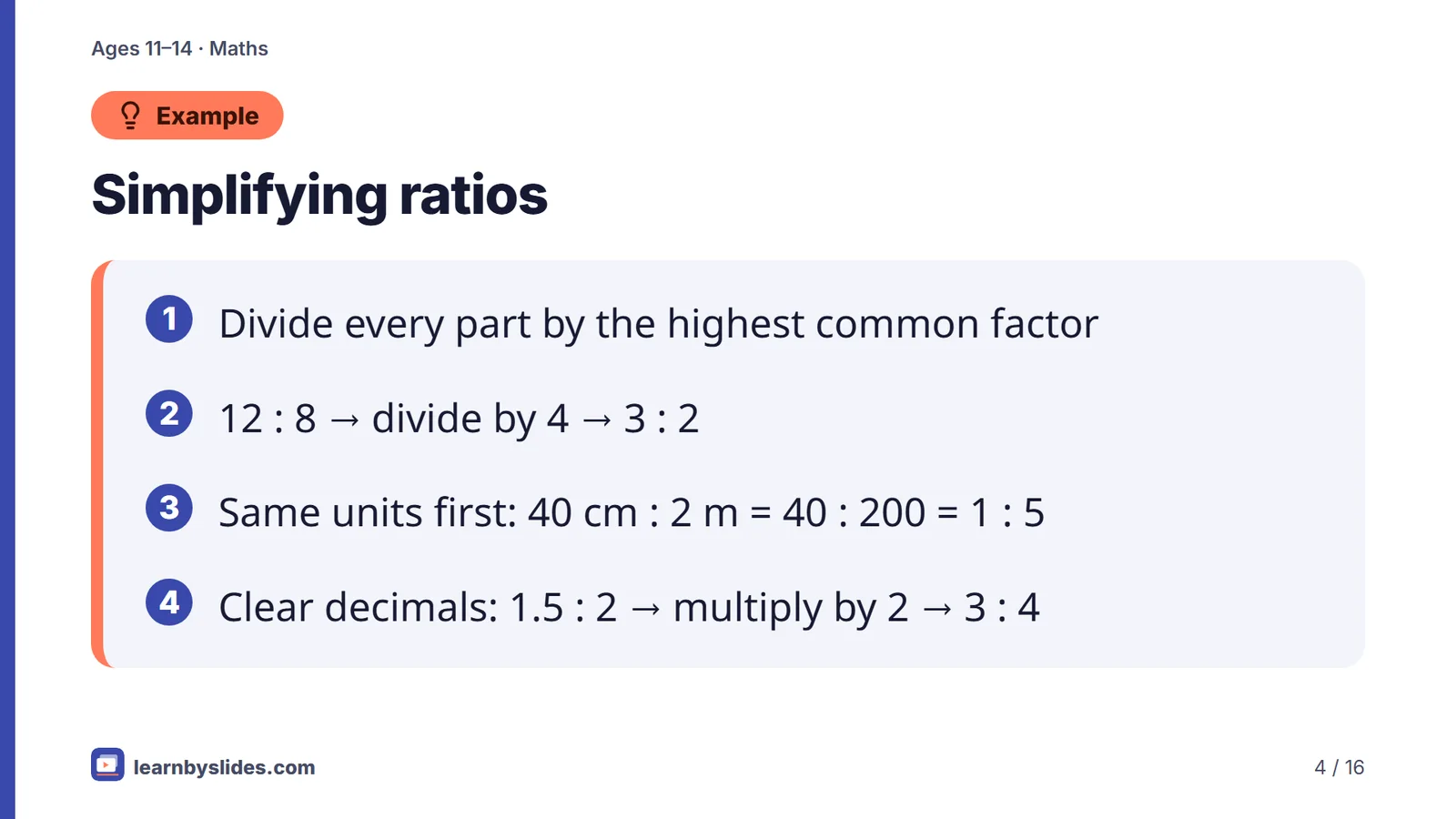
4. Simplifying ratios
- Divide every part by the highest common factor
- 12 : 8 → divide by 4 → 3 : 2
- Same units first: 40 cm : 2 m = 40 : 200 = 1 : 5
- Clear decimals: 1.5 : 2 → multiply by 2 → 3 : 4
Speaker notes
Link back to the starter: 2 : 8 simplifies to 1 : 4, so both drinks are the same strength. Ask: what is 15 : 25 in its simplest form? 3 : 5. Students often divide by a common factor that is not the highest, such as 6 : 4 from 12 : 8; ask them to keep going until no factor is left.
5. Ratio vs fraction
Ratio: part to part
- Red : blue = 3 : 2
- Compares one part with another
- 3 red beads for every 2 blue
Fraction: part of the whole
- Red = 3/5 of the beads
- Compares one part with the total
- 3 + 2 = 5 parts in the whole
Speaker notes
Many students write the ratio 3 : 2 as the fraction 3/2. Ask: if there are 3 red and 2 blue beads, what fraction is blue? 2/5, because the total is 5. Adding the parts of a ratio always gives the denominator.
6. Sharing in a ratio
- Share EUR 350 in the ratio 2 : 5
- Total parts: 2 + 5 = 7
- One part: 350 ÷ 7 = EUR 50
- Shares: 2 × 50 = EUR 100 and 5 × 50 = EUR 250
- Check: 100 + 250 = 350
Speaker notes
Draw a bar model with 7 equal boxes, 2 for the first person and 5 for the second. The most common mistake is dividing by 2 and by 5 instead of by the total 7. Always finish by checking that the shares add back to the amount.
7. Three parts, or one share known
- Share 72 kg in the ratio 1 : 3 : 5
- 9 parts, so one part = 72 ÷ 9 = 8 kg
- Shares: 8 kg, 24 kg and 40 kg
- Boys : girls = 4 : 5 and there are 20 boys
- One part = 20 ÷ 4 = 5, so 25 girls
Speaker notes
The second problem gives one share, not the total, so we find one part from the share we know. Ask: how many children are in the club altogether? 9 parts × 5 = 45. Students who divide 20 by 9 have treated 20 as the total.
8. Unit rates: how much for one?
- A unit rate is an amount per one unit
- 150 km in 2.5 hours: 150 ÷ 2.5 = 60 km/h
- USD 132 for 8 hours: 132 ÷ 8 = USD 16.50 per hour
- Divide by the quantity you want one of
Speaker notes
Ask students for unit rates they see in daily life: price per kilogram, kilometres per hour, pay per hour. Ask: what is the cost per litre if 5 litres of paint cost EUR 42? EUR 8.40. Watch for students who divide the wrong way, such as 2.5 ÷ 150.
9. Best buy: compare unit prices
- 500 g of rice for GBP 2.40, or 750 g for GBP 3.45?
- Per 100 g: 2.40 ÷ 5 = GBP 0.48
- Per 100 g: 3.45 ÷ 7.5 = GBP 0.46
- The 750 g bag is better value
Speaker notes
Point out that we compare the same amount (100 g) of each. Ask: is the cheapest bag always the best value? No: the small bag costs less in total but more per 100 g. Also mention that a bigger bag is only better value if you use it all.
10. Direct proportion
- Both quantities change by the same factor
- Double one and the other doubles
- The ratio between them never changes
- Equation: y = kx, where k is the unit rate
- Graph: a straight line through (0, 0)
Speaker notes
Sketch a graph of cost against number of notebooks at USD 1.50 each: the points lie on a straight line through the origin, and k = 1.50. Ask: what does the point (0, 0) mean here? Zero notebooks cost nothing.
11. The unitary method
- 250 g of flour makes 10 biscuits
- How much flour for 18 biscuits?
- One biscuit: 250 ÷ 10 = 25 g
- 18 biscuits: 25 × 18 = 450 g
- Or scale up: 18 ÷ 10 = 1.8, and 250 × 1.8 = 450 g
Speaker notes
Show both routes and let students choose. The unitary method always works; the scale factor is quicker when the numbers are friendly. A common error is additive thinking: 8 more biscuits so 8 more grams, giving 258 g.
12. Proportional or not?
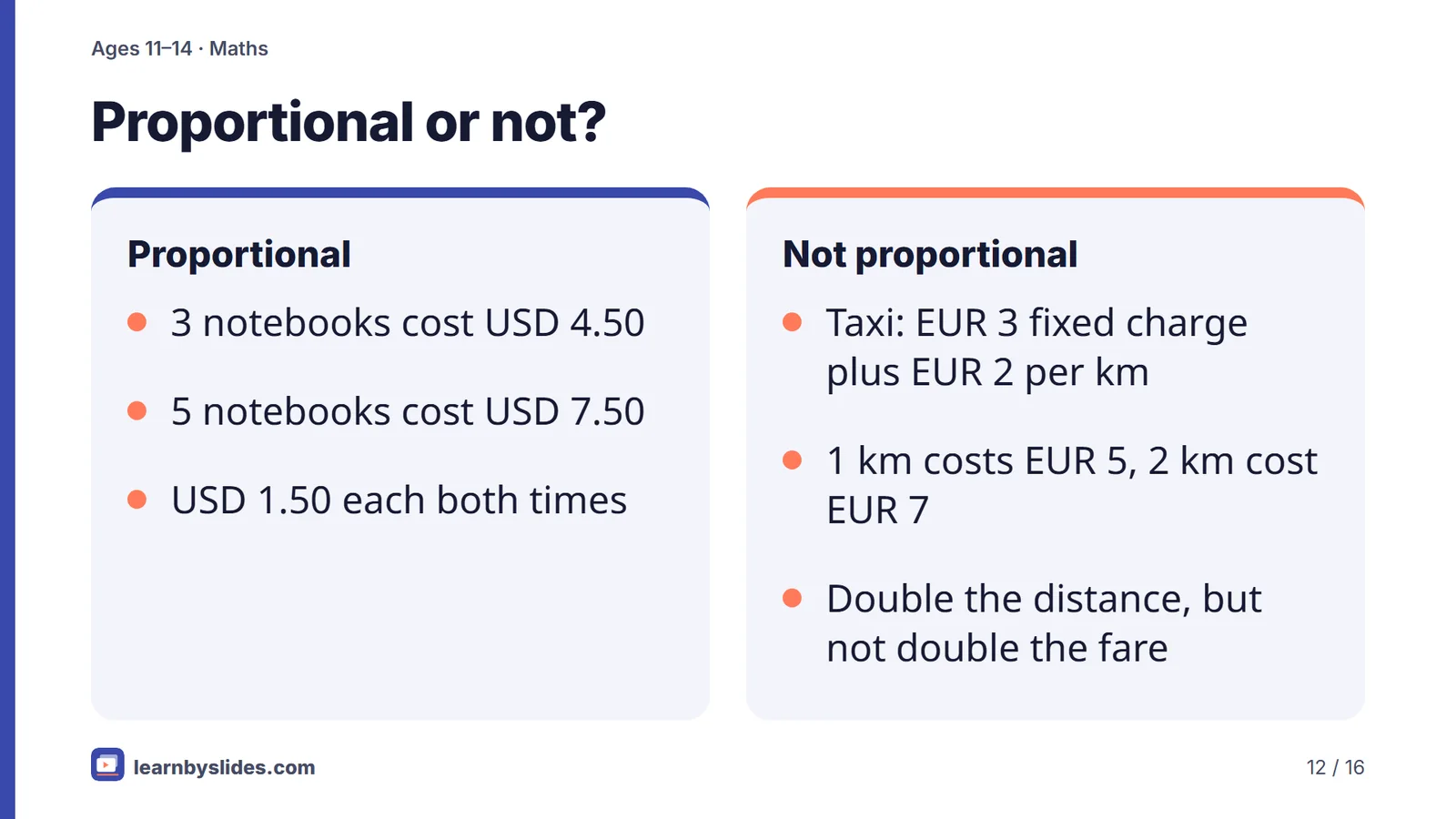
Proportional
- 3 notebooks cost USD 4.50
- 5 notebooks cost USD 7.50
- USD 1.50 each both times
Not proportional
- Taxi: EUR 3 fixed charge plus EUR 2 per km
- 1 km costs EUR 5, 2 km cost EUR 7
- Double the distance, but not double the fare
Speaker notes
Ask students to divide cost by quantity for each pair. The notebooks give 1.50 every time; the taxi gives 5 and then 3.50. The fixed charge means the taxi graph is a straight line that does not pass through the origin.
13. Scale drawings and maps
- Scale 1 : 50 means 1 cm on the plan is 50 cm in real life
- A 3.5 m wall: 350 cm ÷ 50 = 7 cm on the plan
- Map scale 1 : 25,000: 4 cm × 25,000 = 100,000 cm
- 100,000 cm = 1,000 m = 1 km
Speaker notes
Remind students that a scale has no units: both parts are in the same unit. Converting at the end is where most errors happen, so write the chain cm → m → km on the board. Ask: how long would a 2 km road be on that map? 8 cm.
14. Common mistakes to avoid
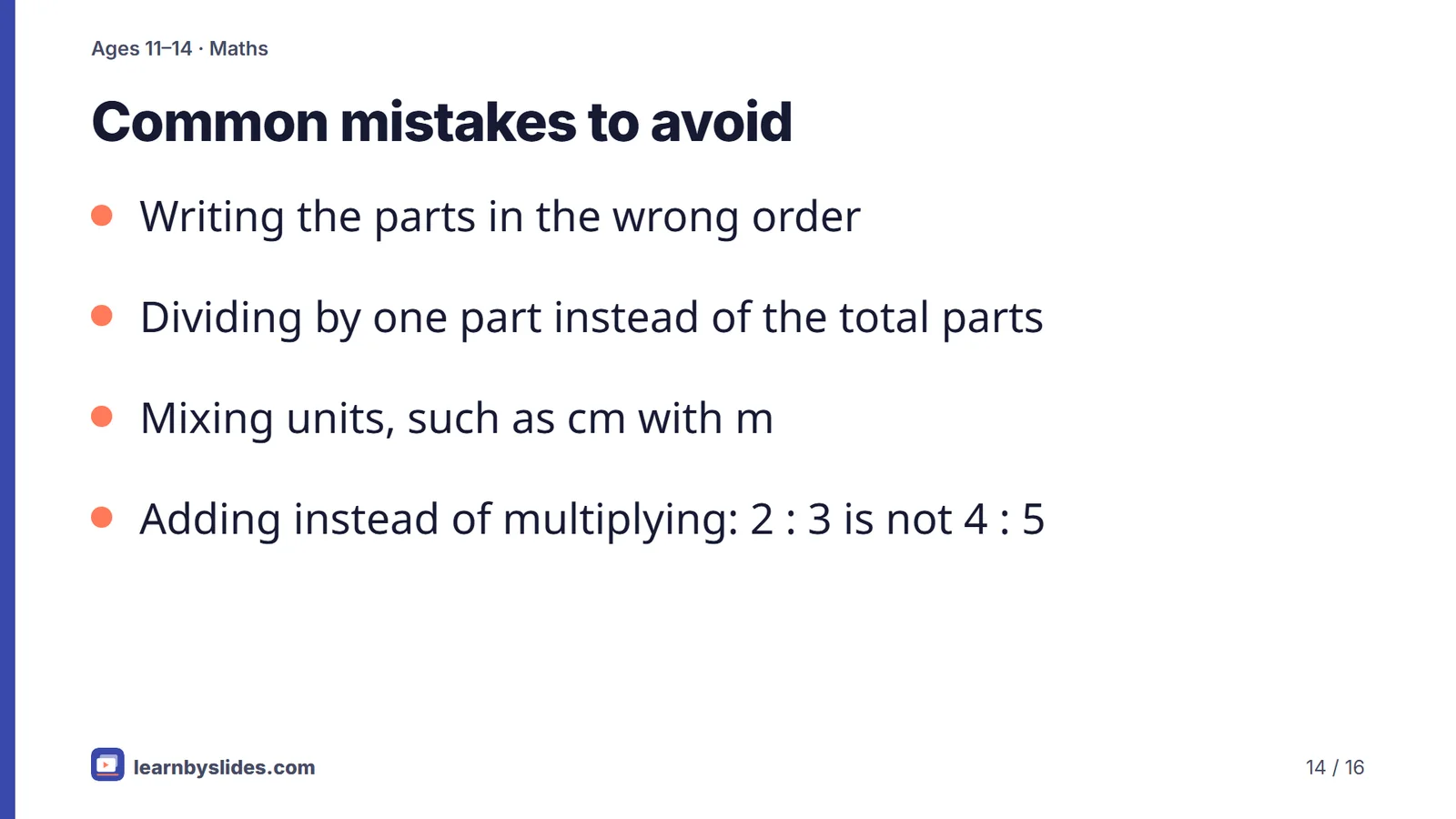
- Writing the parts in the wrong order
- Dividing by one part instead of the total parts
- Mixing units, such as cm with m
- Adding instead of multiplying: 2 : 3 is not 4 : 5
Speaker notes
Show one worked example of each mistake and ask students to find the error. The last one is the most important: equivalent ratios come from multiplying both parts by the same number, so 2 : 3 becomes 4 : 6, not 4 : 5.
15. Quick check
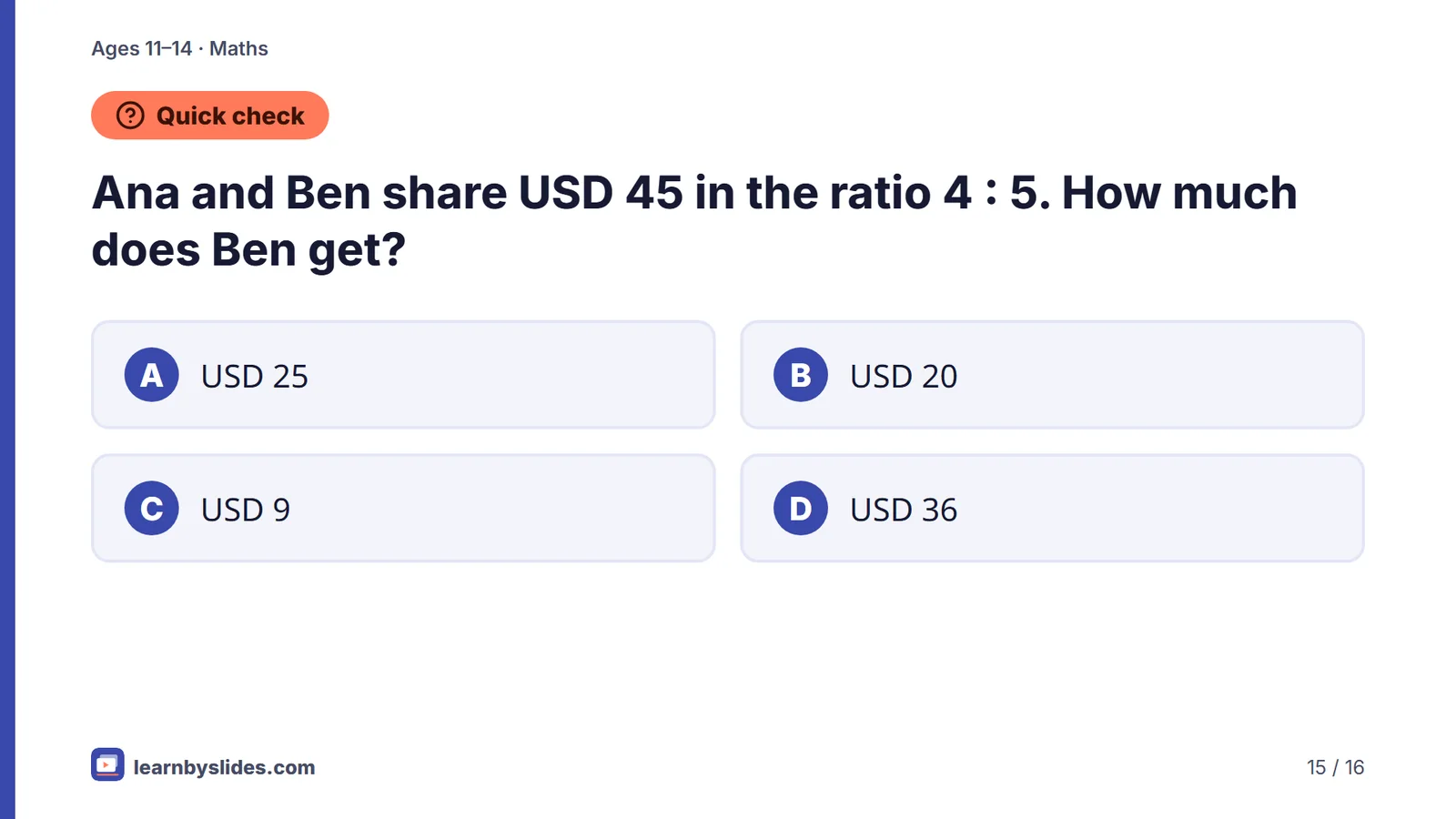
Ana and Ben share USD 45 in the ratio 4 : 5. How much does Ben get?
- USD 25
- USD 20
- USD 9
- USD 36
Speaker notes
Answer: A, USD 25. There are 9 parts, one part is 45 ÷ 9 = USD 5, so Ben gets 5 × 5 = USD 25 and Ana gets USD 20. USD 20 is Ana's share, USD 9 is the number of parts, and USD 36 comes from working out four-fifths of 45.
16. Key takeaways
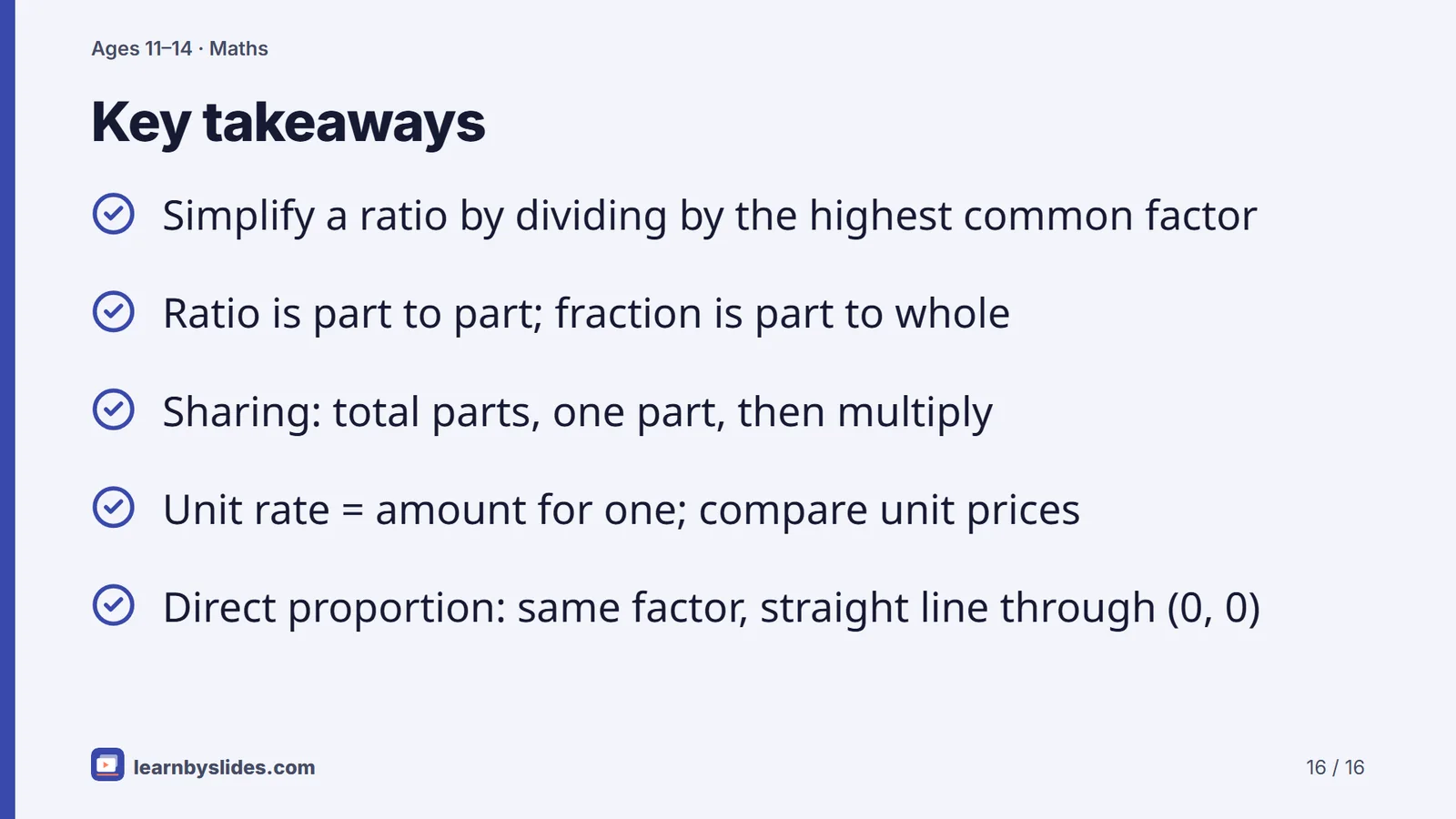
- Simplify a ratio by dividing by the highest common factor
- Ratio is part to part; fraction is part to whole
- Sharing: total parts, one part, then multiply
- Unit rate = amount for one; compare unit prices
- Direct proportion: same factor, straight line through (0, 0)
Speaker notes
Recap one example for each bullet aloud, including the scale example from the previous slides. Then move to the five-question quiz on the page and set the worksheet for practice.
Key terms
- Ratio
- A comparison of the sizes of two or more quantities, written with colons, such as 3 : 2.
- Simplest form
- A ratio whose parts are whole numbers with no common factor other than 1.
- Unit rate
- The amount of one quantity for one unit of another, such as km per hour or price per kilogram.
- Direct proportion
- A relationship where two quantities change by the same factor; y = kx and the graph is a straight line through the origin.
- Unitary method
- Solving a proportion problem by first finding the value of one unit, then multiplying.
- Scale
- The ratio of a length on a drawing or map to the real length, such as 1 : 25,000.
Quick quiz
Teacher notes
Suggested 45-minute plan: 5 minutes on the squash starter and ratio notation; 8 minutes simplifying ratios and comparing ratios with fractions; 10 minutes on sharing in a ratio with bar models; 12 minutes on unit rates, best buys, direct proportion and scale; 10 minutes for the quick check and quiz. Common misconceptions: writing the parts in the wrong order; treating the ratio 3 : 2 as the fraction 3/2; dividing by each part instead of the total number of parts; additive thinking (2 : 3 becomes 4 : 5, or 8 more biscuits needs 8 more grams); forgetting to convert units before simplifying or after using a map scale; assuming anything that increases together is directly proportional. Bar models and ratio tables make the structure visible for most students. Extension: give students a recipe for 4 people and ask them to rewrite it for 6 and for 15, then plot one ingredient against the number of people and explain why the graph passes through the origin.
Frequently asked questions
Which age group is this ratio and proportion lesson for?
Ages 11–14: roughly Grades 6–7 in the US, Years 7–9 in England and Years 7–8 in Australia. Younger students can focus on simplifying and sharing; older students should cover direct proportion graphs and map scales. The curriculum chips at the top of the page list each matching standard.
What is the difference between a ratio and a fraction?
A ratio compares one part with another part, such as 3 red beads to 2 blue beads (3 : 2). A fraction compares a part with the whole, so red beads are 3/5 of the beads. Adding the parts of a ratio gives the denominator of the matching fractions.
How do you share an amount in a given ratio?
Add the parts of the ratio, divide the amount by that total to find one part, then multiply by each number in the ratio. For EUR 350 in the ratio 2 : 5, one part is 350 ÷ 7 = EUR 50, so the shares are EUR 100 and EUR 250.
How can you tell if two quantities are in direct proportion?
Divide one quantity by the other for several pairs of values. If the answer is always the same, they are in direct proportion. On a graph, directly proportional quantities form a straight line that passes through the origin (0, 0).
Sources & methodology
Every fact is checked against the sources below. We write original explanations and draw original graphics; no figures are copied from textbooks. Spotted an error? See our corrections policy.
- Prealgebra 2e, 5.6 Ratios and Rate (OpenStax (Rice University), accessed 1 Oct 2026)
- Prealgebra 2e, 6.5 Solve Proportions and their Applications (OpenStax (Rice University), accessed 1 Oct 2026)
- Grade 6, Unit 2: Introducing Ratios (Illustrative Mathematics (Kendall Hunt), accessed 1 Oct 2026)
- Grade 7, Unit 2: Introducing Proportional Relationships (Illustrative Mathematics (Kendall Hunt), accessed 1 Oct 2026)
Editorial review pending · Updated
Related lessons
 Maths · Ages 12–13
Integers and Negative Numbers: Lesson Slides & Worksheet
Ready-to-teach maths slides for ages 12–13 on integers and negative numbers: the number line, adding and subtracting, sign rules for multiplying and dividing, and key properties, with lift, temperature and money examples, speaker notes and a quiz.
 Maths · Ages 11–14
Percentages: Lesson Slides & Worksheet
Ready-to-teach maths slides for ages 11–14 on percentages: converting fractions, decimals and percentages, finding a percentage of an amount, percentage increase and decrease with multipliers, percentage change and reverse percentages, with speaker notes and a quiz.
 Science · Ages 12–15
Acids, Bases and the pH Scale Lesson Slides
A ready-to-teach chemistry lesson for ages 12–15 on acids, bases and alkalis: the pH scale, litmus and universal indicator, everyday examples, neutralisation and how to name salts, with a safe indicator practical.
For teachers and parents: new LearnBySlides resources by email
One short email when new free resources go live. For adults (18+) only. No spam, no tracking in emails, unsubscribe anytime.