Percentages: Lesson Slides & Worksheet
Ready-to-teach maths slides for ages 11–14 on percentages: converting fractions, decimals and percentages, finding a percentage of an amount, percentage increase and decrease with multipliers, percentage change and reverse percentages, with speaker notes and a quiz.
Ages 11–14 · Grades 6–8 (US) · Years 7–9 (UK) · Classes 6–8 (India)
- Common Core Math 6.RP.A.3c
- Common Core Math 7.RP.A.3
- England KS3 Years 7–9
- AQA GCSE R9
- AQA GCSE N12
- Cambridge IGCSE 0580 C1.4 / E1.4
- Cambridge IGCSE 0580 C1.13 / E1.13
- Australian Curriculum v9 AC9M7N06
- Australian Curriculum v9 AC9M7N09
- Australian Curriculum v9 AC9M8N05
- CBSE Class 8
Cambridge and IGCSE are trademarks of Cambridge University Press & Assessment. Common Core State Standards © Copyright 2010 National Governors Association Center for Best Practices and Council of Chief State School Officers. All rights reserved. Names and codes are used only to describe curriculum fit; LearnBySlides is not endorsed by these organisations.
15 slides · 45 min lesson · 5-question quiz · speaker notes
Learning objectives
- Convert between fractions, decimals and percentages.
- Find a percentage of an amount with and without a calculator.
- Increase and decrease an amount by a percentage using a multiplier.
- Calculate a percentage change from an original value.
- Find the original value in a reverse percentage problem.
What this lesson covers
This deck teaches percentages to students aged 11–14 in one 45-minute lesson. It starts with what a percentage means and how it links to fractions and decimals, then builds up to the skills students use most: finding a percentage of an amount, increasing and decreasing by a percentage, working out a percentage change, and reverse percentages (finding the original value).
Every method is shown twice: a mental method built from 10% and 1%, and a calculator method using a single multiplier. Examples use prices in USD, GBP and EUR, masses in kilograms and lengths in centimetres. Speaker notes on every slide give the teacher a question to ask and a common mistake to watch for.
Percentages, fractions and decimals
Per cent means "out of a hundred", so 37% is the fraction 37/100 and the decimal 0.37. 100% is the whole amount, and percentages above 100% are allowed: 150% of 40 is 60.
To convert:
- Percentage to decimal: divide by 100. 45% = 0.45.
- Decimal to percentage: multiply by 100. 0.06 = 6%.
- Fraction to percentage: divide the top by the bottom, then multiply by 100. 3/8 = 0.375 = 37.5%.
- Percentage to fraction: write it over 100 and simplify. 45% = 45/100 = 9/20.
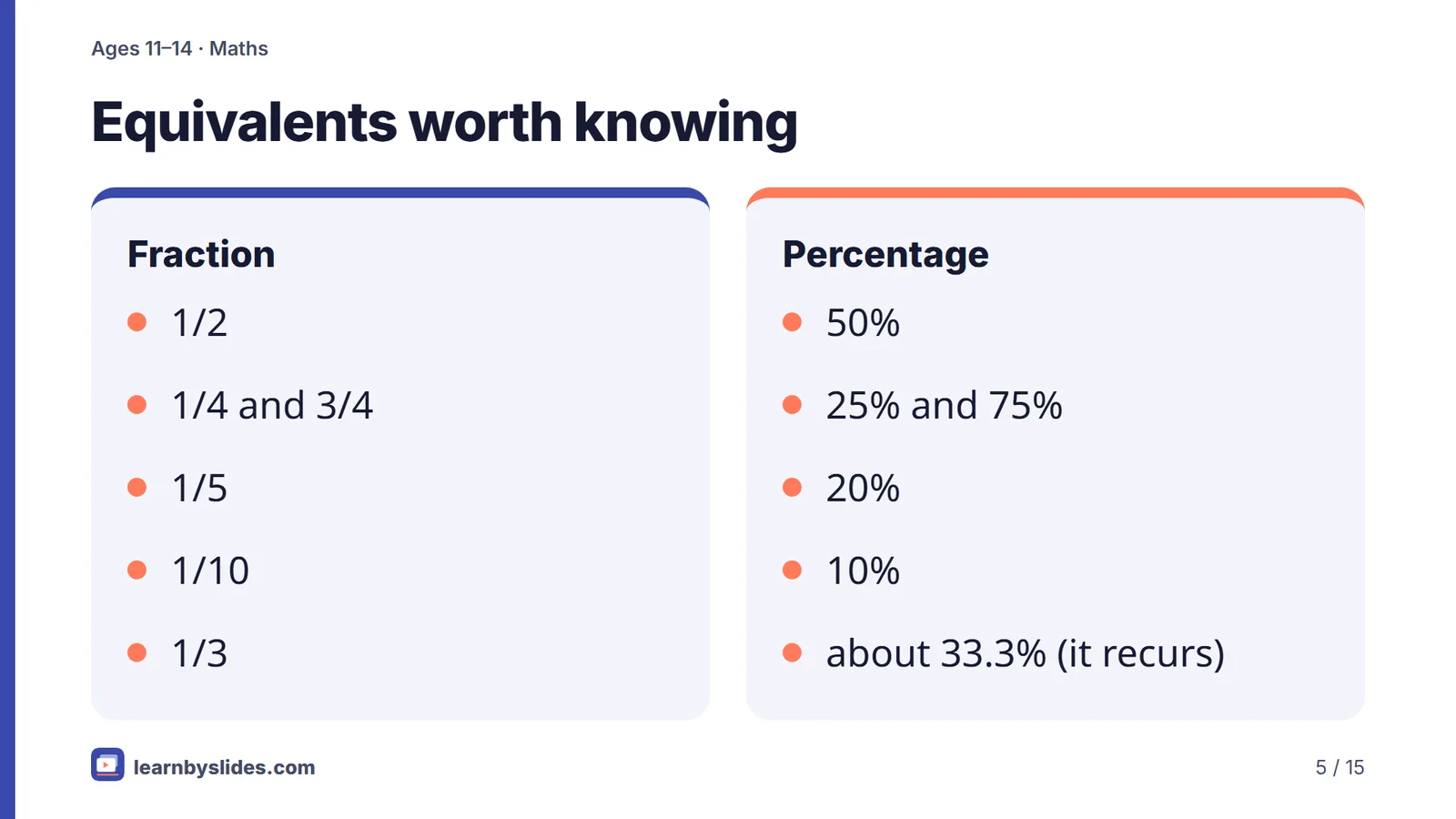
A few equivalents are worth knowing by heart: 1/2 = 50%, 1/4 = 25%, 3/4 = 75%, 1/5 = 20%, 1/10 = 10% and 1/3 ≈ 33.3%.
Finding a percentage of an amount
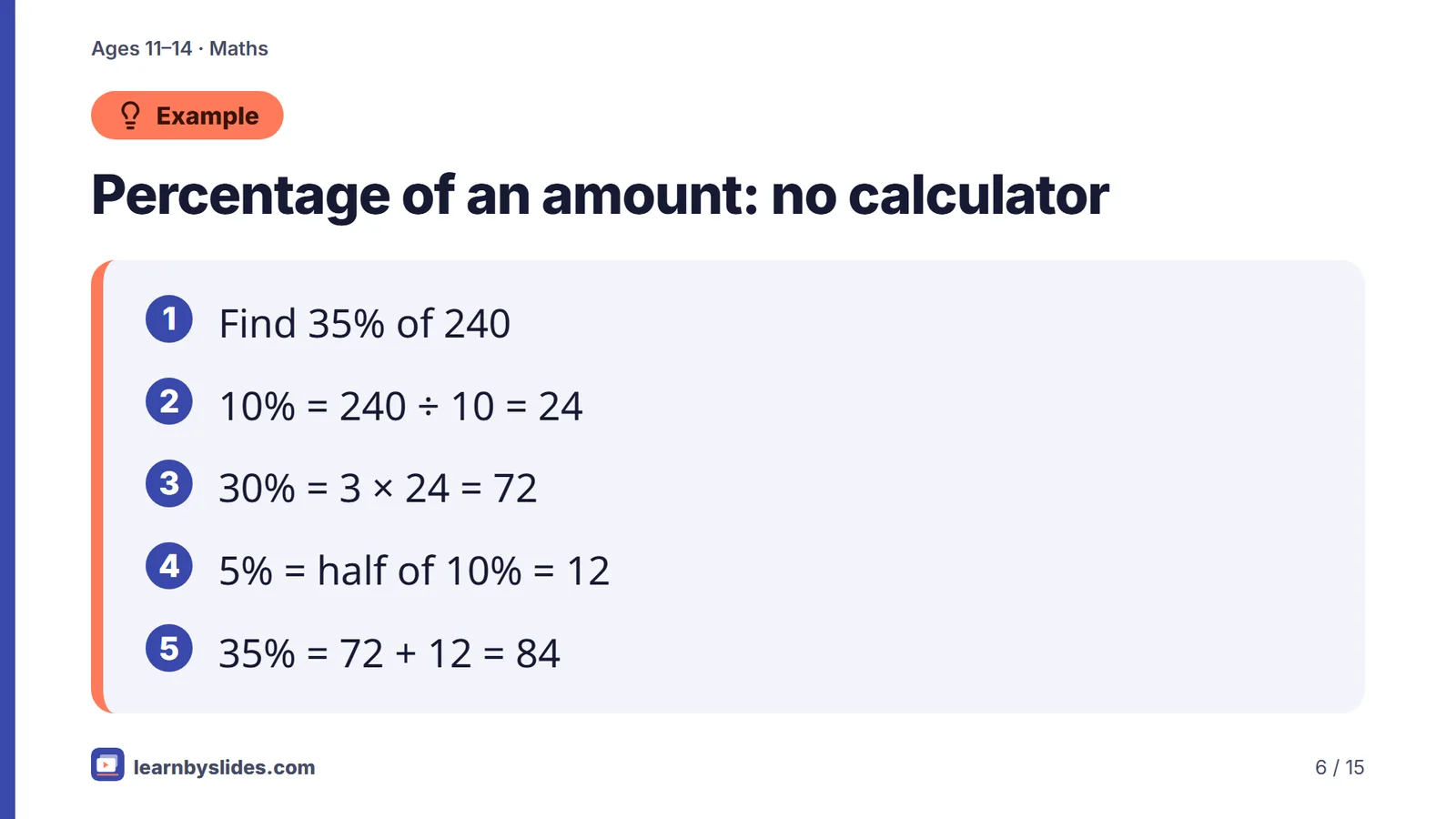
Without a calculator, build the percentage from easy pieces. 10% is found by dividing by 10, 5% is half of 10%, and 1% is found by dividing by 100. For 35% of 240: 10% is 24, so 30% is 72, 5% is 12, and 35% is 72 + 12 = 84.
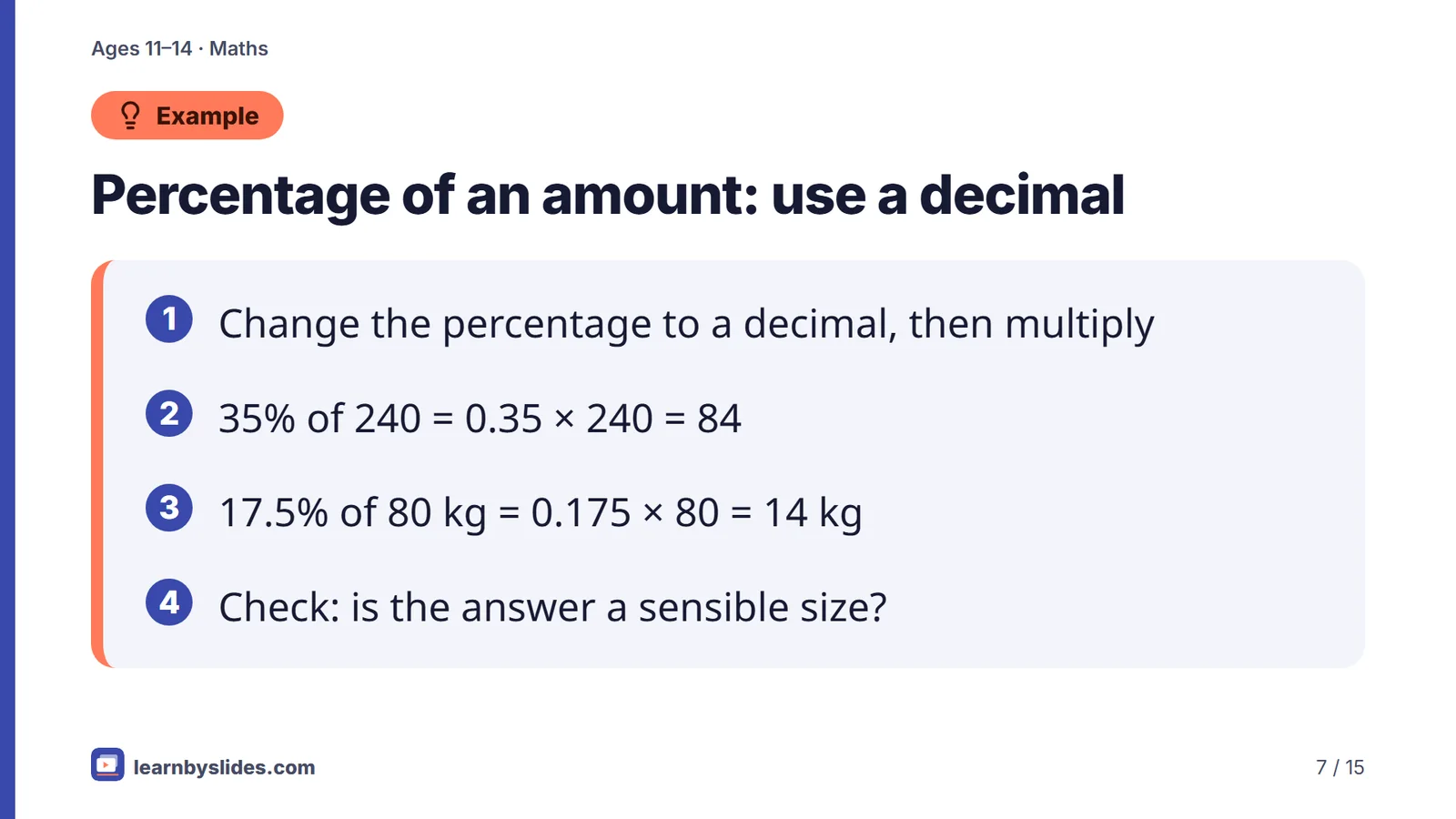
With a calculator, change the percentage to a decimal and multiply: 35% of 240 = 0.35 × 240 = 84. The same idea gives 17.5% of 80 kg = 0.175 × 80 = 14 kg.
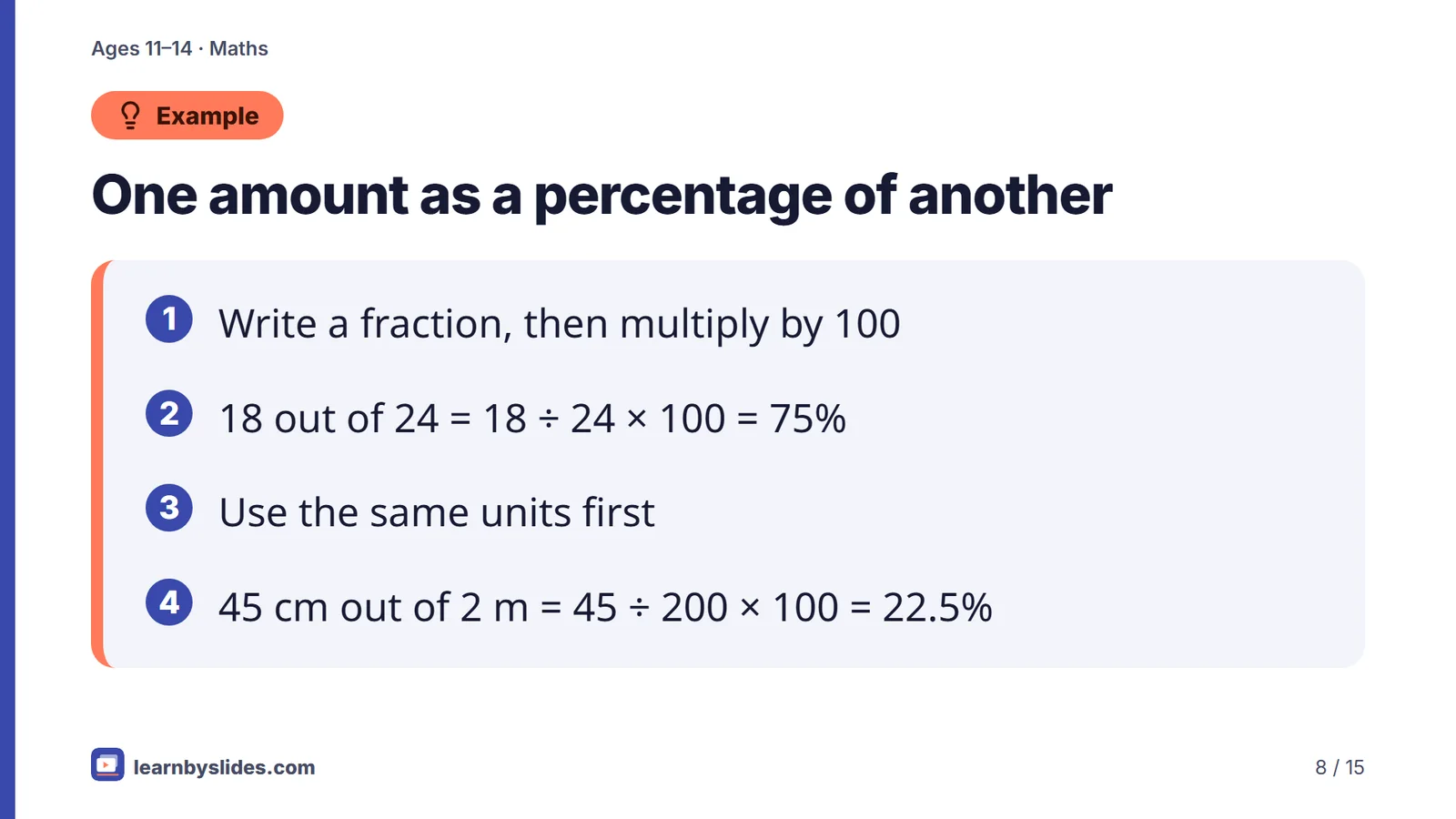
To write one quantity as a percentage of another, make a fraction and multiply by 100: 18 out of 24 is 18 ÷ 24 × 100 = 75%. Put both amounts in the same unit first, so 45 cm out of 2 m is 45 ÷ 200 × 100 = 22.5%.
Increase, decrease and percentage change
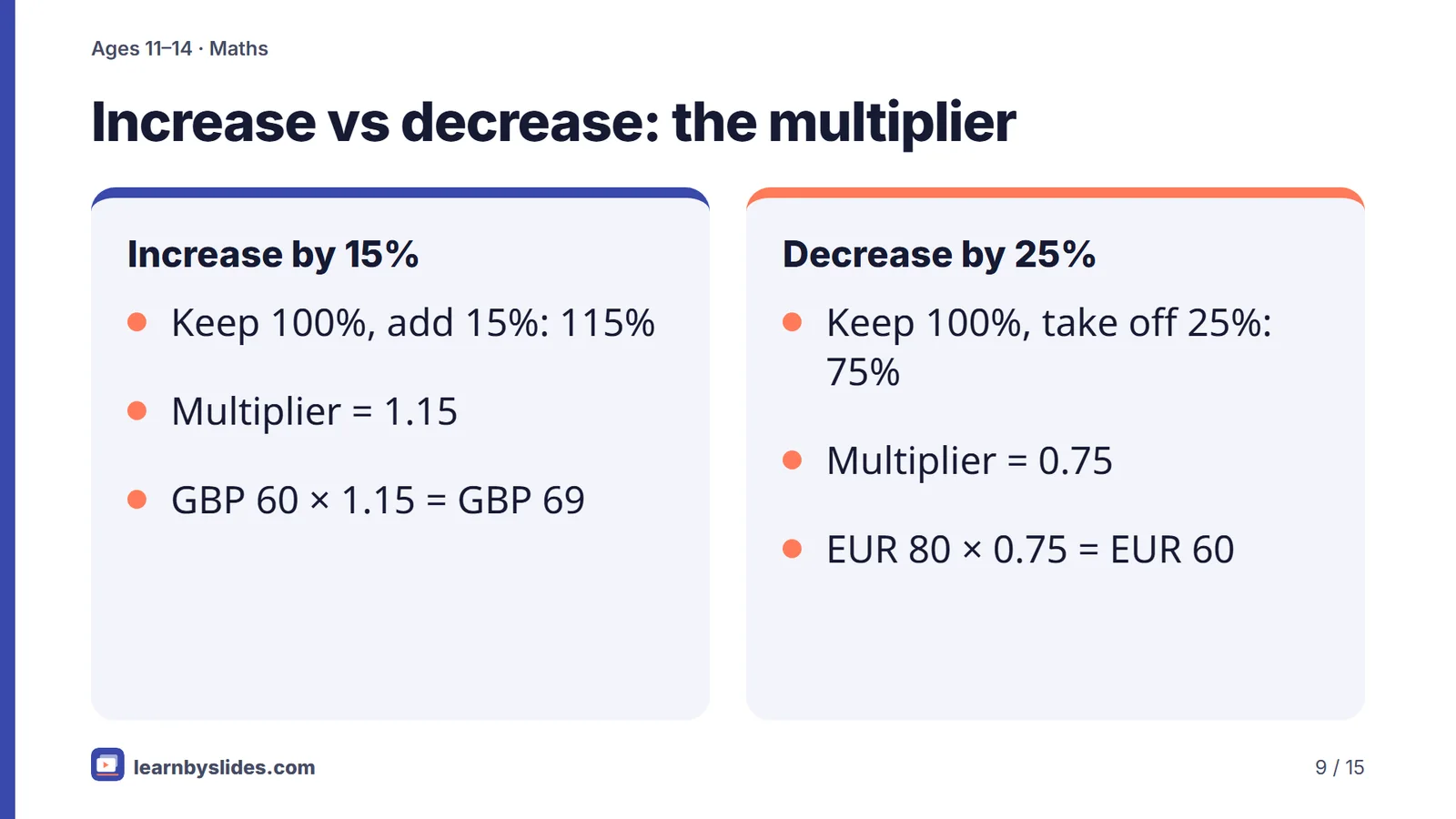
A multiplier does an increase or decrease in one step. To increase by 15%, you keep 100% and add 15%, so multiply by 1.15: a GBP 60 bus pass becomes 60 × 1.15 = GBP 69. To decrease by 25%, you keep 75%, so multiply by 0.75: a EUR 80 jacket becomes 80 × 0.75 = EUR 60.
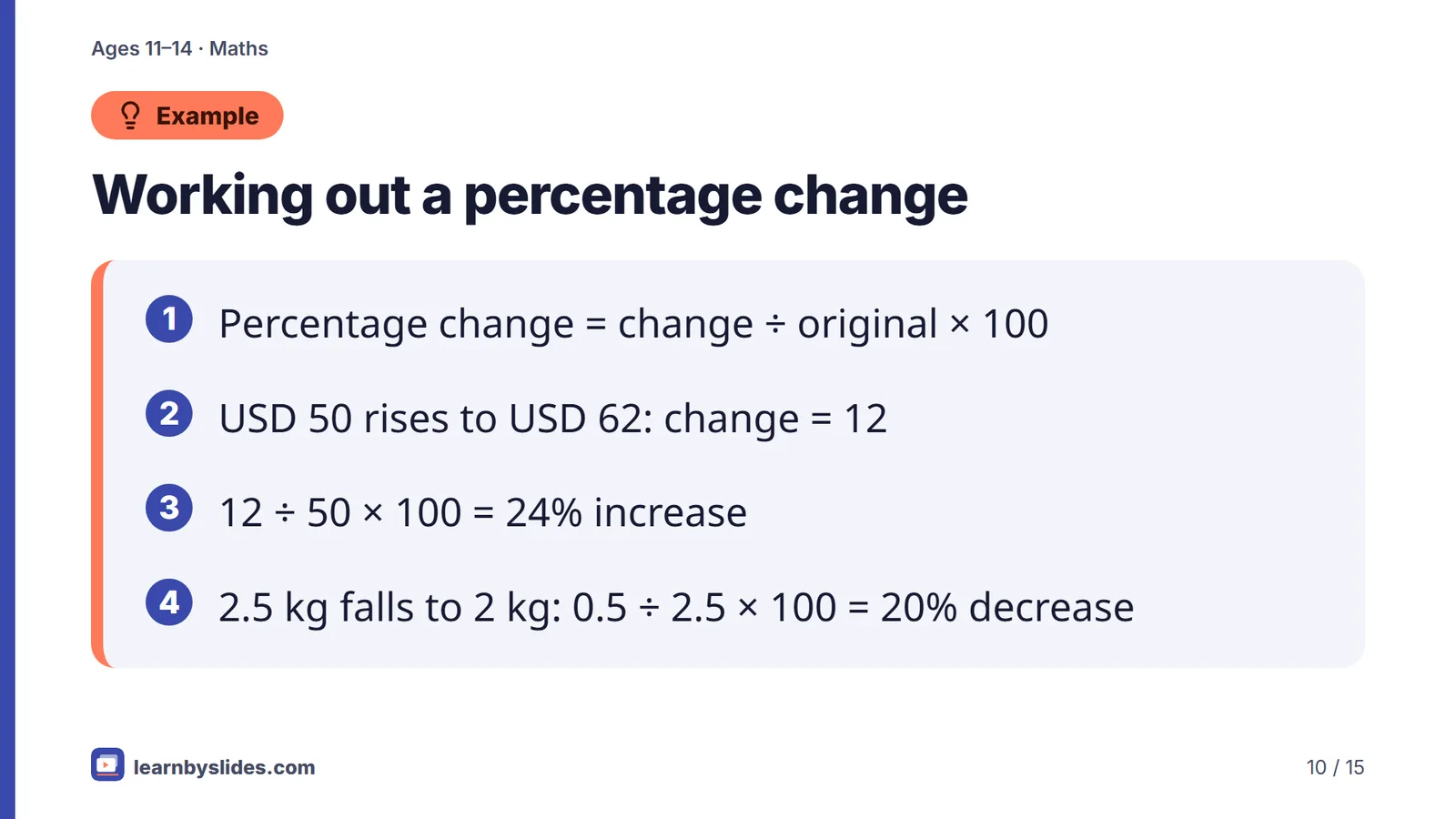
To find a percentage change, divide the change by the original value: percentage change = change ÷ original × 100. A price that rises from USD 50 to USD 62 has changed by 12, and 12 ÷ 50 × 100 = 24%, so it is a 24% increase.
Reverse percentages
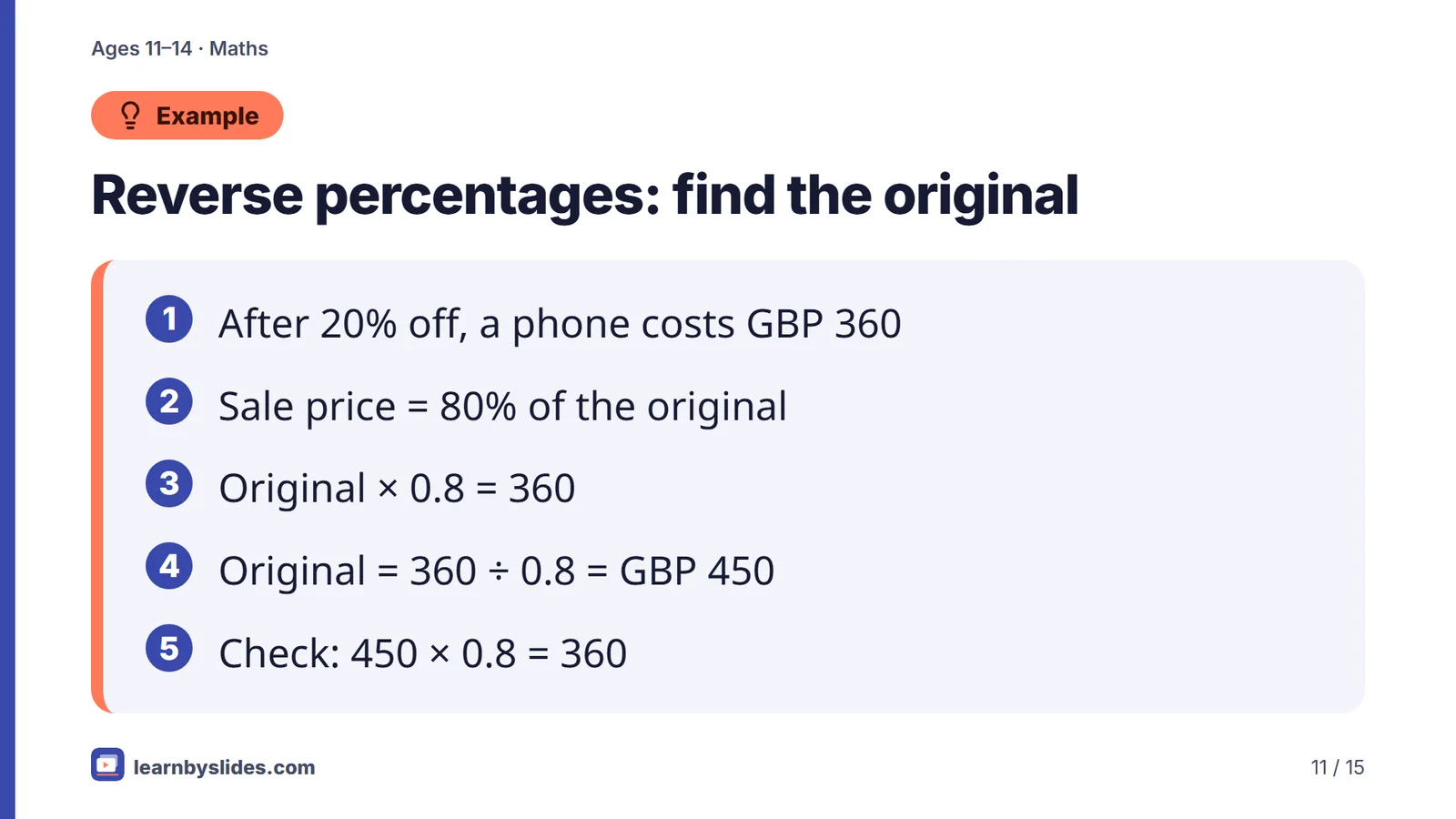
Sometimes you know the value after a change and need the value before it. After a 20% discount a phone costs GBP 360. The sale price is 80% of the original, so the original is 360 ÷ 0.8 = GBP 450. Check: 450 × 0.8 = 360.
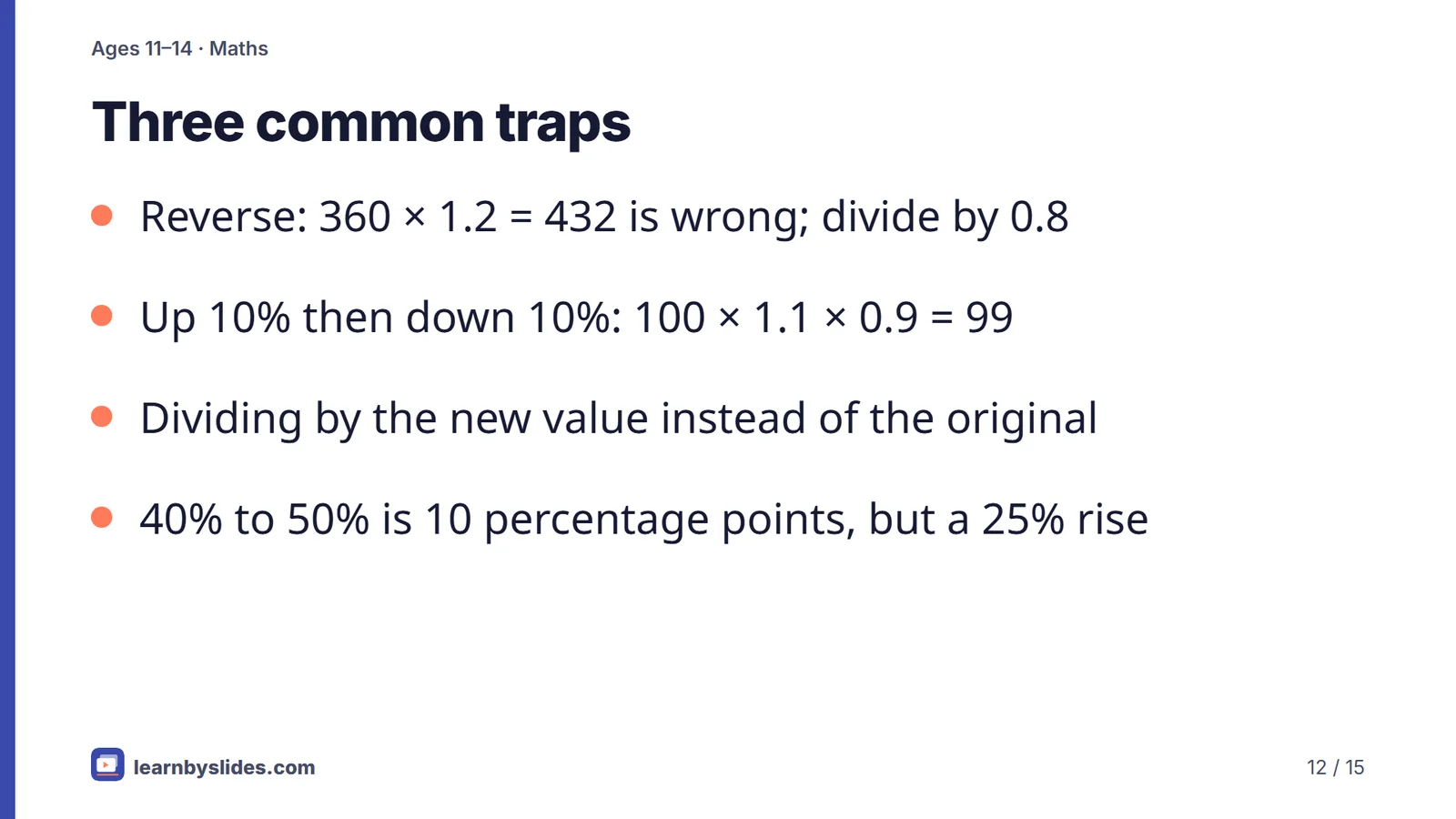
The tempting wrong answer is to add 20% back on: 360 × 1.2 = GBP 432. It fails because the 20% was taken off the original price, not the sale price. For the same reason, increasing by 10% and then decreasing by 10% does not get you back where you started: 100 × 1.1 × 0.9 = 99.
How to use these slides
Present the deck in class, or download the PDF to print handouts and the one-page worksheet. Pause at the quick-check slide for a show of hands, then use the five-question quiz on this page. The editable PPTX and Google Slides copy let you swap in local prices, such as a sale in a shop near your school.
Slide-by-slide content
1. Percentages
Maths · Fractions, decimals, percentage change and reverse percentages
Speaker notes
Show a sale sign such as "Up to 40% off" and ask: if a EUR 50 top is 40% off, is it now EUR 10? Collect answers without correcting them yet. Tell students that by the end of the lesson they will be able to check any sale price, pay rise or test score in one step.
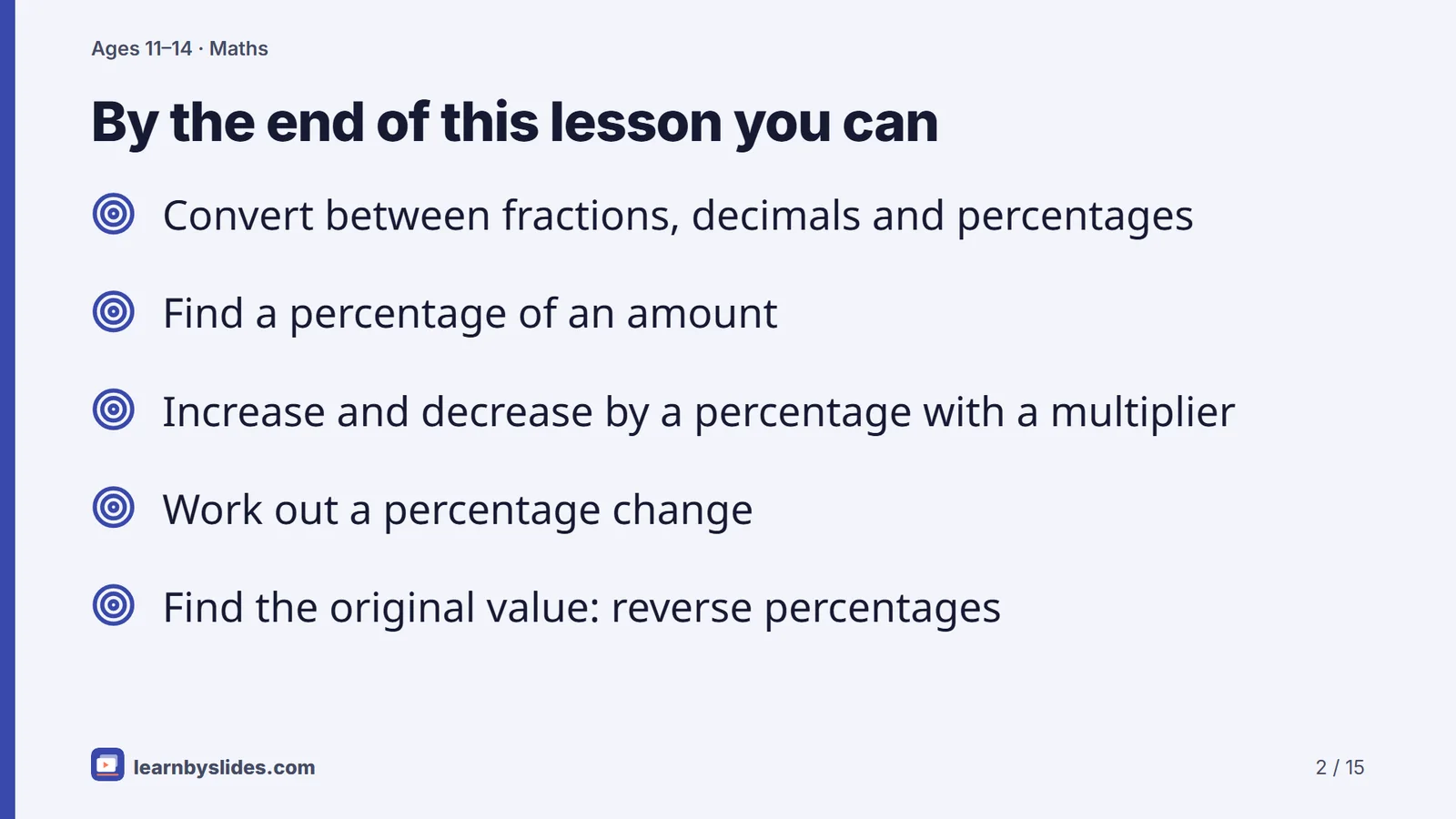
2. By the end of this lesson you can
- Convert between fractions, decimals and percentages
- Find a percentage of an amount
- Increase and decrease by a percentage with a multiplier
- Work out a percentage change
- Find the original value: reverse percentages
Speaker notes
Read the objectives aloud. Tell students there is a five-question quiz at the end, and that the multiplier idea on slide 9 is the one tool that ties everything together.
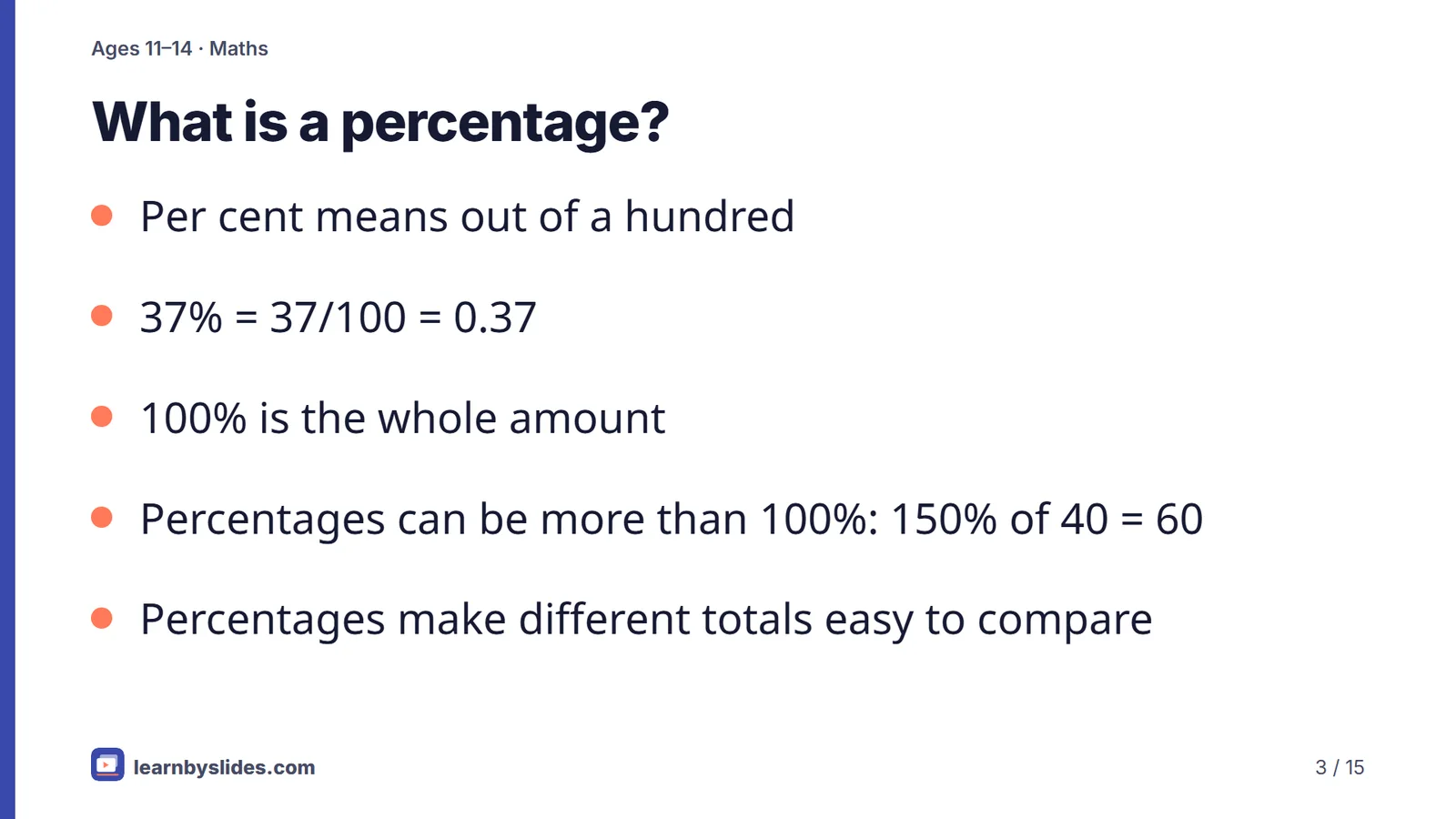
3. What is a percentage?
- Per cent means out of a hundred
- 37% = 37/100 = 0.37
- 100% is the whole amount
- Percentages can be more than 100%: 150% of 40 = 60
- Percentages make different totals easy to compare
Speaker notes
Shade 37 squares of a 10 by 10 grid to show 37%. Ask: what would 100% look like, and what would 150% look like? Some students believe a percentage can never go above 100; a price that rises by half to 150% of its old value is a good counter-example.
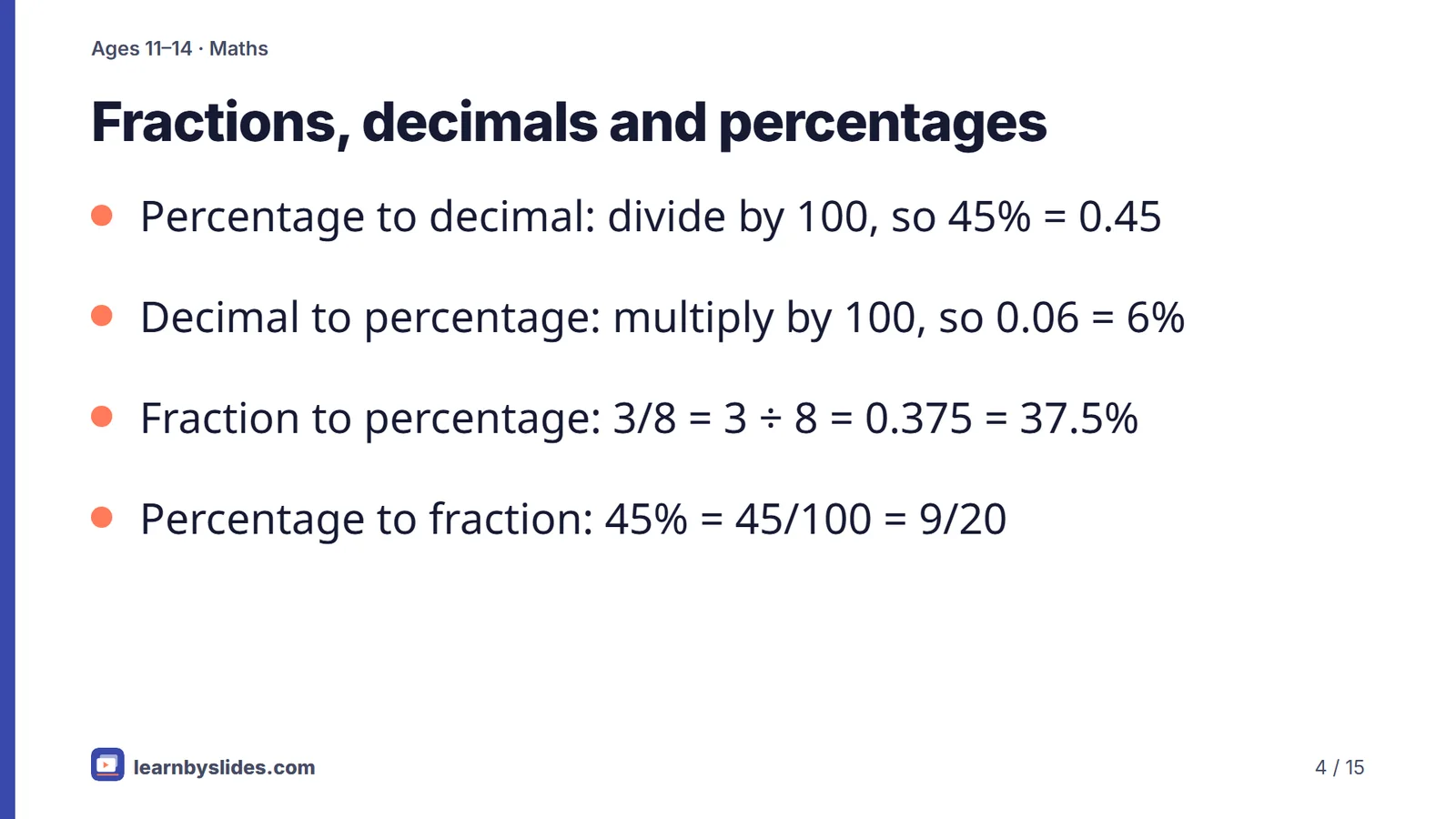
4. Fractions, decimals and percentages
- Percentage to decimal: divide by 100, so 45% = 0.45
- Decimal to percentage: multiply by 100, so 0.06 = 6%
- Fraction to percentage: 3/8 = 3 ÷ 8 = 0.375 = 37.5%
- Percentage to fraction: 45% = 45/100 = 9/20
Speaker notes
Work through each conversion on the board. A very common error is writing 0.06 as 60%; ask students to say the decimal as 6 hundredths before converting. Ask: which is bigger, 3/8 or 40%? Converting both to percentages gives 37.5% and 40%, so 40% is bigger.
5. Equivalents worth knowing
Fraction
- 1/2
- 1/4 and 3/4
- 1/5
- 1/10
- 1/3
Percentage
- 50%
- 25% and 75%
- 20%
- 10%
- about 33.3% (it recurs)
Speaker notes
Cover one column and ask students to call out the other. Point out that 1/3 is 33.333…% and never ends, so we round it. Ask: what is 2/5 as a percentage? Two lots of 20% gives 40%.
6. Percentage of an amount: no calculator
- Find 35% of 240
- 10% = 240 ÷ 10 = 24
- 30% = 3 × 24 = 72
- 5% = half of 10% = 12
- 35% = 72 + 12 = 84
Speaker notes
Model the building-block method step by step. Ask a student to find 12% of 240 the same way: 10% is 24, 1% is 2.4, so 12% is 24 + 2.4 + 2.4 = 28.8. Watch for students who find 10% by dividing by 100 instead of 10.
7. Percentage of an amount: use a decimal
- Change the percentage to a decimal, then multiply
- 35% of 240 = 0.35 × 240 = 84
- 17.5% of 80 kg = 0.175 × 80 = 14 kg
- Check: is the answer a sensible size?
Speaker notes
Show that both methods give 84. Ask: should 17.5% of 80 kg be more or less than 20 kg? Less, because 25% would be 20 kg. Estimating first catches typing errors on the calculator.
8. One amount as a percentage of another
- Write a fraction, then multiply by 100
- 18 out of 24 = 18 ÷ 24 × 100 = 75%
- Use the same units first
- 45 cm out of 2 m = 45 ÷ 200 × 100 = 22.5%
Speaker notes
A test score is the most familiar example: 18 marks out of 24 is 75%. Ask: what goes wrong if we work out 45 ÷ 2 × 100? We get 2,250%, which cannot be right for a part of a length. 2 m must become 200 cm before dividing.
9. Increase vs decrease: the multiplier
Increase by 15%
- Keep 100%, add 15%: 115%
- Multiplier = 1.15
- GBP 60 × 1.15 = GBP 69
Decrease by 25%
- Keep 100%, take off 25%: 75%
- Multiplier = 0.75
- EUR 80 × 0.75 = EUR 60
Speaker notes
Show the two-step method once (60 + 9 = 69 and 80 − 20 = 60), then show that the multiplier does it in one step. Ask: what multiplier increases by 3%? 1.03. What multiplier decreases by 8%? 0.92. A common mistake is 0.08 for an 8% decrease.
10. Working out a percentage change
- Percentage change = change ÷ original × 100
- USD 50 rises to USD 62: change = 12
- 12 ÷ 50 × 100 = 24% increase
- 2.5 kg falls to 2 kg: 0.5 ÷ 2.5 × 100 = 20% decrease
Speaker notes
Stress the word original. Ask: what happens if we divide 12 by 62 instead? We get about 19.4%, which is wrong because the change is measured from where we started. Check the answer with a multiplier: 50 × 1.24 = 62.
11. Reverse percentages: find the original
- After 20% off, a phone costs GBP 360
- Sale price = 80% of the original
- Original × 0.8 = 360
- Original = 360 ÷ 0.8 = GBP 450
- Check: 450 × 0.8 = 360
Speaker notes
Draw a bar split into ten equal parts: eight parts are worth GBP 360, so one part is GBP 45 and ten parts are GBP 450. Ask: a price including a 20% sales tax is EUR 96. What was it before tax? 96 ÷ 1.2 = EUR 80.
12. Three common traps
- Reverse: 360 × 1.2 = 432 is wrong; divide by 0.8
- Up 10% then down 10%: 100 × 1.1 × 0.9 = 99
- Dividing by the new value instead of the original
- 40% to 50% is 10 percentage points, but a 25% rise
Speaker notes
Take each trap in turn and ask students to explain why it fails. The last one appears in news reports: a rise from 40% to 50% is 10 percentage points, but as a percentage change it is 10 ÷ 40 × 100 = 25%. This line is an extension for older students.
13. One number does the whole job
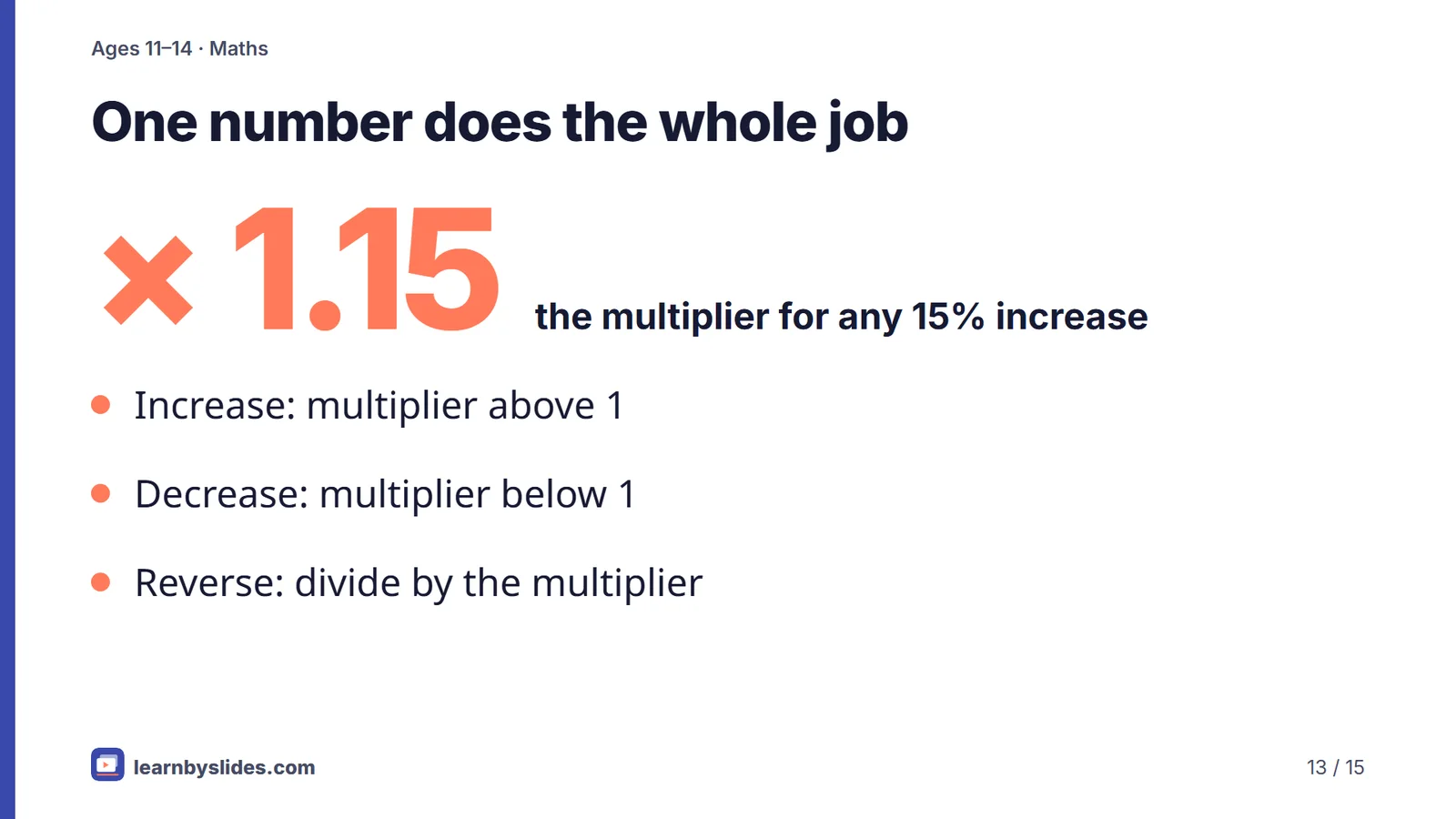
× 1.15 the multiplier for any 15% increase
- Increase: multiplier above 1
- Decrease: multiplier below 1
- Reverse: divide by the multiplier
Speaker notes
Summarise the multiplier idea before the quick check. Ask students to give the multiplier for a 7% increase (1.07), a 30% decrease (0.7) and a 100% increase (2). Doubling is a 100% increase, which surprises many students.
14. Quick check
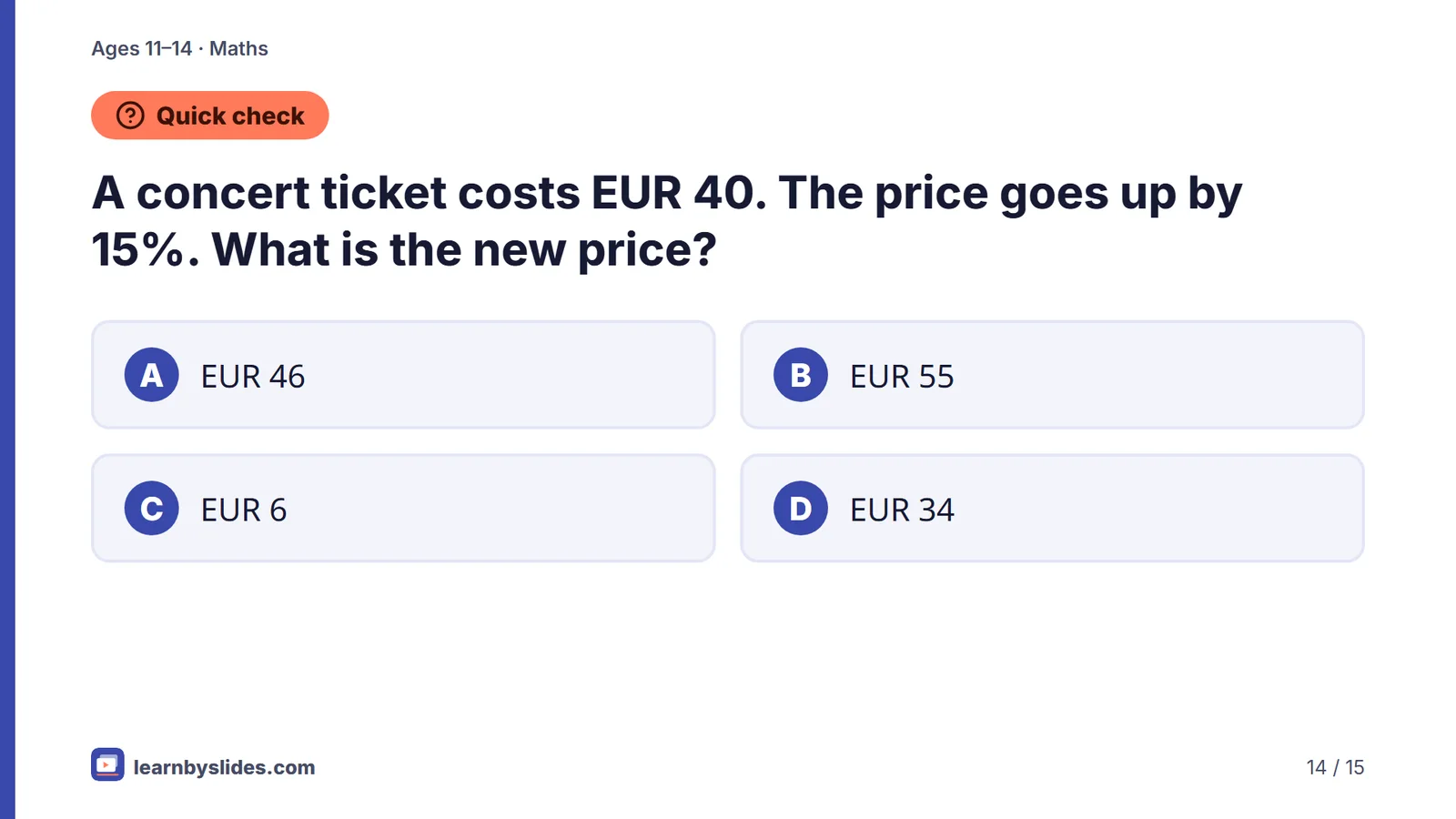
A concert ticket costs EUR 40. The price goes up by 15%. What is the new price?
- EUR 46
- EUR 55
- EUR 6
- EUR 34
Speaker notes
Answer: A, EUR 46, because 40 × 1.15 = 46. EUR 55 comes from adding 15 to 40, EUR 6 is only the increase, and EUR 34 is a 15% decrease. Ask students who chose each wrong answer to spot their own mistake.
15. Key takeaways
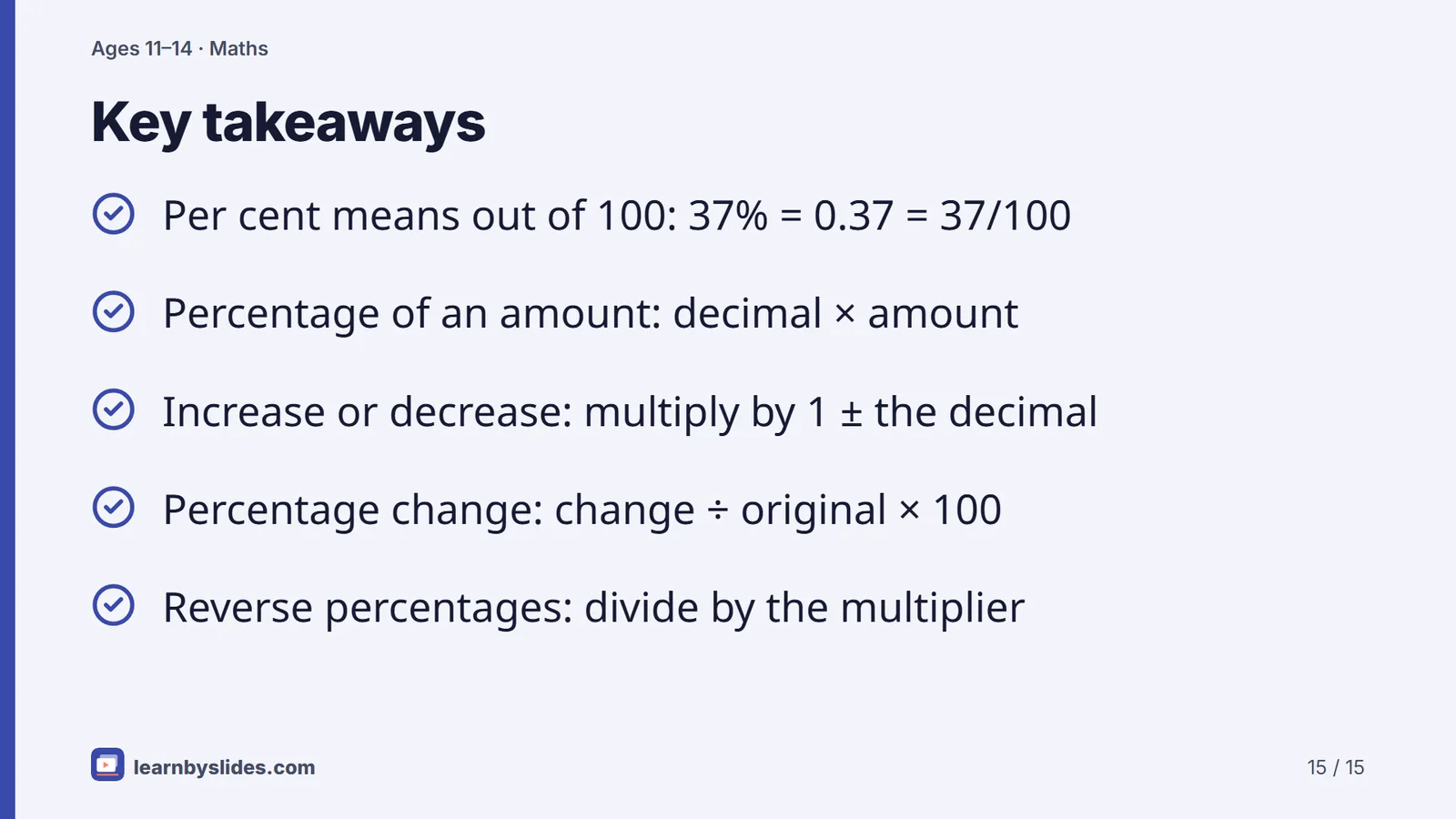
- Per cent means out of 100: 37% = 0.37 = 37/100
- Percentage of an amount: decimal × amount
- Increase or decrease: multiply by 1 ± the decimal
- Percentage change: change ÷ original × 100
- Reverse percentages: divide by the multiplier
Speaker notes
Recap one example for each bullet aloud. Then move to the five-question quiz on the page and set the worksheet for practice.
Key terms
- Percentage
- A number of parts out of 100; 37% means 37 out of every 100.
- Multiplier
- The decimal you multiply by to change an amount in one step; 1.15 for a 15% increase, 0.75 for a 25% decrease.
- Percentage change
- The change in a value as a percentage of its original value: change ÷ original × 100.
- Original value
- The value before an increase or decrease; percentages of change are always worked out from it.
- Reverse percentage
- A problem where you know the value after a percentage change and must find the original value.
- Percentage point
- The plain difference between two percentages; 40% to 50% is a rise of 10 percentage points.
Quick quiz
Teacher notes
Suggested 45-minute plan: 5 minutes on the sale-sign starter and what a percentage means; 8 minutes converting fractions, decimals and percentages; 10 minutes finding a percentage of an amount by both methods and writing one amount as a percentage of another; 12 minutes on multipliers, percentage change and reverse percentages; 10 minutes for the quick check and quiz. Common misconceptions: finding 10% by dividing by 100; writing 0.06 as 60%; thinking percentages cannot exceed 100%; dividing by the new value to find a percentage change; reversing a 20% decrease by adding 20%; expecting +10% then −10% to cancel out. A bar model split into ten parts helps with reverse percentages. Extension: ask students to find a price that went up by 25% and then down by 20%, and explain why it returns to the start (1.25 × 0.8 = 1).
Frequently asked questions
Which age group is this percentages lesson for?
Ages 11–14: roughly Grades 6–8 in the US, Years 7–9 in England and Years 7–8 in Australia. Younger students can stop after finding a percentage of an amount; older students should cover multipliers and reverse percentages. The curriculum chips at the top of the page list each matching standard.
What is the quickest way to increase or decrease by a percentage?
Use a multiplier. For an increase of 15%, multiply by 1.15; for a decrease of 25%, multiply by 0.75. The multiplier is 100% plus or minus the change, written as a decimal, and it does the whole calculation in one step.
How do you work out a reverse percentage?
Write the new value as a percentage of the original, turn that into a multiplier and divide by it. If a price after a 20% discount is GBP 360, it is 80% of the original, so the original is 360 ÷ 0.8 = GBP 450.
Why does a 10% increase followed by a 10% decrease not give the starting value?
Because the two percentages are taken of different amounts. 10% of 100 is 10, giving 110, but 10% of 110 is 11, giving 99. In multipliers, 1.1 × 0.9 = 0.99, which is a 1% decrease overall.
Sources & methodology
Every fact is checked against the sources below. We write original explanations and draw original graphics; no figures are copied from textbooks. Spotted an error? See our corrections policy.
- Prealgebra 2e, 6.1 Understand Percent (OpenStax (Rice University), accessed 1 Oct 2026)
- Prealgebra 2e, 6.2 Solve General Applications of Percent (OpenStax (Rice University), accessed 1 Oct 2026)
- Grade 7, Unit 4: Proportional Relationships and Percentages (Illustrative Mathematics (Kendall Hunt), accessed 1 Oct 2026)
- Grade 6, Unit 3: Unit Rates and Percentages (Illustrative Mathematics (Kendall Hunt), accessed 1 Oct 2026)
Editorial review pending · Updated
Related lessons
 Maths · Ages 12–13
Integers and Negative Numbers: Lesson Slides & Worksheet
Ready-to-teach maths slides for ages 12–13 on integers and negative numbers: the number line, adding and subtracting, sign rules for multiplying and dividing, and key properties, with lift, temperature and money examples, speaker notes and a quiz.
 Maths · Ages 11–14
Ratio and Proportion: Lesson Slides & Worksheet
Ready-to-teach maths slides for ages 11–14 on ratio and proportion: writing and simplifying ratios, ratio vs fraction, sharing in a ratio, unit rates and best buys, direct proportion and scale drawings and maps, with speaker notes and a quiz.
 Science · Ages 12–15
Acids, Bases and the pH Scale Lesson Slides
A ready-to-teach chemistry lesson for ages 12–15 on acids, bases and alkalis: the pH scale, litmus and universal indicator, everyday examples, neutralisation and how to name salts, with a safe indicator practical.
For teachers and parents: new LearnBySlides resources by email
One short email when new free resources go live. For adults (18+) only. No spam, no tracking in emails, unsubscribe anytime.